A systematic review protocol is the single most important document you will write before launching your review. It locks in your methods, shields your work from bias, and tells the research community exactly what you plan to do and why. Without a protocol, even a well-executed review can be dismissed as retrospectively engineered, and rightly so.
This guide walks you through every section of a rigorous protocol, aligned with the Cochrane Handbook for Systematic Reviews of Interventions, PRISMA 2020, the JBI Manual for Evidence Synthesis, and GRADE certainty-of-evidence standards. By the end, you will have a clear roadmap from research question to PROSPERO registration, with practical examples and decision frameworks at every step.
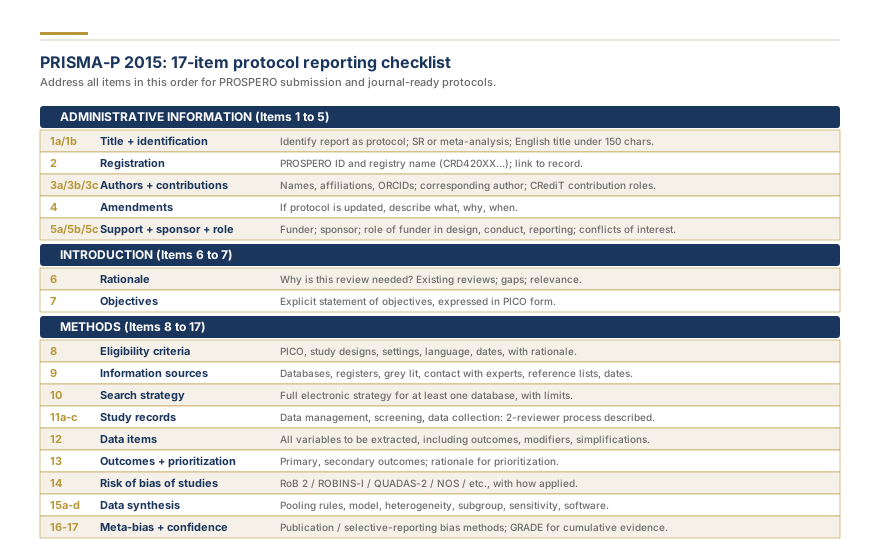
Skip the blank page and start from the PRISMA-P protocol template.
Why Your Systematic Review Needs a Protocol
A protocol is not bureaucratic paperwork. It is a methodological contract that separates credible evidence synthesis from cherry-picked narrative reviews. Registering or publishing your protocol before beginning data collection delivers four critical advantages that directly improve the quality and credibility of your final review.
Bias prevention is the most important function. Pre-specifying inclusion criteria, outcomes, and analysis methods removes the temptation to adjust decisions after seeing the data. This is the same logic behind clinical trial registration, and journals increasingly hold systematic reviews to the same standard. Empirical studies comparing reviews with and without registered protocols consistently find fewer discrepancies between planned and reported methods when protocols exist.
Transparency allows peer reviewers, journal editors, and readers to compare your final manuscript against your original plan. Any deviations must be justified, which raises the bar for intellectual honesty. A registered protocol creates a public timestamp that proves your methods were established before the results were known.
Reduced duplication benefits the entire research community. PROSPERO and other registries are searchable, so registering your protocol alerts other teams working on similar questions. This encourages collaboration instead of redundancy and helps funders avoid financing duplicate work. Before you register, confirm the question is still open with the review novelty check, which searches published reviews in PubMed and ongoing trials on ClinicalTrials.gov.
Team alignment is an often-overlooked practical benefit. A detailed protocol forces your co-authors to agree on methods before the work begins. Disagreements about eligibility criteria, outcome definitions, or synthesis approaches are far cheaper to resolve at the protocol stage than mid-review when you have already screened thousands of records.
If your goal is publication in a high-impact journal, a registered protocol is effectively a prerequisite. Cochrane, The Lancet, JAMA, and BMJ all expect or require protocol registration for systematic reviews.
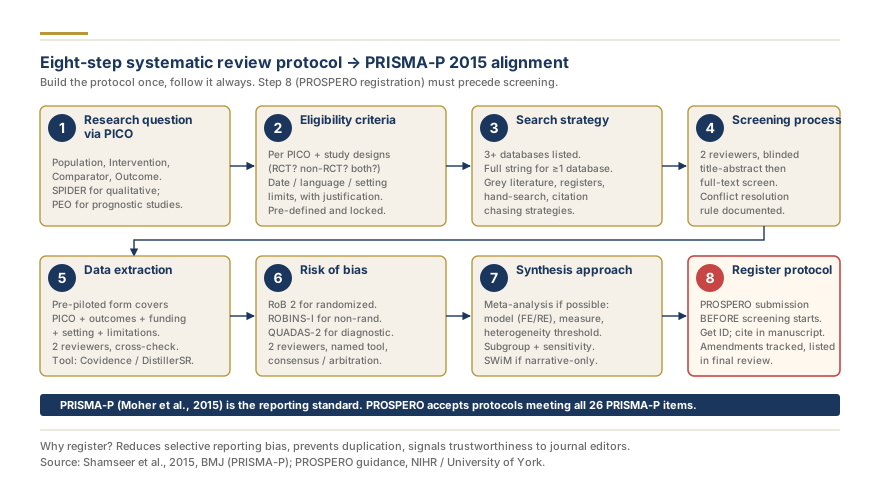
Step 1: Formulate Your Research Question with PICO
Every strong protocol begins with a precisely framed question. The PICO framework is the gold standard for intervention reviews, and it directly shapes every downstream decision in your protocol, from eligibility criteria to search strategy to outcome analysis.
| Element | Definition | Example |
|---|---|---|
| P (Population) | Who are the participants? | Adults aged 18+ with type 2 diabetes mellitus |
| I (Intervention) | What treatment or exposure is being studied? | Continuous glucose monitoring (CGM) devices |
| C (Comparator) | What is the alternative being compared? | Self-monitored blood glucose (SMBG) testing |
| O (Outcome) | What results are measured? | HbA1c reduction at 12 months, hypoglycaemic episodes |
For qualitative or scoping reviews, use PCC (Population, Concept, Context) instead. For diagnostic accuracy reviews, use PIRD (Population, Index test, Reference standard, Diagnosis). The key principle remains the same regardless of framework: every word in your question constrains your eligibility criteria, your search strategy, and your analysis plan.
Common Mistakes When Framing the Research Question
Researchers frequently make three errors at this stage that create cascading problems throughout the review. First, framing the question too broadly results in thousands of irrelevant hits during screening and forces you to either narrow retroactively (which looks like post-hoc decision-making) or spend weeks screening records that should never have been retrieved.
Second, omitting the comparator makes it impossible to assess relative effectiveness. A question like "Does CBT reduce anxiety?" lacks the specificity needed for a meaningful synthesis. "Does CBT reduce anxiety compared to waitlist control in adults with generalised anxiety disorder?" defines exactly what you are comparing and for whom.
Third, specifying only a single outcome when your review should address multiple endpoints. Most clinical questions involve both efficacy outcomes and safety outcomes, and your protocol should declare both primary and secondary endpoints upfront. This prevents the appearance of outcome switching later.
Pro Tip: Test your PICO by converting it to a search query. If your research question does not translate naturally into database search terms, it probably needs refinement. Try running a preliminary search in PubMed using your PICO elements as search concepts. If you retrieve fewer than 50 results, your question may be too narrow. If you retrieve more than 10,000, it is almost certainly too broad. This quick calibration exercise takes 15 minutes and can save weeks of wasted effort.
Step 2: Define Eligibility Criteria
Your eligibility criteria operationalise each PICO element into concrete inclusion and exclusion rules. The goal is to write criteria so explicit and unambiguous that any trained reviewer on your team can apply them consistently without needing to consult you for clarification.
Inclusion Criteria
Structure your inclusion criteria around these six domains, with specific operational definitions for each:
- Study design: Specify acceptable designs (e.g., randomised controlled trials only, or also quasi-experimental and cohort designs). State whether cluster-randomised and crossover trials are eligible, and how you will handle them analytically.
- Population: Define the age range, diagnosis or condition, clinical setting, and any relevant demographic characteristics. Be precise about diagnostic criteria (e.g., "type 2 diabetes diagnosed per ADA or WHO criteria" rather than just "diabetes").
- Intervention: Describe the intervention in sufficient detail, including dose, duration, delivery mode, and provider. State whether variations of the intervention are acceptable (e.g., different CGM devices from different manufacturers).
- Comparator: Define what constitutes an acceptable comparison group, including active comparator, placebo, usual care, waitlist control, or no intervention.
- Outcomes: List primary and secondary outcomes with their measurement instruments and minimum follow-up duration. State whether you require a specific time point or will accept any follow-up period.
- Language and date restrictions: If you restrict by language (e.g., English only) or publication date, provide an explicit justification. Unjustified restrictions weaken the comprehensiveness of your review and will be questioned by peer reviewers.
Exclusion Criteria
Exclusion criteria should address study types you will not consider (case reports, editorials, conference abstracts without full data), populations that overlap with but differ from your target (e.g., excluding gestational diabetes when your focus is type 2 diabetes), and interventions that are conceptually distinct from your intervention of interest. Every exclusion should be justified with a clear rationale.
Pro Tip: Pilot your criteria on 50 records before finalising. Have two reviewers independently screen a random sample of 50 title-abstract records using your draft criteria. If they disagree on more than 10 percent of records, your criteria have ambiguities that need to be resolved before full screening begins. Piloting typically takes half a day and reveals problems that would otherwise surface hundreds of hours into the review.
Step 3: Develop a Reproducible Search Strategy
The search strategy is the engine of your review. A poorly designed search will either miss relevant studies (undermining the comprehensiveness that defines a systematic review) or bury you under thousands of irrelevant records (wasting months of screening effort). Developing a strong search strategy is both a science and a craft, and it benefits enormously from expert input.
Building the Search Step by Step
The process follows a logical sequence that translates your PICO concepts into a comprehensive, reproducible database query:
-
Identify the core concepts from your PICO question. Most searches have two to four main concept blocks. For the CGM example, your concepts would be "type 2 diabetes," "continuous glucose monitoring," and potentially "glycaemic control."
-
List all synonyms for each concept. Include controlled vocabulary terms (MeSH headings for MEDLINE, Emtree descriptors for Embase), free-text keywords, spelling variations (American and British English), abbreviations, and brand names where relevant. Cast a wide net because you can always deduplicate, but you cannot find studies you did not search for.
-
Combine synonyms within each concept using OR to create a comprehensive block for that concept. Then combine the concept blocks using AND to produce results that address all elements of your question simultaneously.
-
Apply validated filters judiciously. The Cochrane Highly Sensitive Search Strategy for randomised controlled trials is a well-validated design filter. Ad-hoc filters for language, date, or study type should be used sparingly and documented with justification. Over-filtering is one of the most common causes of missed studies in systematic reviews.
Minimum Database Requirements
The Cochrane Handbook recommends searching at a minimum these core databases, though your specific topic may require additional sources:
| Database | Coverage | Access |
|---|---|---|
| MEDLINE (via PubMed or Ovid) | Biomedical and life sciences, 1946–present | Free (PubMed) or institutional (Ovid) |
| Embase (via Ovid or Elsevier) | Biomedical with strong pharmacology and international coverage | Institutional subscription |
| CENTRAL (Cochrane Library) | Controlled trials extracted from multiple databases | Free or institutional |
| PsycINFO | Psychology, behavioural sciences, mental health | Institutional subscription |
| CINAHL | Nursing and allied health | Institutional subscription |
Supplementary Search Methods
Database searching alone is insufficient for a comprehensive systematic review. You should also conduct reference list checking of all included studies (backward citation searching), forward citation searching using tools like Google Scholar or Scopus, grey literature searching through clinical trial registries (ClinicalTrials.gov, WHO ICTRP), dissertation databases (ProQuest), and conference proceedings, and direct contact with subject experts to identify unpublished or in-progress studies.
Pro Tip: Involve a research librarian early and use the PRESS checklist. An information specialist can peer-review your search strategy using the PRESS (Peer Review of Electronic Search Strategies) checklist, which evaluates translation across databases, subject headings, spelling, syntax, and Boolean logic. Studies consistently show that librarian-reviewed searches retrieve significantly more relevant records while maintaining precision. If your institution does not have a medical librarian, many university libraries offer consultation services to external researchers for a modest fee.
Step 4: Plan Screening and Selection
Your screening process must be described in enough operational detail that someone outside your team could replicate it independently. This section of your protocol should address every phase of the screening workflow, the tools you will use, and how you will handle disagreements.
Two-Phase Screening Process
Phase 1: Title and abstract screening is where the majority of records are excluded. At least two reviewers should independently screen all records retrieved by the search strategy. Before beginning full screening, conduct a calibration exercise on a batch of 50 to 100 records. During calibration, both reviewers screen the same records, compare their decisions, discuss any disagreements, and refine the application of eligibility criteria until you achieve an acceptable level of agreement (typically Cohen's kappa above 0.80).
Phase 2: Full-text screening involves retrieving and reading the complete publication for every record that passed title-abstract screening. Two reviewers should independently assess each full-text article against your eligibility criteria. For every excluded full-text, record a specific reason for exclusion that maps to one of your criteria (wrong population, wrong intervention, wrong comparator, wrong outcome, wrong study design, or wrong publication type). These exclusion reasons will populate the bottom box of your PRISMA 2020 flow diagram.
Conflict Resolution and Documentation
Specify your conflict resolution process: disagreements should be resolved first by discussion between the two reviewers, then by adjudication from a third senior reviewer if consensus cannot be reached. Name the screening software you will use (Covidence, Rayyan, EPPI-Reviewer, or a custom spreadsheet) and state that you will track records through each phase and report results using the PRISMA 2020 flow diagram template.