The PRISMA 2020 statement is now the definitive reporting standard for systematic reviews and meta-analyses worldwide. Published by Page et al. in The BMJ in 2021, it replaced the original PRISMA 2009 guidelines that had shaped evidence synthesis reporting for over a decade. If you are writing, reviewing, or editing a systematic review in 2026, understanding every change and its practical implications is not optional; it is essential for getting your work published.
This guide breaks down the complete PRISMA 2020 framework, explains the rationale behind each major update, walks through the redesigned flow diagram, and provides actionable guidance for achieving full compliance from protocol stage through manuscript submission.
Apply the current standard with a ready-made reporting checklist.
Why PRISMA Needed a Major Overhaul
The original PRISMA 2009 statement was a landmark achievement in evidence-based medicine. It standardised systematic review reporting, was endorsed by hundreds of journals, and became the most cited reporting guideline in research history. But a decade of widespread use revealed critical gaps that could no longer be patched with minor amendments.
Incomplete reporting persisted despite the guidelines. Multiple studies assessing PRISMA 2009 adherence across hundreds of published systematic reviews consistently found that authors failed to report key methodological details. Search strategies were summarised rather than fully presented. Risk-of-bias assessments were mentioned but not detailed. Certainty-of-evidence evaluations were omitted entirely from the majority of reviews. The original checklist was simply not granular enough to prevent these omissions.
Methodology advanced significantly between 2009 and 2020. New tools and frameworks emerged that the original statement never anticipated, including RoB 2 for randomised trial bias assessment, ROBINS-I for non-randomised studies, the GRADE framework for certainty of evidence, and the Synthesis Without Meta-analysis (SWiM) guideline for narrative synthesis. These advances required corresponding reporting guidance that PRISMA 2009 could not provide.
The landscape of evidence synthesis diversified. Network meta-analyses, scoping reviews, living systematic reviews, and individual participant data meta-analyses all became established methodologies with their own analytical requirements. The original PRISMA framework, designed primarily for conventional pairwise meta-analyses, needed a modular structure that could accommodate this growing family of review types through extensions.
The original flow diagram was oversimplified. It did not distinguish between records identified through database searching and those found through other methods like citation searching, grey literature, or expert contacts. This created an incomplete and sometimes misleading picture of the identification process, hiding important methodological decisions from readers and reviewers.
The Updated Checklist: What Changed and Why
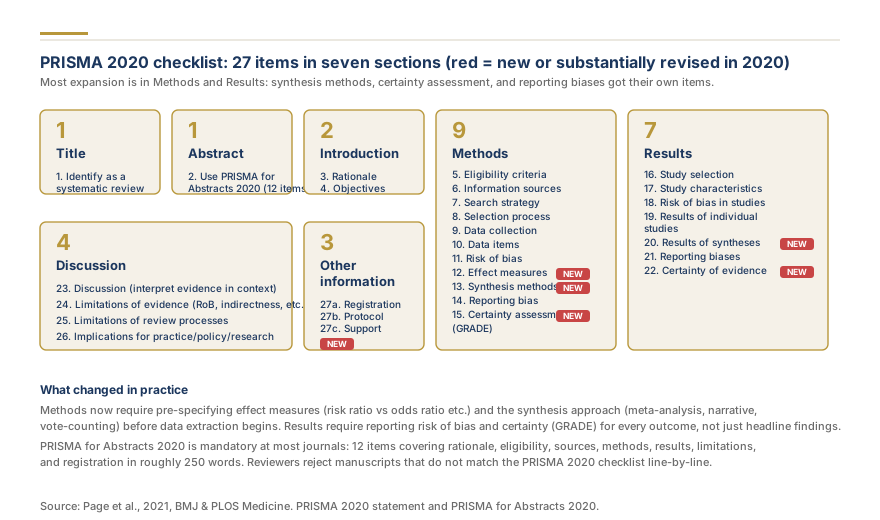
The PRISMA 2020 checklist contains 27 items, many with multiple sub-items that demand substantially greater methodological detail than their 2009 counterparts. While the total item count matches the original, the content has been so extensively revised that treating PRISMA 2020 as a minor update would be a serious mistake. Below are the most significant changes, organised by the section of your manuscript they affect.
Title, Abstract, and Introduction (Items 1–3)
The title requirement remains straightforward: identify the report as a systematic review, meta-analysis, or both. The abstract, however, now must follow a structured 12-item format covering objectives, eligibility criteria, information sources, risk-of-bias assessment, synthesis methods, results including the number of studies and participants, certainty assessments, and interpretation. This expanded abstract ensures that readers can determine the scope and rigour of your review without accessing the full text. This is an increasingly important consideration as AI-powered search engines and abstract databases become primary discovery tools.
The introduction must describe the rationale in the context of existing knowledge (including other systematic reviews on the topic) and state exact objectives with explicit reference to the PICO elements or equivalent framework.
Methods Section (Items 4–16): The Heart of the Update
This is where the most consequential changes occur, and where most compliance failures happen.
Item 4: Protocol and registration is now a mandatory reporting element, not an optional afterthought. You must state whether a protocol was prepared, where it is accessible (registration number, DOI, or URL), and describe any amendments made between protocol registration and final reporting. If no protocol exists, you must explicitly state this. Silence on the topic is no longer acceptable.
Item 5: Eligibility criteria must specify inclusion and exclusion criteria with reference to PICO elements (or the equivalent framework for your review type), study characteristics such as design and minimum sample size, and report characteristics including language restrictions, publication status, and year of publication.
Items 6 and 7: Information sources and search strategy received major expansions. Item 6 requires you to list all information sources searched, including databases, registers, websites, organisations, reference lists, and other sources, along with the date of the last search for each. Item 7 requires the full search strategy for at least one database to be presented, ideally in a supplementary file with strategies for all databases. This single requirement addresses one of the most persistent reporting gaps under PRISMA 2009: vague search descriptions that made replication impossible.
Pro Tip: Start your PRISMA checklist at the protocol stage, not manuscript submission. Open the checklist when you write your protocol and map each item to a section of your methods. This approach ensures you collect the right information throughout the review (screening counts, exclusion reasons, risk-of-bias domain judgements, GRADE domain ratings) rather than scrambling to reconstruct it months later from incomplete notes. A checklist started at the protocol stage is always more accurate and complete than one filled in retroactively.
Items 8 and 9: Selection and data collection require detailed descriptions of the screening process (including the number of reviewers at each stage and how disagreements were resolved) and the data extraction process (including piloting of forms, number of extractors, and methods for obtaining or confirming data from study investigators).
Item 13: Synthesis methods is the most expanded section in the entire checklist and warrants careful attention. It requires you to describe:
- The criteria for deciding which studies were eligible for each synthesis
- How data were prepared for synthesis (e.g., converting means to medians, handling multi-arm trials)
- Methods for tabulating and visually displaying results of individual studies and syntheses
- Statistical methods for meta-analysis, including handling of heterogeneity
- Methods for investigating possible causes of heterogeneity (subgroup analyses, meta-regression)
- Sensitivity analyses planned and conducted
- Methods for assessing reporting biases across studies
This granularity ensures that readers can evaluate not just what you found, but how you arrived at your findings, which is a fundamental principle of reproducible research.
The Redesigned Flow Diagram
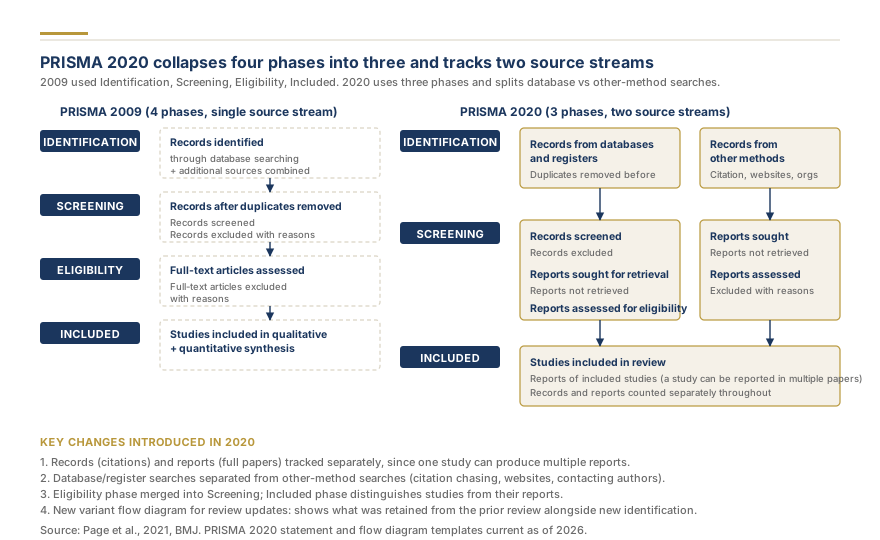
The PRISMA 2020 flow diagram is one of the most visible changes and the element most frequently done incorrectly. Understanding the new structure is essential because editors will desk-reject manuscripts that use the outdated 2009 diagram.
Two Parallel Identification Tracks
The most significant structural change is the introduction of two parallel identification pathways at the top of the diagram. The left track captures records identified through databases and registers, meaning your traditional bibliographic database searching. The right track captures records identified through other methods, meaning citation searching, grey literature, expert contacts, websites, and any other non-database source.
Each track flows independently through its own identification and retrieval stages before converging at the eligibility assessment and inclusion stages. This dual-track structure makes transparent a practice that most rigorous reviews already follow but that the 2009 diagram obscured: comprehensive reviews identify studies through multiple channels, not just database searching.
New Boxes You Must Include
The 2020 flow diagram introduces several new reporting boxes that reflect modern systematic review practices:
| Box | Purpose |
|---|---|
| Records removed before screening | Captures duplicates and records removed by automation tools (e.g., deduplication in Endnote, machine learning classifiers in ASReview) |
| Reports not retrieved | Documents studies where the full text could not be obtained, with a count and reason |
| Exclusion reasons for full-text reports | Requires categorisation of every full-text exclusion by reason (wrong population, wrong intervention, wrong outcome, wrong study design, wrong comparator) |
| Reports from other methods | Separately tracks records from citation searching, grey literature, expert contacts, and websites |
Pro Tip: Use the official PRISMA 2020 flow diagram template. Download the editable template from the official PRISMA website rather than recreating it from scratch. The official version includes all required boxes in the correct layout, and editors will immediately flag custom diagrams that deviate from the standard structure. Templates are available in editable formats for Word, PowerPoint, and Lucidchart. Track your record counts in real time from the first day of screening. Reconstructing exact numbers months later is both tedious and error-prone.
Practical Guidelines for an Accurate Flow Diagram
Populate your flow diagram with exact numbers in every box, recorded contemporaneously throughout the review process. Use your screening software's export function to generate accurate counts at each stage. If your review updates a previously published systematic review, use the optional extended template that separately tracks previously identified studies carried forward into the update versus newly identified studies.