Why diagnostic test accuracy meta-analysis is statistically different
A meta-analysis of intervention trials pools a single effect estimate per study (a risk ratio, an odds ratio, a mean difference). A diagnostic test accuracy review must pool two paired estimates per study at once: sensitivity and specificity. These two indices are negatively correlated within studies because they share an underlying threshold. Moving the cut-off that defines a positive test trades sensitivity for specificity. A standard univariate meta-analysis of either index alone ignores that correlation and produces summary estimates that are biased and over-precise.
The Cochrane Handbook for Systematic Reviews of Diagnostic Test Accuracy resolves this with two equivalent statistical frameworks: the bivariate random-effects model (Reitsma 2005) and the hierarchical summary ROC model (Rutter and Gatsonis 2001). Both are recommended by the Cochrane Screening and Diagnostic Tests Methods Group. The 2010 chapter "Analysing and Presenting Results" by Macaskill, Gatsonis, Deeks, Harbord, and Takwoingi remains the methodological reference standard.
Worked Example: From Six 2x2 Tables to a Paired Forest Plot
Every bivariate or HSROC model starts from the same input: one 2x2 table per study. Suppose a review includes six studies of the same index test against the same reference standard (hypothetical counts). Sensitivity is true positives divided by everyone with the target condition; specificity is true negatives divided by everyone without it. The 95% confidence intervals are exact (Clopper-Pearson) binomial intervals.
| Study | True positives | False positives | False negatives | True negatives | Sensitivity (95% CI) | Specificity (95% CI) |
|---|---|---|---|---|---|---|
| A | 45 | 10 | 5 | 90 | 0.90 (0.78 to 0.97) | 0.90 (0.82 to 0.95) |
| B | 38 | 20 | 12 | 130 | 0.76 (0.62 to 0.87) | 0.87 (0.80 to 0.92) |
| C | 27 | 6 | 3 | 64 | 0.90 (0.73 to 0.98) | 0.91 (0.82 to 0.97) |
| D | 60 | 45 | 15 | 180 | 0.80 (0.69 to 0.88) | 0.80 (0.74 to 0.85) |
| E | 22 | 4 | 8 | 96 | 0.73 (0.54 to 0.88) | 0.96 (0.90 to 0.99) |
| F | 50 | 30 | 6 | 114 | 0.89 (0.78 to 0.96) | 0.79 (0.72 to 0.85) |
Step by step for Study A
- Sensitivity = 45 / (45 + 5) = 0.90. Specificity = 90 / (90 + 10) = 0.90.
- Positive likelihood ratio = sensitivity / (1 - specificity) = 0.90 / 0.10 = 9.00. Its interval is built on the log scale: the standard error of ln(9.00) is √(1/45 - 1/50 + 1/10 - 1/100) = 0.304, so the 95% CI is exp(2.197 ± 1.96 × 0.304) = 4.96 to 16.32.
- Negative likelihood ratio = (1 - 0.90) / 0.90 = 0.11 (95% CI 0.05 to 0.26).
- Diagnostic odds ratio = (45 × 90) / (10 × 5) = 81.0. The standard error of ln(81.0) is √(1/45 + 1/10 + 1/5 + 1/90) = 0.577, giving a 95% CI of 26.1 to 251.2.
- At a pre-test probability of 20% (pre-test odds 0.25), a positive result gives post-test odds of 0.25 × 9.00 = 2.25, a post-test probability of 69.2%. A negative result lowers it to 2.7%.
| Study | Positive likelihood ratio (95% CI) | Negative likelihood ratio (95% CI) | Diagnostic odds ratio (95% CI) |
|---|---|---|---|
| A | 9.00 (4.96 to 16.32) | 0.11 (0.05 to 0.26) | 81.0 (26.1 to 251.2) |
| B | 5.70 (3.68 to 8.82) | 0.28 (0.17 to 0.46) | 20.6 (9.2 to 45.9) |
| C | 10.50 (4.84 to 22.78) | 0.11 (0.04 to 0.32) | 96.0 (22.4 to 412.2) |
| D | 4.00 (3.01 to 5.32) | 0.25 (0.16 to 0.39) | 16.0 (8.3 to 30.8) |
| E | 18.33 (6.85 to 49.05) | 0.28 (0.15 to 0.50) | 66.0 (18.2 to 238.9) |
| F | 4.29 (3.08 to 5.97) | 0.14 (0.06 to 0.29) | 31.7 (12.4 to 80.9) |
What the paired forest plot shows
A paired forest plot puts sensitivity and specificity in two adjacent panels, one row per study. Studies E and F show why both panels matter. Study E has the highest specificity (0.96) and the lowest sensitivity (0.73); Study F has high sensitivity (0.89) and the lowest specificity (0.79). Their diagnostic odds ratios (66.0 and 31.7) hide that mirror image: E is the better test for ruling in (positive likelihood ratio 18.33), while F is better for ruling out (negative likelihood ratio 0.14 against 0.28).
Across the six studies, the Spearman correlation between sensitivity and specificity is -0.12 (p = 0.83). With six studies this descriptive check has almost no power, so threshold variation should be judged from the cut-offs each study reports and from the between-study correlation estimated by the bivariate model, not from this number alone. Pooling the six sensitivities and six specificities in separate univariate analyses would throw away exactly the pairing this plot displays.
The bivariate random-effects model in practice
The bivariate model assumes that the logit-transformed sensitivity and the logit-transformed specificity from each study are drawn from a bivariate normal distribution with a between-study covariance term. The model produces:
- A pooled summary sensitivity and a pooled summary specificity, with confidence intervals that account for the within-study and between-study variance components.
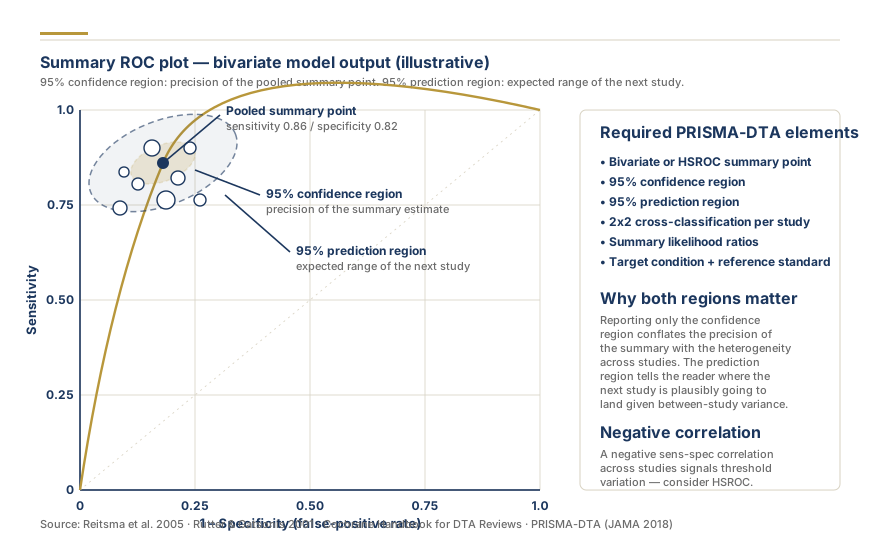
- A summary ROC curve that traces the joint posterior across the threshold space rather than connecting two point estimates.
- A 95% confidence region around the summary point and a 95% prediction region for the next study's expected sensitivity-specificity pair.
- The between-study correlation, which is typically negative when studies used different positivity thresholds.
The Reitsma model is fitted as a generalised linear mixed model with a logit link and study identifiers as random effects. The R package mada (Doebler) implements this via the reitsma() function. The R package metafor implements the bivariate model via rma.glmm() for binary outcomes. Stata users typically rely on metandi, midas, or the metan suite with custom random-effects extensions.
When the HSROC model is preferred
The hierarchical summary ROC model (Rutter and Gatsonis 2001) is mathematically equivalent to the bivariate model when no covariates are included. It expresses test performance with three parameters: an accuracy parameter (analogous to log diagnostic odds ratio), a threshold parameter, and a shape parameter that allows the SROC curve to be asymmetric. The HSROC parameterisation is preferred when:
- The included studies used heterogeneous threshold definitions and you want to model threshold variation explicitly.
- You need to compare two diagnostic tests within the same review using meta-regression of the accuracy parameter.
- The asymmetry of the SROC curve is clinically interpretable, for example when test performance degrades faster at higher specificity than at higher sensitivity.
For most reviews with a fixed test and a small number of threshold variants, the bivariate parameterisation is more interpretable and easier to communicate to clinical collaborators.