What an Individual Participant Data meta-analysis offers that aggregate-data pooling cannot
An individual participant data meta-analysis collects the raw, line-level records of every participant in each included study and re-analyses them together rather than pooling published summary effects. The Cochrane Handbook describes this approach in Chapter 26 and treats it as the methodological reference standard when participant-level data are obtainable, particularly for randomised trials of an intervention with a continuous, binary, time-to-event, or repeated-measures outcome.
Aggregate-data meta-analysis is fast, transparent, and reproducible from public reports, but it inherits whatever choices the original authors made about exposure definitions, follow-up windows, missing-data handling, and covariate adjustment. A pooled analysis of individual participant data lets the review team apply one consistent analytic framework across every study, which usually reduces heterogeneity that originates from analytic divergence rather than true clinical variation.
Why review teams pursue Individual Participant Data even when aggregate data are available
The headline argument for individual participant data pooling is statistical power for subgroup and interaction analysis. Aggregate-data meta-regression can detect ecological associations across studies, but it cannot test whether a treatment effect varies across individuals within studies. Within-trial interaction testing requires participant-level data. When the research question is about effect modification by age, sex, baseline severity, biomarker status, or comorbidity, individual participant data pooling is the only design that protects against ecological bias.
Other practical reasons that drive a team toward individual participant data include:
- Time-to-event outcomes with study-specific follow-up windows, where aggregate hazard ratios cannot be reconstructed without participant-level censoring information.
- Outcome harmonisation when included trials measured the same construct with different scales (Hamilton Depression versus Beck Depression Inventory) and a common conversion is needed.
- Risk of bias from selective reporting at the outcome level, which individual participant data checks can detect by recomputing effects from raw data.
- Updating a network meta-analysis with patient-level covariates to adjust for transitivity violations.
The Cochrane individual participant data Methods Group has documented these gains and the trade-offs in their guidance on individual participant data meta-analyses of randomised trials, and Riley and colleagues' 2010 PLOS Medicine guidance remains the most-cited synthesis of when individual participant data is justified.
The decision rule: when is Individual Participant Data worth the cost
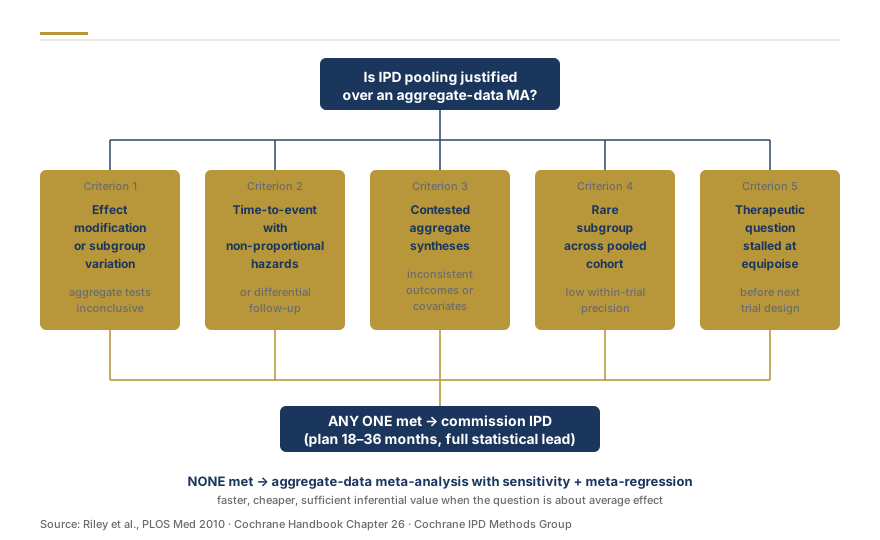
An individual participant data project consumes between 18 and 36 months of calendar time and substantially more researcher and statistical effort than a conventional aggregate-data meta-analysis. Funders increasingly require justification for the additional cost. A defensible individual participant data proposal should rest on at least one of the following criteria:
- The primary question is about effect modification or subgroup variation, and aggregate-data subgroup tests have produced inconclusive or ecologically biased estimates.
- The outcome is time-to-event with non-proportional hazards or differential follow-up across trials.
- Existing aggregate-data syntheses disagree because of inconsistent outcome definitions or covariate adjustment, and harmonised re-analysis would resolve the discrepancy.
- A clinically important subgroup is rare within any single trial but common across the pooled cohort, and within-trial estimates lack precision.
- The therapeutic question has stalled at a clinically equipoise level and a definitive synthesis is needed before the next trial is designed.
If none of these conditions apply, an aggregate-data meta-analysis with sensitivity and meta-regression analyses is usually sufficient and substantially cheaper.
One-stage versus two-stage models
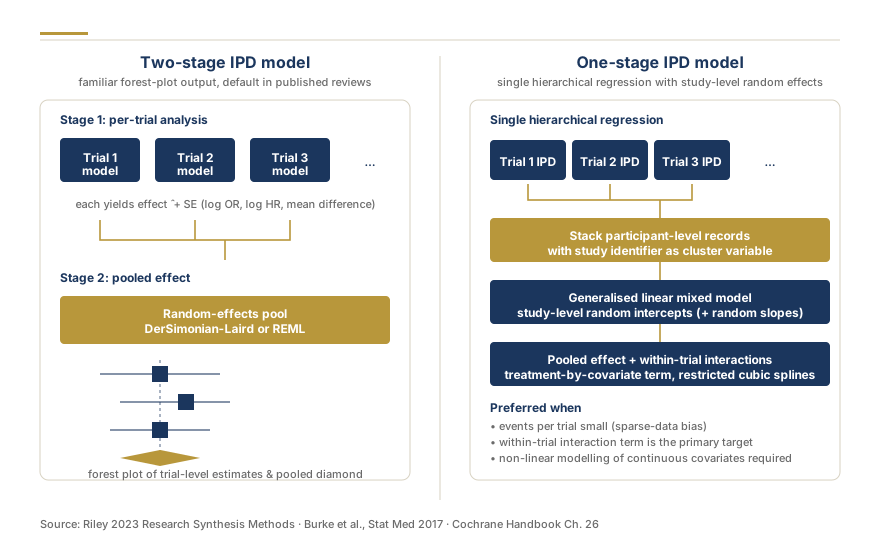
The two analytical frameworks for an individual participant data meta-analysis differ in whether participant-level data from all trials are analysed together or separately followed by pooling.
Two-stage models
Stage one fits a study-specific model to each trial separately, producing an effect estimate (log odds ratio, log hazard ratio, mean difference) and its standard error. Stage two pools those estimates using a standard random-effects meta-analysis model with DerSimonian-Laird or REML estimation of between-study variance. Two-stage models are the default in most published individual participant data reviews because they reproduce the familiar forest-plot output of an aggregate-data review and they handle clustering by study automatically.
The Burke et al. 2017 Statistics in Medicine paper showed that two-stage models give nearly identical inference to one-stage models for continuous outcomes when the within-trial sample size is adequate. They are also more practical when data sharing agreements require trial-level analyses to remain on the host institution's server.
One-stage models
A one-stage model fits a single hierarchical regression across all participant records, with study identifiers entered as random effects (random intercepts and, optionally, random treatment-effect slopes). For binary outcomes the typical specification is a generalised linear mixed model with a logit link and study-level random effects. For time-to-event outcomes a stratified Cox model or a frailty model with study as the frailty term is standard.
One-stage models are preferred when:
- The number of events per trial is small (sparse-data bias makes two-stage estimates unstable).
- Within-trial interaction terms need to be estimated efficiently (the one-stage framework permits a treatment-by-covariate term while keeping study-level confounding under random-intercept control).
- The team needs flexible non-linear modelling of continuous covariates using restricted cubic splines.
The Riley 2023 paper "Two-stage or not two-stage?" in Research Synthesis Methods is the most current guidance and recommends one-stage for sparse-data binary outcomes and two-stage as the default elsewhere.