Editage is widely known for academic editing and journal submission support. Its services index does not list systematic review or meta-analysis. Here is what Editage actually offers, what it doesn't, and where researchers go for full systematic review and meta-analysis projects.
Dr. Sarah Mitchell
April 22, 2026
Key Takeaways
Editage is the largest sub-brand of Cactus Communications, focused on academic editing, journal selection, translation, and a separate Statistical Analysis line.
Editage's Statistical Analysis service can support biostatistical work including some meta-analysis tasks, but is not a full PRISMA-compliant systematic review offering.
Editage does not list systematic review on its services index. Researchers searching 'Editage systematic review' generally need a methodology-first provider.
For full review work, choose a provider with PROSPERO registration, dual-reviewer screening, GRADE certainty assessment, and PRISMA 2020 reporting baked into the standard scope.
Editage is well-suited for finished-manuscript polishing, journal targeting, and translation; pair it with a systematic review service rather than expecting one vendor to do both.
Pricing for Editage Statistical Analysis varies by complexity. Compare against fixed-price systematic review providers before committing to a per-hour billing model.
Editage is one of the largest academic editing brands in the world, owned by the Indian-headquartered Cactus Communications group. Researchers frequently ask whether Editage offers systematic review or meta-analysis services. As of April 2026, Editage's main services index does not list a productized systematic review or meta-analysis service. What Editage does offer is comprehensive editing, journal selection, translation, and a Statistical Analysis service that can support biostatistical work including some meta-analysis tasks. This guide explains what Editage actually delivers, what it doesn't, and where researchers usually go for full systematic review and meta-analysis projects.
Editage vs Research Gold at a glance
Researchers comparing Editage and Research Gold are weighing two different problems. Editage is an editing and author-services brand; Research Gold is a systematic review writing service and methodology firm. The table below makes the boundary clear:
You need
The right vendor
English-language polish on a finished manuscript
Editage
Translation between languages
Editage
Journal-style formatting before submission
Editage
Plagiarism screening on a finished draft
Editage
PROSPERO-registered protocol
Research Gold
Multi-database literature search under PRISMA 2020
Research Gold
Dual-reviewer screening in Rayyan or Covidence
Research Gold
Risk of bias assessment (RoB 2, ROBINS-I, QUADAS-2)
Research Gold
Meta-analysis with reproducible R or Stata code
Research Gold
GRADE certainty profile and summary of findings table
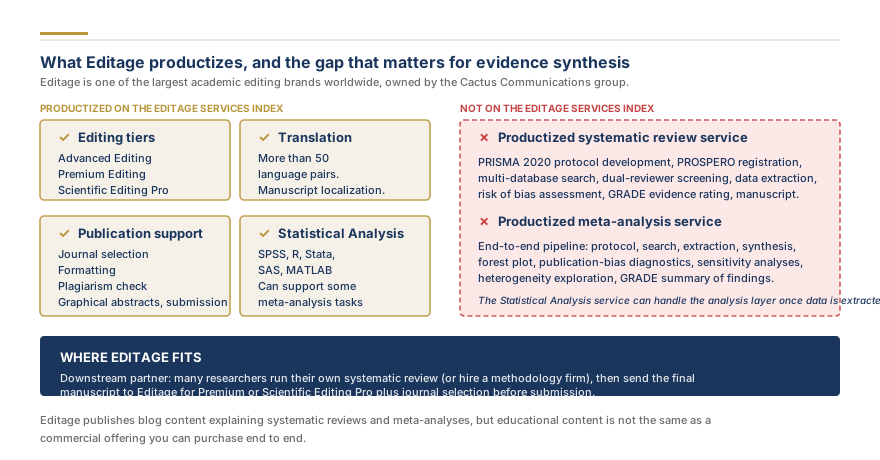
Editing tiers, translation, publication support and Statistical Analysis are productized. Productized systematic review and meta-analysis services are not on the Editage services index.
Editage's services page lists three main categories: editing, translation, and publication support. Within editing, the tiers are Advanced Editing, Premium Editing, and Scientific Editing Pro. Translation covers more than 50 language pairs. Publication support includes journal selection, formatting, plagiarism check, graphical abstracts, and submission. Editage also offers a Statistical Analysis service in SPSS, R, Stata, SAS, and MATLAB. This service is positioned as a review and analysis line that can support studies including meta-analysis, but it is not the same as a productized systematic review service that handles protocol, search, screening, extraction, and write-up end to end.
Editage's parent group also publishes Paperpal, an AI writing assistant; R Discovery, a research feed; and Mind the Graph, a scientific illustration tool. None of these are dedicated systematic review services.
What is not on the Editage services index
The Editage services navigation does not list a dedicated systematic review service or a dedicated meta-analysis service as named offerings. Editage publishes blog content explaining systematic reviews and meta-analyses (as do most academic-services firms), but educational content is not the same as a commercial offering you can purchase end to end.
This matters when a researcher needs a single team to handle PRISMA 2020-compliant protocol development, multi-database search, dual-reviewer screening, data extraction, risk of bias assessment, statistical synthesis, GRADE evidence rating, and a publish-ready manuscript. Editage's Statistical Analysis service can handle the analysis layer if the researcher already has the extracted data. It does not productize the full review pipeline.
Where Editage fits in a systematic review workflow
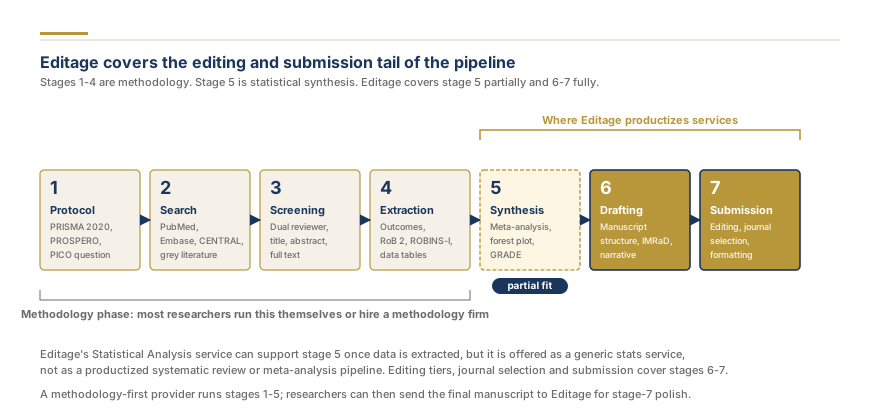
Editage productizes editing and submission at stages 6 and 7. Statistical Analysis can support stage 5 partially.
Editage works well as a downstream partner. Many researchers run their own systematic review (or hire a methodology firm to run it) and then send the final manuscript to Editage for Premium or Scientific Editing Pro before submission. Editage's editing tiers, journal selection support, and translation lines are strong assets for that final-mile work.
Editage also fits when a researcher needs publication support for a single primary study (a randomized trial, observational cohort, qualitative study) rather than evidence synthesis across many studies. The editing-first product is well suited to that pipeline.
Alternatives for full systematic review and meta-analysis
Researchers needing the full systematic review pipeline (protocol through publish-ready manuscript) typically pick a methodology-first provider rather than an editing-first one. The shortlist usually includes:
Research Gold (researchgold.org). Productized systematic review (from $895), meta-analysis (from $825), scoping review (from $750), and systematic review plus meta-analysis bundle (from $1,500). PhD methodologists, PRISMA 2020-compliant, R or Stata for analysis, public starting prices, three turnaround tiers (Gold 1 week, Silver 2 to 3 weeks, Bronze 4 to 5 weeks). 51 free browser-based methodology tools.
Pubrica (pubrica.com). Quote-only pricing, tiered turnarounds (Basic 10 to 15 business days through Advanced 60 to 120 business days for systematic reviews). Strong on the medical writing catalog overall.
A university's institutional librarian and biostatistics core. Free for affiliated researchers but limited by capacity and not staffed for journal-deadline turnarounds.
The trade-off is consistent across the category. Editing-first firms (Editage, Enago, Wordvice) are excellent for polishing finished manuscripts and supporting submission. Methodology-first firms (Research Gold, Pubrica) are built for the upstream work of designing and running a systematic review or meta-analysis from scratch.
Need help with your meta-analysis?
Our PhD statisticians run complete meta-analyses: effect sizes, forest plots, heterogeneity testing, and publication-ready results sections.
The choice depends on where you are in the pipeline. If you have a finished systematic review manuscript and need editing, journal selection, and submission support, Editage is a strong pick. If you have a research question and need a team to run the systematic review or meta-analysis from protocol to manuscript, a methodology-first provider like Research Gold or Pubrica is the better match. If you need both, a common pattern is to commission the systematic review from a methodology firm and the final-mile editing from Editage.
What Editage Statistical Analysis actually delivers
Editage productizes a Statistical Analysis service as a separate line from its editing tiers. It is the closest Editage product to systematic review or meta-analysis work, but the two are not the same.
What the Statistical Analysis service does:
Statistical analysis in SPSS, R, Stata, SAS, or MATLAB.
Support for parametric and non-parametric tests, regression modelling, time-series analysis, survival analysis, and some meta-analysis tasks when the researcher has already extracted the data.
Annotated output, results tables, and figure generation suitable for a manuscript.
What it does not do:
Protocol development with PRISMA-P registration and PROSPERO submission.
Multi-database search strategy in PubMed, Embase, Cochrane CENTRAL, Web of Science.
Dual-reviewer screening with adjudication of disagreements.
Standardized data extraction across studies.
Risk of bias assessment with RoB 2, ROBINS-I, QUADAS-2, or AMSTAR-2.
GRADE certainty of evidence rating and Summary of Findings table.
A publish-ready manuscript meeting PRISMA 2020 reporting requirements.
In other words, Editage Statistical Analysis is a biostatistics service, not a systematic review service. If your project already has the screened studies and the extracted data, the Statistical Analysis line can run the analysis. If your project starts at the research question, you need a methodology-first provider that handles the full pipeline. Our biostatistics consulting rates and pricing guide covers the parallel decision for the analysis layer.
Editage versus methodology firms: the clearest contrast
Element
Editage
Methodology firm
Protocol with PROSPERO registration
Not productized
Standard scope
PRISMA-compliant search across 3+ databases
Not productized
Standard scope
Dual-reviewer screening
Not productized
Standard scope
Standardized data extraction
Not productized
Standard scope
Risk of bias assessment (RoB 2, ROBINS-I)
Not productized
Standard scope
Statistical synthesis (R metafor, Stata)
Statistical Analysis line
Standard scope
GRADE Summary of Findings
Not productized
Standard scope
Editing and journal selection
Premium / Scientific Editing Pro
Manuscript handoff to editor
Translation across 50+ languages
Yes
No
The tradeoff is consistent. Editage is the right pick when the methodology is already done and the bottleneck is editing, journal selection, or translation. A methodology firm is the right pick when the methodology is what you are buying.
Workflow patterns that combine both
Three two-vendor splits work well in practice:
Methodology firm + Editage editing (most common). Methodology firm runs the review pipeline; Editage runs the final-mile polish.
Methodology firm + Editage translation (for non-English-speaking authors). Methodology firm produces an English manuscript; Editage translates if a non-English target journal is preferred.
Editage Statistical Analysis + your team (for self-run reviews). Your team runs the protocol, search, screening, and extraction; Editage's Statistical Analysis service handles the meta-analysis layer.
For the first pattern, the handoff happens at a finished English manuscript. For pricing on the methodology side, our outsource systematic review buyers guide lays out the scope of work template that most methodology firms use, and the Research Gold quote form returns a fixed quote within one business day.
What a statistics add-on actually covers
Statistical analysis sold as an add-on to an editing service and statistical analysis inside an evidence synthesis are not the same product, and the difference is not the software.
An add-on takes a dataset you supply and runs the tests you request. The scope is the analysis itself: descriptive statistics, the model, the output, and often a written interpretation. For primary research where you collected the data and know which comparison you need, that is a complete and reasonable service.
A synthesis is different because the dataset does not exist yet. It has to be built out of published studies, and every judgement made while building it changes the answer. Which studies were eligible. Whether two trials measured the same outcome closely enough to be pooled at all. Which effect measure suits the data. Whether the variation between studies is small enough that a summary estimate means anything, and what to report when it is not. Those decisions come before any test is run, and they are the analysis in a way that choosing between a fixed effect and a random effects model is not.
So the practical question is not whether a vendor can run statistics. It is whether anyone is accountable for the judgements that determine what gets analysed. If you supply the extracted data, an add-on works. If the extraction is itself the disputed part, it does not.
The question to settle before you pay anyone
Most disagreements in this market trace back to a single ambiguity: what exactly is the deliverable, named as a document.
"Statistical support" can mean a results section, a set of figures, an annotated output file, or a paragraph of interpretation. "Manuscript preparation" can mean formatting or writing. Two vendors quoting similar numbers can be selling substantially different amounts of work, and the gap only surfaces at delivery.
Settle these in the quotation itself:
The deliverable, named. Not "analysis support" but "results section with forest plots and reproducible code".
Whether the code and the extraction file come to you, or stay with the vendor.
What happens when a referee asks for an additional analysis after delivery.
Who performs the work and what they have published in this area.
Getting the third one answered early prevents most disputes, because it forces both sides to define scope in writing while there is still goodwill. Authors working toward a clinical journal will find the same logic applied end to end in our medical manuscript preparation guide.
Where Research Gold fits
Research Gold is built around the judgements described above rather than around the text. A methodologist owns the eligibility decisions, the search, the screening, the extraction, and the synthesis, and the statistical work is performed inside that chain rather than bolted onto the end of it. What ships is a complete manuscript with reproducible R or Stata code, a PRISMA 2020 flow diagram, and a certainty assessment where pooling is justified.
That is the right purchase when the evidence base still has to be assembled. It is the wrong purchase when you have a clean dataset and need a competent analyst, and we will say so. Authors still shortlisting can read our side-by-side of the main methodology firms, and those wondering when a statistician becomes necessary at all will find that covered in knowing when to bring in a biostatistician.
If the synthesis itself is what you need built, send us your research question and a methodologist will assess the evidence base with you.
Frequently Asked Questions
5
Editage's services index does not list a dedicated systematic review service. Editage offers editing, translation, journal selection, submission, and a Statistical Analysis line that can support analysis tasks. For end-to-end systematic review (protocol through manuscript), researchers typically use a methodology-first provider.
Editage's Statistical Analysis service supports work in SPSS, R, Stata, SAS, and MATLAB and can handle some meta-analysis tasks. It is not productized as a complete meta-analysis service that handles search, screening, extraction, and write-up end to end.
Editage does not publish a single starting price; rates depend on word count, urgency, and editing tier (Advanced, Premium, or Scientific Editing Pro). Quotes are generated through their site.
Yes. Editage is the editing brand of Cactus Communications, headquartered in Mumbai, India. Cactus also publishes Paperpal, R Discovery, and Mind the Graph.
For full systematic review and meta-analysis, methodology-first providers include Research Gold (public starting prices from $895, 1-week to 5-week turnaround tiers, 51 free methodology tools) and Pubrica (quote-only, tiered turnarounds 10 days to 120 business days).
Share
Found this useful? Share it with your colleagues.
Need help with your meta-analysis?
Our PhD statisticians run complete meta-analyses: effect sizes, forest plots, heterogeneity testing, and publication-ready results sections.
Reading About Meta-Analysis? Our PhD Team Runs Them Every Day.
From data extraction to forest plots, sensitivity analysis, and a journal-ready manuscript. We handle the full meta-analysis so you can focus on your research question.
Our promise: Free re-run of the pooled analysis if reviewers question the estimate or model.
4.9 / 5Quote within a few hoursmetafor R + Cochrane HandbookPhD methodologistConfidential by default
Dr. Sarah Mitchell holds a PhD in Biostatistics from Johns Hopkins Bloomberg School of Public Health and has over 15 years of experience in systematic review methodology and meta-analysis. She has authored or co-authored 40+ peer-reviewed publications in journals including the Journal of Clinical Epidemiology, BMC Medical Research Methodology, and Research Synthesis Methods. A former Cochrane Review Group statistician and current editorial board member of Systematic Reviews, Dr. Mitchell has supervised 200+ evidence synthesis projects across clinical medicine, public health, and social sciences.
Reading About Meta-Analysis? Our PhD Team Runs Them Every Day.
From data extraction to forest plots, sensitivity analysis, and a journal-ready manuscript. We handle the full meta-analysis so you can focus on your research question.
Meta-analysis in psychology pools the effect sizes from many studies into one reliable result. Learn the definition, real examples, and how researchers run one.
Human-written, AI-assisted, AI-screened: the labels have stopped being descriptive. Here is the single threshold journals actually use, what you must disclose, and where Research Gold draws the line.