Back to Blog
Guides
6

Enago Systematic Review Service: Honest Review

Enago is one of the largest academic editing brands, with editing tiers, simulated peer review, and translation. Enago's services do not include a productized systematic review or meta-analysis offering. Here is what Enago does, what it does not, and where researchers go for full SR or meta-analysis projects.

Dr. Sarah Mitchell

April 21, 2026

Key Takeaways

Enago is the academic-services brand of Crimson Interactive, headquartered in Mumbai. Best known for high-volume English editing and pre-submission peer review.

Enago does not productize systematic review or meta-analysis. The fees page and services index list editing tiers, peer review, and formatting, not full review work.

Enago's network of 3,000+ subject-matched editors is a strong fit for English polishing after a systematic review is drafted, not for the synthesis itself.

If you searched 'Enago systematic review' expecting a methodology service, look at Cochrane review groups, university centers, or focused providers like Research Gold.

Pricing for Enago editing scales by word count and turnaround. Systematic review services typically bundle protocol, screening, extraction, synthesis, and manuscript drafting into one fee.

A two-vendor split (full systematic review with one provider, English polishing with Enago or similar) is common and works well when each vendor is in their lane.

Enago is the academic-services brand of Crimson Interactive, headquartered in Mumbai. Enago is best known for high-volume English editing, pre-submission peer review, and a network of more than 3,000 subject-matched editors. Researchers occasionally ask whether Enago offers systematic review or meta-analysis services. The Enago services index and fees page do not list a productized systematic review or meta-analysis offering. This guide explains what Enago actually delivers, what its disclosed pricing covers, and where to look for full systematic review and meta-analysis support.

Enago vs Research Gold at a glance

Researchers comparing Enago and Research Gold are weighing two different problems. Enago is an editing and author-services brand; Research Gold is a systematic review writing service and methodology firm. The table below makes the boundary clear:

You needThe right vendor
English-language polish on a finished manuscriptEnago
Translation between languagesEnago
Journal-style formatting before submissionEnago
Plagiarism screening on a finished draftEnago
PROSPERO-registered protocolResearch Gold
Multi-database literature search under PRISMA 2020Research Gold
Dual-reviewer screening in Rayyan or CovidenceResearch Gold
Risk of bias assessment (RoB 2, ROBINS-I, QUADAS-2)Research Gold
Meta-analysis with reproducible R or Stata codeResearch Gold
GRADE certainty profile and summary of findings tableResearch Gold
Publish-ready systematic review manuscript end-to-endResearch Gold

For full pricing and turnaround tiers, see the Research Gold systematic review writing services page (starting price $895) and the pricing page for the deadline-tier breakdown.

What Enago offers

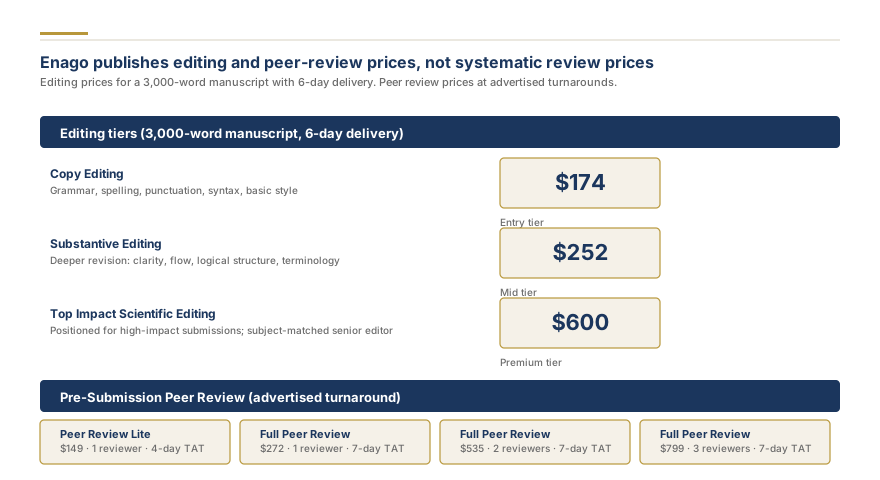
Enago disclosed pricing for editing tiers and pre-submission peer review
Editing tier prices for a 3,000-word manuscript with 6-day delivery: Copy 174, Substantive 252, Top Impact 600. Peer Review Lite 149; Full 272 to 799 by reviewer count.

Enago's services span English editing, translation, plagiarism checks, publication support, and pre-submission peer review. Editing tiers are Copy Editing, Substantive Editing, and Top Impact Scientific Editing. Pre-submission peer review comes in Lite (single reviewer) and full (1, 2, or 3 reviewers) options. Enago's homepage cites 3,000-plus editors with a Master's or PhD, an average editor experience of 19.4 years, and a Precise Subject Area Matching System covering more than 1,600 subjects.

Enago publishes editing prices on its fees page. For a 3,000-word manuscript with 6-day delivery, Top Impact Scientific Editing is $600, Substantive Editing $252, and Copy Editing $174. Peer Review Lite is $149 for a 4-day turnaround. Full Pre-Submission Peer Review is $272 for one reviewer, $535 for two, and $799 for three reviewers, all at 7-day delivery. These are editing and review prices, not systematic review or meta-analysis prices.

What is not on the Enago services index

The Enago services list and fees page do not include a productized systematic review service or meta-analysis service. Enago is positioned as an editing and publication-support firm. Researchers needing PRISMA 2020-compliant protocol development, multi-database search, dual-reviewer screening, data extraction, risk of bias assessment, statistical synthesis, and GRADE evidence rating need a methodology-first provider rather than an editing-first one.

Where Enago fits in a systematic review workflow
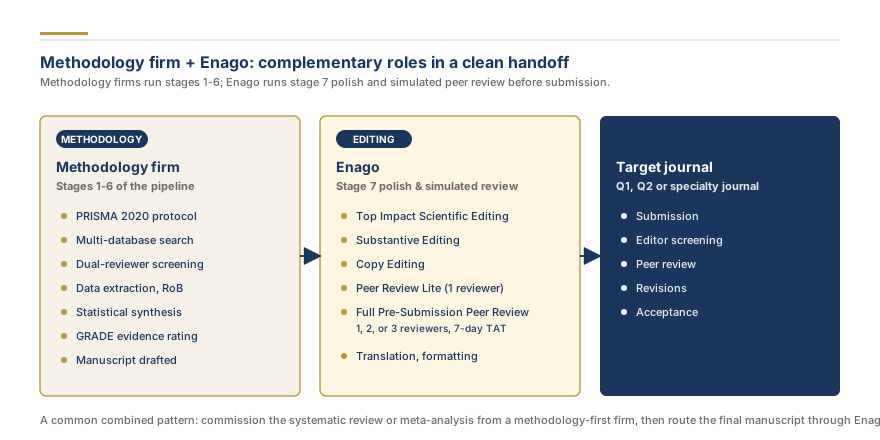
Three-zone handoff showing methodology firm to Enago to journal
Methodology firms run stages 1-6; Enago runs stage 7 polish and simulated peer review before submission. The two roles are complementary.

Enago's clearest role in a systematic review workflow is at the end. Once your team has finalized the manuscript, Enago's editing tiers can polish the language, and Enago's pre-submission peer review can simulate reviewer feedback before you submit to your target journal. The Top Impact Scientific Editing tier is positioned for high-impact submissions; the simulated peer review is unusual and useful for first-time authors targeting Q1 journals where a real revision cycle would otherwise be the first feedback you receive.

Enago is also reasonable for translating a draft from a non-English first language into English suitable for a peer-reviewed journal, and for journal-formatting and submission support after editing.

Alternatives for full systematic review and meta-analysis

Researchers needing the full systematic review pipeline typically choose between methodology-first providers. A short list:

  • Research Gold (researchgold.org). Public starting prices: systematic review from $895, meta-analysis from $825, scoping review from $750, systematic review and meta-analysis bundle from $1,500. PRISMA 2020-compliant, R or Stata analysis, three turnaround tiers (Gold 1 week, Silver 2 to 3 weeks, Bronze 4 to 5 weeks). 51 free browser-based methodology tools available without sign-up.
  • Pubrica (pubrica.com). Quote-only pricing. Tiered turnarounds: systematic review Basic 10 to 15 business days, Standard 30 to 40 business days, Advanced 60 to 120 business days. Lists 11 meta-analysis variants including network, IPD, diagnostic test accuracy, Bayesian, and dose-response.

A common combined pattern: commission the systematic review or meta-analysis from a methodology-first firm, then route the final manuscript through an editing firm like Enago for Top Impact Scientific Editing and pre-submission peer review before journal submission. The handoff is clean because the methodology firm produces a finished manuscript that editing firms are well set up to polish.

Need help with your meta-analysis?

Our PhD statisticians run complete meta-analyses: effect sizes, forest plots, heterogeneity testing, and publication-ready results sections.

Choosing between Enago and a methodology firm

If you have a research question and need a team to design and run a systematic review or meta-analysis from protocol to manuscript, a methodology-first provider like Research Gold or Pubrica is the right pick. If you have a finished manuscript and need world-class editing or simulated peer review before submission, Enago's editing tiers and Pre-Submission Peer Review service are strong choices. The two roles are complementary rather than competitive; pick the one that matches your stage in the pipeline.

What Enago's pricing actually buys

Enago publishes disclosed prices for its editing and pre-submission peer review tiers. That is unusual in the editing category and useful when comparing vendors. For a 3,000-word manuscript with 6-day delivery:

  • Copy Editing $174. Grammar, syntax, punctuation, basic style consistency.
  • Substantive Editing $252. Adds developmental edits, flow, paragraph reorganization, transitions.
  • Top Impact Scientific Editing $600. Adds rigorous developmental review aimed at Q1 journal submission.
  • Peer Review Lite $149. A single reviewer, 4-day turnaround, simulated reviewer-style comments.
  • Full Pre-Submission Peer Review $272 to $799. One, two, or three reviewers, 7-day delivery.

These prices are not systematic review prices. They cover language polish and simulated peer feedback on an already-written manuscript. A productized systematic review (protocol, search, screening, extraction, risk of bias, synthesis, GRADE, manuscript) is multiples of this and is not on Enago's services index.

For a sense of the methodology-side number, see our meta-analysis cost and pricing guide or the public ranges on the Research Gold pricing page.

Where the Pre-Submission Peer Review actually helps

Enago's Pre-Submission Peer Review is one of the more interesting products in the editing category. It pairs your manuscript with one to three subject-matched reviewers who simulate a journal review. The deliverable is a written reviewer report similar in shape to what you would receive from the journal itself.

This is most useful for first-time authors targeting Q1 or Q2 journals, where a real revision cycle is the first feedback you would otherwise see. Catching a major-revision-level issue at the simulated stage means you can redesign before submission rather than after.

It is less useful when the methodology has gaps. A simulated reviewer flagging "the search strategy is not reproducible" or "risk of bias was not assessed with a validated tool" is feedback you can already act on without a paid review. For methodology-side help, see our respond to statistical reviewer comments guide and our manuscript rejected after revision guide.

Combining Enago with methodology-first work

The clean pattern: methodology firm first, Enago second. The methodology firm handles the upstream pipeline; Enago handles the downstream polish and (optionally) the simulated peer review.

A typical sequence for a Q1-targeted systematic review and meta-analysis:

  1. Commission the systematic review and meta-analysis from a methodology-first provider with a 1-week or 2 to 3-week turnaround tier. Files delivered: protocol, search log, screening log, extraction sheet, risk of bias judgements, forest plots, GRADE table, manuscript draft, reference list.
  2. Send the manuscript to Enago for Top Impact Scientific Editing. Adds rigorous developmental edits, flow improvements, and journal-style polish.
  3. (Optional) Send the polished manuscript through Enago Full Pre-Submission Peer Review with two reviewers. Adds reviewer-style report.
  4. Submit to journal.

For a fixed quote on stage 1 with a published starting price, share your scope on the request a fixed quote. The reply lists turnaround tier and the file handoff that Enago can polish at stage 2.

What a pre-submission peer review can and cannot catch

A pre-submission review is a reader's report. Someone experienced reads the manuscript as a referee would and tells you where it is weak. That is genuinely useful, and it is worth being precise about what it can reach.

It reaches presentation. Whether the research question is stated clearly, whether the methods section explains what you did in the order a referee expects, whether the tables support the claims in the text, whether the discussion overreaches. Those are real rejection causes and a good reader will find them.

It cannot reach the decisions that were made before the writing started. If the search covered three databases where the field expects five, a reader can flag the concern but cannot run the missing searches. If screening was done by one person, no report converts that into dual screening after the fact. If the studies were pooled when they should not have been, the fix is a different analysis, not a clearer paragraph about the one you ran. A reader's report tells you the wall is in the wrong place; it does not move the wall.

That distinction decides whether the service is worth buying at your particular stage. Bought after a sound synthesis, it is cheap insurance. Bought instead of a methodologist, it produces a well-written account of a study that referees will still reject.

Reading a quote before you accept it

Editing quotes and methodology quotes are priced on different units, which makes them look deceptively comparable. Editing is quoted per word against a finished document. Methodology is quoted per project against the size of the evidence base, because the cost sits in records screened, studies extracted, and whether a statistical synthesis is in scope.

Three things are worth pinning down in writing before money moves, whichever you are buying:

  1. When does the clock start. On signature, or when you hand over a completed draft? These are very different commitments if you have a submission deadline.
  2. What counts as a revision. If a referee asks for something the original scope did not cover, is that included or a new quotation? Ambiguity here is the single most common source of dispute in this market.
  3. Who does the work, and what have they done before. Not the company's record, the record of the person assigned to your manuscript.

A vendor that answers all three plainly, in the quotation rather than in conversation, is usually the one that behaves predictably later. For a broader view of how the publication support market divides these layers, that breakdown covers the same ground across vendor types.

Where Research Gold fits

Research Gold sits on the other side of the line described above. The work begins at the research question rather than the draft, which means the protocol, the searches, the screening, the extraction, the bias assessment, and the synthesis are ours to run and ours to defend. The deliverable is a complete manuscript with reproducible R or Stata code and a PRISMA 2020 flow diagram, plus a certainty assessment where pooling is appropriate.

Authors who already have a sound synthesis and want only the language layer are better served by an editing desk, and we say so when that is the honest answer. Authors weighing several methodology providers can compare them in our round-up of systematic review providers, and those deciding between an individual contractor and a firm will find the trade-offs in our freelancer against an established provider comparison.

If you want the review run rather than reviewed, tell us what you are studying and a methodologist will scope it with you.

Frequently Asked Questions

5
Enago's services index and fees page do not list a productized systematic review service. Enago offers editing, translation, pre-submission peer review, and publication support. For full systematic review work, researchers typically use methodology-first providers.
Enago publishes editing prices on its fees page. For a 3,000-word manuscript with 6-day delivery: Top Impact Scientific Editing $600, Substantive Editing $252, Copy Editing $174. Peer Review Lite is $149.
Pre-Submission Peer Review is a paid simulated peer review service. Lite uses one reviewer at $149 (4-day turnaround). Full reviews are $272 (1 reviewer), $535 (2 reviewers), or $799 (3 reviewers) at 7-day delivery.
Enago is positioned as an editing and publication-support firm; the services index does not include a productized meta-analysis offering. For meta-analysis work, methodology-first providers are the typical choice.
Research Gold (public starting prices from $895, 1-week to 5-week tiers, 51 free methodology tools) and Pubrica (quote-only, tiered turnarounds) are the most direct alternatives for end-to-end systematic review and meta-analysis work.
Share

Found this useful? Share it with your colleagues.

Need help with your meta-analysis?

Our PhD statisticians run complete meta-analyses: effect sizes, forest plots, heterogeneity testing, and publication-ready results sections.

Explore our Meta-Analysis Service, handled end-to-end by a PhD methodologist.

Meta-Analysis Support

Reading About Meta-Analysis? Our PhD Team Runs Them Every Day.

From data extraction to forest plots, sensitivity analysis, and a journal-ready manuscript. We handle the full meta-analysis so you can focus on your research question.

Our promise: Free re-run of the pooled analysis if reviewers question the estimate or model.

4.9 / 5Quote within a few hoursmetafor R + Cochrane HandbookPhD methodologistConfidential by default
Chat on WhatsApp now
DS

Written by

Dr. Sarah Mitchell

PhD, Biostatistics & Research Methodology
Systematic Review MethodologyMeta-AnalysisBiostatistics

Dr. Sarah Mitchell holds a PhD in Biostatistics from Johns Hopkins Bloomberg School of Public Health and has over 15 years of experience in systematic review methodology and meta-analysis. She has authored or co-authored 40+ peer-reviewed publications in journals including the Journal of Clinical Epidemiology, BMC Medical Research Methodology, and Research Synthesis Methods. A former Cochrane Review Group statistician and current editorial board member of Systematic Reviews, Dr. Mitchell has supervised 200+ evidence synthesis projects across clinical medicine, public health, and social sciences.

Reading About Meta-Analysis? Our PhD Team Runs Them Every Day.

From data extraction to forest plots, sensitivity analysis, and a journal-ready manuscript. We handle the full meta-analysis so you can focus on your research question.

Starting from the research question, not just the data? We run the whole systematic review and meta-analysis together. Quote my review + meta-analysis

Quote within a few hours. Pay only after you approve your quote. Unlimited revisions within your agreed scope. Confidential by default.