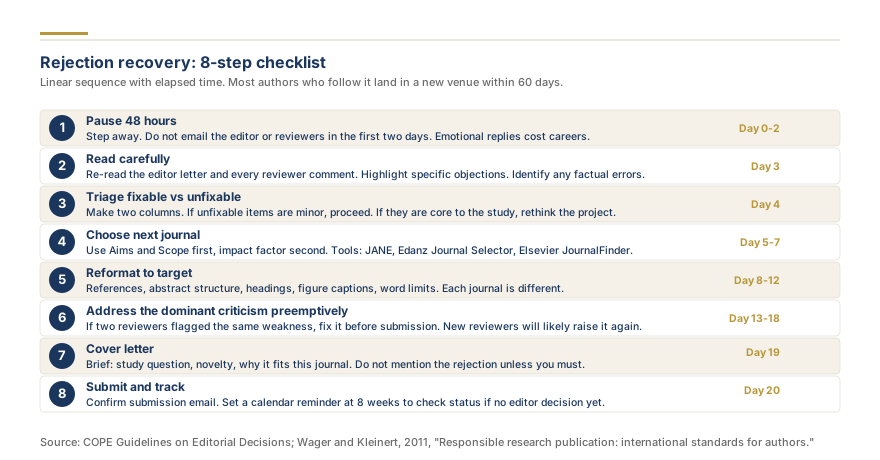
A manuscript rejected after revision means the journal editor reviewed your revised submission alongside the original reviewer comments and decided the paper still does not meet the journal's standards for publication. This happens more often than most researchers expect. Elsevier reports that approximately 21 percent of revised manuscripts are ultimately rejected, while Springer Nature journals see rejection rates of 15 to 30 percent even after a revise-and-resubmit decision. The rejection stings, but the manuscript is far from dead. You have already refined the work based on expert feedback, and that improvement carries forward to your next submission. This guide walks you through every step of recovering from a post-revision rejection, from decoding the decision letter to selecting your next target journal and getting your paper published.
Why Journals Reject Manuscripts After Revise and Resubmit
Understanding why the rejection happened is the first step toward a successful resubmission. Post-revision rejections rarely come down to a single factor, and recognizing the pattern behind your specific rejection shapes your entire recovery strategy.
Editor-reviewer disagreement is the most common cause. One reviewer may recommend acceptance while another recommends rejection, forcing the editor to make a judgment call. The Committee on Publication Ethics (COPE) guidelines give editors the authority to override split reviewer opinions when they believe the manuscript does not advance the field sufficiently. In these cases, your revision may have satisfied one reviewer completely but failed to convince the other, and the editor sided with the critical voice.
Inadequate revision depth triggers rejection when the editor feels you addressed reviewer comments superficially rather than substantively. A reviewer who asked you to restructure your statistical analysis will not be satisfied with a paragraph explaining why the original approach was adequate. Editors at journals managed through ScholarOne and Editorial Manager track revision histories closely, and they notice when authors provide defensive responses rather than genuine improvements.
New concerns raised during re-review can derail an otherwise strong revision. Reviewers sometimes identify additional problems in the revised manuscript that were not apparent in the original submission. This is particularly common with Research Gold systematic review services and meta-analyses, where a revised search strategy or updated inclusion criteria can reveal new methodological questions.
Scope reassessment by the editorial board occasionally results in rejection when a journal's editorial priorities shift between your initial submission and your revised resubmission. BMJ and The Lancet, for example, regularly update their editorial focus areas, and a manuscript that fit their scope six months ago may no longer align with their current priorities.
Competitive submissions on the same topic can also play a role. If a journal accepted a similar paper while yours was under revision, the editor may decide that publishing both adds insufficient novelty. This is not a reflection of your work's quality but rather of publishing timing.
How to Analyze Your Rejection Letter
The rejection letter contains critical intelligence for your next move. Read it carefully, more than once, before making any decisions about what to do next.
Identify the decision type. Journals use different rejection categories, and each one signals a different path forward. A "reject with encouragement to resubmit" is fundamentally different from a "final reject." The International Committee of Medical Journal Editors (ICMJE) recommends that journals use clear, unambiguous decision language, but many editors still use hedging phrases that require interpretation. Look for phrases like "we would be willing to consider a substantially revised version" versus "we are unable to consider this manuscript further."
Separate editor comments from reviewer comments. The editor's letter typically appears at the top and carries the most weight. If the editor writes that the fundamental study design is flawed, no amount of revision will satisfy this journal. If the editor says the reviewers raised concerns that were not adequately addressed, you have a roadmap for improvement.
Categorize each reviewer point. Create a spreadsheet with four columns: the reviewer's concern, whether you addressed it in your revision, the reviewer's response to your revision, and your assessment of whether the concern is valid. This systematic approach prevents emotional reactions from clouding your judgment and helps you respond to peer reviewers more effectively in future submissions.
Look for consensus between reviewers. When both reviewers raise the same concern, that issue is almost certainly a genuine weakness in your manuscript. When only one reviewer raises a point and the other does not mention it, the concern may reflect a difference in perspective rather than an objective flaw. Prioritize fixing consensus concerns for your next submission.
Note any new information. Some rejection letters mention that a similar paper was recently accepted, that the journal's scope has changed, or that the editor consulted an additional statistical reviewer. This context helps you determine whether the rejection reflects a fixable problem or a mismatch between your work and the journal.
The Decision Framework: Appeal, Resubmit, or Move On
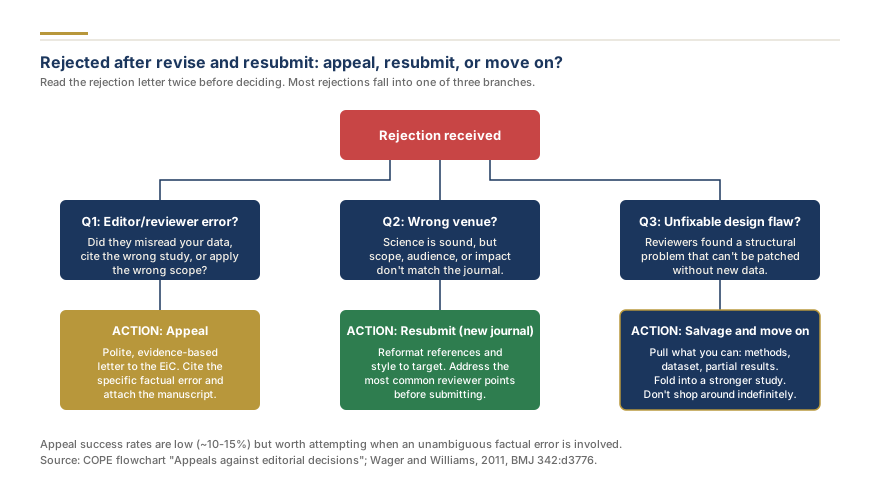
After analyzing your rejection letter, you face three options. Choosing the right one depends on the specific circumstances of your rejection, not on your emotional state in the moment.
Appeal to the same journal when all of the following conditions are met: the rejection appears to be based on a factual error or misunderstanding by a reviewer, you can provide clear evidence that the reviewer's criticism is incorrect, the editor's letter does not indicate a fundamental problem with your study, and the journal's appeal policy allows it. Wiley, Elsevier, and Springer Nature all have formal appeal processes, but success rates are low, typically under 10 percent. An appeal is not an opportunity to argue that you disagree with the reviewer's opinion. It is strictly for cases where a reviewer made an objectively incorrect statement about your methods, results, or interpretation.
Resubmit to a different journal when the rejection reflects genuine weaknesses you can fix, when the journal's scope or priorities no longer align with your work, or when a competitive publication has made your manuscript less novel for that specific journal. This is the most common and usually the best path forward. You retain all the improvements from your revision while targeting a journal that may be a better fit.
Substantially restructure the manuscript before resubmitting anywhere when multiple reviewers identified fundamental problems with your study design, analysis, or interpretation. If both reviewers and the editor raised concerns about your methodology, rushing to submit elsewhere without addressing those concerns will likely produce the same result at the next journal.
The worst strategy is submitting the rejected version to another journal without any changes. Reviewers in specialized fields frequently review for multiple journals, and encountering the same unrevised manuscript creates a negative impression that can follow your work.
Salvaging Reviewer Feedback for Your Next Submission
Every reviewer comment from your rejected submission is a free expert consultation. Even hostile or unfair reviews contain usable information if you extract it correctly.
Incorporate all valid criticisms regardless of the outcome. The fact that your manuscript was rejected does not invalidate the feedback. If a reviewer correctly identified that your full systematic review walkthrough search strategy missed a key database, that problem exists regardless of the journal's decision. Fix it before submitting anywhere else.
Use reviewer suggestions to strengthen your methods section. Reviewers who requested additional sensitivity analyses, subgroup analyses, or alternative statistical models are telling you what the field expects. Running those analyses now, even if you did not think they were necessary, makes your manuscript stronger for the next submission and pre-empts the same criticism from future reviewers.
Upgrade your reporting compliance. If reviewers mentioned gaps in your PRISMA reporting for a systematic review, use the online PRISMA diagram maker to create a compliant flow chart and check every item on the PRISMA 2020 checklist. If they noted issues with your clinical trial reporting, audit your manuscript against the full CONSORT checklist. Reporting guideline compliance is one of the easiest improvements to make, and it eliminates an entire category of reviewer criticism.
Strengthen your limitations section. Reviewers respect authors who acknowledge genuine limitations rather than those who try to hide them. If reviewers raised concerns about selection bias, confounding variables, or generalizability, address those concerns directly in your limitations section rather than arguing against them. A transparent discussion of limitations paradoxically strengthens your paper by demonstrating scientific rigor.
Document your revision trail. Keep a master document tracking every revision you have made across all submission attempts. This document becomes invaluable when preparing your response-to-reviewers letter for the next journal, especially if you need to explain prior peer review improvements.
Frustrated by reviewer demands that keep changing? You are not alone. Many researchers invest months addressing reviewer comments only to face rejection with entirely new concerns. Research Gold's response-to-reviewers service pairs you with subject matter experts who craft point-by-point responses that satisfy even the most demanding reviewers. Our medical writing team can also restructure your manuscript to address methodological concerns before resubmission. Request a free assessment and get a clear plan for your next submission within 48 hours.
How to Choose Your Next Target Journal
Selecting the right journal for your resubmission is arguably more important than any revision you make to the manuscript itself. A poor journal match produces repeated rejections regardless of manuscript quality.
Move strategically, not emotionally. Resist the urge to submit to the first journal that comes to mind or to drop several impact factor tiers out of frustration. Your revised manuscript is stronger than the original submission. Target a journal that genuinely fits your work rather than one you choose out of desperation.
Analyze the rejection for scope signals. If the editor mentioned that your topic is "outside the journal's current focus," you have a clear scope mismatch that no revision can fix. Use this information to target journals whose recent publications demonstrate active interest in your specific topic. Review the last 12 months of publications in candidate journals and verify that papers similar to yours have been accepted recently.
Consider the reviewer pool. In specialized fields like systematic review methodology, the same reviewers serve on editorial boards of multiple journals. If your reviewer's concerns were legitimate, submitting an unrevised manuscript to a sister journal where the same reviewer may be assigned guarantees another rejection. However, if you have substantially improved the manuscript, a knowledgeable reviewer will recognize and appreciate the improvements.
Match your methods to the journal's standards. Some journals require Bayesian analysis alongside frequentist results. Others expect pre-registered protocols. Some require data sharing as a condition of publication. Review the target journal's author guidelines and recent publications to ensure your methodology aligns with their expectations before submitting.
Use rejection data strategically. COPE and the ICMJE both support the practice of mentioning prior peer review when submitting to a new journal. Some journals explicitly ask whether the manuscript was previously reviewed elsewhere. Honest disclosure, combined with evidence that you addressed prior reviewer concerns, can actually strengthen your submission by demonstrating responsiveness.