Learning how to respond to peer reviewers is one of the most consequential skills in academic publishing. A peer review response letter, the formal document you submit alongside your revised manuscript, determines whether months of research effort result in acceptance or rejection. The point-by-point response format is the standard expected by virtually all biomedical and social science journals, yet most doctoral programs never teach researchers how to write one effectively. This guide provides a complete, step-by-step framework for crafting responses that satisfy reviewers, impress editors, and maximize your probability of acceptance.
A peer review response (also called a point-by-point response letter) is a structured document in which authors address each reviewer comment individually, explaining what changes were made to the manuscript and providing evidence-based justifications for any methodological decisions that were maintained. It accompanies a revised manuscript and cover letter to the editor during the revise and resubmit process.
We have helped researchers respond to over 300 peer review decisions, the most common mistake is treating the response letter as a defense brief rather than a collaborative dialogue. The researchers who get accepted treat reviewer feedback as an opportunity to strengthen their work, even when they disagree with specific comments.
Why Journals Expect a Point-by-Point Response
A point-by-point response letter is the universally expected format for addressing reviewer comments after receiving a revision decision from a journal editor. Every biomedical journal that follows COPE guidelines (Committee on Publication Ethics) and ICMJE Recommendations (International Committee of Medical Journal Editors) expects this structured format when authors resubmit a revised manuscript.
The format works as follows. For each reviewer, you number every comment and provide three elements: the original reviewer comment (quoted verbatim or paraphrased), your detailed response explaining what you did and why, and a precise reference to the location in the manuscript where the change appears (page number, line number, or section heading). This structure makes it easy for editors and reviewers to verify that every concern has been addressed, and easy for them to reject your paper if it has not.
Why does format matter so much? Because editors evaluate hundreds of manuscripts per year. A reviewer response format that is clean, numbered, and easy to navigate signals professionalism. A disorganized response, paragraphs of text without clear mapping to specific comments, signals that the author has not taken the revision process seriously. The point-by-point response letter structures reviewer responses in a way that respects the editor's time and demonstrates methodological rigor.
The standard structure looks like this:
- Reviewer 1, Comment 1: [Quoted comment]
- Response: [Your detailed response]
- Change made: [Description of manuscript change with page/line reference]
This pattern repeats for every comment from every reviewer. Some researchers bold the response text or use colored fonts to visually distinguish their responses from quoted comments, both approaches are acceptable as long as the format remains consistent throughout the document.
Rebuttal Letter vs Response to Reviewers: Are They the Same?
If your decision letter or a colleague mentions a rebuttal letter while your target journal asks for a "response to reviewers," you are dealing with two names for the same document. A rebuttal letter, a response to reviewers, a point-by-point response, and an author response letter all describe the structured reply you submit to defend and revise a manuscript after peer review. The word rebuttal emphasizes the parts where you push back on a comment with evidence, but a strong letter does far more than rebut: it accepts valid points, partially accepts others, and reserves evidence-based disagreement for the few comments that genuinely warrant it.
Knowing how to write a rebuttal letter therefore means knowing how to write a complete response to reviewers, not just how to argue. Journals that explicitly use the term "rebuttal," common in engineering, computer science, and several clinical specialties, expect the same numbered, comment-by-comment structure described below. The five-step framework that follows applies to both, and further down you will find a full rebuttal letter example and a copy-paste template you can adapt to any journal.
Step 1, Read All Comments and Do Not React Immediately
The first step in any successful response to reviewer comments is to read all comments from all reviewers end-to-end, and then step away for 24 to 48 hours. This is not procrastination. It is a strategic pause that prevents the emotional reactions that lead to defensive, counterproductive responses.
Reviewer criticism can feel personal. You have invested months or years in this research, and now strangers are pointing out flaws. The initial emotional response, frustration, defensiveness, the urge to explain why the reviewer is wrong, is natural and universal. It is also dangerous. Responses written in the first 24 hours after receiving reviewer comments are disproportionately likely to contain defensive language, dismissive phrasing, and missed opportunities for genuine improvement.
After the cooling period, read all comments again with a pen and paper. This time, categorize each comment into one of three groups:
Easy fixes, Comments you agree with that require straightforward changes: fixing a typo, adding a missing reference, clarifying an ambiguous sentence, reformatting a table. These are quick wins that demonstrate good faith. Address them thoroughly to build goodwill with the editor.
Substantive improvements, Comments that require real work but that will genuinely strengthen the manuscript: running an additional analysis, expanding the literature review, restructuring the Discussion section, adding a limitations paragraph. These are the comments that matter most. A major revision response lives or dies on how well you handle this category.
Disagreements, Comments where you believe the reviewer is mistaken, where the requested change would weaken the manuscript, or where the reviewer is asking for something outside the scope of the study. These require the most careful handling. You can disagree, editors expect it, but you must support your position with published evidence, not opinion.
This categorization exercise transforms an overwhelming wall of criticism into a manageable action plan. It also reveals the overall revision strategy: if most comments are easy fixes, you are looking at a straightforward revision with high acceptance probability. If most comments are substantive or involve disagreements, you need a more careful, evidence-heavy approach.
Step 2, Structure Your Response Letter
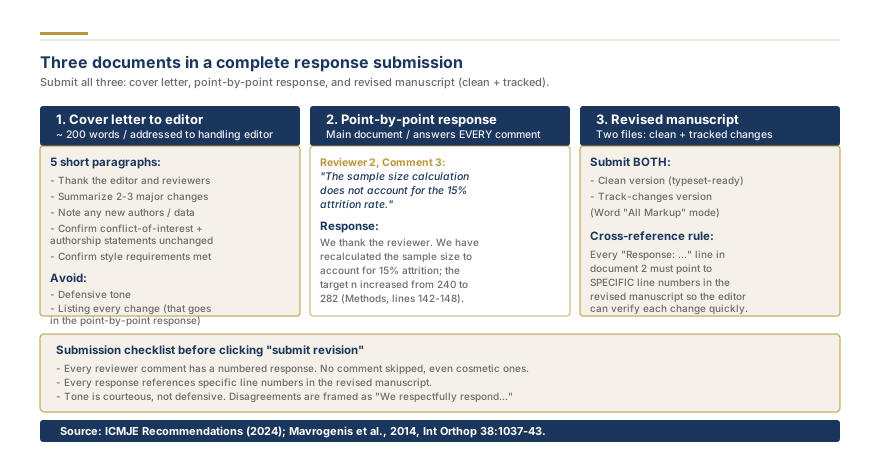
The physical structure of your peer review response letter matters almost as much as the content. A well-organized response signals competence. A disorganized one, regardless of how good your answers are, creates friction that works against acceptance.
Your complete resubmission package should contain three documents: a cover letter to the editor, the point-by-point response letter, and the revised manuscript with tracked changes. Some journals ask for a clean copy of the manuscript as well. Check your journal's author guidelines for specific requirements.
The response letter itself should be structured as follows:
Header: Include the manuscript ID, title, and date. Address it to the handling editor by name if known.
Opening paragraph: Thank the editor and reviewers for their constructive feedback. State that you have carefully addressed all comments and revised the manuscript accordingly. Keep this to 2-3 sentences, editors skim this section.
Reviewer 1 section: Number every comment from Reviewer 1. For each comment, use the three-part structure: quoted comment, your response, and the specific change made with page/line reference. If Reviewer 1 made 8 comments, you should have 8 numbered responses.
Reviewer 2 section: Repeat the same structure for Reviewer 2. If there are additional reviewers, continue with the same format.
Formatting conventions: Use bold or italics to distinguish reviewer comments from your responses. Some researchers use block quotes for reviewer comments and regular text for responses. Others use a different font color. The specific convention matters less than consistency, pick one approach and apply it uniformly.
The reviewer response format should make it effortless for the editor to cross-reference your responses with the revised manuscript. If a reviewer asks you to clarify the inclusion criteria and you respond by saying you have revised the Methods section, the editor should be able to find the exact location instantly: "We have revised the inclusion criteria in the Methods section (page 6, lines 12-18) to specify..."
Step 3, Address Each Comment Individually
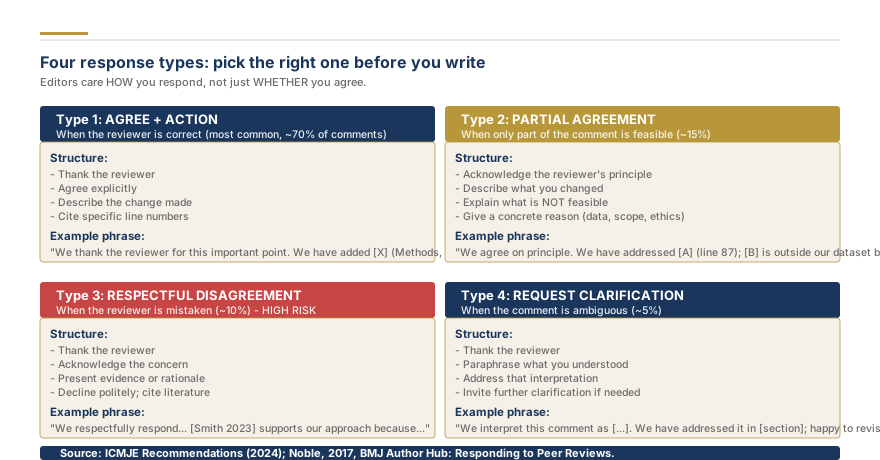
This is the core of your manuscript revision letter, the section that determines acceptance or rejection. Every comment requires a direct, complete, respectful response. No exceptions.
Comments You Agree With
For comments where the reviewer is right and the fix is clear, your response should be brief, grateful, and specific. Acknowledge the validity of the comment, describe exactly what you changed, and provide the location.
Example response: "We thank the reviewer for this observation. We have revised the sample size calculation in the Methods section (page 7, lines 4-9) to include the ICC and design effect, as recommended. The revised calculation now reads: '...'"
Avoid over-explaining when you agree. A concise, action-oriented response shows confidence and efficiency. The reviewer does not need a paragraph explaining why they were right, they know they were right. Show them the fix and move on.
Comments You Partially Agree With
Partial agreement requires more nuance. The reviewer has identified a genuine issue, but their proposed solution is not exactly what you want to implement. In these cases, acknowledge the underlying concern, explain your alternative approach, and justify it with evidence.
Example response: "We appreciate this valuable suggestion. The reviewer recommends adding a subgroup analysis by geographic region. While we agree that geographic variation is an important consideration, our dataset includes only 3 studies from outside North America, making a formal subgroup analysis underpowered and potentially misleading (Deeks et al., 2019). Instead, we have added a narrative discussion of geographic variation in the Discussion section (page 14, lines 8-15) and identified this as a limitation warranting future research (page 16, lines 3-5)."
This response validates the reviewer's concern, explains why the exact request was not feasible, describes what was done instead, and cites published evidence to support the decision. This is how to respond to peer reviewers when you partially agree, with evidence, not defensiveness.
Comments You Disagree With
Disagreement is where most researchers struggle, and where the quality of your response matters most. Editors expect disagreement. A response that agrees with everything looks like the author did not think critically about the feedback. But disagreement must be handled with diplomatic language, published evidence, and a tone of professional respect.
An evidence-based rebuttal follows this structure: acknowledge the reviewer's perspective, explain your reasoning, cite published literature or established methodology guidelines that support your position, and state your decision clearly.
Example response: "We appreciate the reviewer's suggestion to use a fixed-effect model instead of a random-effects model. However, given the clinical and methodological heterogeneity across the 12 included studies, which span three continents, two decades, and multiple intervention delivery formats, a random-effects model is more appropriate (Borenstein et al., 2010; Cochrane Handbook, Section 10.10.4). The I-squared value of 74% further supports this choice, as it indicates substantial heterogeneity that a fixed-effect model would fail to account for. We have added a brief justification for the model choice in the Methods section (page 8, lines 20-23)."
Notice the structure: gratitude, then evidence, then action. The reviewer is not told they are wrong. They are shown, with citations, why the author's approach is more appropriate. This is how effective evidence-based rebuttals work, they turn a potential conflict into a demonstration of methodological expertise.
When you disagree with a reviewer, COPE guidelines recommend that authors engage constructively with all feedback and provide transparent justifications for decisions. ICMJE Recommendations similarly emphasize that authors should respond to all reviewer comments with clear explanations. Following these standards protects you if the editor needs to adjudicate.
Need help crafting your response to peer reviewers? Our team writes point-by-point response letters, implements requested revisions, and prepares resubmission packages that satisfy editorial boards. partner with our experts for your project, or explore our professional peer review response help.
Step 4, Revise Your Manuscript with Tracked Changes
Every change described in your response letter must be visible in a tracked changes manuscript. This is non-negotiable. If your response letter says you revised the Methods section on page 7, the editor must be able to open the tracked changes document, navigate to page 7, and see the modification highlighted.
Use Microsoft Word's Track Changes feature or LaTeX's latexdiff package consistently throughout the document. Do not turn tracking off and on selectively, reviewers will notice. If you made changes that are not tracked, it creates suspicion about what else might have been altered without disclosure.
For every response in your letter, include a precise reference: page number, line number, or section heading. Vague references like "we revised the Methods section" force the reviewer to hunt for changes, which creates frustration and reduces goodwill. Specific references like "We revised the inclusion criteria (page 6, lines 12-18)" respect the reviewer's time.
When revisions cascade, a change in the Methods affects the Results, which affects the Discussion, which affects the Abstract, track every downstream modification and note it in your response. Consistency across sections is something reviewers check carefully, and inconsistencies between sections are a common reason for second-round revisions.
The tracked changes manuscript should be a clean, professional document. Remove personal comments, resolve all internal markup, and ensure formatting is consistent. The tracked changes document is part of your professional presentation, treat it with the same care as the manuscript itself.
Step 5, Write the Cover Letter to the Editor
The cover letter to the editor is the first document the editor reads when your resubmission arrives. It frames the entire revision and sets expectations for what follows. A strong cover letter does not rehash the point-by-point responses, it provides a high-level summary that helps the editor understand the scope and nature of the revision at a glance.
Your cover letter should include:
Manuscript identification: Reference the manuscript ID, title, and original submission date. State that this is a revised submission in response to the editor's decision letter of [date].
Summary of major changes: In 3-5 bullet points, highlight the most significant revisions. Focus on substantive changes, new analyses, revised methodology, restructured arguments, not minor corrections. This tells the editor that you took the major concerns seriously.
Acknowledgment of the review process: A brief sentence thanking the editor and reviewers for their thorough evaluation. This is standard professional courtesy.
New material flag: If you added new analyses, new figures, or new supplementary materials that were not in the original submission, flag them explicitly. Editors need to know what is new versus what was revised.
Closing: Express confidence in the revised manuscript and state your willingness to address any remaining concerns.
The cover letter should be one page, no longer. It is a navigational document, not a detailed response. The detailed responses belong in the point-by-point letter.
If a reviewer asks for statistical work that sits outside your comfort zone, a PhD methodologist can run the analysis and draft the reply for each technical comment. Hand your reviewer response to a methodologist and focus on the parts of the revision you can answer yourself.