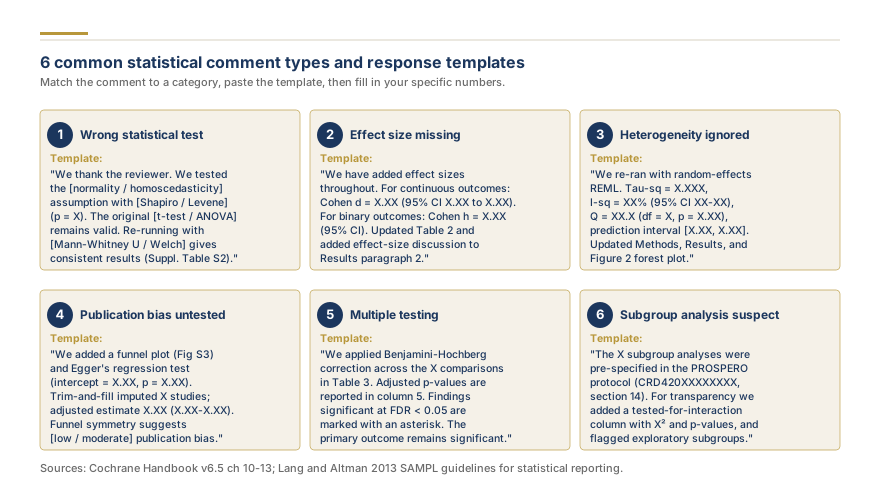
Responding to statistical reviewer comments is one of the most challenging parts of the publication process. When a reviewer questions your choice of statistical test, requests additional effect size reporting, raises concerns about heterogeneity, or flags missing sensitivity analyses, you need a structured approach that addresses every point without unraveling your entire manuscript. The key is to treat each comment as a specific, answerable question, provide the requested evidence or analysis, and explain your reasoning with citations to established methodological guidelines from organizations like ICMJE, COPE, and the Cochrane Collaboration.
This guide covers the six most common categories of statistical reviewer comments, provides response templates you can adapt immediately, and includes concrete before-and-after examples that show how weak responses become persuasive ones. Whether you are defending a meta-analysis forest plot or explaining why you chose a random-effects model over fixed effects, the frameworks here will save you weeks of revision time.
The Anatomy of an Effective Statistical Rebuttal
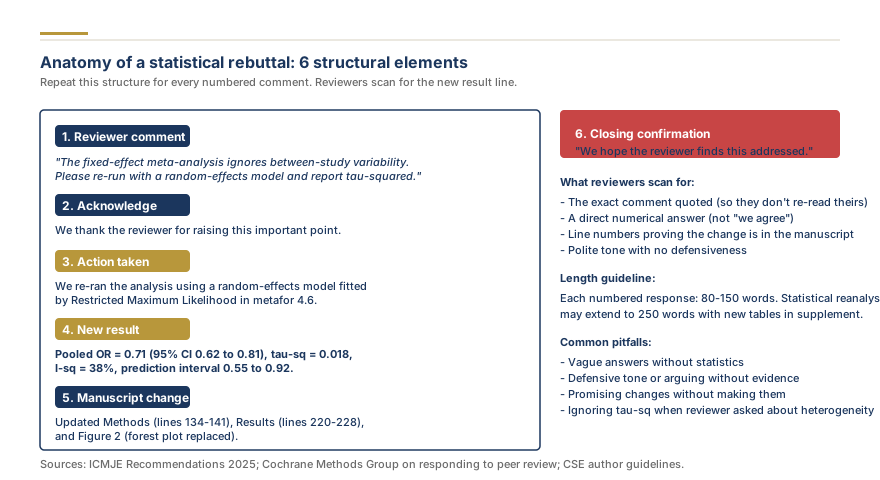
Before addressing specific comment types, you need a response structure that works for every statistical criticism. A strong rebuttal follows a consistent pattern that reviewers and editors expect.
Acknowledge the concern first. Start every response by restating the reviewer's point in your own words. This signals that you understood the criticism and prevents editors from sending the manuscript back because you "did not address the comment." A simple opening such as "We thank the reviewer for raising this important methodological point" sets the right tone without sounding defensive.
State what you did in response. Be explicit about the action you took. Did you run a new analysis? Did you add a table or figure? Did you revise the methods section? Reviewers scan for concrete changes, not general assurances that you "carefully considered" their feedback.
Present the evidence. Show the new results, cite the methodological reference that supports your approach, or point to the specific manuscript section and line numbers where the revision appears. When presenting reanalysis results, include the full statistical output: test statistic, degrees of freedom, p-value, effect size with confidence intervals, and sample size.
Explain why the results support your conclusion. Connect the new evidence back to your original finding. If the additional analysis confirms your results, say so clearly. If the results changed, describe the change and its implications for your conclusions honestly.
Reference the manuscript change. End every response with a specific pointer such as "This analysis has been added to Table 3 and described in the Results section, page 12, lines 8 through 14." Editors should never have to search for the revision.
This five-part structure, acknowledge, act, evidence, interpret, reference, works for 90 percent of statistical reviewer comments. The remaining 10 percent require diplomatic pushback, which we cover later in this guide.
Responding to "Wrong Statistical Test" Comments
The most anxiety-inducing reviewer comment is the one that claims you used the wrong statistical test entirely. These comments typically take forms like "The authors should have used a non-parametric test given the distribution of their data" or "A mixed-effects model is more appropriate than repeated measures ANOVA for this design."
Before (weak response):
"We believe our choice of independent samples t-test was appropriate for our data."
After (strong response):
"We thank the reviewer for this suggestion. We assessed the normality of our primary outcome variable using the Shapiro-Wilk test (W = 0.97, p = 0.31) and visual inspection of Q-Q plots, both of which supported the normality assumption. We additionally ran the Mann-Whitney U test as a sensitivity analysis. The results were consistent with our original findings (U = 342, p = 0.008), confirming that the choice of parametric versus non-parametric test did not affect the conclusions. Both analyses are now reported in the Results section (page 9, lines 4 through 12), and the Q-Q plots have been added to Supplementary Figure S2."
The strong response works because it provides empirical evidence for the distributional assumption, runs the alternative test proactively, and shows that conclusions hold regardless of the test chosen. This is the gold standard for defending a statistical approach.
Template for "wrong test" comments:
"We thank the reviewer for this methodological suggestion. We verified [assumption name] using [diagnostic test/plot] (test statistic = X, p = Y). As an additional sensitivity check, we reanalyzed the data using [reviewer's suggested test]. The results [confirmed/slightly modified] our original findings ([full statistics]). Both the original and sensitivity analyses are now presented in [specific location]. The interpretation of our primary outcome [remains unchanged/has been updated accordingly]."
When the reviewer is actually right and you did use an inappropriate test, acknowledge it directly. Running the correct analysis and presenting updated results demonstrates methodological rigor. If the conclusions change, update your Discussion section accordingly and note this in your response letter. Editors respect honesty far more than deflection.
Addressing Effect Size and Reporting Deficiency Comments
Reviewers frequently request additional reporting of effect sizes, confidence intervals, or standardized measures that were missing from the original submission. These comments reflect growing emphasis on effect estimation over null hypothesis significance testing, aligned with APA 7th edition reporting standards and recommendations from the ICMJE.
Common reviewer requests include adding Cohen's d or Hedges' g for group comparisons, reporting odds ratios or risk ratios with 95 percent confidence intervals, presenting number needed to treat calculations for clinical outcomes, and including standardized effect sizes alongside raw mean differences.
Before (weak response):
"We have added effect sizes as requested."
After (strong response):
"We appreciate this suggestion, which strengthens the interpretability of our findings. We have calculated Hedges' g for all primary and secondary comparisons using the pooled standard deviation with the small-sample correction factor (Hedges, 1981). For the primary outcome, the effect size was g = 0.64 (95% CI: 0.31 to 0.97), indicating a medium-to-large effect favoring the intervention group. Effect sizes for all secondary outcomes are presented in the revised Table 2. The Methods section now specifies the effect size calculation approach (page 7, lines 18 through 22), and the Results section reports all effect sizes alongside the original test statistics (pages 10 through 13)."
Template for effect size requests:
"Thank you for this recommendation. We have calculated [specific effect size metric] using [calculation method, with citation]. For the primary outcome, [metric] = X (95% CI: Y to Z), which represents a [small/medium/large] effect per established benchmarks (Cohen, 1988). All effect sizes are now reported in [Table/Figure reference] and described in the Results section (page X, lines Y through Z). The Methods section has been updated to specify the effect size calculation approach."
Use Research Gold's free Hedges' g calculator to compute Cohen's d, Hedges' g, odds ratios, and correlation coefficients from your summary statistics. Having accurate calculations before drafting your response prevents errors that could trigger a second round of revision.
Handling Heterogeneity and Publication Bias Concerns
For researchers submitting systematic reviews and meta-analyses, heterogeneity and publication bias comments are nearly guaranteed. Reviewers scrutinize I-squared values, request explanations for high between-study variability, and expect formal assessment of publication bias through multiple methods.
Heterogeneity response template:
"We agree that the observed heterogeneity warrants thorough investigation. The overall pooled estimate showed substantial heterogeneity (I-squared = 74%, tau-squared = 0.18, Cochran's Q = 38.5, df = 10, p < 0.001). To explore sources of this heterogeneity, we conducted the following pre-specified analyses: (1) subgroup analyses by study design, geographic region, and risk of bias rating; (2) meta-regression with publication year and sample size as covariates; and (3) sensitivity analysis excluding studies rated as high risk of bias. The subgroup analysis revealed that study design explained a substantial portion of the heterogeneity, with randomized controlled trials showing lower between-study variability (I-squared = 32%) compared to observational studies (I-squared = 71%). These results are presented in the revised Figure 3 and Supplementary Tables S4 through S6."
When reviewers raise publication bias concerns, they expect to see more than a single funnel plot. A comprehensive response should address Egger's regression test results (Egger et al., 1997), a visual funnel plot with an interpretation of asymmetry, Begg's rank correlation test for additional confirmation, trim-and-fill analysis showing the adjusted pooled estimate after imputing missing studies, and a fail-safe N calculation (Rosenthal, 1979) indicating how many null-result studies would be needed to overturn the finding.
Before (weak response):
"We performed Egger's test and found no evidence of publication bias (p = 0.12)."
After (strong response):
"We have now conducted a comprehensive assessment of publication bias using multiple complementary methods, as recommended by the Cochrane Handbook (Higgins et al., 2023). Egger's regression test showed no statistically significant asymmetry (intercept = 1.23, 95% CI: -0.41 to 2.87, p = 0.12). Begg's rank correlation test was also non-significant (Kendall's tau = 0.18, p = 0.24). Visual inspection of the funnel plot (revised Figure 4) shows slight rightward asymmetry in smaller studies. Trim-and-fill analysis (Duval and Tweedie, 2000) imputed two potentially missing studies on the left side, yielding an adjusted pooled estimate of 0.58 (95% CI: 0.29 to 0.87) compared to the original estimate of 0.64, a minimal change that does not alter our conclusions. The fail-safe N was 187, far exceeding the Rosenthal criterion of 5k + 10 = 60. These analyses are reported in the revised Results section (pages 14 through 15) with the updated funnel plot in Figure 4 and trim-and-fill results in Supplementary Table S7."
This level of detail may feel excessive, but it almost always prevents a second round of statistical revision on the same point.
Adding New Analyses Without Redoing Everything
One of the biggest fears researchers face when receiving statistical revision requests is that addressing one comment will cascade into redoing the entire analysis. This fear is usually unfounded if you approach the revision strategically.
Sensitivity analyses are additive, not destructive. When a reviewer asks you to perform a leave-one-out analysis tool, run a different random-effects estimator (for example, switching from DerSimonian-Laird to REML), or test a subgroup interaction, these are new analyses that supplement your original work. They do not replace it.
Wondering how to handle complex statistical revision requests? If reviewer comments are demanding analyses beyond your statistical expertise, including requests for Bayesian sensitivity analyses, network meta-analysis comparisons, or individual participant data reanalysis, a professional biostatistician can run the additional analyses, draft the statistical portions of your response letter, and ensure your revised methods section meets journal standards. Research Gold's biostatistical analysis support and response to reviewers support have helped hundreds of researchers clear statistical revision hurdles. request your scoping call to discuss your specific reviewer comments.
Software-specific tips for adding analyses efficiently. In R, use the metafor package (Viechtbauer, 2010) to run sensitivity analyses with a single function call. The leave1out() function generates a complete table of results excluding each study sequentially. In Stata, the metainf command produces equivalent output. In SPSS, meta-analytic sensitivity analyses require manual re-specification for each iteration, which is one reason many journals now prefer R or Stata for reproducibility.
Present new analyses in supplementary materials when appropriate. If the additional analysis confirms your original finding, mention it briefly in the main text and place the full output in a supplementary table. This keeps the manuscript focused while demonstrating methodological thoroughness. If the additional analysis changes your conclusions, it belongs in the main text with appropriate discussion.
Document every analytical decision. Create an analysis log that records which software and version you used (for example, R 4.4.1 with metafor 4.6-0), the exact code or command for each analysis, any data transformations applied, and how you handled each reviewer request. This log becomes invaluable if a second reviewer raises follow-up questions in a subsequent revision round.