Statistical Analysis Services for Researchers: R, Stata, and SPSS Analysis by PhD Biostatisticians
Statistical analysis services for researchers performed by PhD biostatisticians. R, Stata, SPSS, and SAS analysis with reproducible code, publication-ready tables and figures, and narrative interpretation for your manuscript.
Dr. Sarah Mitchell
April 20, 2026
Need expert statistical analysis for your research? Our PhD biostatisticians deliver reproducible R, Stata, or SPSS analyses with publication-ready tables and figures. Request a quote and receive a detailed estimate.
Key Takeaways
Research Gold's statistical analysis services are performed by PhD biostatisticians with published work in clinical medicine, epidemiology, and the social sciences.
We work in R, Stata, SPSS, and SAS, selecting the platform that fits your project, institution, or target journal requirements.
Every project includes reproducible code, publication-ready tables and figures, narrative results interpretation, and a methods section draft.
Analysis types include regression, survival analysis, mixed-effects models, propensity score methods, Bayesian methods, diagnostic test accuracy, and time series.
Pricing starts at $400 for single-model analyses and scales with complexity, with all projects including revisions for reviewer comments.
Free browser-based tools are available for power analysis, effect size calculation, chi-square testing, and intraclass correlation.
Why statistical reviewers reject more papers than methods reviewers
Statistical analysis services for researchers provide hands-on analytical support where PhD biostatisticians perform data analysis on your behalf, from raw data through publication-ready results. Rather than learning complex statistical software or second-guessing which test is appropriate, you submit your dataset and research question to a specialist who delivers verified results, annotated code, formatted tables, and manuscript-ready figures.
At Research Gold, our statistical analysis team is led by Prof. David Okonkwo (PhD, Biostatistics) and includes doctoral-level statisticians with published work spanning clinical medicine, public health, epidemiology, psychology, education, and the social sciences. We work in R, Stata, SPSS, and SAS, selecting the platform that best fits your project requirements or institutional conventions.
The distinction between a statistical analysis service and statistical software is important. Software gives you the tools. A service means an expert runs the analysis, checks assumptions, handles edge cases in your data, and delivers results that satisfy peer reviewers. This is especially critical for statistical analysis for medical research, where incorrect model specification, violated assumptions, or inappropriate handling of missing data can invalidate conclusions and compromise patient safety.
Whether you are a PhD candidate analyzing dissertation data, a clinical researcher preparing a journal submission, or a grant applicant who needs preliminary results to support a funding proposal, our service covers the full analytical pipeline. We follow the reporting standards recommended by the EQUATOR Network (Simera et al., 2010) and apply methods consistent with current best-practice guidelines in biostatistics and epidemiology.
Buyers guide vs service page. This article is the buyers guide: it explains what statistical analysis services are, how the category prices and packages, what red flags to watch, and how to compare vendors. If you already know you need help and want a fixed quote, the statistical analysis service page lists turnaround, pricing tiers, deliverables, and the file handoff. If you want category context first, keep reading.
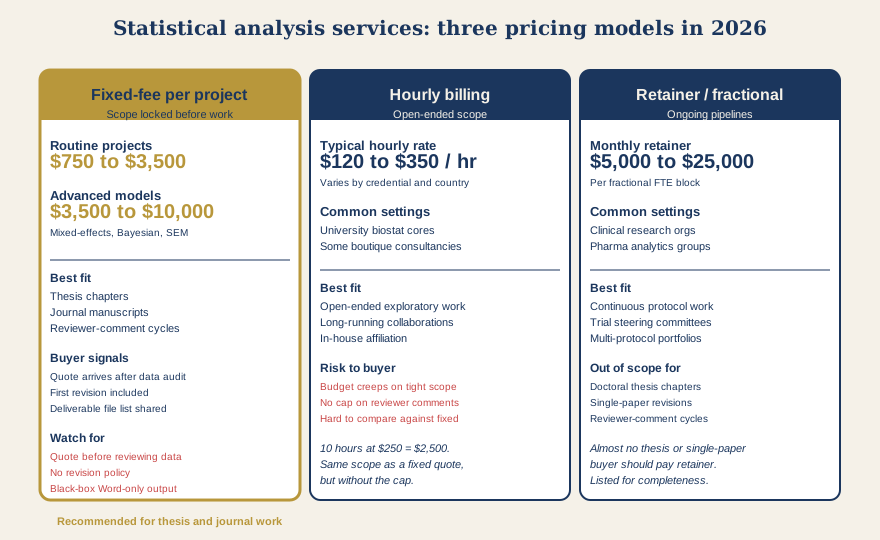
Fixed-fee, hourly, and retainer pricing models compared with typical price ranges and best-fit project types.
How this category prices in 2026
Statistical analysis services are priced three ways across the market. The pricing model matters as much as the headline number, because how a vendor charges you is a strong signal of how disciplined the analysis plan will be.
Fixed-fee per project. A scope-locked quote agreed before work begins. Best for thesis chapters, journal manuscripts, and reviewer-comment revisions where the deliverable is known up front. Typical range: $750 to $3,500 for routine projects, $3,500 to $10,000 for advanced models (mixed-effects, Bayesian, structural equation modelling).
Hourly billing. Common at university biostatistics cores and some boutique consultancies. Hourly rates run $120 to $350 per hour depending on credentials and country. Hourly is appropriate for open-ended exploratory work but creates budget risk on tightly scoped projects.
Retainer or fractional. Used by groups running ongoing pipelines, mostly clinical research organizations and pharma. Outside the scope of most thesis or single-paper buyers.
A red flag in any pricing model: a vendor who quotes before reviewing the dataset. Without a data audit, no statistician can size the actual scope. A good fixed-fee quote arrives after a free 30-minute discovery call and a brief look at variable counts, missing-data patterns, and design.
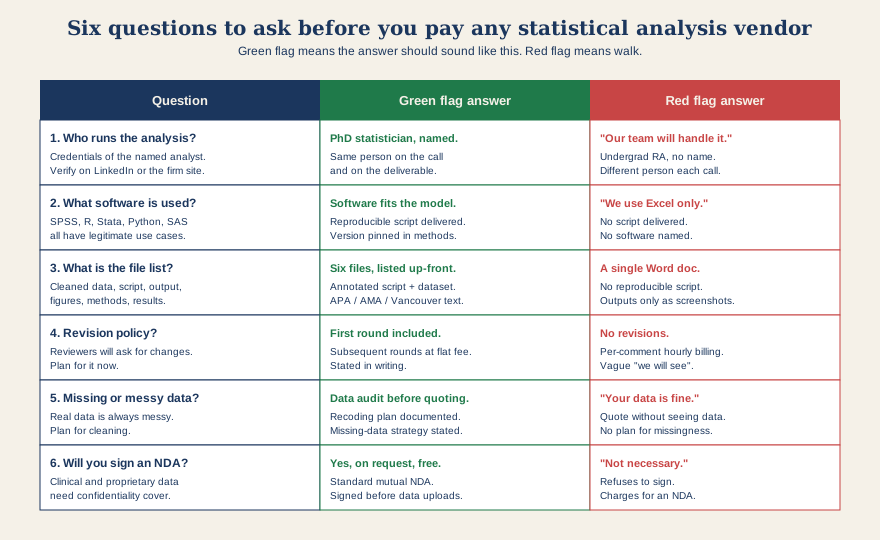
Six diagnostic questions with green-flag and red-flag answers for each.
What to ask any statistical analysis vendor before paying
Use this checklist on every sales call regardless of vendor:
Who runs the analysis? A PhD statistician, a Master's-level research assistant, or an undergraduate? Credentials should be verifiable.
What software is used? R, Stata, SPSS, Python, SAS each have legitimate use cases; "we choose the right tool" is acceptable, "we use Excel only" is not.
What is the deliverable file list? Cleaned dataset, annotated script, output workbook, figures, methods paragraph, results section. A vendor that only ships a Word document is shipping a black box.
What is the revision policy? First revision included is standard. No revisions or per-comment hourly is a red flag.
What happens with missing or messy data? A vendor that says "your data is fine" without seeing it is bluffing. Real vendors do a data audit and propose a recoding plan.
Are NDAs available? Standard yes. If a vendor will not sign an NDA on clinical or proprietary data, walk.
Vendor categories you will encounter
Three vendor types compete for statistical analysis work, and the right pick depends on stage and complexity:
University biostatistics cores. Free or subsidized for affiliated researchers. Constraint: capacity. Many cores run multi-month queues, which fails for revision-cycle deadlines.
Boutique methodology firms (Research Gold, Stats Make Easy, Pubrica's analysis line). Fixed-fee, dedicated PhD statisticians, defined turnarounds. Right for thesis chapters, journal submissions, and reviewer revisions with hard deadlines.
Editing-house statistical analysis lines (Editage Statistical Analysis, similar). A statistician runs your analysis but the firm's primary product is editing. Acceptable for routine analyses; less depth on advanced methods.
Our biostatisticians cover the full spectrum of quantitative methods used in health sciences, social sciences, and applied research. Each analysis is performed with appropriate assumption checking, model diagnostics, and sensitivity testing.
Regression Analysis
Regression modeling forms the backbone of most quantitative research. We perform linear regression for continuous outcomes, logistic regression (binary, ordinal, multinomial) for categorical outcomes, Poisson and negative binomial regression for count data, and robust regression methods when standard assumptions are violated. Every regression analysis includes residual diagnostics, multicollinearity assessment (variance inflation factors), and goodness-of-fit evaluation.
Survival Analysis
Time-to-event data requires specialized methods that account for censoring. We produce Kaplan-Meier survival curves with log-rank tests, fit Cox proportional hazards models with proportional hazards assumption testing (Schoenfeld residuals), and perform competing risks analysis using Fine-Gray subdistribution hazard models. These methods are standard in oncology, cardiology, and infectious disease research.
Mixed-Effects Models
Clustered and hierarchical data structures are common in multicenter trials, educational research, and longitudinal studies. We fit linear mixed-effects models and generalized linear mixed models that correctly account for the correlation structure within clusters, repeated measures, or nested observations. Random intercept and random slope specifications are selected based on your study design and research question.
Propensity Score Methods
Observational studies often require methods to reduce confounding bias when randomization is not possible. We implement propensity score matching, inverse probability of treatment weighting, stratification, and doubly robust estimation. Balance diagnostics (standardized mean differences, variance ratios) are reported to demonstrate covariate balance after adjustment.
Bayesian Methods
When your research question benefits from prior information or when frequentist methods are insufficient for your design, we apply Bayesian approaches. This includes Bayesian regression, hierarchical models, and Bayesian meta-analysis. We use informative or weakly informative priors as appropriate, report posterior distributions with credible intervals, and perform prior sensitivity analysis.
Diagnostic Test Accuracy
For studies evaluating screening tools, biomarkers, or clinical prediction rules, we calculate sensitivity, specificity, positive and negative predictive values, likelihood ratios, and area under the receiver operating characteristic curve. We construct ROC curves and apply DeLong's test for comparing diagnostic accuracy across tests or models.
Time Series and Longitudinal Analysis
For data collected repeatedly over time, we apply growth curve models, generalized estimating equations, autoregressive integrated moving average models, and interrupted time series designs. These methods are common in policy evaluation, pharmacovigilance, and public health surveillance research.
We perform all analyses using industry-standard statistical software recognized by Cochrane, the Joanna Briggs Institute, and leading peer-reviewed journals. The table below summarizes each platform and its typical applications.
Software
Strengths
Common Research Applications
R
Open source, extensive package ecosystem, advanced visualization, Bayesian methods
Menu-driven interface, widely taught in graduate programs
Descriptive statistics, ANOVA, chi-square tests, logistic regression, scale reliability analysis, common in social science and nursing research
SAS
Regulatory acceptance, macro programming, large dataset handling
Clinical trial reporting for FDA and EMA submissions, pharmaceutical research, health insurance claims data, CDISC-compliant outputs
All code is fully annotated with inline comments explaining each analytical step. We select the software that fits your project, or use the platform required by your institution, funder, or target journal. If you have no preference, we default to R for its flexibility and open-source reproducibility.
Our Analysis Process
Our workflow follows a structured, transparent sequence from initial consultation through final deliverables. Every step is documented so you and your reviewers can trace the analytical decisions.
Consultation and study review. We discuss your research question, study design, outcome variables, and analytical goals. We review your dataset structure and identify any immediate data quality issues such as missing values, outliers, or coding inconsistencies.
Statistical analysis plan. We draft a formal analysis plan documenting all primary and secondary analyses, covariates and confounders, handling of missing data (listwise deletion, multiple imputation, or maximum likelihood), planned sensitivity analyses, and the significance threshold. This plan serves as a methodological roadmap and is useful for ethics applications and journal submissions.
Data cleaning and preparation. We clean and restructure your data as needed, including variable recoding, data transformation, outlier assessment, and merging of multiple data files. We document every data manipulation step in the code for full transparency.
Analysis execution. We run all planned analyses with appropriate model diagnostics and assumption checks. Each model is evaluated for correct specification, and alternative approaches are tested when assumptions are not met.
Results compilation. We produce formatted tables (descriptive statistics, regression coefficients, odds ratios, hazard ratios), publication-quality figures (forest plots, Kaplan-Meier curves, ROC curves, scatter plots), and a narrative interpretation of every result.
Delivery and revision. We deliver the complete package: annotated code, statistical outputs, tables, figures, and results narrative. All tiers include revisions, and we handle additional analyses requested by journal peer reviewers at no extra cost within the engagement scope.
What You Receive
Every statistical analysis project from Research Gold includes a comprehensive deliverable package designed for immediate use in your manuscript, thesis, or grant application.
Reproducible Code
Fully annotated R scripts, Stata do-files, or SPSS syntax files documenting every step from data import through final output. Your code runs independently on any machine with the specified software installed, enabling you and your reviewers to verify and replicate every result.
Publication-Ready Tables
Formatted tables following the conventions of your target journal. This includes Table 1 (baseline characteristics with means, standard deviations, frequencies, and percentages), regression output tables (coefficients, standard errors, confidence intervals, p-values), and any additional summary tables required by your study design.
Publication-Ready Figures
High-resolution figures delivered in PNG, PDF, and editable vector formats. Common figures include forest plots, Kaplan-Meier survival curves, ROC curves, scatter plots with regression lines, residual diagnostic plots, and box plots. All figures are sized to match standard journal column widths.
Narrative Results Interpretation
A written summary of your results in academic prose, suitable for direct inclusion in the results section of your manuscript. This narrative covers the magnitude and direction of effects, statistical significance, confidence intervals, effect sizes, and clinical or practical interpretation. We explain what the numbers mean in the context of your research question, not just whether a p-value crossed a threshold.
Methods Section Draft
A draft of the statistical methods paragraph for your manuscript, describing the analytical approach, software version, packages used, and reporting standards followed. This section is written to satisfy peer reviewer scrutiny and meets the statistical reporting requirements of CONSORT, STROBE, or other applicable EQUATOR Network guidelines.
Choosing the right statistical software depends on your discipline, research design, institutional requirements, and analytical complexity. The comparison below helps you decide which platform best fits your project.
Descriptive statistics, ANOVA, scale reliability, social science
Reproducibility
Excellent (scripts, R Markdown, Quarto)
Excellent (do-files, logs)
Limited (syntax files less commonly used)
Visualization
Superior (ggplot2, plotly)
Good (built-in graphics, user-written schemes)
Basic (chart builder)
Package ecosystem
Largest (20,000 plus CRAN packages)
Moderate (community-contributed commands)
Limited (extensions available)
Regulatory acceptance
Increasingly accepted, FDA R Submissions Working Group
Widely accepted
Accepted for academic research
Common in
Biostatistics, genomics, data science, ecology
Epidemiology, economics, public health
Psychology, nursing, education, social work
When you use our R statistical analysis service, you receive scripts built with tidyverse, ggplot2, and domain-specific packages such as survival, lme4, brms, and metafor. When you choose our Stata analysis service, deliverables include do-files with Stata commands optimized for clinical and epidemiological workflows. Our SPSS analysis service provides syntax files alongside annotated output for researchers whose programs or committees require SPSS-based results.
If you are unsure which software to select, we will recommend the best option based on your discipline, analytical requirements, and target journal conventions.
Who Uses Our Statistical Analysis Services
Our clients span every stage of the research lifecycle and represent a wide range of disciplines and career stages.
PhD candidates and doctoral researchers. Your dissertation committee expects rigorous statistical analysis, but your training may not have covered the specific methods your data require. Our service delivers defensible results with code your committee can inspect at your viva or defense. This is the most common use case for our data analysis service for PhD researchers.
Clinical researchers and physician-scientists. You have patient data from a hospital-based study or clinical trial and need a biostatistician to analyze it correctly, handle missing data, and produce results that satisfy journal peer reviewers and institutional review board requirements.
Grant applicants. Preliminary statistical results strengthen grant proposals by demonstrating feasibility and effect size estimates. We deliver analyses formatted for National Institutes of Health, National Institute for Health and Care Research, and institutional funding applications. See our grant methodology service for additional support.
Systematic review teams. You have completed a qualitative review and now need quantitative analysis of your extracted data. Our biostatisticians pool results, generate forest plots, and assess heterogeneity. Learn more on our meta-analysis service page.
Authors responding to peer reviewer comments. Journal reviewers have requested additional analyses, alternative models, or sensitivity checks. Our expedited turnaround helps you meet your revision deadline. See our our response to reviewers service for dedicated support.
Research teams without in-house statistical expertise. Many departments and research groups lack a dedicated biostatistician. We serve as your external statistical arm, providing expert analysis without the overhead of a full-time hire.
Pricing
Our statistical analysis pricing is based on project scope and complexity rather than a fixed menu. Variables that influence the quote include the number of outcome variables, the complexity of the analytical methods, the size and quality of the dataset, and the turnaround timeline.
Project Type
Typical Price Range
Includes
Single regression model with descriptive statistics
$400 to $600
Data cleaning, assumption checks, regression output, formatted table, code
Multi-model analysis (3 to 5 models)
$600 to $1,000
Multiple regression or survival models, tables, figures, narrative interpretation
Full analytical pipeline, multiple outcomes, subgroup analyses, complete results chapter
All projects include reproducible code, formatted tables, publication-quality figures, narrative interpretation, and revisions for reviewer comments within the engagement scope.
We offer free, browser-based statistical calculators for researchers who want to explore methods, verify calculations, or run preliminary analyses before ordering our full service.
Power analysis calculator: Determine the sample size needed to detect a meaningful effect with adequate statistical power for your study design.
ICC calculator: Compute the ICC calculator intraclass correlation coefficient for inter-rater reliability and measurement agreement studies.
These tools complement our professional service. Use them for teaching, preliminary exploration, or quick verification. For publication-ready results with expert oversight and narrative interpretation, our full statistical analysis service provides the rigor and documentation that peer reviewers expect.
Professional statistical services now deliver reproducible R code alongside results, allowing you and reviewers to verify every step of the analysis.
Pro Tip
Share your raw data file and codebook together
Send your dataset in its original format (CSV, Excel, SAV, or DTA) along with a codebook or data dictionary that defines each variable. Clear variable labeling reduces turnaround time and ensures we code your analysis correctly.
Pro Tip
State your research question and hypotheses explicitly
Write out your primary research question and any specific hypotheses you are testing. This allows us to specify the correct models and tailor the analysis plan to your study objectives rather than running generic tests.
Pro Tip
Identify your target journal before we begin
Different journals have different table and figure formatting requirements, preferred statistical reporting standards (CONSORT, STROBE, ARRIVE), and software expectations. Knowing the target journal upfront lets us format deliverables to match.
Pro Tip
Request your preferred software at the outset
If your institution, supervisor, or dissertation committee requires R, Stata, or SPSS specifically, let us know before we start. All platforms produce equivalent results, but specifying early avoids the need for code translation later.
Frequently Asked Questions
8
We use R, Stata, SPSS, and SAS depending on your project requirements, institutional preferences, or target journal conventions. R is our default for its flexibility and open-source reproducibility. Stata is common for epidemiology and clinical trials. SPSS is standard in social science and nursing research. SAS is used for regulatory submissions. All code is fully annotated and reproducible.
Pricing depends on project scope and complexity. Single regression models with descriptive statistics typically range from $400 to $600. Multi-model analyses cost $600 to $1,000. Complex analyses involving mixed-effects models, propensity score methods, or Bayesian methods range from $1,000 to $2,000. All projects include reproducible code, formatted tables, figures, narrative interpretation, and revisions.
Yes. PhD candidates are our most common client group. We deliver rigorous statistical analysis with fully annotated code that your dissertation committee can inspect. We also provide a narrative interpretation of results and a methods section draft suitable for your thesis chapter.
We cover regression analysis (linear, logistic, ordinal, Poisson, negative binomial), survival analysis (Kaplan-Meier, Cox regression, competing risks), mixed-effects models for clustered and longitudinal data, propensity score methods, Bayesian analysis, diagnostic test accuracy (ROC curves, sensitivity, specificity), time series analysis, and meta-analysis.
Yes. Every project includes a narrative results summary written in academic prose, suitable for direct inclusion in your manuscript. This covers effect sizes, confidence intervals, statistical significance, and clinical interpretation. We also draft the statistical methods paragraph describing the analytical approach, software version, and reporting standards.
We assess the pattern and mechanism of missingness (missing completely at random, missing at random, or missing not at random) and apply the appropriate method. Options include listwise deletion when missingness is minimal, multiple imputation for data missing at random, maximum likelihood estimation, and sensitivity analyses comparing complete-case and imputed results.
Yes. All projects include revisions for reviewer-requested analyses within the engagement scope. If peer reviewers ask for alternative models, additional sensitivity checks, subgroup analyses, or different adjustment strategies, we handle those requests as part of your original engagement.
R is ideal for advanced modeling, Bayesian methods, meta-analysis, and custom visualization. Stata excels in epidemiology, clinical trials, and panel data analysis. SPSS is best for researchers who prefer a menu-driven interface and is standard in psychology, nursing, and social work. If you have no preference, we recommend R for its flexibility and reproducibility.
Share
Found this useful? Share it with your colleagues.
Need statistical analysis support?
Our PhD statisticians handle data analysis, produce reproducible R code, and write results sections that satisfy peer reviewers.
Need a Statistician? Our PhD Team Handles the Numbers.
From data cleaning to advanced statistical analysis, reproducible R code, and a results section ready for peer review. We handle the stats so you focus on the science.
Our promise: Free re-run and re-write if reviewers question the analysis or reporting.
4.9 / 5Quote within a few hoursReproducible R or Stata codePhD methodologistConfidential by default
Dr. Sarah Mitchell holds a PhD in Biostatistics from Johns Hopkins Bloomberg School of Public Health and has over 15 years of experience in systematic review methodology and meta-analysis. She has authored or co-authored 40+ peer-reviewed publications in journals including the Journal of Clinical Epidemiology, BMC Medical Research Methodology, and Research Synthesis Methods. A former Cochrane Review Group statistician and current editorial board member of Systematic Reviews, Dr. Mitchell has supervised 200+ evidence synthesis projects across clinical medicine, public health, and social sciences.
Need expert statistical analysis support? Our PhD biostatisticians work in R, Stata, SPSS, and SAS, delivering diagnostics, sensitivity checks, and APA-formatted results. See the statistical analysis service or get a free quote.
Need a Statistician? Our PhD Team Handles the Numbers.
From data cleaning to advanced statistical analysis, reproducible R code, and a results section ready for peer review. We handle the stats so you focus on the science.
Meta-analysis in psychology pools the effect sizes from many studies into one reliable result. Learn the definition, real examples, and how researchers run one.
Human-written, AI-assisted, AI-screened: the labels have stopped being descriptive. Here is the single threshold journals actually use, what you must disclose, and where Research Gold draws the line.