If you have just received a major revision decision on your journal manuscript, take a breath, this is good news. A major revision means the editor and peer reviewers see genuine merit in your work and are inviting you to strengthen it for publication. Journals typically accept 40 to 60% of manuscripts after a major revision, and most give you 30 to 90 days to respond. Unlike an outright rejection, a major revision signals that the editor believes your manuscript belongs in the journal, provided you address the reviewers' concerns thoroughly and systematically.
In our experience helping researchers navigate peer review, the authors who succeed at the revision stage are those who approach it with a clear strategy. Peer review evaluates manuscript quality across methodology, analysis, and interpretation, and a structured response demonstrates that you have taken every concern seriously. This guide walks you through exactly how to handle a major revision response, from reading the decision letter to resubmitting a strengthened manuscript.
Your First 72 Hours: The Action Plan
Here is the sequence that experienced authors follow, before any writing starts:
| When | What to do |
|---|---|
| Day 0 | Read the editor's letter and every reviewer comment once, in full. Do not reply to anyone and do not open the manuscript |
| Day 1 to 2 | Let the defensive reaction pass. Re-read the letter and highlight the editor's own instructions separately from the reviewers' comments; the editor's notes carry the most weight |
| Day 2 to 3 | Build the response matrix (template below): every comment quoted verbatim, categorized, with a planned action and a manuscript location |
| Day 3 onward | Work methodology and statistics comments first, presentation and wording last |
| 7 days before deadline | Draft the point-by-point letter, then assemble tracked-changes and clean manuscript versions plus the cover letter |
| Any time | If the deadline is unrealistic, email the editor for an extension. Editors grant 2 to 4 week extensions routinely when asked professionally |
Two shortcuts worth knowing before you start: our free response letter drafting tool structures the point-by-point document for you, and the worked examples later in this guide show exactly how to agree with a reviewer and how to decline a request without sinking the resubmission.
What Does "Major Revision" Actually Mean?
A major revision sits between minor revision and reject-and-resubmit on the spectrum of editorial decisions: the journal is not yet committing to publish, but it is keeping your manuscript in the review pipeline, and your revised version usually returns to the same editor and the original reviewers. The requested changes are substantial, typically to methodology, analysis, or interpretation, rather than surface-level clarifications.
The editor decision letter will contain the reviewers' comments, usually organized by reviewer. The editor decision determines publication path: the editor may add their own comments, highlight specific reviewer concerns that are most important, or provide guidance on which changes are essential versus optional. Read the editor's cover note carefully, it often signals what matters most for acceptance.
Journals typically accept 40–60% of manuscripts after a major revision decision, making it a positive signal for authors. The key variable is not the severity of the revision request but the quality of your response. A well-executed major revision response that addresses every concern with evidence and clarity has a strong chance of acceptance. A rushed or defensive response, even to minor concerns, can lead to rejection.
Most journals set a journal revision deadline of 30 to 90 days for major revisions. If you need additional time, for example, to collect supplementary data or run new analyses, contact the editor to request an extension. This is standard practice, and editors almost always grant reasonable extensions when asked professionally.
Major Revision vs Minor Revision vs Reject and Resubmit
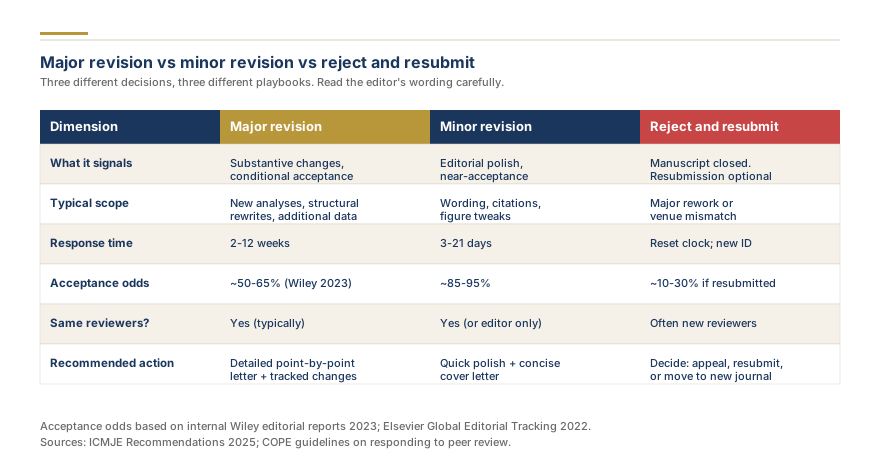
Understanding where your decision falls on the spectrum of peer review decision outcomes helps you calibrate your response strategy. A minor revision typically involves surface-level changes, clarifications, formatting, or additional references, that do not require substantive reworking of methodology or results. A minor revision response is usually brief and accepted quickly.
A major revision, by contrast, asks for fundamental improvements. Reviewers may request additional analyses, methodological justifications, restructured arguments, or responses to concerns about validity. The key difference is scope: minor revisions can typically be completed in a few days, while major revisions require weeks of focused effort.
A revise and resubmit (R&R) decision is sometimes used interchangeably with major revision, though in some disciplines it implies an even more substantial overhaul. In the social sciences, R&R often means the manuscript will be treated nearly as a new submission after revision.
| Decision | Scope of Changes | Typical Deadline | Acceptance Likelihood | Review Process |
|---|---|---|---|---|
| Minor Revision | Clarifications, formatting, minor additions | 14–30 days | 85–95% | Often editor-only review |
| Major Revision | Methodology, analysis, interpretation changes | 30–90 days | 40–60% | Returns to original reviewers |
| Revise and Resubmit | Substantial reworking of the manuscript | 60–180 days | 30–50% | May go to new reviewers |
| Rejection | Not suitable for the journal | N/A | 0% (at that journal) | N/A |
Regardless of the specific label, the underlying principle is the same: the journal is telling you what it needs in order to say yes. Your job is to deliver exactly that.
Step-by-Step: How to Handle a Major Revision
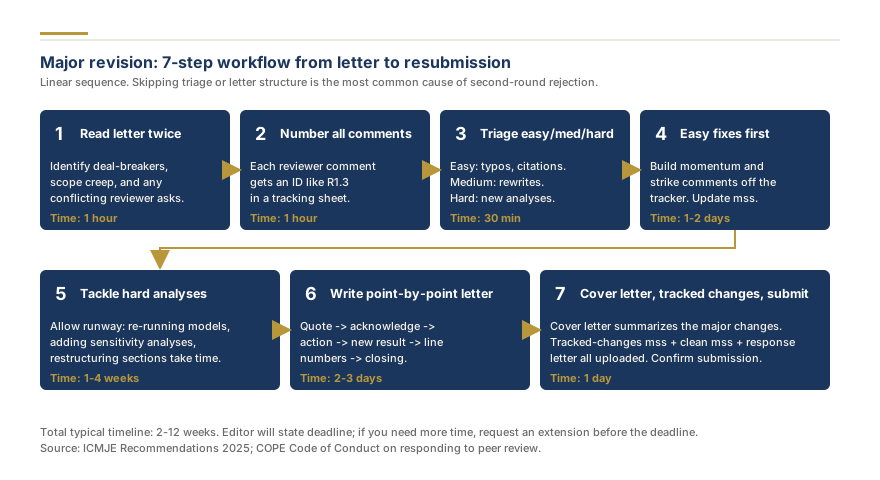
A major revision requires systematic response, not a hasty rewrite. Follow this process to maximize your chances of acceptance and avoid the common reasons for rejection that plague revised manuscripts.
Step 1: Read everything carefully, then wait. Read the editor's letter, all reviewer comments, and any supplementary notes. Do not start writing immediately. Allow 24–48 hours for the initial emotional reaction to pass. Almost every author's first instinct is to feel defensive, this is normal but counterproductive.
Step 2: Build a response matrix. Create a spreadsheet with the following columns: Reviewer number, Comment number, Comment text (verbatim), Category (methodology, statistics, presentation, or interpretation), Your planned response, Manuscript change required, and Page/Line reference. This reviewer comment template becomes your project management tool for the entire revision. It ensures you track every comment and can verify completeness before resubmission.
| Reviewer | Comment # | Comment Text | Category | Response | Manuscript Change | Page/Line |
|---|---|---|---|---|---|---|
| R1 | 1 | "The sample size justification is unclear" | Methods | Added power analysis details | Section 2.3 expanded | p.8, L12–18 |
| R1 | 2 | "Consider controlling for age" | Stats | Added age as covariate in all models | Table 3 updated | p.14, L5 |
| R2 | 1 | "Literature review misses Smith et al. (2024)" | Presentation | Added citation and discussion | Paragraph added to Discussion | p.22, L8–15 |
Step 3: Prioritize by impact. Categorize each comment as methodology, statistics, presentation, or interpretation. Address methodology and statistical concerns first, these are the comments most likely to determine whether the editor accepts your revision. Presentation issues (writing clarity, figure formatting) are important but secondary.
Step 4: Conduct the revision. Make every change in your manuscript using tracked changes manuscript mode so that reviewers and the editor can see exactly what was modified. If a reviewer requests an additional analysis, run it and report the results, even if the findings do not change your conclusions. This demonstrates thoroughness. If you need statistical support, consider our professional research services.
Step 5: Write the point-by-point response letter. This is the most critical document in your resubmission package. See the detailed guidance in the next section.
Step 6: Draft the resubmission cover letter. Your resubmission cover letter is addressed to the editor and summarizes the key changes you made. It is not a duplicate of the point-by-point letter, it is a high-level overview (typically one page) that highlights the most significant modifications.
Step 7: Final quality check. Before submitting, verify three things: every comment in your response matrix has a corresponding response in the letter, every manuscript change is visible in tracked changes, and your cover letter accurately summarizes the revision scope. A complete major revision response includes three components: a point-by-point response letter addressing every reviewer comment, a revised manuscript with tracked changes, and a cover letter summarizing key modifications for the editor.
How to Write a Point-by-Point Response Letter
If the statistics or methods questions from reviewers are over your head, a PhD methodologist can prepare the reanalysis and the point-by-point response for you. You can get expert help with your revision before the resubmission deadline gets close.
The point-by-point response letter is the document that determines whether your revision succeeds. Response-to-reviewers addresses peer review concerns in a structured format that makes it easy for reviewers and the editor to verify you have addressed every issue. A point-by-point letter structures reviewer responses into a logical, navigable document. For a comprehensive guide to crafting these responses, see our reviewer response guide.
Here is the format you should follow for your point-by-point response letter:
RESPONSE TO REVIEWERS
Manuscript ID: [Your manuscript ID]
Title: [Your manuscript title]
Dear Editor and Reviewers,
We sincerely thank the reviewers for their constructive and thorough evaluation of our manuscript. We have carefully considered every comment and have made substantial revisions accordingly. Below, we provide a point-by-point response to each comment. Reviewer comments are shown in bold, and our responses follow in regular text. All changes in the manuscript are highlighted using tracked changes.
REVIEWER 1
We thank Reviewer 1 for their detailed and insightful feedback.
Comment 1.1: [Quote the reviewer's comment verbatim]
Response: [Your detailed response, including the rationale for your changes and any supporting evidence or citations]
Changes made: [Specific description of what was changed, with page and line numbers]
This format ensures that every response to reviewer comments is traceable and verifiable. For each comment, include three elements: the original comment quoted verbatim, your substantive response explaining what you did and why, and a precise reference to where the change appears in the manuscript.
When you disagree with a reviewer, frame your response diplomatically. Provide evidence, citations, data, or methodological justification, for your position. Phrases like "We respectfully believe" or "We appreciate this perspective and have considered it carefully" maintain a professional tone. Never dismiss a comment, even if you believe it reflects a misunderstanding. Instead, clarify your original intent and strengthen the manuscript text to prevent similar misreadings.
If you need professional help with peer review, specialized services can draft or refine your response letter while preserving your voice and intellectual contribution.