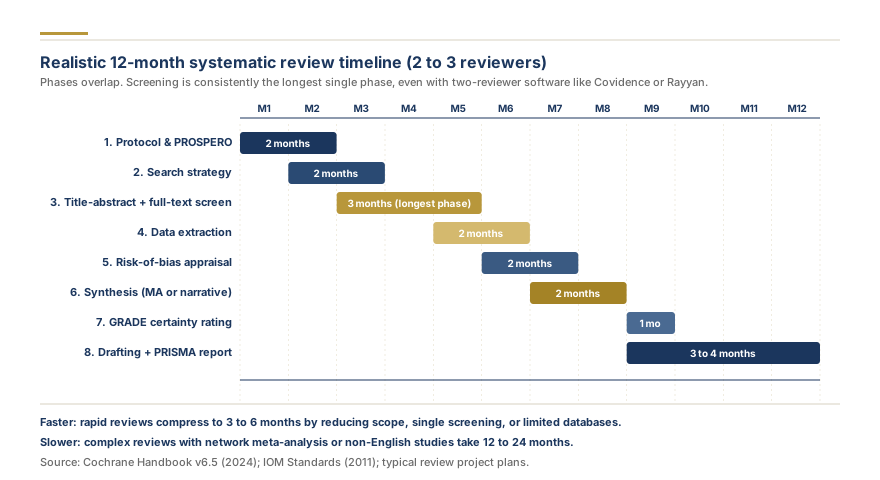
How to write a systematic review is the single most common question researchers face when asked to produce high-level evidence synthesis. A systematic review is not a literature review with extra steps. It is a distinct research method governed by the Cochrane Handbook (Higgins et al., 2023) and reported according to PRISMA 2020 guidelines (Page et al., 2021). This guide walks you through every phase of the systematic review process, from formulating your research question to submitting a publish-ready manuscript, with links to free tools you can use at each step.
Whether you are a PhD student conducting your first review for a dissertation chapter or a medical researcher synthesizing clinical trial evidence for guideline development, this step-by-step systematic review guide gives you the complete methodology. Every recommendation is grounded in the Cochrane Handbook and PRISMA 2020, the two authoritative sources that peer reviewers and thesis examiners will use to evaluate your work.
A systematic review is a rigorous, protocol-driven research method that identifies, appraises, and synthesizes all available evidence on a specific question. It follows PRISMA 2020 reporting guidelines (Page et al., 2021), uses pre-registered protocols on PROSPERO, and applies Cochrane Handbook methodology (Higgins et al., 2023) to minimize bias and maximize reproducibility.
Work through every stage with the ready-made files in the Systematic Review Toolkit.
Three Features That Set a Systematic Review Apart
Three characteristics distinguish a systematic review from other review types:
-
Pre-registered protocol. The methodology is documented and registered before the review begins, typically on PROSPERO, locking decisions about eligibility criteria, search strategy, risk of bias tools, and synthesis methods. This prevents post-hoc outcome switching.
-
Reproducible search strategy. The search uses structured Boolean search operators across multiple databases (PubMed, Embase, CINAHL, Cochrane Library, Web of Science), with the full electronic strategy reported as a supplementary appendix. Another researcher should be able to replicate your search and retrieve the same results.
-
Standardized quality assessment. Every included study is assessed for risk of bias using validated tools, not subjective judgment. Our side-by-side look at RoB 2, Newcastle-Ottawa, JBI, and GRADE shows which tool fits each study design. The Cochrane Handbook (Higgins et al., 2023) specifies which tool to use for each study design.
A systematic review is an evidence synthesis method, it synthesizes primary research rather than generating new data. It follows PRISMA 2020 reporting guidelines, which provide a 27-item checklist and a flow diagram that structure the manuscript. And it follows the methodology of the Cochrane Handbook, the definitive reference for how each phase should be conducted.
Understanding how systematic reviews differ from literature reviews is critical before you begin. If your supervisor or funder expects a systematic review but you deliver a narrative review, the work will be rejected regardless of its quality. The differences between narrative and systematic reviews explain why the two are not interchangeable. For an overview of the broader landscape, see our guide to types of evidence synthesis reviews.
Before You Start, Planning Your Systematic Review
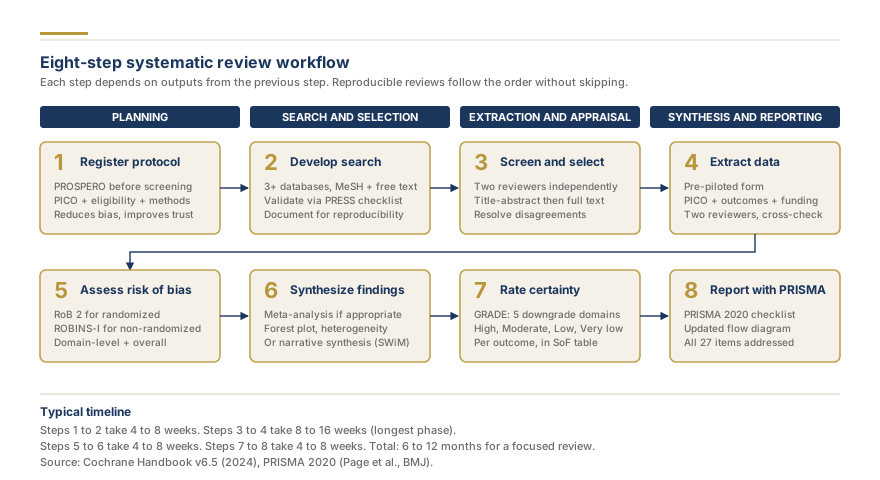
Planning determines whether your review succeeds or stalls at screening. Our free systematic review screening software handles the screening stage with relevance ranking and PRISMA counts. Before opening a single database, complete three preparatory tasks: formulate your question, assemble your team, and check for existing reviews.
Formulate Your Research Question Using PICO
A well-structured research question is the foundation of every systematic review decision, your eligibility criteria, search strategy, data extraction variables, and outcome measures all flow from it. The PICO framework structures research questions into four components:
- P (Population): Who are you studying? (e.g., adults with type 2 diabetes)
- I (Intervention): What treatment, exposure, or strategy? (e.g., SGLT2 inhibitors)
- C (Comparator): What is the alternative? (e.g., placebo or standard care)
- O (Outcome): What are you measuring? (e.g., HbA1c reduction, cardiovascular events)
PICO structures research questions by forcing specificity. A vague question like "What treatments work for diabetes?" is unsearchable. A PICO-structured question, "In adults with type 2 diabetes (P), do SGLT2 inhibitors (I) compared with placebo (C) reduce HbA1c levels and cardiovascular events (O)?", directly translates into search terms and eligibility criteria.
Use our free PICO question builder to structure your research question with PICO. It generates your PICO table, suggests search terms, and formats the output for your protocol.
Assemble Your Review Team
A systematic review following Cochrane methodology requires a minimum of two independent reviewers for study screening, with inter-rater agreement measured by Cohen's kappa (Higgins et al., 2023). This is not optional, single-reviewer screening introduces selection bias that peer reviewers will identify and criticize.
Your minimum team:
| Role | Responsibility | Minimum |
|---|---|---|
| Lead reviewer | Protocol, search, screening, extraction, writing | 1 |
| Second reviewer | Independent screening, extraction verification | 1 |
| Subject expert | Clinical or domain guidance | 1 (can overlap with reviewer) |
| Information specialist | Search strategy development | Recommended |
| Statistician | Meta-analysis (if applicable) | As needed |
If you are a PhD student working on a dissertation, your supervisor typically serves as the second reviewer. If your supervisor cannot commit to screening duties, consider enlisting a co-student or hiring a systematic review expert for specific phases. You can also calculate agreement statistics using our inter-rater reliability calculator.
Check for Existing Reviews
Before investing months of work, verify that your review does not already exist. Search these four sources:
-
Cochrane Library, The most comprehensive collection of systematic reviews in health. If a Cochrane review on your topic exists and is recent (updated within 2-3 years), your review may be redundant unless you have a different scope or population.
-
PROSPERO, Search the registry for ongoing or recently completed reviews on your topic. If a protocol is registered but not yet published, consider whether your review adds sufficient novelty or whether collaboration would be more productive.
-
PubMed, Search with your PICO terms plus the filter "systematic review" in the publication type field.
-
JBI Evidence Synthesis, The Joanna Briggs Institute maintains a registry of systematic review protocols and completed reviews, particularly in nursing and allied health.
Finding an existing review does not necessarily stop your project. Your review may cover a different population, include newer studies, use different eligibility criteria, or address a different outcome. But you must justify why a new review is needed, and this justification belongs in your protocol introduction. Our check for existing systematic reviews shows how many trials have appeared since the closest review, which is the usual evidence for that justification.
Step 1, Write and Register Your Protocol
A systematic review requires protocol registration before screening begins. The protocol is the blueprint of your review, it documents every methodological decision so that readers (and peer reviewers) can verify that you followed your plan rather than making post-hoc adjustments based on results.
What Goes in the Protocol
Your systematic review protocol should document:
- Objectives, The research question in PICO format and the review's purpose
- Eligibility criteria, Detailed inclusion exclusion criteria for study design, population, intervention, comparator, outcome, setting, and date range. Use our eligibility criteria tool to structure these systematically
- Information sources, Which databases you will search (minimum 2-3; Cochrane recommends PubMed, Embase, and the Cochrane Central Register)
- Search strategy, Draft Boolean strings with MeSH terms and free-text synonyms
- Study selection process, How screening will work (dual-reviewer, conflict resolution process)
- Data extraction plan, What variables you will extract and what form you will use
- Risk of bias tool, Which validated tool (RoB 2, ROBINS-I, Newcastle-Ottawa Scale, JBI Checklist) and why
- Synthesis method, Whether you plan narrative synthesis, quantitative synthesis (meta-analysis), or both, and under what conditions
PRISMA-P for Protocol Reporting
PRISMA-P (Preferred Reporting Items for Systematic Review and Meta-Analysis Protocols) is the checklist designed specifically for protocols. It contains 17 items covering administrative information, introduction, and methods. Do not confuse PRISMA-P with PRISMA 2020, they serve different stages. PRISMA-P guides your protocol; PRISMA 2020 guides your final manuscript.
For a comprehensive walkthrough of systematic review protocol development, read our systematic review protocol development guide.
Register on PROSPERO
PROSPERO is the international prospective register of systematic reviews. PROSPERO protocol registration is strongly recommended by Cochrane and required by many high-impact journals. Registration serves two purposes:
- Prevents duplication, Other researchers can see your ongoing review and avoid redundant work
- Prevents outcome switching, Your registered protocol locks your primary outcomes before you see the data, strengthening the credibility of your findings
Registration is free. On the current PROSPERO system a record is published automatically once system checks finish and all named authors have approved it, and PROSPERO notes that records can take up to 24 hours to appear on the public site. PROSPERO requires the review to start after the protocol is complete but before data extraction begins; registering before screening is stronger still, because no records have been read when the plan is fixed.
Use our free prospero registration formatter to prepare your submission fields, or read our full PROSPERO registration guide for a detailed walkthrough.
Step 2, Develop Your Search Strategy
A comprehensive search strategy is the methodological backbone of your systematic review. Boolean search retrieves studies from electronic databases using structured combinations of terms, operators, and filters. A poorly constructed search either misses relevant studies (low sensitivity) or retrieves thousands of irrelevant records (low specificity). The goal is high sensitivity with manageable specificity.
Build Your Boolean Search String
Boolean search operators combine your PICO-derived terms into executable queries:
- AND, Narrows results by requiring all terms. Example: "diabetes AND SGLT2 inhibitors" retrieves only records containing both concepts.
- OR, Broadens results by accepting any term. Example: "SGLT2 inhibitors OR gliflozins OR empagliflozin" captures all synonyms for the intervention.
- NOT, Excludes terms. Use sparingly, overly aggressive NOT filters can exclude relevant studies.
A standard search structure follows this pattern: (Population terms OR synonyms) AND (Intervention terms OR synonyms) AND (Outcome terms OR synonyms). Each concept block combines controlled vocabulary with free-text keywords.
Each concept block should include MeSH terms (Medical Subject Headings) for controlled vocabulary indexing plus free-text terms for natural-language coverage. MeSH terms capture studies that have been indexed under a specific concept even if the exact words do not appear in the title or abstract.
Use our free Boolean search string generator to build and validate your search string, then translate PubMed to Embase search syntax for cross-database execution.
Which Databases to Search
The Cochrane Handbook (Higgins et al., 2023) recommends searching a minimum of two databases, but most published reviews search three to five. The core databases for health-related systematic reviews:
| Database | Coverage | Controlled Vocabulary | Best For |
|---|---|---|---|
| PubMed / MEDLINE | 36M+ records, biomedical | MeSH terms | Clinical trials, biomedical research |
| Embase | 40M+ records, pharmaceutical | Emtree terms | Drug studies, pharmacology, European literature |
| CINAHL | Nursing and allied health | CINAHL headings | Nursing interventions, qualitative studies |
| Cochrane Library (CENTRAL) | Controlled trials register | MeSH terms | RCTs, Cochrane reviews |
| Web of Science | Multidisciplinary, citation indexing | None (keyword-based) | Cross-disciplinary reviews, citation tracking |
Each database uses different controlled vocabulary and search syntax. A PubMed search cannot be copy-pasted into Embase, you must translate MeSH terms to Emtree equivalents and adapt the syntax. Our syntax translator for literature search automates this translation.
Sensitivity vs. Specificity
Your search must balance two competing priorities:
- Sensitivity (recall): The proportion of all relevant studies that your search retrieves. A sensitive search casts a wide net using many synonyms, broader MeSH explosions, and fewer filters.
- Specificity (precision): The proportion of retrieved records that are actually relevant. A specific search uses narrower terms and more filters to reduce noise.
For systematic reviews, the Cochrane Handbook prioritizes sensitivity over specificity. It is better to screen 5,000 records and miss nothing than to screen 500 records and miss three pivotal studies. Plan your screening capacity around a high-sensitivity search.
For detailed guidance on building your search strategy, including database-specific syntax examples and grey literature sources, read our dedicated search strategy guide.
Step 3, Screen and Select Studies
Dual-reviewer screening is the quality control mechanism that separates systematic reviews from narrative literature reviews. Two reviewers independently assess every record against your pre-specified study selection criteria, and disagreements are resolved through discussion or a third reviewer. Dual-reviewer screening reduces selection bias by ensuring that no single reviewer's judgment determines which studies enter the review.
Title and Abstract Screening
Title and abstract screening is the first filter. Each reviewer independently reads the title and abstract of every record retrieved by your search and classifies it as "include," "exclude," or "maybe." At this stage, apply a low threshold for inclusion, if there is any doubt, advance the record to full-text screening. It is safer to review a full text unnecessarily than to exclude a relevant study based on an ambiguous abstract.
Before beginning, calibrate your screening criteria by piloting on 50 abstracts. Both reviewers screen the same 50 records independently, then compare decisions. If agreement is low (Cohen's kappa below 0.61), discuss the eligibility criteria, clarify ambiguities, and pilot again until you reach substantial agreement.
Cohen's kappa measures inter-rater reliability, the degree of agreement beyond chance. The widely used Landis and Koch (1977) bands label kappa values of 0.61 to 0.80 "substantial" and 0.81 to 1.00 "almost perfect." Record your kappa value; you will report it in your methods section. Calculate yours with our inter-rater reliability calculator.
Worked example: two calibration rounds of 50 abstracts. Suppose two reviewers independently screen the same 50 pilot abstracts, then a fresh set of 50 after a discussion.
| Round | Both include | Reviewer A only | Reviewer B only | Both exclude | Observed agreement | Chance agreement | Kappa |
|---|---|---|---|---|---|---|---|
| 1 | 9 | 5 | 3 | 33 | 42/50 = 0.84 | 0.6144 | 0.59 |
| 2 (new 50, criteria clarified) | 10 | 2 | 2 | 36 | 46/50 = 0.92 | 0.6352 | 0.78 |
Chance agreement comes from each reviewer's include rate. In round 1, Reviewer A included 14 of 50 and Reviewer B included 12 of 50, so expected agreement is (14 × 12 + 36 × 38) / 50² = 1,536 / 2,500 = 0.6144, and kappa is (0.84 minus 0.6144) / (1 minus 0.6144) = 0.585. Agreeing on 84% of abstracts sounds strong, but most of that agreement sits on easy exclusions, and kappa is below 0.61. The pair should go through the 8 disagreements, rewrite the criterion that caused most of them (for example, whether conference abstracts count as eligible reports), and pilot again on new records. In round 2 both reviewers included 12 of 50, giving expected agreement of 1,588 / 2,500 = 0.6352 and kappa of 0.78. In the methods section, report the pilot size, the number of rounds and the final kappa, for example: "Two reviewers piloted the eligibility criteria on two sets of 50 records; agreement improved from kappa 0.59 to 0.78 before full screening began."
Full-Text Screening
Records that pass title and abstract screening advance to full-text screening. Both reviewers read the full text of each remaining study and apply the complete eligibility criteria. At this stage, record the specific reason for every exclusion, PRISMA 2020 requires you to report the number of excluded full texts with reasons, categorized by exclusion criterion (Page et al., 2021).
Common reasons for full-text exclusion:
- Wrong population (does not match your P)
- Wrong intervention or exposure (does not match your I)
- Wrong comparator (does not match your C)
- Wrong outcome (does not match your O)
- Wrong study design (e.g., case report when you specified RCTs)
- Duplicate dataset (same cohort reported in multiple publications)
- Published in a non-eligible language
Create Your PRISMA Flow Diagram
A systematic review produces a PRISMA flow diagram, a visual that tracks records through three labelled phases: identification, screening (which includes full-text assessment), and included (Page et al., 2021). The diagram reports:
- Records identified from each database
- Records removed before screening (duplicates)
- Records screened at title/abstract stage
- Records excluded at title/abstract stage
- Reports sought for retrieval
- Reports assessed at full-text stage
- Reports excluded at full-text stage (with reasons)
- Studies included in the review
- Studies included in quantitative synthesis (if applicable)
Use our free tool to create your PRISMA flowchart with automatic formatting that meets PRISMA 2020 specifications. You can also remove duplicate citations before screening begins.
Step 4, Extract Data from Included Studies
Data extraction is the process of systematically collecting study-level information from each included study into a standardized data extraction form. A data extraction form collects study-level data in a structured, reproducible format, ensuring that every reviewer captures the same variables in the same way.
What to Extract
Your extraction form should capture these categories:
Study characteristics:
- Author(s), year, country, journal
- Study design (RCT, cohort, cross-sectional, case-control)
- Setting (hospital, community, outpatient)
- Funding source and conflicts of interest
Population characteristics:
- Sample size (total and per arm)
- Demographics (age, sex, ethnicity)
- Clinical characteristics (disease severity, comorbidities)
- Inclusion and exclusion criteria used by the primary study
Intervention and comparator details:
- Intervention description (dose, frequency, duration, delivery method)
- Comparator description (placebo, active control, standard care)
- Co-interventions
Outcome data:
- Primary and secondary outcomes as defined by the study authors
- Effect size estimates (mean difference, standardized mean difference, odds ratio, risk ratio, hazard ratio)
- Measures of variability (standard deviation, confidence interval, standard error)
- Follow-up duration
- Number of events and total participants per arm (for dichotomous outcomes)
- Attrition and missing data
Pilot Your Extraction Form
Before extracting data from all included studies, pilot the form on 3-5 studies of varying designs and quality. Piloting reveals ambiguities in your extraction categories, missing fields, and inconsistencies in how different reviewers interpret the same data point.
Both reviewers should independently extract data from the pilot studies, then compare. Discrepancies indicate fields that need clearer operational definitions. Revise the form based on pilot findings before proceeding.
Use our free tool to build your data extraction form with pre-populated fields aligned to Cochrane Handbook recommendations. For an in-depth walkthrough, read our guide on data extraction best practices.
Handle Missing Data
Primary studies frequently omit data you need for synthesis. Common scenarios:
- Missing standard deviations, Calculate from confidence intervals, standard errors, or p-value derivations from confidence intervals using standard formulas
- Median and IQR instead of mean and SD, Use validated conversion methods (Wan et al., 2014)
- Outcome reported at multiple time points, Pre-specify in your protocol which time point you will extract
- Incomplete reporting, Contact the study authors. Cochrane recommends at least one attempt; document all contact attempts and responses
Record all data transformations and imputation decisions transparently. These belong in your methods section and supplementary materials.
Step 5, Assess Risk of Bias
Risk of bias assessment evaluates the internal validity of each included study. It answers the question: how confident can we be that this study's results reflect the true effect rather than systematic error? The Cochrane Handbook (Higgins et al., 2023) requires risk of bias assessment for every included study, using validated tools matched to study design.
RoB 2 for Randomized Controlled Trials
RoB 2 (Risk of Bias 2 tool) assesses risk of bias in randomized controlled trials across five domains:
- Bias arising from the randomization process, Was the allocation sequence random? Was it concealed?
- Bias due to deviations from intended interventions, Were participants and personnel blinded? Were there protocol deviations?
- Bias due to missing outcome data, Was outcome data complete? Were dropouts balanced?
- Bias in measurement of the outcome, Was outcome assessment blinded? Were validated instruments used?
- Bias in selection of the reported result, Was the analysis plan pre-specified? Are all outcomes reported?
Each domain is rated "low risk," "some concerns," or "high risk." The overall judgment follows an algorithm: if any domain is high risk, the overall assessment is high risk. RoB 2 assesses risk of bias in RCTs using a structured, signaling-question approach that reduces subjectivity compared to older tools.
Try our free RoB 2 assessment tool to conduct your assessment with guided signaling questions and automated summary generation.
ROBINS-I for Non-Randomized Studies
ROBINS-I (Risk Of Bias In Non-randomized Studies of Interventions) assesses risk of bias in non-randomized studies, cohort studies, case-control studies, and controlled before-after studies. ROBINS-I assesses risk of bias in non-randomized studies across seven domains:
- Bias due to confounding
- Bias in selection of participants
- Bias in classification of interventions
- Bias due to deviations from intended interventions
- Bias due to missing data
- Bias in measurement of outcomes
- Bias in selection of the reported result
ROBINS-I uses the same "low," "moderate," "serious," and "critical" risk of bias terminology. A study rated "critical" in any domain should generally be excluded from quantitative synthesis or subjected to sensitivity analysis.
Newcastle-Ottawa Scale for Observational Studies
The Newcastle-Ottawa Scale (NOS) is a simpler quality assessment tool designed for cohort and case-control studies. NOS evaluates observational study quality across three categories: selection, comparability, and outcome (for cohort studies) or exposure (for case-control studies). Each study can receive a maximum of 9 stars.
The NOS is less granular than ROBINS-I but is widely accepted and faster to apply. It is particularly common in public health and epidemiology reviews. The JBI Checklist provides an alternative for specific study designs including qualitative research and prevalence studies.
Use our free NOS quality assessment calculator to score your observational studies.
Presenting Risk of Bias Results
Present your risk of bias results in two formats:
- Traffic light plot, A table showing each study's rating for each domain (green = low, yellow = some concerns, red = high risk)
- Summary bar chart, The proportion of studies rated low, some concerns, and high risk for each domain
Both figures should appear in your results section. Risk of bias ratings also feed into your GRADE assessment (Step 7) and inform sensitivity analyses in your synthesis (Step 6).
For a comprehensive walkthrough of all tools, read our complete risk of bias guide.
Want your systematic review handled by an experienced team? Our methodologists, information specialists, and biostatisticians manage every phase, from protocol registration through manuscript submission. get a free quote for your meta-analysis, or learn more about our our systematic review team.