The GRADE framework (Grading of Recommendations, Assessment, Development and Evaluations) is the most widely adopted system for rating the certainty of evidence in systematic reviews and clinical guidelines. Adopted by over 110 organizations including Cochrane, WHO, and NICE, GRADE evaluates each outcome across 5 downgrade domains and 3 upgrade domains, produces a rating of High, Moderate, Low, or Very Low certainty, and separates the certainty of evidence from the strength of recommendations, a distinction that transformed how systematic reviews inform clinical practice and public health policy.
| GRADE downgrade domain | What it penalizes |
|---|---|
| Risk of bias | Flaws in the design or conduct of the contributing studies |
| Inconsistency | Unexplained variation in results across studies |
| Indirectness | Evidence that does not directly match your population, intervention, or outcome |
| Imprecision | Wide confidence intervals or too few events to be confident in the estimate |
| Publication bias | Selective publication leaving parts of the evidence unseen |
Where you start and where you can end: evidence from randomized controlled trials starts at High certainty and can only move down. Observational evidence starts at Low certainty and can move down, or up through three upgrade domains (large effect, dose-response gradient, plausible confounding working against the effect). Each serious concern subtracts one level, each very serious concern subtracts two: High → Moderate → Low → Very Low.
We apply GRADE assessments in every systematic review we deliver, the most common client question is why observational evidence starts at "low" rather than being rated on its own merits. This guide walks through every domain, every certainty level, and a complete worked example so you can apply the framework confidently. Rate your evidence certainty with our free GRADE assessment tool, structured domain-by-domain with export.
Why GRADE Exists and What It Does Not Do
Before GRADE, systematic review authors used inconsistent terminology and subjective judgments to describe the quality of their evidence. Some labeled evidence as "strong" or "weak" without defining what those terms meant. Others applied different criteria depending on the field, making it impossible to compare evidence ratings across reviews or disciplines.
The GRADE Working Group, established in 2000, developed the framework to solve this problem. Their goal was to create a single, transparent system that any researcher could apply consistently and any reader could interpret unambiguously. By 2026, GRADE has been adopted by over 110 organizations worldwide including Cochrane, WHO, NICE, and the CDC for rating the certainty of evidence in systematic reviews and clinical practice guidelines (GRADE Working Group).
It is critical to understand what GRADE is not. GRADE does not assess the methodological quality of individual studies, that is the role of risk of bias tools like RoB 2 or ROBINS-I, covered in our risk of bias assessment overview. GRADE operates at the outcome level, evaluating the entire body of evidence for a specific outcome across all included studies. A GRADE assessment asks: "How confident are we that the true effect lies close to the estimated effect?", not "Was this study well-conducted?"
This distinction matters because a single high-quality randomized controlled trial can provide high-certainty evidence, while ten poorly designed randomized controlled trials may provide only low-certainty evidence. The assessment is always about the body of evidence, not any one study.
The 5 Downgrade Domains in GRADE Assessment
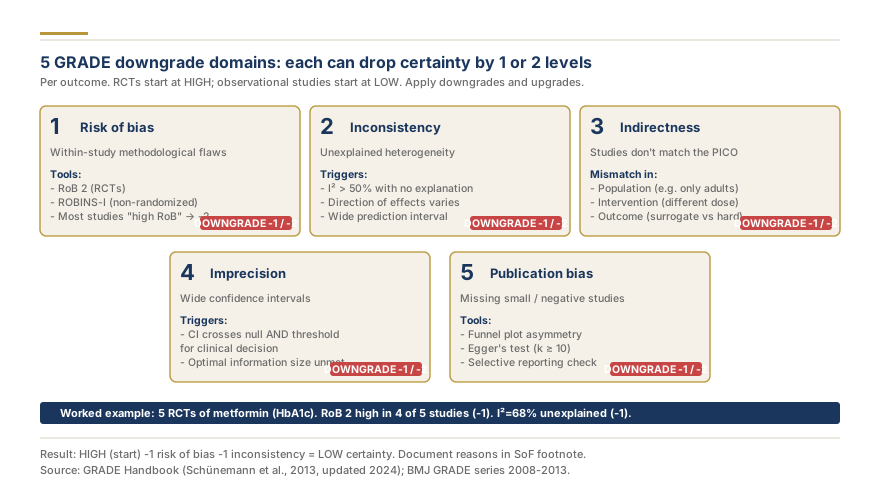
Each GRADE assessment begins at a starting certainty level, High for randomized controlled trials, Low for observational studies, and then evaluates 5 domains that can each lower the certainty by one or two levels. Understanding these GRADE domains is the core skill required for any researcher conducting a systematic review.
Risk of bias is input to GRADE assessment at the domain level. Each domain is assessed as "no serious concern," "serious concern" (downgrade by one), or "very serious concern" (downgrade by two). The total downgrade across all 5 domains determines the final certainty of evidence rating.
Domain 1, Risk of Bias (Study Limitations)
The risk of bias domain evaluates whether the included studies have systematic flaws that could bias the effect estimate. For RCTs, this includes inadequate randomization, lack of blinding, incomplete outcome data, selective reporting, and other sources of bias. For observational studies, this includes confounding, selection bias, measurement error, and missing data.
GRADE assesses risk of bias across the body of evidence, not for individual studies. If most studies contributing to an outcome are at low risk of bias and a single small study is at high risk, the overall domain judgment may still be "no serious concern." Conversely, if the largest and most influential study has critical risk of bias, a downgrade is warranted even if smaller studies are sound.
The most common mistake here is double-counting. If you already assessed risk of bias using RoB 2 or the Newcastle-Ottawa Scale, the GRADE risk of bias domain draws on those results, it does not repeat the assessment. It synthesizes individual study ratings into a single judgment about the body of evidence. Use our risk of bias assessment tool to ensure your individual study assessments are correct before applying GRADE.
Domain 2, Inconsistency (Heterogeneity Across Studies)
The inconsistency domain evaluates whether the results of individual studies point in the same direction and have similar magnitude. When study results vary widely, some showing benefit, others showing harm, or effect sizes ranging from trivial to large, our confidence that the true effect lies near the pooled estimate decreases.
GRADE uses several indicators to assess inconsistency: the direction of effects across studies, the overlap of confidence intervals, statistical heterogeneity measured by I-squared (I-squared measures statistical heterogeneity in meta-analysis), and the results of subgroup analyses exploring the source of variation. An I-squared above 50% raises concern, but the number alone is insufficient, the clinical significance of the variation matters more than the statistical metric.
If heterogeneity can be explained by pre-specified subgroup analyses (for example, studies in children versus adults show different effects, and this difference is clinically plausible), you may decide not to downgrade. Instead, you present subgroup-specific estimates with their own GRADE ratings. Unexplained heterogeneity, however, warrants downgrading.
Domain 3, Indirectness (Generalizability Issues)
The indirectness domain assesses whether the evidence directly answers the review question. Indirectness occurs when the population, intervention, comparator, or outcome in the included studies differs from the question the review is trying to answer.
There are two types of indirectness. Direct indirectness occurs when studies use a proxy outcome instead of the outcome of interest, for example, using bone density as a surrogate for fracture risk. Indirect comparisons occur when you are comparing interventions A and B, but no head-to-head trials exist, so you rely on studies comparing A versus placebo and B versus placebo separately.
Indirectness is the domain most frequently overlooked by novice GRADE users. If your review includes studies conducted exclusively in high-income hospital settings but your review question concerns primary care in low-resource settings, the evidence is indirect even if the studies are perfectly designed.
Domain 4, Imprecision (Wide Confidence Intervals, Few Events)
The imprecision domain evaluates whether the effect estimate is precise enough to support a confident conclusion. Wide confidence intervals that cross clinically important thresholds, for example, an interval that includes both meaningful benefit and meaningful harm, indicate imprecision.
GRADE recommends assessing imprecision using optimal information size (OIS): would the total sample across included studies be large enough to detect a clinically important effect in a single adequately powered trial? If the total sample is smaller than the OIS, or if the confidence interval crosses the threshold for clinical decision-making, downgrade for imprecision.
For dichotomous outcomes, a total event count below 300 is a common threshold for concern. For continuous outcomes, GRADE suggests examining whether the confidence interval includes effects that would lead to different clinical decisions. The key question is whether the data provide enough precision to act on.
Domain 5, Publication Bias (Missing Studies)
The publication bias domain addresses the possibility that studies with null or negative results were never published, skewing the available evidence toward positive findings. A funnel plot detects publication bias by plotting study effect sizes against their precision, asymmetry suggests that small studies with unfavorable results may be missing.
Assessing publication bias is inherently difficult because you are trying to detect what is not there. GRADE recommends considering several factors: funnel plot asymmetry (when at least 10 studies are available), whether the included studies were funded by industry (which has a documented tendency toward selective reporting), whether unpublished data were sought, and whether study registries like ClinicalTrials.gov reveal completed but unreported studies.
In practice, publication bias is the domain where reviewers are most uncertain. When in doubt, GRADE suggests a "suspected" judgment with a downgrade by one level rather than ignoring the concern entirely.
The 3 Upgrade Domains for Observational Studies
Observational studies start at Low certainty in the GRADE framework, but three domains can upgrade the certainty by one or two levels. These upgrade domains are applied only after the 5 downgrade domains have been assessed and only when no downgrade has been applied for any domain, or when the evidence is so compelling that upgrading is justified despite downgrades.
Large magnitude of effect, When the effect size is large (relative risk greater than 2 or less than 0.5 in the absence of plausible confounders), GRADE permits upgrading by one level. Very large effects (RR greater than 5 or less than 0.2) can warrant upgrading by two levels. Evidence from randomized controlled trials starts at High certainty and can be downgraded, while observational evidence starts at Low and can be upgraded if the effect size is large (RR > 2), a dose-response gradient exists, or plausible confounding would reduce the observed effect (Schunemann et al., 2013).
Dose-response gradient, A clear dose-response relationship between exposure and outcome increases confidence that the association is causal. If higher doses consistently produce larger effects in a graded, predictable pattern, the certainty of evidence can be upgraded by one level.
Plausible confounding would reduce the observed effect, If all plausible residual confounders would bias the result toward the null (or toward a smaller effect), but a significant effect is still observed, this strengthens the causal inference. For example, if unmeasured confounders would be expected to reduce the association between smoking and lung cancer, but the association remains strong, confounding actually makes the true effect more likely to be at least as large as observed.
GRADE Framework Certainty of Evidence Levels
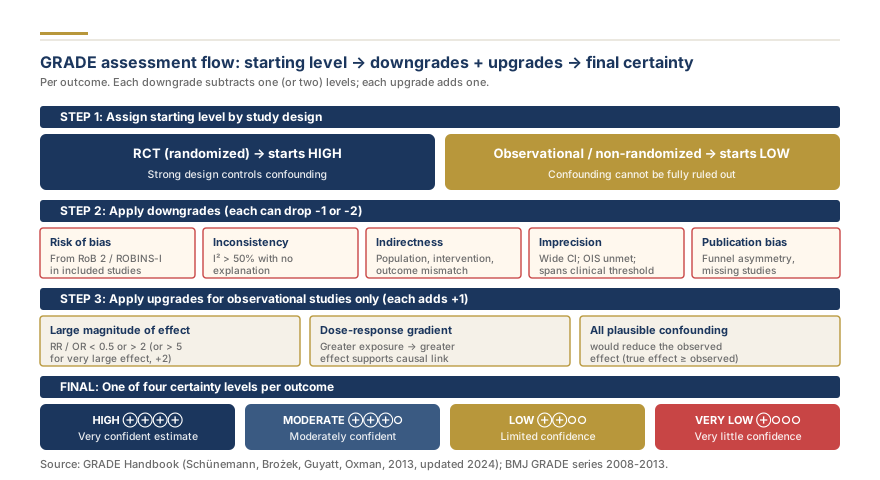
The four certainty of evidence levels represent the endpoint of every GRADE assessment. Each level communicates a specific degree of confidence in the effect estimate, and each has direct implications for how the evidence should be used in decision-making.
| Certainty Level | Definition | What It Means for Decision-Making | Starting Point |
|---|---|---|---|
| High certainty | Very confident that the true effect lies close to the estimate | Strong basis for recommendations; unlikely to change with new research | randomized controlled trials (no downgrades) |
| Moderate certainty | Moderately confident; true effect is likely close to estimate | Reasonable basis for recommendations; new research may change confidence | randomized controlled trials (1 downgrade) or Observational (upgrades) |
| Low certainty | Limited confidence; true effect may be substantially different | Weak basis for recommendations; new research likely to change estimate | Observational (no changes) or randomized controlled trials (2 downgrades) |
| Very low certainty | Very little confidence; true effect likely substantially different | Very weak basis; any estimate is highly uncertain | Multiple downgrades from starting point |
Evidence from randomized controlled trials (RCTs) starts at high certainty and can only move downward through the 5 downgrade domains. Evidence from observational studies starts at low certainty and can move downward through downgrades or upward through the 3 upgrade domains.
The final evidence certainty rating is determined by the cumulative effect of all domain assessments. A body of randomized controlled trial evidence with serious risk of bias and serious imprecision would be downgraded twice, moving from High to Low. Observational evidence with a very large effect size and no downgrades could be upgraded from Low to Moderate or even High, though this is rare in practice.
It is important to note that certainty of evidence is not the same as strength of recommendation. A strong recommendation can be made even with low-certainty evidence when the benefits clearly outweigh the harms, and a weak recommendation may be appropriate even with high-certainty evidence when the balance of benefits and harms is close.
Need expert GRADE assessments for your systematic review? Our methodologists apply the GRADE framework with transparent domain-level justifications and publication-ready Summary of Findings tables. request your free project assessment, or explore our evidence synthesis services.