Risk of bias in a systematic review is a domain-based evaluation of whether systematic errors in study design, conduct, or reporting may distort results. Unlike quality scoring, risk of bias assessment examines specific domains, selection, performance, detection, attrition, and reporting bias, using validated tools such as RoB 2 (for RCTs), ROBINS-I (for non-randomized studies), and the Newcastle-Ottawa Scale (for observational studies).
Every systematic review must include a formal risk of bias assessment of its included studies. The Cochrane Handbook (Higgins et al., 2023, Chapter 8) mandates domain-based evaluation because a single high-risk domain can invalidate an otherwise well-conducted study. Whether you are reviewing randomized controlled trials, cohort studies, or qualitative research, selecting the correct bias assessment tool and applying it consistently determines whether your review's conclusions can be trusted. Need to assess risk of bias? Use our free online risk of bias tool for randomized controlled trials or ROBINS-I assessment tool for non-randomized studies.
Keep your judgements organised in the risk-of-bias worksheets.
Risk of Bias Versus Reporting and Methodological Quality
Risk of bias is not the same as reporting quality or methodological quality. Reporting quality evaluates whether a study describes what was done (assessed by tools like CONSORT or STROBE). Methodological quality is a broader, less precise term that can encompass everything from study design to statistical analysis. Risk of bias specifically asks: did systematic errors in the study's design, conduct, or analysis produce results that deviate from the truth?
The Cochrane Handbook identifies five core bias domains that apply across study designs:
- Selection bias, systematic differences between groups at baseline, caused by flawed randomization or allocation concealment
- Performance bias, systematic differences in care provided to groups, typically caused by lack of blinding of participants and personnel
- Detection bias, systematic differences in how outcomes are measured, caused by lack of blinding of outcome assessors
- Attrition bias, systematic differences in withdrawals and dropouts between groups, leading to incomplete outcome data
- Reporting bias, systematic differences between reported and unreported results, including selective outcome reporting
Each bias domain is assessed independently because problems in one domain can completely undermine a study's findings regardless of how well other domains were handled.
Why Risk of Bias Assessment Matters
Risk of bias assessment directly determines whether your systematic review's conclusions are credible. Without it, readers and guideline developers cannot judge whether the studies supporting your findings are trustworthy.
Three authoritative frameworks require formal risk of bias evaluation. The Cochrane Handbook mandates it for all Cochrane reviews and provides detailed guidance on tool selection and application. PRISMA 2020 (Page et al., 2021) requires authors to describe the risk of bias methods used and present results for each included study. Most peer-reviewed journals now reject systematic reviews that lack risk of bias assessment, making it a practical requirement for publication.
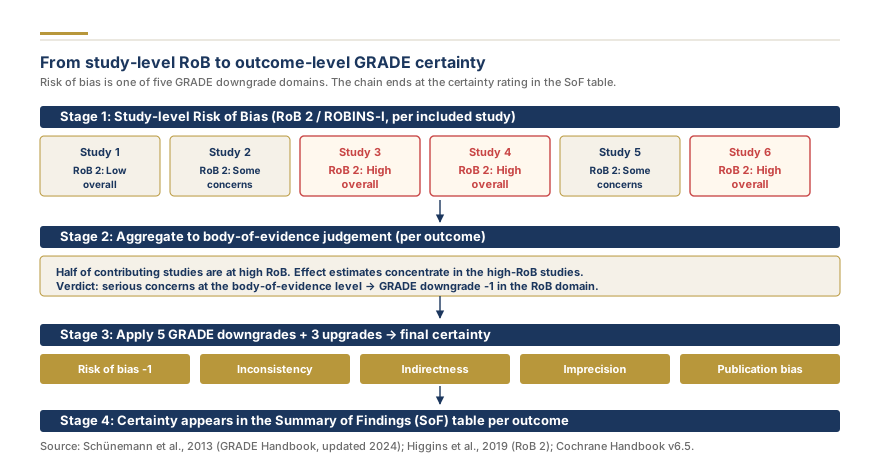
Risk of bias is the first domain evaluated in the GRADE framework for assessing certainty of evidence. When studies contributing to a body of evidence have high risk of bias, GRADE downgrades the certainty of evidence, potentially moving it from "high" to "moderate" or lower. This directly affects whether clinical guidelines classify a recommendation as strong or conditional.
Choosing the Right Risk of Bias Tool
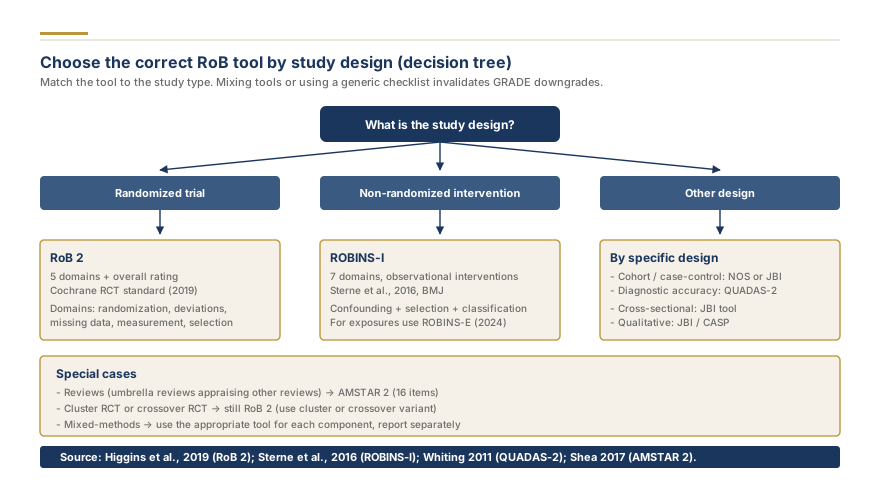
Which risk of bias tool should I use? Use RoB 2 for randomized controlled trials, ROBINS-I for non-randomized studies of interventions, Newcastle-Ottawa Scale for observational cohort and case-control studies, and JBI checklists for qualitative or other study types.
The decision depends entirely on the study design of your included studies. Many systematic reviews include multiple study designs, requiring you to use more than one tool. The table below maps each tool to its intended use:
| Tool | Study Design | Domains Assessed | Scoring Method | Developer |
|---|---|---|---|---|
| RoB 2 | Randomized controlled trials | 5 domains | Low risk / Some concerns / High risk | Cochrane (Sterne et al., 2019) |
| ROBINS-I | Non-randomized studies of interventions | 7 domains | Low / Moderate / Serious / Critical / No information | Cochrane (Sterne et al., 2016) |
| Newcastle-Ottawa Scale | Observational (cohort, case-control) | 3 categories (8 items) | Star-based (max 9 stars) | Wells et al. |
| JBI Checklist | Qualitative, cross-sectional, prevalence, and others | Varies by checklist | Yes / No / Unclear / Not applicable | Joanna Briggs Institute |
RoB 2 -- For Randomized Controlled Trials
RoB 2 (revised Cochrane risk of bias tool) is the standard for assessing randomized controlled trials. It replaced the original Cochrane risk of bias tool in 2019 and provides a more structured, signaling-question-based approach. RoB 2 assesses risk of bias in randomized controlled trials across five domains, each evaluated through a series of signaling questions that guide the assessor to a domain-level judgment.
ROBINS-I -- For Non-Randomized Studies of Interventions
ROBINS-I (Risk Of Bias In Non-randomized Studies of Interventions) was developed for studies that compare health outcomes across groups but lack randomization. ROBINS-I assesses risk of bias in non-randomized studies by evaluating seven domains organized into pre-intervention, at-intervention, and post-intervention categories. Because non-randomized studies lack the built-in protection against confounding that randomization provides, ROBINS-I is necessarily more complex than RoB 2 and demands careful consideration of each study's analytical approach to confounding control. For a full walkthrough, see our ROBINS-I assessment guide.
Newcastle-Ottawa Scale -- For Observational Studies
The Newcastle-Ottawa Scale is widely used for cohort and case-control studies. It is simpler than ROBINS-I and uses a star-based scoring system rather than domain-level judgments. NOS is particularly common in public health and epidemiology reviews where observational designs predominate. Its ease of use makes it accessible to reviewers without extensive methodological training, though this simplicity comes at the cost of less detailed domain-level insight compared to ROBINS-I.
JBI Checklists -- For Qualitative and Other Study Types
The JBI Checklist (Joanna Briggs Institute) provides JBI critical appraisal tools for study types that RoB 2, ROBINS-I, and NOS do not cover. These include qualitative studies, cross-sectional studies, prevalence studies, case reports, and diagnostic accuracy studies. Each checklist is tailored to the methodological features of its target study design. JBI checklists use a Yes/No/Unclear/Not applicable format and are freely available from the JBI website, making them the most versatile option for mixed-methods systematic reviews.
Assessing observational studies? Use our Newcastle-Ottawa Scale calculator or JBI critical appraisal tool.
RoB 2 -- Domain-by-Domain Overview
RoB 2 evaluates five domains for each RCT, with each domain containing signaling questions that lead to a structured judgment. Cochrane Handbook recommends domain-based risk of bias assessment over summary quality scores, because a single high-risk domain can invalidate an otherwise well-conducted study (Higgins et al., 2023, Chapter 8).
Domain 1: Randomization process, This domain evaluates whether the allocation sequence was truly random and whether allocation concealment was adequate. Signaling questions ask whether the sequence was generated using a validated method (computer-generated, random number tables) and whether participants and recruiters could foresee assignments. Inadequate randomization introduces selection bias at baseline.
Domain 2: Deviations from intended interventions, This domain assesses whether participants, caregivers, or study personnel were aware of intervention assignments and whether any deviations from the protocol occurred. Blinding of participants and personnel is the primary safeguard. The domain also considers whether an intention-to-treat analysis was used, which preserves the benefits of randomization even when protocol deviations occur.
Domain 3: Missing outcome data, This domain evaluates whether outcome data were available for all or nearly all randomized participants. High dropout rates, differential attrition between groups, or inappropriate handling of missing data can introduce attrition bias. The signaling questions assess both the proportion of missing data and whether missingness is likely related to the outcome.
Domain 4: Measurement of the outcome, This domain examines whether the method of outcome measurement was appropriate and whether outcome assessors were blinded to intervention status. Subjective outcomes (pain scales, clinician-rated scores) are more vulnerable to detection bias than objective outcomes (mortality, laboratory values).
Domain 5: Selection of the reported result, This domain evaluates whether the reported results were selected from multiple eligible analyses of the data. Reporting bias includes switching primary outcomes, selecting favorable subgroup analyses, or choosing between multiple measurement time points. Pre-registration of protocols (e.g., on ClinicalTrials.gov or PROSPERO) is strong evidence against selective reporting.
Each domain receives a judgment of Low risk, Some concerns, or High risk, reached by answering the domain's signalling questions (Yes, Probably yes, Probably no, No, or No information) and following the tool's algorithm. The overall judgment is Low only when every domain is Low, and it is High when any domain is High. The shorthand "overall follows the worst domain" misses one rule: the RoB 2 guidance (version of 22 August 2019, riskofbias.info) also allows an overall High judgment when a trial raises Some concerns in multiple domains in a way that substantially lowers confidence in the result.
Worked Example: One Trial Assessed With RoB 2
Suppose a review includes a hypothetical trial that randomized 240 adults with chronic low back pain 1:1 to a supervised exercise program or usual care. The result being assessed is self-reported pain on a 0 to 10 numerical rating scale at 12 weeks, and the review team's aim is the effect of assignment to the intervention. The trial report describes a computer-generated sequence, allocation through a central web system, similar baseline characteristics, no crossover between groups, every participant analysed in the group they were randomized to, and a statistical analysis plan finalized before unblinding. Pain data were available for 108 of 120 participants in the exercise group (90.0%) and 96 of 120 in usual care (80.0%), so 204 of 240 overall (85.0%), with no sensitivity analysis for the missing data. Participants knew their allocation and rated their own pain.
| Domain | Signalling questions answered | Domain judgment |
|---|---|---|
| 1. Randomization process | 1.1 Random sequence? Yes. 1.2 Concealed until assignment? Yes. 1.3 Baseline differences suggest a problem? No | Low |
| 2. Deviations from intended interventions | 2.1 Participants aware? Yes. 2.2 Carers and people delivering the intervention aware? Yes. 2.3 Deviations that arose because of the trial context? Probably no (2.4 and 2.5 not applicable). 2.6 Appropriate analysis? Yes (2.7 not applicable) | Low |
| 3. Missing outcome data | 3.1 Data for all or nearly all participants? No (36 of 240 missing, 12 versus 24 by arm). 3.2 Evidence the result was not biased? No. 3.3 Could missingness depend on the true value? Yes. 3.4 Likely that it did? Probably no (reported reasons for dropout were similar across arms and unrelated to health) | Some concerns |
| 4. Measurement of the outcome | 4.1 Method inappropriate? No. 4.2 Could measurement differ between groups? No. 4.3 Assessors aware? Yes (participants self-report). 4.4 Could knowledge have influenced the assessment? Probably yes. 4.5 Likely that it did? Probably no | Some concerns |
| 5. Selection of the reported result | 5.1 Analysed according to a plan finalized before unblinded data were available? Yes. 5.2 Selected from multiple outcome measurements? No. 5.3 Selected from multiple analyses? No | Low |
Two answers decide most of this assessment. In Domain 3, the algorithm gives Some concerns because missingness could depend on pain level but probably did not; had the answer to 3.4 been Probably yes, the domain would be High. Domain 4 works the same way: if participants held strong beliefs about exercise, 4.5 could reasonably be answered Probably yes, which makes the domain High. Write the reason for each of these answers into the support-for-judgment column, because they are the answers a second reviewer is most likely to dispute.
The overall default is Some concerns, because no domain is High and two raise concerns. The reviewers still have to decide whether concerns in two domains substantially lower confidence in this pain result. If they judge that they do, the overall judgment becomes High. Record that reasoning in the risk of bias table, because it decides whether the trial stays in a sensitivity analysis limited to low risk of bias trials, and it feeds the risk of bias domain of GRADE for the pain outcome.
Need comprehensive risk of bias assessment for your systematic review? Our methodologists apply validated tools (RoB 2, ROBINS-I, Newcastle-Ottawa) with dual-reviewer calibration and transparent reporting. get a free ballpark research estimate, or see our professional systematic review support.