The discussion section of a systematic review is where you interpret your findings, explain what they mean for clinical practice and future research, and acknowledge the limitations that affect how confidently readers should act on your results. According to PRISMA 2020 Item 23 (Page et al., 2021), the discussion must include a general interpretation of results in the context of other evidence, a discussion of limitations at both the study and review level, and implications for practice, policy, and future research. The Cochrane Handbook Chapter 15 (Higgins et al., 2023) expands on this by recommending that authors frame their conclusions around the certainty of evidence rather than statistical significance alone. A well-written discussion does not simply restate the results. It contextualizes them, qualifies them, and points toward their practical consequences.
Many researchers find the discussion the hardest section to write because it requires you to move from reporting what you found to arguing what it means. The difference between a mediocre discussion and a strong one is the ability to balance confidence with caution, connecting your findings to the broader evidence base while being transparent about what your review cannot tell us.
Structuring the Discussion for Clarity and Completeness
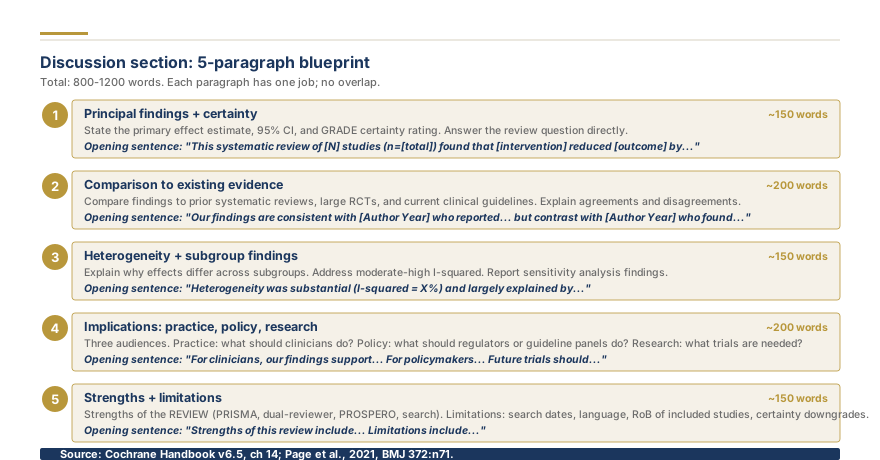
A systematic review discussion typically follows a six-part structure that satisfies both PRISMA 2020 requirements and the expectations of peer reviewers. This structure is not rigid, but deviating from it without good reason invites requests for revision.
1. Summary of main findings. Open with a concise summary of your principal results, stated in plain language. This paragraph should answer your review question directly. If you conducted a meta-analysis, report the pooled effect estimate, its confidence interval, and the direction of the effect. If your review was qualitative, summarize the dominant themes or patterns across included studies. Avoid repeating numbers verbatim from the results section; instead, translate them into a narrative that a non-specialist can follow.
2. Comparison with prior reviews and primary studies. Place your findings alongside existing systematic reviews, meta-analyses, and landmark primary studies on the same topic. Explain whether your results confirm, contradict, or extend what has been reported previously. When your findings differ from earlier reviews, propose explanations: differences in search dates, eligibility criteria, populations studied, or analytical methods. This comparison signals to reviewers that you understand the evidence landscape, not just your own dataset.
3. Strengths of the review. Describe the methodological strengths of your review. These might include a comprehensive search strategy across multiple databases, dual independent screening, pre-registered protocol on PROSPERO, adherence to PRISMA 2020 reporting standards, or the use of validated risk of bias tools. Be specific rather than generic. "We searched six databases without language restrictions" is more convincing than "We conducted a thorough search."
4. Limitations at the study and review level. Discuss limitations at two distinct levels. At the study level, address the quality of the included evidence: were most studies at high risk of bias? Were sample sizes small? Were outcomes measured inconsistently? At the review level, address constraints of your own methodology: were certain databases or grey literature sources excluded? Was the search limited to English-language publications? Could Egger's test for publication bias have flagged small-study effects in the pooled estimate? The Cochrane Handbook recommends separating these two levels because they have different implications for how readers should interpret your conclusions.
5. Implications for practice and policy. Based on the evidence you synthesized and its certainty, what should clinicians, policymakers, or patients do differently? Use GRADE language to calibrate your recommendations. If the certainty of evidence is high, you can make stronger statements. If it is low or very low, frame implications as tentative and conditional. Never overstate what the evidence supports.
6. Implications for future research. Identify the specific gaps your review has revealed. What types of studies are needed? Which populations remain underrepresented? What outcomes should future trials measure? Be concrete. "More research is needed" adds nothing. "A multicenter randomized controlled trial comparing intervention X with active control in adult populations over 12 months, measuring patient-reported outcomes, would address the primary gap identified in this review" gives future researchers a starting point.
This six-part structure aligns with the expectations described in the PRISMA 2020 guidelines and provides a framework that reviewers can follow without confusion.
Framing the Certainty of Evidence with GRADE Language
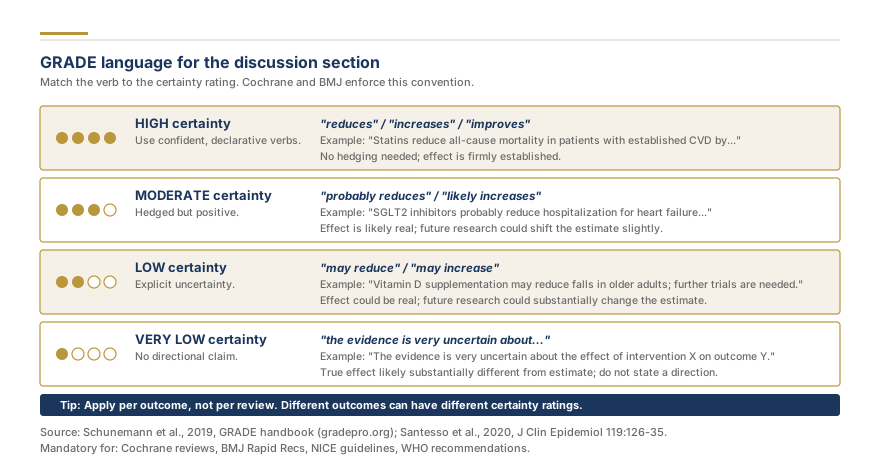
One of the most common mistakes in systematic review discussions is making claims that the evidence does not support. The GRADE framework (Grading of Recommendations, Assessment, Development, and Evaluation) provides a standardized vocabulary for expressing how much confidence you have in your findings, and using it correctly separates competent reviews from excellent ones.
GRADE classifies the certainty of evidence into four levels: high, moderate, low, and very low. Each level carries specific language that should appear in your discussion.
High certainty: "The evidence shows that..." or "Intervention X reduces outcome Y." You can use direct, declarative statements because the evidence is unlikely to change with future research.
Moderate certainty: "Intervention X likely reduces outcome Y" or "The evidence suggests that..." The word "likely" signals that future research may change the estimate, but the direction of the effect is probably correct.
Low certainty: "Intervention X may reduce outcome Y." The word "may" signals substantial uncertainty. Future research is very likely to change the estimate.
Very low certainty: "The evidence is very uncertain about the effect of intervention X on outcome Y." At this level, any statement about the effect is speculative, and the discussion should emphasize the need for higher-quality primary studies.
Using the wrong certainty language is a red flag for peer reviewers. Writing "the evidence clearly demonstrates" when your GRADE assessment is low undermines your credibility and may result in a desk rejection. Conversely, hedging excessively when the evidence is strong makes your review less useful to decision-makers.
You can assess and visualize the certainty of your evidence using the GRADE evidence assessment tool, which walks through each domain (risk of bias, inconsistency, indirectness, imprecision, and publication bias) and generates a summary table for your manuscript.
For a complete introduction to the framework, see our guide to the GRADE framework and certainty of evidence.
Discussing Heterogeneity Without Losing the Reader
Statistical heterogeneity is the variation in effect estimates across included studies that exceeds what chance alone would produce. If your meta-analysis reported an I-squared value, your discussion needs to interpret it. Reviewers expect more than "heterogeneity was high (I-squared = 78%)." They want you to explain why heterogeneity exists and what it means for your conclusions.
Start by reporting the heterogeneity statistic and its magnitude. An I-squared of 0 to 40 percent generally represents low heterogeneity. 40 to 75 percent represents moderate to substantial heterogeneity. Above 75 percent represents considerable heterogeneity (Higgins et al., 2023). But these thresholds are guidelines, not absolute cutoffs. The clinical significance of heterogeneity depends on the context.
Next, explain the likely sources. Clinical heterogeneity arises from differences in patient populations, interventions, comparators, or outcomes. Methodological heterogeneity arises from differences in study design, risk of bias, or measurement approaches. If you conducted subgroup analyses or meta-regression, report whether these analyses identified variables that explained the heterogeneity. Be honest about what remains unexplained.
Finally, address the implications. High heterogeneity does not automatically invalidate a pooled estimate, but it does mean that the average effect may not apply uniformly across all populations or settings. If heterogeneity is substantial, your discussion should caution readers against applying the pooled result without considering local context. You might write: "The pooled effect estimate should be interpreted with caution given the considerable heterogeneity observed (I-squared = 82%, p < 0.01). Subgroup analysis suggested that study setting (hospital versus community) accounted for a portion of this variation, but residual heterogeneity remained unexplained."
Handling Conflicting Results Across Included Studies
Not all systematic reviews produce clean, consistent findings. When individual studies report effects in opposite directions, your discussion needs to address the conflict transparently rather than burying it or dismissing inconvenient results.
Step 1: Acknowledge the conflict directly. State which studies found a positive effect, which found a negative or null effect, and the approximate magnitude of each. Do not ignore outliers.
Step 2: Explore explanations. Differences in study population, intervention dose or duration, comparison group, outcome measurement, follow-up period, and risk of bias can all explain conflicting results. The Cochrane Handbook Chapter 15 recommends examining whether the conflicting studies differ systematically on any of these dimensions. If a single large, well-conducted trial contradicts several smaller, higher-risk studies, the discussion should note that quality-adjusted interpretation may favor the larger trial.
Step 3: Assess whether a pooled estimate is still meaningful. If the conflict is severe, a pooled effect estimate may be misleading. Your discussion should address whether the prediction interval (which captures the range of true effects across settings) is more informative than the pooled point estimate. A prediction interval that crosses the null tells readers that, even though the average effect may favor the intervention, the effect in a new setting could be null or harmful.
Step 4: Frame the conflict as a research gap. Conflicting results are not a failure of your review. They are a finding. Recommend that future primary studies address the specific sources of disagreement you identified.
Struggling with the discussion section? Writing a discussion that balances evidence interpretation, limitations, and clinical implications is one of the most challenging parts of a systematic review. If you need expert support with medical writing or a complete systematic review, Research Gold's team can help at any stage. request your project quote and describe where you are stuck.