PRISMA 2020 guidelines explained item by item, all 27 checklist items, the updated four-phase flow diagram, key changes from 2009, and PRISMA extensions for scoping reviews, diagnostic test accuracy, and network meta-analyses.
Research Gold Team
February 18, 2026
Need a PRISMA-compliant flow diagram? Our free PRISMA Flow Diagram Generator builds a publication-ready four-phase diagram in minutes.
Key Takeaways
PRISMA 2020 (Page et al., 2021) is the updated reporting guideline for systematic reviews and meta-analyses, replacing the original PRISMA 2009 statement
The checklist contains 27 items organized across seven sections: title, abstract, introduction, methods, results, discussion, and other information
Key updates from 2009 include protocol registration requirements, an updated four-phase flow diagram, certainty of evidence assessment via GRADE, and reporting of automation tools
PRISMA 2020 is required by most biomedical journals and is endorsed by the EQUATOR Network as the gold standard for systematic review reporting
The redesigned four-phase flow diagram now separately tracks records from databases versus registers and includes a section for studies retrieved from other methods
Compliance with PRISMA 2020 reduces the risk of desk rejection by demonstrating transparent, complete reporting from the first submission
A free PRISMA flow diagram generator is available on Research Gold to create publication-ready diagrams instantly
The PRISMA 2020 guidelines are the current international standard for reporting systematic reviews and meta-analyses. Published by Page et al. in 2021, the PRISMA 2020 statement replaced the original PRISMA 2009 guidelines that had governed systematic review reporting for over a decade. Every researcher conducting a systematic review must understand these guidelines, not as an afterthought during manuscript preparation, but as a framework that shapes the entire review process from protocol to publication.
In every systematic review we deliver, PRISMA 2020 compliance is our baseline, not an optional extra.
The distinction between a reporting guideline and a methodological guide matters. PRISMA 2020 does not tell you how to conduct a systematic review. It tells you what to report about how you conducted one. The Cochrane Handbook for Systematic Reviews of Interventions (Higgins et al., 2023) provides methodological guidance; PRISMA 2020 ensures that the methods you used are communicated transparently to readers, peer reviewers, and editors.
PRISMA 2020 applies to systematic reviews of interventions, exposures, diagnostic test accuracy, prognosis, and other research questions. It applies whether or not the review includes a meta-analysis. The guidelines are relevant across disciplines, from medicine and public health to psychology, education, and environmental science, wherever systematic reviews are conducted and published.
The EQUATOR Network maintains PRISMA 2020 as part of its library of reporting guidelines and recommends its use by authors, editors, and peer reviewers worldwide. Journals that endorse EQUATOR guidelines, which includes the majority of biomedical journals indexed in MEDLINE, expect submitted systematic reviews to comply with PRISMA 2020.
The 27 Checklist Items Explained
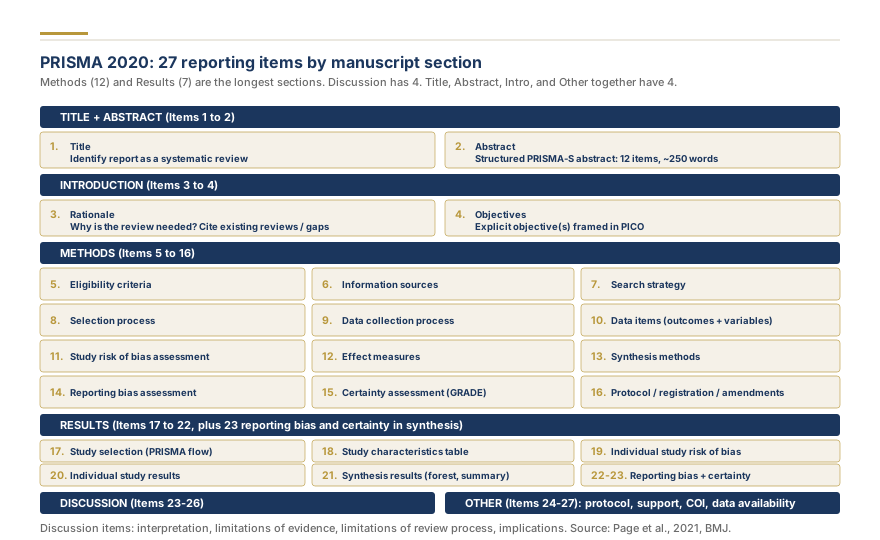
All 27 PRISMA 2020 items by section. Source: Page et al., 2021, BMJ.
The PRISMA 2020 checklist contains 27 items organized across seven sections. Each item specifies a reporting element that should be present in your manuscript, with the corresponding section (title, abstract, introduction, methods, results, discussion, or other information) indicating where the information belongs.
Section 1: Title (Item 1)
Item 1, Title: Identify the report as a systematic review. The title must explicitly state that the manuscript is a systematic review, a meta-analysis, or both. Titles that describe the topic without identifying the study design fail this item. A compliant title reads something like "Effectiveness of cognitive behavioral therapy for insomnia: a systematic review and meta-analysis" rather than simply "Cognitive behavioral therapy for insomnia."
Section 2: Abstract (Item 2)
Item 2, Abstract: Provide a structured summary including background, objectives, data sources, study eligibility criteria, participants, interventions, study appraisal and synthesis methods, results, limitations, conclusions, and registration information. Most journals require structured abstracts for systematic reviews, and PRISMA 2020 specifies what each section should contain.
Section 3: Introduction (Items 3-4)
Item 3, Rationale: Describe the rationale for the review in the context of existing knowledge. This means explaining why the review is needed, whether previous reviews are outdated, conflicting, or nonexistent.
Item 4, Objectives: Provide an explicit statement of the review question using the PICO framework (Population, Intervention, Comparator, Outcome) or an appropriate alternative.
Section 4: Methods (Items 5 to 15)
The methods section spans items 5 to 15, eleven numbered items with sub-items 10a and 10b and 13a to 13f, reflecting PRISMA 2020's emphasis on methodological transparency. This is where most reporting failures occur, and where compliance matters most for peer review.
Item 5, Eligibility criteria: Specify the inclusion and exclusion criteria for the review, including study characteristics (PICO elements) and report characteristics (publication date, language, publication status).
Item 6, Information sources: Describe all information sources searched, including databases, registers, websites, organizations, and reference lists. Specify the date of the last search for each source.
Item 7, Search strategy: Present the full search strategies for all databases, registers and websites, including any filters and limits used. PRISMA 2009 asked for the full electronic strategy for at least one database; PRISMA 2020 extends the requirement to every source searched.
Item 8, Selection process: Specify the methods used to decide whether a study meets the eligibility criteria, including how many reviewers screened each record and each report, whether they worked independently, and what software or automation tools were used.
Item 9, Data collection process: Specify the methods used to collect data from reports, including how many reviewers collected data, whether they worked independently, any processes for obtaining or confirming data from study investigators, and any automation tools used.
Item 10, Data items: List and define all outcomes and other variables for which data were sought, specifying any assumptions and simplifications made.
Item 11, Study risk of bias assessment: Specify the methods used to assess risk of bias in included studies, including which tool was used (such as RoB 2 for randomized trials or ROBINS-I for non-randomized studies), how many reviewers assessed each study, and whether they worked independently.
Item 12, Effect measures: Specify for each outcome the effect measure used (risk ratio, odds ratio, mean difference, etc.) and how it was calculated.
Item 13, Synthesis methods: Describe the processes used to synthesize results, including the statistical model (fixed-effect or random-effects), the method for calculating the summary effect, methods for assessing heterogeneity (such as I-squared and tau-squared), any sensitivity analyses, and subgroup analyses planned a priori. This item also covers narrative synthesis approaches when meta-analysis is not possible.
Item 14, Reporting bias assessment: Describe any methods used to assess the risk of reporting bias across studies, such as funnel plots, Egger's test, or trim-and-fill analysis.
Item 15, Certainty assessment: Describe any methods used to assess certainty (or confidence) in the body of evidence for each outcome, such as the GRADE (Grading of Recommendations, Assessment, Development and Evaluations) approach. This is a new requirement in PRISMA 2020 that was not present in the 2009 version.
Section 5: Results (Items 16 to 22)
Items 16a and 16b, Study selection: Describe the results of the search and selection process, from the number of records identified to the number of studies included, ideally using a flow diagram (16a). Cite studies that might appear to meet the inclusion criteria but were excluded, and explain why they were excluded (16b).
Item 17, Study characteristics: Cite each included study and present its characteristics.
Item 18, Risk of bias in studies: Present the risk of bias assessment for each included study.
Item 19, Results of individual studies: For all outcomes, present for each study the summary statistics for each group (where appropriate) and an effect estimate with its precision, ideally in structured tables or plots such as a forest plot.
Items 20a to 20d, Results of syntheses: Summarize the characteristics and risk of bias of the contributing studies, present every statistical synthesis with its summary estimate, precision and heterogeneity measures, and report the investigations of heterogeneity and the sensitivity analyses.
Item 21, Reporting biases: Present assessments of risk of bias due to missing results for each synthesis assessed.
Item 22, Certainty of evidence: Present assessments of certainty (or confidence) in the body of evidence for each outcome, typically in a GRADE summary of findings table.
Section 6: Discussion (Items 23a to 23d)
Items 23a to 23d, Discussion: Give a general interpretation of the results in the context of other evidence (23a), discuss the limitations of the included evidence (23b) and of the review processes (23c), and discuss implications for practice, policy, and future research (23d).
Section 7: Other Information (Items 24 to 27)
Items 24a to 24c, Registration and protocol: Give the register name and registration number, or state that the review was not registered (24a); say where the protocol can be accessed, or that none was prepared (24b); and describe and explain any amendments to the registration or protocol (24c).
Item 25, Support: Describe sources of financial or non-financial support for the review and the role of the funders or sponsors.
Item 26, Competing interests: Declare any competing interests of the review authors.
Item 27, Availability of data, code and other materials: Report which materials are publicly available and where, such as template data collection forms, data extracted from included studies, data used for analyses, and analytic code.
Changes from PRISMA 2009 to PRISMA 2020
Understanding what changed between the two versions is critical for researchers who learned systematic review methods using the 2009 statement. The following table summarizes the major differences.
Feature
PRISMA 2009
PRISMA 2020
Number of items
27 items
27 items (but content substantially revised)
Protocol registration
One item (protocol and registration)
Items 24a to 24c: register name and number, protocol access, and amendments
Search strategy
Present for at least one database
Present for all databases, with emphasis on full reproducibility
Automation tools
Not addressed
Requires reporting of any automation or machine learning tools used in screening, data extraction, or risk of bias assessment
Certainty of evidence
Not a specific item
Items 15 and 22: methods and results of certainty assessment (for example GRADE)
Flow diagram phases
Four phases (identification, screening, eligibility, included)
Three labelled phases (identification, screening, included), with optional separate columns for databases and registers versus other methods
Data items
Describe data items
List and define all outcomes and variables with assumptions
Reporting bias
Describe and present results
Expanded to include specific methods and tools
Abstract structure
Structured summary
More detailed requirements for abstract content
Amendments to protocol
Not required
Must describe any amendments to the registered protocol
Software and tools
Not addressed
Requires reporting of review management software and any automation
Funding sources
Included studies funding not required
Requires reporting funding sources for both the review and included studies
Several requirements are new compared with 2009, including amendments to the registration or protocol (item 24c), certainty of evidence (items 15 and 22), details of automation tools in the selection process (item 8), and availability of data, code and other materials (item 27). Additionally, several items from 2009 were split, merged, or substantially reorganized to improve clarity and completeness.
The most visible change is the redesigned flow diagram, which drops the separate eligibility phase label and can separately track records identified through database searching versus those identified through other methods such as citation searching, grey literature, or expert consultation.
Need help with your systematic review?
Our team builds comprehensive search strategies, handles screening across databases, and delivers PRISMA 2020-compliant systematic reviews.
The PRISMA flow diagram is perhaps the most recognizable element of PRISMA reporting. The 2020 version introduces a substantially redesigned diagram that provides greater transparency about the identification, screening, and inclusion process.
The boxes run through four steps, grouped under three phase labels on the template (identification, screening, included):
Step 1, Identification: Records are identified from two streams. The first stream captures records identified through database searching (e.g., MEDLINE, Embase, CINAHL) and register searching (e.g., ClinicalTrials.gov, PROSPERO). The second stream captures records identified through other methods, including citation searching, grey literature searching, and contacting experts. Duplicates are removed within each stream before proceeding to screening.
Step 2, Title and abstract screening: Records remaining after duplicate removal are screened by title and abstract. Records excluded at this stage are counted and the total is reported. Records marked as ineligible by automation tools (if used) are reported separately.
Step 3, Full-text assessment (still within the screening phase): Reports sought for retrieval are assessed. Any reports not retrieved are counted. Retrieved reports are assessed for eligibility against the inclusion criteria, and excluded reports are counted with reasons for exclusion categorized and reported.
Step 4, Included: The final number of studies and reports included in the review is presented. If the review includes both new studies and studies from a previous version of the review, these are reported separately.
The arithmetic must be consistent throughout the diagram. The number of records at each stage must reconcile, records identified minus duplicates removed must equal records screened, and so on through each phase. Our free try our prisma flow diagram generator automates this arithmetic to prevent errors that frequently occur in manually constructed diagrams.
Worked Example: A Flow Diagram That Reconciles at Every Box
Suppose a review searched three databases and two trial registers and uses the PRISMA 2020 template for new reviews that searched databases and registers only. Every number below is derived from the box before it.
Box
Calculation
n
Records identified from databases (MEDLINE 1,412; CINAHL 538; Web of Science 1,206)
1,412 + 538 + 1,206
3,156
Records identified from registers (ClinicalTrials.gov 187; WHO ICTRP 95)
187 + 95
282
Duplicate records removed
from the deduplication step
1,071
Records marked ineligible by automation tools; records removed for other reasons
none in this review
0; 0
Records screened
3,156 + 282, minus 1,071
2,367
Records excluded
title and abstract decisions
2,241
Reports sought for retrieval
2,367 minus 2,241
126
Reports not retrieved
full text unobtainable
7
Reports assessed for eligibility
126 minus 7
119
Reports excluded, with reasons
38 wrong population + 29 wrong study design + 21 wrong comparator + 11 wrong outcome + 6 conference abstract only
105
Reports of included studies
119 minus 105
14
Studies included in review
14 reports, 3 of which are secondary reports of trials already counted
11
Three details trip reviewers up. First, the template's footnote asks for the number of records from each database or register where feasible, not only the total. Second, if automation tools excluded records, the Records excluded box should state how many were excluded by a person and how many by the tool. Third, studies and reports are different units: the last two boxes (14 reports, 11 studies) do not match, and they should not be forced to.
The matching results text for item 16a reads: "Searches identified 3,438 records (3,156 from databases and 282 from registers). After removing 1,071 duplicates, 2,367 titles and abstracts were screened and 2,241 were excluded. Of 126 reports sought, 7 could not be retrieved; 119 full-text reports were assessed and 105 were excluded (reasons in Figure 1). Eleven studies, described in 14 reports, were included." Item 16b then asks you to cite the near-miss studies, for example trials excluded only because of the comparator, and to state why each one was excluded.
A correctly completed flow diagram demonstrates the transparency of your search and selection process at a glance. Peer reviewers examine it closely, checking for arithmetic consistency and adequate documentation of exclusion reasons. Missing or inconsistent flow diagrams are among the most common reasons for revision requests in systematic review manuscripts.
Need your systematic review to meet PRISMA 2020 standards? Our methodologists ensure every section of your review, from search documentation to flow diagrams, complies with current reporting guidelines. see how we can help with your project, or see our full our systematic review support.
How to Use the PRISMA 2020 Checklist
Using the PRISMA 2020 checklist effectively requires integrating it into your workflow from the earliest stages of your review, not treating it as a post-hoc documentation exercise. Here is a practical approach.
Start at the protocol stage. Before you begin your review, download the PRISMA 2020 checklist and familiarize yourself with every item. Use PRISMA-P (Preferred Reporting Items for Systematic review and Meta-Analysis Protocols) to guide your protocol, then transition to PRISMA 2020 for the final manuscript. This two-stage approach ensures continuity from protocol to publication.
Complete items as you write each section. As you draft each section of your manuscript, open the corresponding checklist items and verify that you have included the required information. For the methods section, this means checking Items 5 through 16 as you write your eligibility criteria, information sources, search strategy, and synthesis methods. Do not wait until the manuscript is complete, by then, gaps are harder to fill.
Record page and line numbers. The PRISMA 2020 checklist includes a column for recording the page number where each item is reported. Fill this column as you write. When you submit the checklist as supplementary material (as most journals require), editors and reviewers can immediately locate each item in your manuscript.
Use the expanded checklist for meta-analyses. If your review includes a meta-analysis, pay special attention to items 13a to 13f (synthesis methods), item 19 (results of individual studies), items 20a to 20d (results of syntheses), and item 21 (reporting biases). These items require detailed reporting of statistical models, heterogeneity measures, and any quantitative sensitivity or subgroup analyses.
Verify flow diagram consistency. Before submission, independently verify that every number in your flow diagram is arithmetically consistent. The most common errors are: duplicates removed not reconciling with records screened, exclusion reasons not summing to total exclusions, and mismatches between full-text screening numbers and eligibility assessment totals.
Address not-applicable items. If a checklist item does not apply to your review, for example, reporting bias assessment when you have fewer than 10 studies, explicitly state that the item is not applicable and explain why. Leaving items blank suggests omission rather than intentional exclusion.
PRISMA Extensions: PRISMA-ScR, PRISMA-DTA, PRISMA-NMA, and PRISMA-P
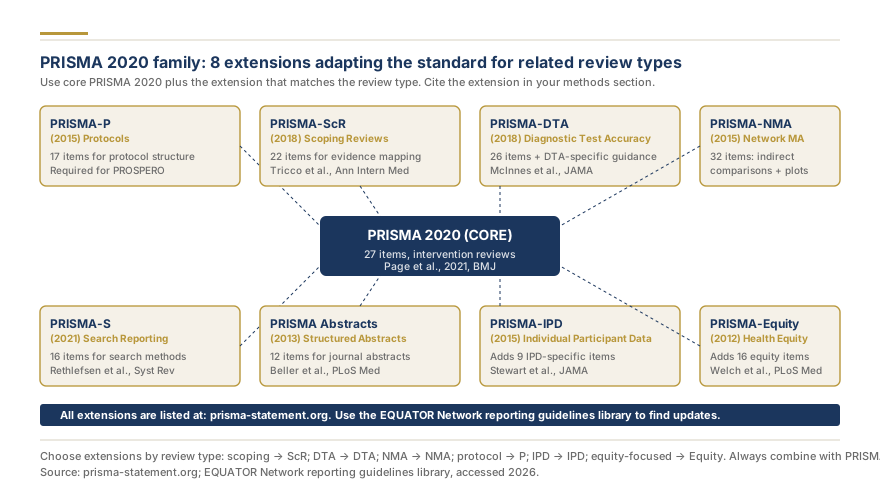
PRISMA family: 8 extensions for related review types. Source: prisma-statement.org; EQUATOR Network.
PRISMA 2020 is the core statement for systematic reviews of interventions and exposures, but several extensions address specific review types that require additional or modified reporting items.
PRISMA-ScR (Scoping Reviews): Published by Tricco et al. (2018), PRISMA-ScR provides a 22-item checklist specifically designed for scoping reviews. Scoping reviews differ from systematic reviews in purpose (mapping evidence rather than answering a specific question), methodology (broader inclusion criteria, no risk of bias assessment), and output (descriptive rather than quantitative synthesis). Using PRISMA 2020 for a scoping review is incorrect, use PRISMA-ScR instead. Our PRISMA-ScR checklist guide provides a detailed walkthrough of each item, and our free PRISMA-ScR checklist tool helps you track compliance.
PRISMA-DTA (Diagnostic Test Accuracy): PRISMA-DTA extends the core PRISMA statement for systematic reviews of diagnostic test accuracy studies. These reviews have unique methodological requirements, paired forest plots of sensitivity and specificity, summary ROC curves, and quality assessment using QUADAS-2, that the standard PRISMA checklist does not adequately address.
PRISMA-NMA (Network Meta-Analysis): Network meta-analyses compare multiple interventions simultaneously using both direct and indirect evidence. PRISMA-NMA extends the reporting requirements to cover network geometry, transitivity assessment, ranking of interventions, and the presentation of network diagrams and contribution matrices.
PRISMA-P (Protocols): PRISMA-P provides a 17-item checklist for systematic review protocols. Using PRISMA-P at the protocol stage and PRISMA 2020 at the reporting stage creates a complete documentation chain from planning through publication. PRISMA-P covers items specific to protocols, such as the planned timeline, team roles, and amendments procedures, that are not relevant in the final manuscript report.
PRISMA-S (Search Reporting): PRISMA-S is a more recent extension that elaborates on the search reporting requirements within PRISMA 2020 Item 7. It provides a 16-item checklist specifically for documenting the search strategy, including database selection rationale, search validation, and peer review of the search (using tools such as PRESS, Peer Review of Electronic Search Strategies).
Each extension is maintained by the EQUATOR Network and updated independently. Researchers should identify which PRISMA extension applies to their specific review type before beginning the manuscript, as retrofitting compliance is more difficult and error-prone than building it in from the start.
Working on a scoping review instead? Use our free PRISMA-ScR Checklist Tool to ensure your scoping review meets reporting standards.
Common PRISMA 2020 Compliance Mistakes
These compliance failures come up again and again in peer review, and each is avoidable.
Incomplete search strategy reporting. Item 7 requires the full search strategies for all databases, registers and websites, including every search term, Boolean operator, field tag, and filter. Many authors provide only a summary or list of keywords. Reviewers who cannot reproduce your search will question the comprehensiveness of your identification process.
Missing or inconsistent flow diagram. The flow diagram is often constructed hastily at the end of the writing process, leading to arithmetic errors. Numbers that do not reconcile across phases signal carelessness to reviewers. Use our try our prisma flow diagram generator to eliminate arithmetic inconsistencies.
No protocol registration. Item 24a requires the register name and registration number, or a statement that the review was not registered. Reviews that were not prospectively registered should acknowledge this as a limitation. Journals increasingly expect PROSPERO registration for systematic reviews, and failure to register, or failure to report registration, weakens the manuscript.
Omitting certainty of evidence assessment. PRISMA 2020 items 15 and 22 require that authors describe their method for assessing certainty of evidence (typically GRADE) and present the results. This was not required in PRISMA 2009, and many researchers trained on the earlier version overlook it. The GRADE approach assesses the certainty of evidence across five domains: risk of bias, inconsistency, indirectness, imprecision, and publication bias.
Incomplete risk of bias reporting. Item 11 requires specification of the risk of bias tool used, and item 18 requires presentation of the assessment for each included study. Presenting only a summary table without individual study assessments is insufficient. Individual study-level risk of bias results, ideally in a traffic-light plot or summary figure, are expected.
Ignoring reporting bias assessment. Items 14 and 21 address reporting bias, the systematic non-publication or selective reporting of study results. When 10 or more studies are included in a meta-analysis, funnel plots and statistical tests (Egger's test, Begg's test) should be reported. When fewer than 10 studies are included, authors should explain why these assessments were not conducted rather than simply omitting them.
Vague exclusion reasons. The flow diagram requires reasons for excluding full-text reports, and item 16b asks you to cite near-miss studies with the reason each was excluded. Reasons such as "did not meet inclusion criteria" are uninformative. Specific reasons, wrong population, wrong intervention, wrong outcome, wrong study design, wrong publication type, allow readers to assess whether potentially relevant studies were inappropriately excluded.
Failing to report automation tools. PRISMA 2020 explicitly requires reporting of any automation or machine learning tools used during the review process. If you used Covidence, Rayyan, ASReview, or any other tool for screening, data extraction, or risk of bias assessment, this must be reported. Many researchers use these tools but neglect to mention them in the manuscript.
PRISMA 2020 and Journal Requirements
Understanding how journals enforce PRISMA 2020 helps researchers prepare manuscripts that pass editorial screening on the first submission. The relationship between PRISMA 2020 and journal requirements determines whether compliance is advisory or mandatory for your target publication.
Most biomedical journals indexed in MEDLINE endorse the EQUATOR Network reporting guidelines, which means they expect, and many explicitly require, PRISMA 2020 compliance for submitted systematic reviews. Journals such as The BMJ, The Lancet, JAMA, and Annals of Internal Medicine require a completed PRISMA checklist as supplementary material at submission. Cochrane Reviews follow an adapted version of PRISMA 2020 integrated into the Cochrane format.
Some journals conduct formal PRISMA compliance checks during editorial screening, rejecting manuscripts that fail to meet minimum reporting standards before they even reach peer review. This desk rejection can be avoided entirely by ensuring PRISMA 2020 compliance before submission.
Even journals that do not formally require the checklist will evaluate your manuscript against PRISMA standards during peer review. Reviewers trained in systematic review methodology use PRISMA as their assessment framework, and missing items will appear as revision requests. Proactive compliance eliminates these preventable revision rounds.
For researchers targeting high-impact journals, PRISMA 2020 compliance signals methodological rigor and familiarity with current reporting standards. Combined with prospective protocol registration in PROSPERO and adherence to the Cochrane Handbook methodology, PRISMA compliance positions your manuscript competitively for journals that receive far more submissions than they can publish.
Our guide to writing a systematic review step by step covers how PRISMA 2020 integrates with the broader systematic review workflow, from formulating the research question through submission. And for researchers who want professional support with PRISMA-compliant manuscript preparation, our systematic review writing support delivers completed manuscripts with full PRISMA 2020 checklists, flow diagrams, and risk of bias assessments ready for journal submission.
Researchers updating an older review should also read our summary of what changed in PRISMA 2020 to catch the reporting-item revisions from the 2009 statement.
Pro Tip
Use PRISMA-P at protocol stage, PRISMA 2020 at reporting stage
PRISMA-P (Preferred Reporting Items for Systematic review and Meta-Analysis Protocols) guides your protocol, while PRISMA 2020 guides your final manuscript. Using both at the appropriate stage ensures comprehensive reporting throughout your project.
Pro Tip
Complete the checklist page-by-page as you write
Rather than filling the checklist after drafting your manuscript, complete each section of the PRISMA 2020 checklist as you write the corresponding section. This prevents omissions and makes revision easier.
Pro Tip
Use our flow diagram generator for accuracy
Manual flow diagram construction introduces transcription errors. Use Research Gold's free PRISMA flow diagram generator to produce accurate, publication-ready diagrams with correct arithmetic across all four phases.
Frequently Asked Questions
6
Most biomedical journals require PRISMA 2020 compliance for systematic reviews and meta-analyses. Even when not explicitly mandated, editors and peer reviewers evaluate manuscripts against PRISMA standards, making compliance effectively necessary for publication.
PRISMA 2020 adds four new items not present in the 2009 version, reorganizes existing items for clarity, introduces a redesigned four-phase flow diagram, and requires reporting on protocol registration, certainty of evidence, and automation tools used during the review process.
Yes. The PRISMA 2020 flow diagram is a required component of compliant reporting. It visually documents the flow of records through identification, screening, eligibility assessment, and inclusion, allowing readers to assess the completeness and transparency of your search and selection process.
No. Scoping reviews should use PRISMA-ScR (PRISMA Extension for Scoping Reviews), which is specifically designed for the different methodology and reporting needs of scoping reviews. PRISMA 2020 is intended for systematic reviews with or without meta-analysis.
Most journals require the completed PRISMA 2020 checklist as supplementary material uploaded alongside your manuscript during submission. Some journals request it embedded in the cover letter or as a separate file. Check your target journal's author guidelines for specific instructions.
Yes. PRISMA 2020 covers both systematic reviews and meta-analyses. When a meta-analysis is included, additional checklist items related to synthesis methods, heterogeneity assessment, and certainty of evidence become especially relevant.
Share
Found this useful? Share it with your colleagues.
Need help with your systematic review?
Our team builds comprehensive search strategies, handles screening across databases, and delivers PRISMA 2020-compliant systematic reviews.
Building Your Search Strategy? We Can Run the Whole Review.
From protocol to PRISMA flow diagram, our PhD team handles database searches, screening, data extraction, and a publication-ready manuscript. Every step, done right.
Our promise: Free rework on search, screening, or synthesis if reviewers push back.
4.9 / 5Quote within a few hoursPRISMA 2020 + Cochrane HandbookPhD methodologistConfidential by default
Research Gold Team is our group of PhD methodologists and statisticians who deliver our systematic review, meta-analysis and statistical analysis work. The same team writes and checks the guides and tools on this site.
Research Gold's systematic review service delivers PRISMA 2020-compliant manuscripts with completed checklists, flow diagrams, and risk of bias assessments. Start your project today.
Building Your Search Strategy? We Can Run the Whole Review.
From protocol to PRISMA flow diagram, our PhD team handles database searches, screening, data extraction, and a publication-ready manuscript. Every step, done right.
EQUATOR Network explained: what it is, how to find the right reporting guideline for your study design, and which checklist applies to each type of research.
Complete PRISMA-ScR checklist guide covering all 22 reporting items, PRISMA-ScR vs PRISMA 2020 differences, flow diagram requirements, and compliance strategies to avoid desk rejection of your scoping review.
PRISMA flow diagram template, 2020 vs 2009 differences, tools to build it, numbers to report, exclusion reasons, and common errors to avoid before submission.