How to Write a Systematic Review Abstract: PRISMA Checklist and Examples
A complete guide to writing a systematic review abstract using the PRISMA 2020 Abstract Checklist, with before-and-after examples, template sentences for each section, journal word count limits, and the 12 reporting items every abstract must include.
Research Gold Team
April 8, 2026
Preparing your systematic review for journal submission? Research Gold ensures your abstract, methods, and results meet every PRISMA 2020 reporting requirement. Get a free quote for expert manuscript support.
Key Takeaways
The PRISMA 2020 Abstract Checklist contains 12 items that every systematic review abstract must address, including objectives, eligibility criteria, information sources, risk of bias tool, included study count, synthesis results, limitations, registration number, and funding.
Structured abstracts with labeled sections (Objectives, Methods, Results, Conclusions) are required by most biomedical journals, while unstructured formats are accepted by some social science and humanities journals.
Journal word limits range from 250 to 400 words. Eliminate filler phrases, combine eligibility criteria with the research question, and report only the primary outcome to stay within the limit.
Registration information, funding source, and risk of bias assessment method are the three most commonly omitted items in systematic review abstracts, according to Beller et al. (2013).
Write the abstract last, after completing the full manuscript, to ensure consistency between abstract figures and full-text results.
Conference abstracts and journal abstracts serve different purposes. Conference abstracts may present preliminary results and allow more words, while journal abstracts must report final results with complete PRISMA compliance.
A systematic review abstract is a structured summary that reports the objectives, methods, results, and conclusions of a systematic review in approximately 250 to 350 words. The PRISMA 2020 Abstract Checklist, published by Page et al. (2021), specifies 12 reporting items that every systematic review abstract must address, including the review question, eligibility criteria, information sources, risk of bias assessment, number of included studies, synthesis results, limitations, registration number, and funding. Writing a strong abstract matters because it is the single most-read section of any published paper, it determines whether journal editors send your manuscript for peer review, and it is the only content indexed in full by PubMed, Cochrane Library, and other databases. Researchers who follow the PRISMA abstract checklist produce abstracts that are more complete, more transparent, and more likely to survive peer review without requests for revision.
The 12 Items on the PRISMA 2020 Abstract Checklist
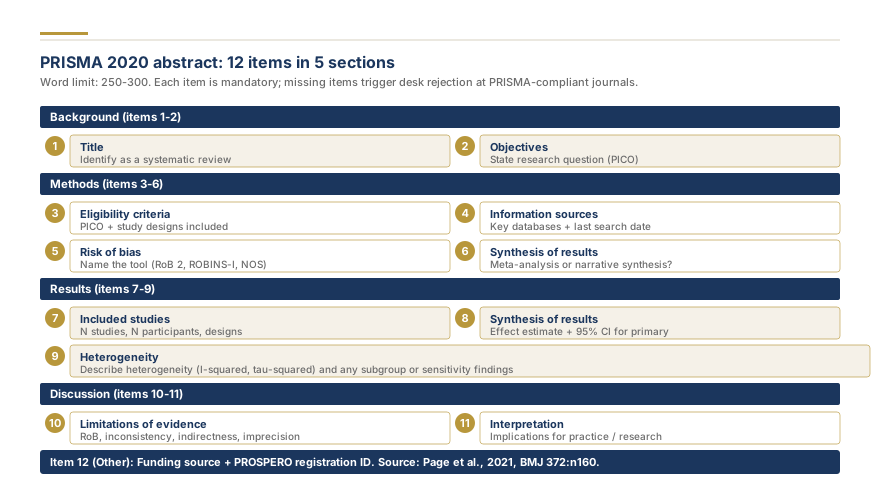
All 12 items are mandatory at PRISMA-compliant journals. Source: Page et al., 2021, BMJ 372:n160.
The PRISMA 2020 statement, authored by Page et al. (2021) and endorsed by hundreds of journals worldwide, includes a dedicated abstract checklist with 12 reporting items organized across six domains. Each item corresponds to a specific piece of information that readers, reviewers, and database indexers need to evaluate your review at a glance.
Item 1: Title. Identify the report as a systematic review, a meta-analysis, or both. The word "systematic review" must appear in the title. If you conducted quantitative pooling, add "and meta-analysis" as well.
Item 2: Objectives. State the research question using a structured format such as PICO (Population, Intervention, Comparison, Outcome). Be specific enough that readers understand exactly what the review aimed to answer.
Item 3: Eligibility criteria. Describe the inclusion criteria for studies: types of participants, interventions or exposures, comparators, outcomes, and study designs. Mention any restrictions such as language or date limits.
Item 4: Information sources. Name the databases searched and the date of the most recent search. At minimum, report the specific databases (for example, PubMed, Embase, Cochrane CENTRAL) and the search date range.
Item 5: Risk of bias assessment. Specify the tool or tools used to assess risk of bias in included studies, such as the Cochrane Risk of Bias 2 (RoB 2) tool for randomized trials or the Newcastle-Ottawa Scale for observational studies.
Item 6: Included studies. Report the number of studies and participants included in the review. If the review includes a meta-analysis, state the number of studies contributing to each pooled estimate.
Item 7: Synthesis of results. Present the main results of the review, including summary effect estimates with confidence intervals and measures of statistical heterogeneity (such as the I-squared statistic). For narrative syntheses, summarize the direction and consistency of findings.
Item 8: Limitations. Describe the main limitations of the evidence, such as risk of bias across studies, imprecision, inconsistency, indirectness, or publication bias. Also note any limitations of the review process itself.
Item 9: Interpretation. Provide a general interpretation of the results in the context of other evidence and the implications for practice, policy, or future research.
Item 10: Funding. Specify the primary funding source for the review, or state that no specific funding was received.
Item 11: Registration. Provide the registration number (typically from PROSPERO) and, if available, the protocol DOI or URL. Learn how to register your review in our PROSPERO step-by-step guide.
Item 12: Systematic review methods. Briefly describe the methods used for data synthesis, such as random-effects meta-analysis, narrative synthesis, or a specific synthesis framework.
These 12 items apply to every systematic review abstract regardless of journal, specialty, or whether the review includes a meta-analysis. Beller et al. (2013) first demonstrated that systematic review abstracts frequently omit critical information, and the PRISMA 2020 abstract checklist was designed to close those gaps.
Structured Versus Unstructured Abstract Formats
Journals differ in how they want you to organize your abstract, and understanding the format before you begin writing prevents wasted revision time.
Structured abstracts use labeled sections, typically Background, Objectives, Methods, Results, and Conclusions. Most medical and health sciences journals require structured abstracts because they force authors to address each domain explicitly. The Cochrane Database of Systematic Reviews uses a structured format with standardized headings, and journals such as The BMJ, JAMA, and The Lancet follow similar conventions.
Unstructured abstracts present the same information in a single flowing paragraph without section headings. Some social science, education, and interdisciplinary journals prefer this format. Even without headings, you must still cover all 12 PRISMA abstract checklist items. The difference is organizational, not substantive.
How to choose the right format. Always check your target journal's author guidelines before drafting. Look for three pieces of information: (1) whether the abstract must be structured or unstructured, (2) the maximum word count, and (3) whether the journal specifies its own heading labels. Never assume one journal's format applies to another.
Mapping PRISMA items to structured headings. If your journal requires a structured abstract, the mapping is straightforward. The Objectives heading covers PRISMA items 1 and 2. The Methods heading covers items 3, 4, 5, and 12. The Results heading covers items 6 and 7. The Conclusions heading covers items 8 and 9. Registration and funding (items 10 and 11) are usually placed at the end of the abstract or in a separate line below it, depending on journal requirements.
Word Count Limits by Journal and How to Stay Within Them
One of the most common challenges when writing a systematic review abstract is fitting all 12 PRISMA items into a tight word limit. Here are the typical limits for major journals and practical strategies for staying within them.
Journal word count reference table. The BMJ allows up to 250 words for structured abstracts. JAMA permits 350 words. The Lancet allows 300 words. Cochrane reviews allow up to 400 words. PLoS Medicine allows 300 words. The Annals of Internal Medicine allows 275 words. Most specialty journals fall between 200 and 350 words. Always verify the current limit in the author guidelines because journals update requirements periodically.
Strategy 1: Eliminate filler phrases. Remove introductory padding such as "In this systematic review, we aimed to" and replace it with a direct statement: "This systematic review assessed." Cut phrases like "it is well known that" or "there is a growing body of evidence suggesting." Every word in an abstract must carry information.
Strategy 2: Combine eligibility criteria with the research question. Instead of devoting separate sentences to objectives and eligibility criteria, merge them. For example: "We searched for randomized controlled trials comparing cognitive behavioral therapy with pharmacotherapy for generalized anxiety disorder in adults." This single sentence addresses objectives, study design, intervention, comparison, condition, and population.
Strategy 3: Report only the primary outcome in the abstract. If your review assessed five outcomes, report the primary outcome with full statistical detail (effect estimate, confidence interval, I-squared) and mention secondary outcomes only as supporting text. Reserve detailed secondary outcome reporting for the full-text results section.
Strategy 4: Use numerals for all numbers. Most journals allow numerals in abstracts even when style guides require words for numbers below ten in the main text. Writing "7 studies" instead of "seven studies" saves characters that accumulate across the abstract.
Strategy 5: Front-load each sentence with the most important information. Place the key finding or method at the beginning of the sentence, not at the end. This writing pattern makes the abstract scannable and allows you to trim trailing qualifications if you need to cut words.
What to Include in Each Section: Template Sentences
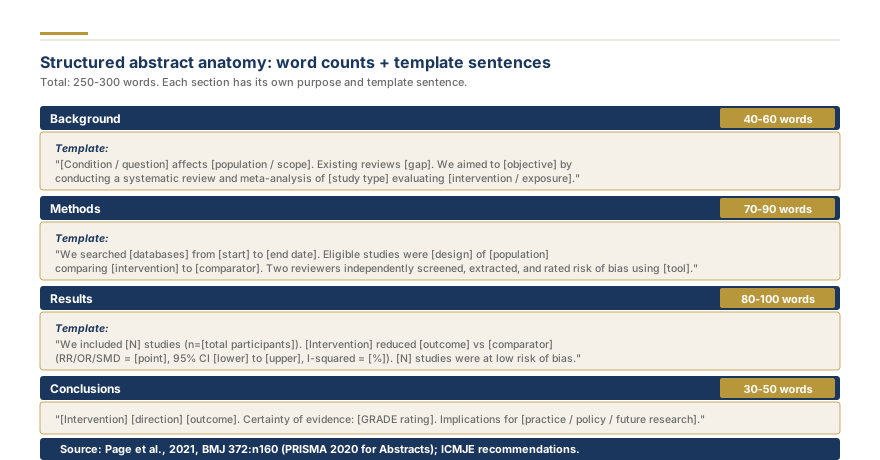
Total 250-300 words. Source: Page et al., 2021, BMJ 372:n160; ICMJE recommendations.
Template sentences give you a starting framework that you can customize for your specific review. Below are field-tested sentence structures organized by abstract section.
Objectives
Template: "This systematic review [and meta-analysis] aimed to evaluate the [effectiveness/safety/diagnostic accuracy] of [intervention] compared with [comparator] for [outcome] in [population]."
Example: "This systematic review and meta-analysis aimed to evaluate the effectiveness of mindfulness-based stress reduction compared with usual care for reducing anxiety symptoms in adults with chronic pain."
Methods
Search strategy template: "We systematically searched [database names] from inception to [date] using terms related to [key concepts]."
Eligibility template: "We included [study designs] that enrolled [population] and compared [intervention] with [comparator], reporting [outcome] as [primary/any] outcome."
Risk of bias template: "Risk of bias was assessed using the [tool name]."
Registration template: "The protocol was registered on PROSPERO ([registration number])."
Results
Screening template: "The search identified [number] records, of which [number] studies ([number] participants) met the inclusion criteria."
Synthesis template for meta-analysis: "Pooled analysis showed a [statistically significant/non-significant] [direction of effect] in [outcome] (effect estimate: [value]; 95% confidence interval: [lower] to [upper]; I-squared: [value]%; [number] studies)."
Synthesis template for narrative reviews: "Findings from [number] studies consistently indicated that [summary of direction and consistency], although [note about heterogeneity or evidence quality]."
Conclusions
Template: "[Intervention] [appears to/does not appear to] [effect] [outcome] in [population]. The certainty of evidence is [high/moderate/low/very low] due to [reasons]. Future research should [specific recommendation]."
Funding and Registration
Template: "This review was funded by [source] and registered on PROSPERO (registration number: [CRD number])."
If no funding was received: "No specific funding was received for this review. Protocol registration: PROSPERO [CRD number]."
Need help with your systematic review?
Our team builds comprehensive search strategies, handles screening across databases, and delivers PRISMA 2020-compliant systematic reviews.
Before-and-After Examples: Weak Versus Strong Abstracts
Seeing concrete examples of weak and strong abstracts makes the PRISMA checklist tangible. The examples below illustrate the most common problems and how to fix them.
Weak Abstract Example
"Background: Type 2 diabetes is a growing global health problem. Many interventions have been studied. We did a systematic review of exercise for diabetes. Methods: We searched PubMed. We included relevant studies. Results: Exercise was found to be beneficial. The results were significant. Conclusions: Exercise should be recommended for patients with diabetes."
What is wrong. This abstract violates at least 9 of the 12 PRISMA items. It does not state a specific objective using PICO. It names only one database. It does not mention eligibility criteria, risk of bias assessment, the number of included studies, effect estimates with confidence intervals, limitations, registration, or funding. The language is vague ("relevant studies," "beneficial," "significant") and provides no quantitative detail.
Strong Abstract Rewrite
"Objectives: This systematic review and meta-analysis evaluated the effect of structured aerobic exercise programs on glycated hemoglobin (HbA1c) levels in adults with type 2 diabetes compared with usual care. Methods: We searched PubMed, Embase, Cochrane CENTRAL, and CINAHL from inception to January 2026. We included randomized controlled trials enrolling adults aged 18 years or older with type 2 diabetes, comparing supervised aerobic exercise programs of at least 8 weeks duration with usual care or no intervention, and reporting HbA1c as a primary or secondary outcome. Risk of bias was assessed using the Cochrane RoB 2 tool. Data were pooled using a random-effects model. The protocol was registered on PROSPERO (CRD42025012345). Results: From 3,847 records screened, 24 randomized controlled trials (1,892 participants) met inclusion criteria. Pooled analysis showed that structured aerobic exercise significantly reduced HbA1c compared with usual care (mean difference: -0.45%; 95% confidence interval: -0.62 to -0.28; I-squared: 58%; 24 studies). Subgroup analysis indicated larger reductions with supervised sessions exceeding 150 minutes per week. Conclusions: Structured aerobic exercise programs reduce HbA1c in adults with type 2 diabetes, with moderate certainty of evidence. Limitations include high heterogeneity in exercise protocols and reliance on self-reported adherence in 8 studies. No specific funding was received."
What improved. Every one of the 12 PRISMA items is addressed. The objective uses PICO structure. Four databases are named with a search date. Eligibility criteria specify study design, population, intervention characteristics, comparator, and outcome. The risk of bias tool is named. The number of screened records and included studies with participant counts are reported. The pooled effect estimate includes the mean difference, 95% confidence interval, I-squared value, and study count. Limitations are specific. Registration and funding are stated.
Struggling to get your systematic review abstract past peer review? Research Gold's medical writing team specializes in preparing systematic review manuscripts that meet PRISMA 2020 reporting standards, from abstract through discussion. If your abstract keeps getting flagged for incomplete reporting, get pricing for your project and let our specialists polish it for submission.
The Strong Abstract Annotated by PRISMA Item
A before-and-after example shows you what good looks like, but it does not show you why each sentence earns its place. Annotating a compliant abstract against the 12 PRISMA-for-Abstracts items turns the example into a self-audit template you can hold your own draft against. The bracketed numbers below map each clause to its checklist item.
Effect of structured exercise on glycaemic control in type 2 diabetes: a systematic review and meta-analysis[Item 1: identify as a systematic review and meta-analysis in the title]
Background: Exercise is widely recommended for type 2 diabetes, but the pooled effect on HbA1c across trial designs is uncertain. [Item 2: objectives / question]Methods: We searched MEDLINE, Embase, and CENTRAL from inception to March 2026 [Item 5: information sources and date] for randomized controlled trials of structured exercise of at least 12 weeks versus usual care in adults with type 2 diabetes. [Items 3 and 4: eligibility criteria] Two reviewers screened and extracted data independently, and risk of bias was assessed with RoB 2. [Item 6: risk of bias] Data were pooled with a random-effects model. [Item 7: synthesis methods]
Results: Of 3,847 records, 24 trials (1,892 participants) were included. [Item 8: included studies; Item 9: characteristics] Structured exercise reduced HbA1c by a mean difference of -0.45% (95% CI -0.62 to -0.28; I-squared = 58%). [Item 10: synthesis of results with effect estimate, interval, and heterogeneity] Most trials were at low or some-concern risk of bias; results were robust to exclusion of high-risk trials. [Item 11: risk of bias across studies]
Discussion: Structured exercise produces a clinically meaningful reduction in HbA1c, though moderate heterogeneity suggests the effect varies by exercise type. [Item 12: interpretation and limitations]Funding: No external funding. Registration: PROSPERO CRD42026XXXXXX. [Funding and registration]
Run your own abstract through this map. The most commonly dropped items are Item 6 (risk of bias), which authors omit to save words, and Item 10's heterogeneity statistic, which is often cut to "a significant reduction" without the I-squared value. If any bracketed item has no corresponding sentence in your draft, that is precisely where a reviewer or editor will mark it incomplete. For the registration number itself, see our PROSPERO registration walkthrough.
Conference Abstract Versus Journal Abstract: Key Differences
Researchers often need to write two versions of their systematic review abstract: one for a conference submission and one for the eventual journal manuscript. These serve different purposes and follow different rules.
Conference abstracts are typically longer. Many conferences allow 400 to 500 words because the abstract is the complete presentation of your work, not a summary of a longer manuscript. The Cochrane Colloquium and the Campbell Collaboration annual meetings allow structured abstracts up to 500 words. Medical conferences such as the American Heart Association and the European Society of Cardiology typically allow 400 words.
Conference abstracts may present preliminary results. If your review is still in progress, a conference abstract can report results from a partial search or ongoing data extraction. Journal abstracts must present final, complete results. Never submit a journal abstract with preliminary data.
Conference abstracts do not require registration numbers. While including your PROSPERO number is good practice, most conferences do not mandate it. Journal abstracts increasingly require registration information, and many journals will not send your manuscript for review without it.
Tables and figures in conference abstracts. Some conferences allow a small table or figure within the abstract (for example, a miniature forest plot generator tool). Journal abstracts almost never permit visual elements; all information must be conveyed in text.
Conversion strategy. When converting a conference abstract into a journal abstract, start by checking the target journal's word limit and format requirements. Trim preliminary language, add final results with complete statistical reporting, include the registration number and funding statement, and ensure all 12 PRISMA items are covered. Do not simply copy your conference abstract into the journal submission.
Struggling to get your systematic review abstract past peer review? Research Gold's medical writing team specializes in preparing systematic review manuscripts that meet PRISMA 2020 reporting standards, from abstract through discussion. If your abstract keeps getting flagged for incomplete reporting, request a quote and let our specialists polish it for submission.
What NOT to Include in a Systematic Review Abstract
Knowing what to leave out is just as important as knowing what to include. Overloading an abstract with unnecessary detail wastes precious word count and distracts from the essential information.
Do not include a literature review. The abstract is not the place to explain why your topic is important with background citations. A single sentence establishing clinical context is sufficient. Save the detailed rationale for the introduction section of your manuscript.
Do not list all secondary outcomes. If your review assessed six outcomes, report the primary outcome with full statistical detail. Mention secondary outcomes briefly or omit them entirely from the abstract. Readers who want secondary outcome data will read the full text.
Do not include individual study results. An abstract reports the synthesized findings of the review, not the results of specific included studies. Statements like "Smith et al. (2023) found a significant reduction" belong in the results section of the manuscript, not the abstract.
Do not include methodological justifications. Do not explain why you chose a random-effects model over a fixed-effect model, why you selected RoB 2 instead of another tool, or why you restricted your search to specific databases. State what you did; explain why in the methods section.
Do not include clinical recommendations beyond the evidence. The abstract conclusion should interpret the findings, not issue treatment guidelines. Avoid statements like "Clinicians should immediately adopt this intervention." Instead, state what the evidence supports and note the certainty level.
Do not repeat the title verbatim. The first sentence of your abstract should not simply restate the title. The title identifies the topic; the abstract provides the substance.
For a comprehensive understanding of the full PRISMA 2020 reporting framework beyond the abstract, see our detailed PRISMA 2020 guidelines guide.
Step-by-Step Process for Writing Your Abstract
Writing the abstract should be the last step in manuscript preparation, not the first. Follow this sequence to produce a complete, accurate abstract efficiently.
Step 1: Write the full manuscript first. Your abstract must accurately reflect the content of your manuscript. Writing the abstract before the manuscript introduces the risk of inconsistencies between the abstract and the full text, which peer reviewers will flag immediately.
Step 2: Open the PRISMA 2020 Abstract Checklist. Download the checklist from the PRISMA website or use the build a PRISMA flow diagram to ensure your reporting is complete. Check off each of the 12 items as you draft your abstract.
Step 3: Draft the methods section of the abstract first. Methods are the most information-dense section and the most likely to exceed your word budget. By drafting methods first, you can allocate remaining words to results and conclusions.
Step 4: Insert your key quantitative results. Copy the exact effect estimates, confidence intervals, and heterogeneity statistics from your results section. Do not round differently in the abstract than in the full text. Inconsistencies between abstract and manuscript figures are a common reason for peer review revisions.
Step 5: Write the objectives sentence. Now that you have your methods and results drafted, write an objectives statement that matches what was actually done, not what was originally planned. If your review scope evolved during the process, the abstract must reflect the final scope.
Step 6: Write the conclusions. Conclusions should directly answer the research question stated in the objectives. Match the strength of your conclusion to the certainty of the evidence. A review with high risk of bias and high heterogeneity should not conclude with strong clinical recommendations.
Step 7: Add registration, funding, and limitations. These items are frequently omitted under word count pressure. Prioritize them. Beller et al. (2013) found that registration information was missing from over 50% of systematic review abstracts, and the PRISMA 2020 checklist was specifically designed to address this gap.
Step 8: Verify word count and format. Count your words against the journal's limit. If you are over, apply the trimming strategies from the word count section above. Verify that your headings match the journal's required labels exactly.
Most journals require systematic review abstracts between 250 and 350 words. The BMJ allows 250, JAMA allows 350, The Lancet allows 300, and Cochrane reviews allow up to 400. Always check author guidelines for your target journal before drafting.
The original PRISMA statement (2009) did not provide a separate abstract checklist. The PRISMA 2020 update introduced a dedicated 12-item abstract checklist that explicitly addresses registration, funding, risk of bias tools, and limitations.
Yes. The PRISMA 2020 Abstract Checklist lists registration information as item 11. Including your PROSPERO number signals methodological transparency and allows readers to verify pre-registration. Many journals require it as a submission condition.
It depends on the journal. Some social science and humanities journals accept unstructured abstracts. Most biomedical journals require structured abstracts with labeled sections. Regardless of format, all 12 PRISMA items should be addressed.
According to Beller et al. (2013), the most frequently omitted items are registration information, funding source, risk of bias assessment method, limitations of the evidence, and the number of participants across included studies.
A systematic review abstract summarizes the synthesis of multiple studies, reporting databases searched, number of studies identified and included, synthesis method, and pooled effect estimates. Primary research abstracts focus on sample size, study design, and original measurements.
Share
Found this useful? Share it with your colleagues.
Need help with your systematic review?
Our team builds comprehensive search strategies, handles screening across databases, and delivers PRISMA 2020-compliant systematic reviews.
Building Your Search Strategy? We Can Run the Whole Review.
From protocol to PRISMA flow diagram, our PhD team handles database searches, screening, data extraction, and a publication-ready manuscript. Every step, done right.
Our promise: Free rework on search, screening, or synthesis if reviewers push back.
4.9 / 5Quote within a few hoursPRISMA 2020 + Cochrane HandbookPhD methodologistConfidential by default
Research Gold Team is our group of PhD methodologists and statisticians who deliver our systematic review, meta-analysis and statistical analysis work. The same team writes and checks the guides and tools on this site.
Building Your Search Strategy? We Can Run the Whole Review.
From protocol to PRISMA flow diagram, our PhD team handles database searches, screening, data extraction, and a publication-ready manuscript. Every step, done right.
The methods section of a systematic review must describe your eligibility criteria, information sources, search strategy, selection process, data collection, risk of bias assessment, effect measures, synthesis methods, reporting bias assessment, and certainty assessment. This guide walks through every PRISMA 2020 methods item with templates, example paragraphs, and common reviewer criticisms to avoid.
Complete PRISMA-ScR checklist guide covering all 22 reporting items, PRISMA-ScR vs PRISMA 2020 differences, flow diagram requirements, and compliance strategies to avoid desk rejection of your scoping review.
PRISMA 2020 guidelines explained item by item, all 27 checklist items, the updated four-phase flow diagram, key changes from 2009, and PRISMA extensions for scoping reviews, diagnostic test accuracy, and network meta-analyses.