PROSPERO registration is the process of submitting your systematic review protocol, including your research question PICO, search strategy, eligibility criteria, and analysis plan, to the international prospective register of systematic reviews maintained by the Centre for Reviews and Dissemination (CRD) at the University of York. Registration is free, records publish after automated checks and approval by every listed author (often within days on the platform launched in February 2025), and your record receives a unique PROSPERO registration number (for example CRD420261444111) that journals and peer reviewers use to verify your review was planned before results were known.
| Question | Answer |
|---|---|
| How much does PROSPERO registration cost? | Nothing, it is free |
| How long does PROSPERO registration take? | Records publish after automated checks and approval by all listed authors, often within a few days |
| What is a PROSPERO number? | A unique identifier (CRD42XXXXXXX) cited in your abstract, methods, and PRISMA flow diagram |
| When should I register? | After your protocol is final, before title and abstract screening begins |
| Who runs PROSPERO? | Centre for Reviews and Dissemination, University of York, funded by NIHR |
| What does it cover? | Health-related systematic reviews |
The most common registration problem is registering after screening has already begun, which triggers the retrospective flag and weakens the credibility of an otherwise sound protocol. This guide walks through every field with weak versus strong examples so you get it right the first time. If you are still deciding where to register, start with how PROSPERO compares with other registries, including OSF, INPLASY and journal protocol articles.
Draft what you will register from the protocol template for registration.
How PROSPERO Compares to Other Registries
The purpose of protocol registration is straightforward: by recording your research question, methods, and analysis plan before you see the data, you demonstrate that your conclusions were not shaped by results. This transparency is the foundation of credible evidence synthesis. Every evidence synthesis protocol, whether for a systematic review, scoping review, or rapid review, benefits from prospective registration.
PROSPERO passed 300,000 registered protocols in 2025, with researchers registering worldwide. Each registration receives a unique identifier (for example CRD420261444111) that you cite in your manuscript abstract, methods section, and PRISMA flow diagram. Journals, peer reviewers, and guideline developers use this identifier to verify that your review was planned prospectively.
| Feature | PROSPERO | OSF Preregistration | Cochrane CDSR |
|---|---|---|---|
| Focus | Health-related systematic reviews | Any study type, any discipline | Cochrane systematic reviews only |
| Cost | Free | Free | Requires Cochrane author team |
| Scope | Protocols only | Protocols + data + materials | Full protocol + completed review |
| Approval time | Days (automated checks, then author approval) | Immediate | Months (editorial process) |
| Unique ID | CRD42XXXXXXX | DOI-based | Cochrane DOI |
For a complete overview of the protocol development process that feeds into registration, see our systematic review protocol guide.
Why You Should Register on PROSPERO
PROSPERO registration prevents outcome-switching, demonstrates methodological rigor to journals, and reduces duplication of effort across the research community. A systematic review requires protocol registration to establish credibility before results are known.
Prevents outcome-switching. When you register your primary outcomes, analysis methods, and eligibility criteria before screening, you create a public record that reviewers can check. If your published review deviates from the registered protocol without documented amendments, peer reviewers will flag it, and rightly so. Prospective registration eliminates the suspicion that you adjusted your methods after seeing which results looked favorable.
Demonstrates rigor to journals. Many high-impact journals, including BMJ, The Lancet, JAMA, and all Cochrane publications, either require or strongly recommend PROSPERO registration. Submitting a manuscript with a PROSPERO ID signals to editors that your review followed established methodological standards. Even journals that do not mandate registration view it favorably during peer review.
Reduces duplication. Before starting a new systematic review, researchers are expected to search PROSPERO CRD for ongoing reviews on the same topic. The ability to register systematic review protocols publicly is one of PROSPERO's most important contributions to research transparency. Your registration helps the broader community avoid duplicating effort, and it helps you identify potential collaborators working on similar questions. To check the published literature at the same time, run your topic through our systematic review topic checker, which also lists registered trials that have not finished yet.
Strengthens your peer review defense. When reviewers question your methodology, pointing to a prospectively registered protocol is one of the strongest responses available. The protocol was locked in before you had results, that is difficult to argue with.
For guidance on structuring the research question that anchors your registration, see our our guide to pico framework guide.
When to Register on PROSPERO
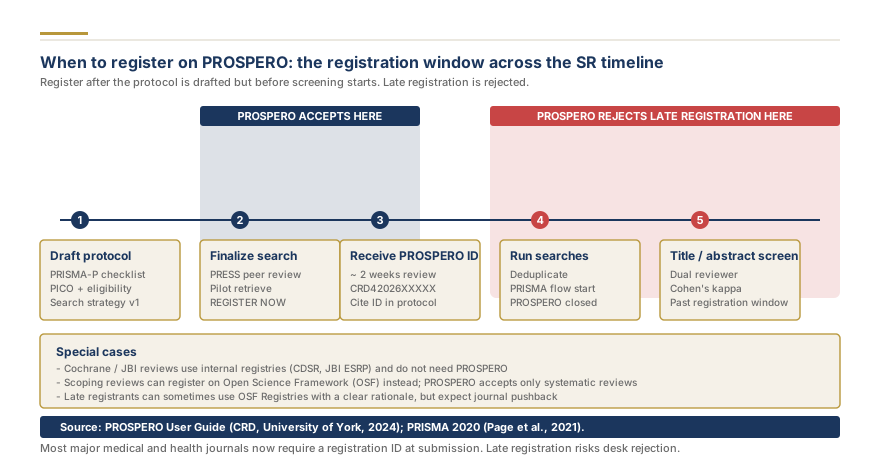
You should register your systematic review on PROSPERO after finalizing your protocol but before beginning title and abstract screening. This is the optimal window, your methods are set, but you have not yet been exposed to study results that could bias your approach.
Before screening begins (prospective). The gold standard. CRD explicitly designed PROSPERO for prospective registration, recording your plan before you encounter the evidence. Registrations submitted before screening carry no flags or caveats.
After screening has started (retrospective). If you register after screening has begun, CRD will flag your registration as retrospective. This flag appears publicly on your PROSPERO record and in any exports. While retrospective registration is still better than no registration at all, it weakens your methodological credibility because it cannot rule out the possibility that results influenced your protocol decisions. PROSPERO registration should occur before study screening begins, retrospective registrations are flagged by CRD, indicating that the protocol was finalized after seeing study results (CRD, University of York).
Cochrane reviews. If you are conducting a Cochrane systematic review, your protocol is registered through the Cochrane Database of Systematic Reviews (CDSR) rather than PROSPERO. Cochrane has its own editorial and registration process. Do not register a Cochrane review on PROSPERO.
Data extraction or later. If you have already begun data extraction or analysis, PROSPERO does not accept the registration. At that stage, register the protocol on the Open Science Framework instead and explain the timing in your methods section.
Want your PROSPERO registration handled professionally? Our team writes and submits complete protocol registrations, including search strategy documentation and methodology sections that satisfy reviewers. arrange a free research project discussion, or see our systematic review registration support.
Step-by-Step PROSPERO Registration Walkthrough
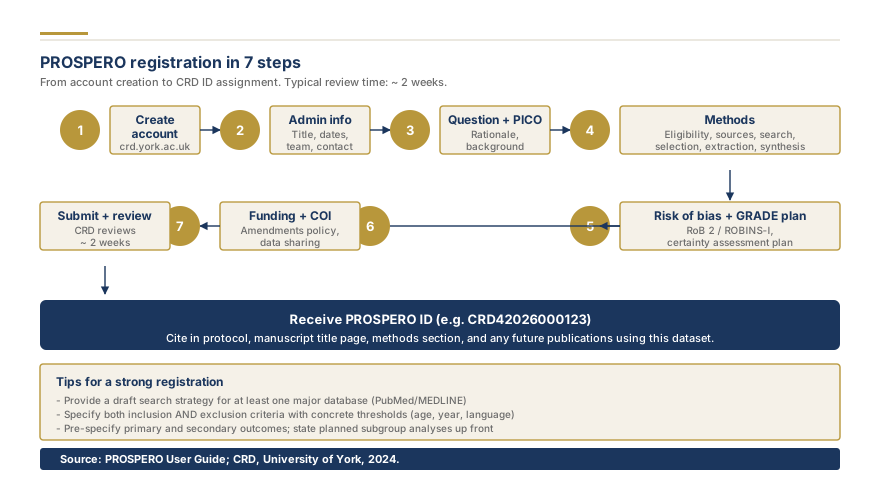
The PROSPERO registration form was restructured when the new platform launched on 24 February 2025. It now asks for a rationale for the review and explicit review objectives, splits each eligibility element into included and excluded entries, and adds dedicated fields for the selection (screening) process, reporting bias assessment, certainty (GRADE) assessment, peer review status, and a designated review guarantor. The fields still map to the PRISMA-P protocol checklist (Shamseer et al., 2015), covering the complete methodological plan for the systematic review. Below is a field-by-field walkthrough of the 10 major steps.
Before you open the registration form, draft every field in the right structure with our PROSPERO protocol formatter. When each section reads well, you can paste it straight into the registry.
Step 1, Create a PROSPERO Account
Navigate to crd.york.ac.uk/prospero and click "Register." You will need an institutional email address, your ORCID (recommended but not required), and your institutional affiliation. Account creation takes approximately five minutes. Once your account is confirmed via email, you can log in and begin a new registration.
If you already have a PROSPERO account from a previous registration, use the same credentials. Multiple registrations can be managed from a single account.
Step 2, Start a New Registration
After logging in, click "New Registration" from your dashboard. PROSPERO will ask whether your review has already started screening. Answer honestly, selecting "Yes" when screening is underway triggers the retrospective flag. Selecting "No" when screening has not begun ensures your registration is marked as prospective.
You will also confirm that your review is health-related. If it is not, PROSPERO will redirect you to alternative registries such as OSF.
Step 3, Review Title, Rationale, and Objectives (PICO)
Enter your review title exactly as it will appear in your manuscript. The title should be descriptive and include key terms that help other researchers find your registration when checking for duplication.
For your research question, use the PICO framework (Population, Intervention, Comparator, Outcome) for intervention reviews. Scoping reviews are among the review types PROSPERO does not accept, so register those on the Open Science Framework instead. The form asks for a short rationale (why the review is needed now), your review objectives, and eligibility criteria entered as separate included and excluded entries for each element. Be specific: "Adults aged 18+ with type 2 diabetes" is stronger than "Patients with diabetes."
The PICO framework structures research questions for PROSPERO registration, each element maps to a dedicated registration field. For detailed guidance on constructing your PICO, see our our guide to pico framework guide.
Step 4, Anticipated Start and Completion Dates
Enter the date you plan to begin screening (or have already begun, if registering retrospectively) and your anticipated completion date. These dates help CRD track the progress of registered reviews and allow other researchers to gauge when your results might become available.
Be realistic. Systematic reviews typically take 6–18 months from protocol to submission. If your timeline changes, you can update these dates through the amendment process.
Step 5, Search Strategy Details
Describe your search strategy in sufficient detail that another researcher could replicate it. This includes:
- Databases: List every database you plan to search (e.g., MEDLINE via PubMed, Embase, CINAHL, Cochrane CENTRAL, PsycINFO, Scopus). List ALL databases, omitting one that you later search raises questions about post-hoc additions.
- Search terms: Provide your key search terms, Boolean operators, and any controlled vocabulary (MeSH terms, Emtree terms). You do not need to paste full search strings, but enough detail to demonstrate rigor.
- Date restrictions: State any date limits on your search and justify them.
- Language restrictions: Specify whether you will include non-English studies and how you will handle translation.
- Grey literature: Describe any plans to search grey literature sources (conference abstracts, theses, government reports, clinical trial registries).
- Pilot search date: Include the date you ran your pilot search. This demonstrates that your strategy has been tested and refined.
For help building an effective search strategy protocol, see our Boolean search strategy guide.
Step 6, Eligibility Criteria (Inclusion/Exclusion)
State your eligibility criteria clearly and completely. PROSPERO provides fields for both inclusion and exclusion criteria. Structure these around your PICO elements:
| PICO Element | Inclusion Example | Exclusion Example |
|---|---|---|
| Population | Adults aged 18+ with diagnosed type 2 diabetes | Children, type 1 diabetes, gestational diabetes |
| Intervention | Structured exercise programs (aerobic, resistance, or combined) | Pharmacological interventions without exercise |
| Comparator | Usual care, no intervention, or alternative exercise | Studies without a comparator group |
| Outcome | HbA1c change, fasting blood glucose | Studies not reporting glycemic outcomes |
| Study design | randomized controlled trials and quasi-experimental studies | Case reports, cross-sectional studies, reviews |
Be explicit about study design restrictions. If you are including only randomized controlled trials, state it. If you are including observational studies, specify which types (cohort, case-control, cross-sectional).
Step 7, Data Extraction Plan
Describe what data you will extract from included studies and how. PROSPERO expects you to specify:
- Data items: List the variables you will extract (study characteristics, participant demographics, intervention details, outcome measures, effect sizes, confidence intervals).
- Extraction method: State whether you will use a standardized form, piloted on a subset of studies, with independent extraction by two reviewers.
- Disagreement resolution: Describe how discrepancies between extractors will be resolved (discussion, third reviewer, consensus).
The data extraction plan is one of the fields reviewers examine most closely. A vague description ("Data will be extracted") is insufficient. Specify the tool or form you will use and the process for ensuring accuracy.
Step 8, Risk of Bias Approach
Name the specific risk of bias tool you will use. Do not write "An appropriate tool will be used", name it explicitly:
| Review Type | Recommended Tool | Reference |
|---|---|---|
| RCTs | Cochrane Risk of Bias tool (RoB 2) | Sterne et al., 2019 |
| Non-randomized studies | ROBINS-I | Sterne et al., 2016 |
| Observational (cohort/case-control) | Newcastle-Ottawa Scale (NOS) | Wells et al. |
| Diagnostic accuracy | QUADAS-2 | Whiting et al., 2011 |
| Qualitative studies | CASP Qualitative Checklist | CASP, 2018 |
The current form asks you to pick your tool from a list, with a free-text option if yours is missing. Specify how many reviewers will independently assess risk of bias, how disagreements will be resolved, and how results will be presented (summary table, traffic light plot, or both). The data collection section also asks two related questions: how you will assess reporting bias (risk of bias due to missing results, for example funnel plots and Egger's test) and whether you will rate the certainty of the evidence, typically with GRADE. Answer both explicitly rather than leaving them blank. The risk of bias approach is a critical field, vague answers here are the single most common reason CRD requests revisions to a registration.
Step 9, Synthesis Method (Narrative or Meta-Analysis)
Describe your planned synthesis method. If you plan a meta-analysis, specify:
- Effect measure: Risk ratio, odds ratio, mean difference, standardized mean difference, or hazard ratio.
- Model: Fixed-effect or random-effects (and justify your choice).
- Heterogeneity assessment: I-squared statistic, Cochran Q test, prediction intervals.
- Subgroup analyses: Pre-specify any planned subgroup analyses and the rationale for each.
- Sensitivity analyses: Describe what sensitivity analyses you will conduct (e.g., excluding high risk-of-bias studies, excluding outliers).
- Publication bias: State whether you will assess publication bias (funnel plot, Egger test) and the minimum number of studies required.
If a meta-analysis is not feasible (due to high heterogeneity or insufficient studies), describe your narrative synthesis approach. The Synthesis Without Meta-analysis (SWiM) reporting guideline (Campbell et al., 2020) provides a useful framework. For a detailed walkthrough of meta-analysis methodology, see our complete guide to meta-analysis.
Step 10, Review and Submit
Before submitting, review every field for completeness and consistency. Common issues that delay CRD approval include:
- Inconsistencies between the PICO fields and the eligibility criteria
- Vague risk of bias descriptions that do not name a specific tool
- Missing databases in the search strategy field
- Eligibility criteria that do not specify study design restrictions
Once you are satisfied, submit the record. The platform runs automated completeness checks, compares your submission against existing registrations to flag similar reviews, and then emails every listed team member asking them to approve the record. Once all authors approve, the record is published, often within days, and you receive your unique PROSPERO registration number (for example CRD420261444111).