A boolean search strategy systematic review is a structured method of combining search terms using logical operators, AND, OR, and NOT, to retrieve relevant studies from bibliographic databases. It maps each element of a research question to a set of synonyms and controlled vocabulary terms, then intersects those sets to produce a comprehensive, reproducible list of citations for screening. Modern AI literature review tools can then accelerate title-and-abstract screening. Take that citation list into a free screening tool for your search results to sift includes from excludes.
The search strategy is the single most consequential methodological decision in a systematic review. A poorly constructed search misses relevant studies, introduces bias, and undermines every downstream step, from screening to meta-analysis. A well-constructed Boolean search strategy retrieves the evidence base with high sensitivity while keeping the volume manageable for screening. In our systematic reviews, we build search strategies across 3-5 databases, the most common client error we see is searching only PubMed and missing 20-40% of relevant studies indexed only in Embase or CINAHL.
This guide walks through every component of building your search strategy: Boolean operators, PICO mapping, database-specific syntax, cross-database translation, advanced techniques, and PRISMA-compliant documentation. Whether you are conducting your first review or refining an existing protocol, you will leave with a search strategy that meets Cochrane standards and satisfies peer reviewers.
Record your finished search string in the search-strategy log template.
Why Systematic Review Searches Need Boolean Structure
The PICO framework structures research questions into Population, Intervention, Comparison, and Outcome. A Boolean search strategy translates each PICO element into a block of search terms, then combines those blocks using AND to find studies that address the full research question. This systematic approach ensures that the search is comprehensive, transparent, and reproducible, three requirements that distinguish a systematic review search from an ad hoc literature search (Higgins et al., 2023).
A comprehensive literature search is defined by its sensitivity: the ability to retrieve all or nearly all relevant studies on a topic. The Cochrane Handbook for Systematic Reviews of Interventions states that searches must be "as comprehensive as possible" to minimize bias (Higgins et al., 2023). Boolean logic provides the mechanism: OR operators broaden the search within each concept block, while AND operators narrow the intersection between blocks, producing a result set that is both comprehensive and focused.
If you are still developing your review protocol, see our PROSPERO registration guide for how to register your search strategy before execution.
Boolean Operators Explained
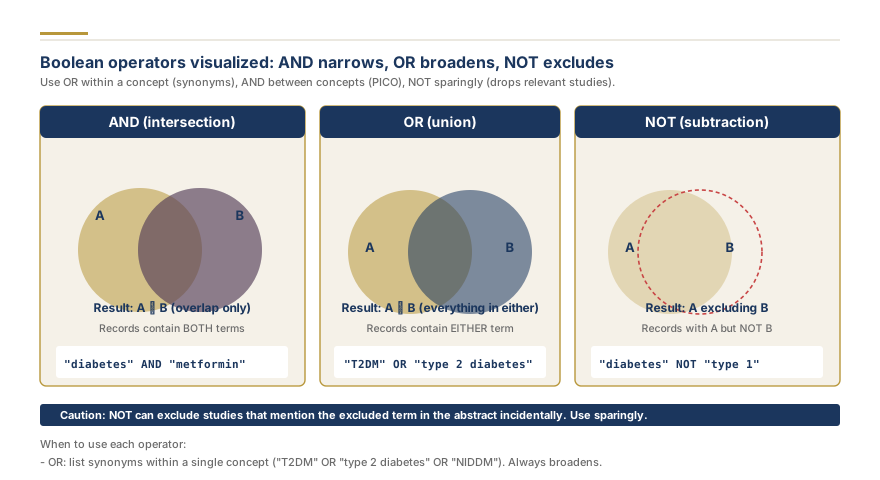
Boolean operators are the logical connectors that tell a database how to combine your search terms. There are three primary operators, OR, AND, and NOT, plus parentheses that control the order of operations. Understanding how each operator affects your result set is essential before you write a single search line.
Test each operator as you go: the interactive Boolean search builder assembles your concept blocks into a database-ready search string.
OR, Expanding Within a Concept
The OR operator combines synonyms and related terms within a single concept block. It tells the database to retrieve records containing any of the listed terms. OR always increases the number of results because it adds alternative terms to the search.
For example, if your Population is children, your OR block might be: children OR adolescents OR pediatric OR paediatric OR youth OR minors. A record needs to contain only one of these terms to be retrieved. The more synonyms you include, the more sensitive your search becomes.
In systematic review searching, OR is used within each PICO element. Every synonym, spelling variant, and related term for a given concept is connected with OR. This is the single most important principle in systematic review search construction: exhaustive synonym coverage within each concept block.
AND, Intersecting Between Concepts
The AND operator intersects two or more concept blocks. It tells the database to retrieve only records that contain at least one term from each block. AND always reduces the number of results because it requires the presence of multiple concepts.
For example: (children OR adolescents OR pediatric) AND (asthma OR wheeze OR bronchospasm) AND (inhaled corticosteroids OR budesonide OR fluticasone). This search retrieves only records that mention at least one population term, at least one condition term, and at least one intervention term. The intersection of these three blocks produces a focused, relevant result set.
The fundamental architecture of a search string systematic review is: PICO Block 1 (OR terms) AND PICO Block 2 (OR terms) AND PICO Block 3 (OR terms). This structure, OR within, AND between, is the standard approach recommended by the Cochrane Handbook and used by information specialists worldwide.
NOT, Excluding Terms
The NOT operator excludes records containing a specified term. It tells the database to remove any record that contains the NOT term, regardless of whether it also contains your desired terms. NOT always reduces the number of results.
Use NOT with extreme caution in systematic reviews. A NOT operator can inadvertently exclude relevant studies. For example, NOT animal would remove a study about a drug tested in both animals and humans if the animal keyword appears in the record. The Cochrane Handbook advises against using NOT except in clearly justified circumstances (Higgins et al., 2023). If you must use NOT, test your search with and without it and manually check what studies are being excluded.
Parentheses, Controlling Order of Operations
Parentheses group terms and determine the order in which Boolean operators are processed. Without parentheses, databases may process operators in an unexpected order, producing incorrect results. Parentheses function exactly like they do in mathematics: operations inside parentheses are processed first.
Consider the difference between: asthma AND children OR adults (ambiguous, does AND apply to children only, or to both children and adults?) versus asthma AND (children OR adults) (clear, retrieve records about asthma that mention either children or adults). Always use parentheses to group your OR terms within each concept block before connecting blocks with AND. This eliminates ambiguity and ensures the database processes your search as intended.
Building Your Search Strategy from PICO
The PICO framework provides the structure for translating a research question into a searchable Boolean strategy. Each element of PICO becomes a concept block in your search, and the process of building that strategy follows five sequential steps. The PICO framework structures research questions into searchable components that map directly onto Boolean logic.
Step 1: Define your PICO elements. Write out your research question and identify Population, Intervention, Comparison, and Outcome. Not every review uses all four elements, many searches use only P, I, and O, omitting the comparator to avoid over-narrowing the search. For example: P = adults with type 2 diabetes, I = metformin, O = glycemic control.
Step 2: Generate synonyms and related terms for each element. For each PICO element, brainstorm every synonym, spelling variant, abbreviation, and related term. Use database thesauri (MeSH Browser for PubMed, Emtree for Embase) to identify controlled vocabulary terms. Check relevant systematic reviews for additional terms. This step determines the sensitivity of your search, missing a key synonym means missing relevant studies.
Step 3: Add controlled vocabulary terms. MeSH terms index PubMed/MEDLINE literature using a standardized hierarchical vocabulary maintained by the National Library of Medicine. Emtree terms serve the same function in Embase. Controlled vocabulary captures articles regardless of the specific terminology used by authors, because indexers assign standard terms during the indexing process. Combine controlled vocabulary terms with free-text keywords using OR within each concept block.
Step 4: Combine terms within each PICO block using OR. Connect all synonyms, spelling variants, truncated terms, and controlled vocabulary terms for each PICO element with OR. This produces one search block per PICO element, each maximizing sensitivity for its respective concept.
Step 5: Intersect PICO blocks using AND. Connect your completed PICO blocks with AND. This intersection produces your final result set, records that address your population AND your intervention AND your outcome simultaneously.
For a deeper walkthrough of this entire process, see our guide to building your search strategy. You can also use our Boolean search string generator to automate the construction of PICO-based Boolean strings.
Database-Specific Syntax
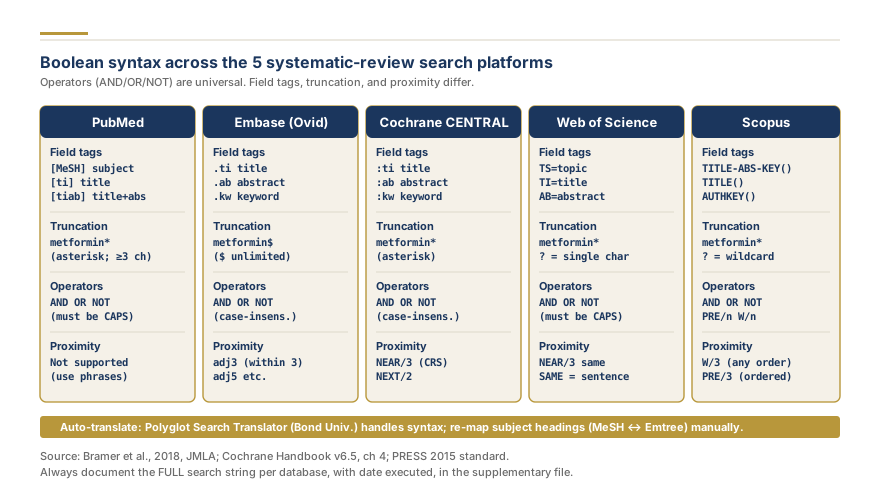
One of the most challenging aspects of systematic review searching is that search syntax differs across databases. The same conceptual search must be written differently in PubMed, Embase, CINAHL, Cochrane Library, and Web of Science. Each database has its own field tags, controlled vocabulary system, and syntax rules. A Boolean search strategy retrieves studies from databases, but the specific syntax varies by platform.
PubMed / MEDLINE
PubMed is the most widely used biomedical database and the starting point for most systematic review searches. PubMed uses MeSH terms (Medical Subject Headings) as its controlled vocabulary, accessed with the [MeSH] tag. Free-text searching uses field tags such as [tiab] (title and abstract), [ti] (title only), and [tw] (text word, which includes title, abstract, and MeSH terms).
Example PubMed search block for "type 2 diabetes":
"Diabetes Mellitus, Type 2"[MeSH] OR "type 2 diabetes"[tiab] OR "type II diabetes"[tiab] OR "non-insulin dependent diabetes"[tiab] OR T2DM[tiab] OR NIDDM[tiab]
PubMed automatically "explodes" MeSH terms, meaning it retrieves records indexed with the specified MeSH term and all narrower terms in the hierarchy. MeSH terms index PubMed/MEDLINE literature systematically, capturing conceptual matches that free-text searching alone would miss.
Embase
Embase covers more pharmacological and European literature than PubMed, making it essential for most systematic reviews. Embase uses Emtree as its controlled vocabulary, designated with the /exp tag for exploded terms. Field tags differ from PubMed: :ab,ti searches abstracts and titles.
Example Embase search block for "type 2 diabetes":
'non insulin dependent diabetes mellitus'/exp OR 'type 2 diabetes':ab,ti OR 'type II diabetes':ab,ti OR 'non-insulin dependent diabetes':ab,ti OR T2DM:ab,ti OR NIDDM:ab,ti
Note the use of single quotes around multi-word Emtree terms and the :ab,ti field tag. Embase search syntax uses different conventions from PubMed, and direct copy-paste of a PubMed strategy into Embase will produce incorrect or incomplete results.
CINAHL
CINAHL (Cumulative Index to Nursing and Allied Health Literature) is essential for reviews in nursing, physiotherapy, occupational therapy, and allied health. Physiotherapy reviews should also search PEDro, the discipline's flagship database, as our physical therapy systematic review guide explains. CINAHL uses CINAHL Subject Headings as its controlled vocabulary, accessed with the (MH) tag. The "explode" function uses (MH+).
Example CINAHL search block: (MH "Diabetes Mellitus, Type 2+") OR TI "type 2 diabetes" OR AB "type 2 diabetes"
CINAHL uses TI for title and AB for abstract, different from both PubMed and Embase conventions.
Cochrane Library
The Cochrane Library contains the Cochrane Database of Systematic Reviews (CDSR) and the Cochrane Central Register of Controlled Trials (CENTRAL). Cochrane uses MeSH terms in its search interface, with the syntax [mh "term"] for MeSH and :ti,ab,kw for title, abstract, and keyword searching.
Example Cochrane search block: [mh "Diabetes Mellitus, Type 2"] OR "type 2 diabetes":ti,ab,kw
Web of Science
Web of Science does not use controlled vocabulary. All searching is free-text based. Field tags include TS (topic, which searches title, abstract, author keywords, and Keywords Plus) and TI (title).
Example Web of Science search block: TS=("type 2 diabetes" OR "type II diabetes" OR "non-insulin dependent diabetes" OR T2DM OR NIDDM)
Database Syntax Comparison Table
| Feature | PubMed | Embase | CINAHL | Cochrane | Web of Science |
|---|---|---|---|---|---|
| Controlled vocabulary | MeSH [MeSH] | Emtree /exp | CINAHL Headings (MH) | MeSH [mh] | None |
| Title/Abstract | [tiab] | :ab,ti | TI / AB | :ti,ab,kw | TS= |
| Truncation | * | * | * | * | * |
| Phrase search | "term" | 'term' | "term" | "term" | "term" |
| Explode | Automatic | /exp | (MH+) | Automatic | N/A |
| Proximity | Not supported | NEAR/n | Nn | NEAR/n | NEAR/n |
| Subheadings | /qualifier | :lnk | MW | [mh /qualifier] | N/A |
This table serves as a quick reference when translating your search. For automated conversion, use our cross-database search converter.
Need help building your systematic review search strategy? Our methodologists design and validate Boolean searches across multiple databases, ensuring PRISMA-compliant documentation and maximum sensitivity. get your free research quote for expert search strategy support, or explore our full systematic review services.