Grey Literature in Systematic Reviews: Search Guide
Grey literature includes conference abstracts, theses, government reports, preprints, trial registries, and regulatory documents that are not indexed in standard bibliographic databases. Including grey literature in a systematic review reduces publication bias, broadens the evidence base, and strengthens the validity of your conclusions. This guide covers specific sources by type, search strategies, PRISMA-compliant documentation, and quality assessment methods.
Research Gold Team
March 31, 2026
Building a comprehensive search for your systematic review? Start with our free search strategy builder to construct validated search strings, then use the database search translator to adapt your strategy across platforms.
Key Takeaways
Grey literature includes conference abstracts, theses, government reports, preprints, trial registries, and regulatory documents not indexed in standard bibliographic databases.
Including grey literature reduces publication bias because studies with null or negative results are less likely to be published in peer-reviewed journals, skewing meta-analytic estimates.
Search at least one trial registry (ClinicalTrials.gov or WHO ICTRP), one thesis database (ProQuest), and additional sources relevant to your topic area for comprehensive coverage.
PRISMA 2020 requires transparent reporting of all grey literature sources searched, including search dates, terms used, and number of records retrieved from each source.
Apply the same risk of bias tools used for published studies to grey literature, and use the AACODS checklist for non-research grey literature like government reports.
Always conduct sensitivity analyses comparing results with and without grey literature to assess the impact of unpublished evidence on your pooled estimates.
Grey literature refers to research output produced outside traditional commercial or academic publishing channels. In the context of a systematic review, grey literature includes conference abstracts, doctoral and master's theses, government and agency reports, preprints, clinical trial registries, regulatory documents, and working papers that are not indexed in databases like PubMed, Embase, or Web of Science. Including grey literature is essential for reducing publication bias, because studies with statistically significant or favorable results are more likely to be published in peer-reviewed journals, while studies with null or negative findings often remain unpublished. The Cochrane Handbook for Systematic Reviews of Interventions (Higgins et al., 2023) explicitly recommends searching for grey literature to ensure a comprehensive and unbiased evidence synthesis. Failing to search beyond standard databases risks overestimating treatment effects and producing conclusions that do not reflect the full body of available evidence.
The PRISMA 2020 guidelines (Page et al., 2021) require authors to report all information sources searched, including grey literature databases and registries. Reviewers and journal editors increasingly expect to see documented grey literature searches in systematic review manuscripts. This guide provides a practical, source-by-source approach to identifying, searching, documenting, and appraising grey literature for your next review.
Why Grey Literature Matters for Reducing Publication Bias
Publication bias is one of the most significant threats to the validity of a systematic review. Research consistently shows that studies reporting positive or statistically significant results are published at higher rates and with shorter timelines than studies reporting null or negative findings. A landmark analysis by Scherer et al. (2018) estimated that approximately 50 percent of completed clinical trials remain unpublished years after completion. When a systematic review relies exclusively on published literature, it captures a skewed sample of the available evidence.
The consequences are measurable. Meta-analyses that exclude grey literature tend to produce larger pooled effect sizes than those that include it. This inflation occurs because the missing studies, those with null results, smaller effects, or inconclusive findings, would pull the pooled estimate downward if included. By searching grey literature sources, you recover studies that were never submitted to journals, were rejected, or are still in progress. This broader net produces a more accurate estimate of the true effect.
Several tools can help you assess and visualize publication bias after incorporating grey literature. A funnel plot displays the relationship between study effect sizes and their precision; asymmetry in the funnel suggests missing studies. You can generate funnel plots using our free publication bias funnel chart. For a deeper explanation of statistical methods for detecting publication bias, including Egger's test and trim-and-fill analysis, see our guide to publication bias detection methods.
Beyond reducing bias, grey literature serves additional purposes. It provides access to early-stage evidence from preprints and trial registries before peer-reviewed publication. It captures research conducted by government agencies, international organizations, and regulatory bodies that may never appear in academic journals. And it identifies ongoing or recently completed studies that could influence the conclusions of your review.
Comprehensive Source List Organized by Type
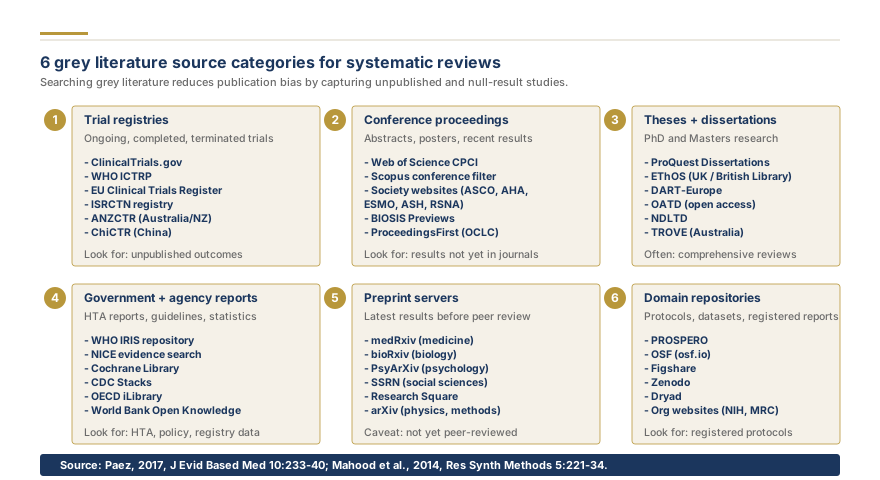
Searching grey literature reduces publication bias. Source: Paez, 2017, J Evid Based Med 10:233-40.
The following sections organize grey literature sources into categories. Each category includes specific databases, repositories, and platforms with their URLs and coverage.
Conference Abstracts and Proceedings
Conference presentations often report preliminary results that are never developed into full publications. Searching conference abstract databases captures this evidence.
Conference Proceedings Citation Index (CPCI): Part of Web of Science, indexes proceedings from over 12,000 conferences annually across sciences, social sciences, and humanities
Embase Conference Abstracts: Embase indexes conference abstracts from major biomedical and pharmaceutical conferences, searchable alongside journal articles
Individual society proceedings: Many professional societies (American Heart Association, American Society of Clinical Oncology, European Society of Cardiology) maintain searchable archives of annual meeting abstracts on their websites
Scopus Conference Papers: Scopus indexes selected conference proceedings and allows filtering by document type
Theses and Dissertations
Doctoral and master's theses represent substantial, peer-reviewed (by committee) research that may not be published in journals.
ProQuest Dissertations and Theses Global: The largest single repository of graduate dissertations and theses, containing over 5 million records from institutions worldwide
DART-Europe E-Theses Portal: Aggregates open-access research theses from over 600 European universities
EThOS (British Library): Provides access to UK doctoral theses, with over 500,000 records
NDLTD (Networked Digital Library of Theses and Dissertations): An international organization promoting electronic theses and dissertations, linking to institutional repositories globally
Institutional repositories: Most universities maintain digital repositories (e.g., DSpace, EPrints) where students deposit theses. Check repositories of institutions known for research in your topic area
Government and Agency Reports
Government agencies, health technology assessment bodies, and international organizations produce research reports that are often more comprehensive than journal articles.
NICE Evidence Search: The National Institute for Health and Care Excellence (NICE) maintains a search portal covering guidance, evidence summaries, and health technology assessments relevant to UK healthcare
Agency for Healthcare Research and Quality (AHRQ): Publishes systematic evidence reviews, technology assessments, and research reports (effectivehealthcare.ahrq.gov)
WHO publications: The World Health Organization publishes technical reports, guidelines, and research documents through its institutional repository (apps.who.int/iris)
Centers for Disease Control and Prevention (CDC): Publishes Morbidity and Mortality Weekly Reports (MMWR) and other technical documents
National Technical Information Service (NTIS): U.S. government repository for federally funded research reports
Preprint Servers
Preprints are manuscripts deposited on public servers before peer review. They provide early access to research findings and capture studies that may never proceed to formal publication.
medRxiv: Preprint server for health sciences, operated by Cold Spring Harbor Laboratory, Yale, and BMJ
bioRxiv: Preprint server for biological sciences
SSRN (Social Science Research Network): Covers social sciences, humanities, and applied sciences; now part of Elsevier
arXiv: Primarily physics, mathematics, and computer science, but increasingly used for quantitative health research
OSF Preprints: Open Science Framework aggregates preprints from multiple discipline-specific servers
Research Square: Multi-disciplinary preprint platform with a focus on transparency
Clinical Trial Registries
Trial registries document protocols and results of clinical studies, including those that were completed but never published. Searching registries is mandatory for Cochrane reviews and strongly recommended by PRISMA 2020.
ClinicalTrials.gov: The largest clinical trial registry, maintained by the U.S. National Library of Medicine, containing over 450,000 registered studies from 221 countries
WHO International Clinical Trials Registry Platform (ICTRP): A meta-registry that aggregates records from national and regional trial registries worldwide, including ClinicalTrials.gov, EU Clinical Trials Register, ISRCTN, and others
EU Clinical Trials Register: Covers clinical trials conducted in the European Economic Area
ISRCTN Registry: International registry of clinical trials, originally focused on randomized controlled trials
ANZCTR (Australian New Zealand Clinical Trials Registry): Covers trials conducted in the Australia and New Zealand region
Regulatory Documents
Regulatory agencies review unpublished data submitted by pharmaceutical and medical device companies. These documents often contain efficacy and safety data not available elsewhere.
FDA (U.S. Food and Drug Administration): Medical and statistical reviews for approved drugs and biologics are available through Drugs@FDA (accessdata.fda.gov). Advisory committee briefing documents provide detailed efficacy and safety analyses
EMA (European Medicines Agency): European Public Assessment Reports (EPARs) contain clinical data summaries, risk assessments, and scientific discussions for centrally authorized medicines (ema.europa.eu)
Health Canada Drug Product Database: Includes Summary Basis of Decision documents with clinical evidence summaries
TGA (Therapeutic Goods Administration, Australia): Publishes Australian Public Assessment Reports for prescription medicines
Other Grey Literature Sources
OpenGrey: A European-focused repository for grey literature in science, technology, biomedical science, economics, social science, and humanities. Note that OpenGrey has transitioned some of its content to other platforms; check current availability
Google Scholar: While primarily indexing published literature, Google Scholar also captures theses, preprints, conference papers, and reports that are not found in traditional databases. Use it as a supplementary search, not a primary source
Grey Literature Report (New York Academy of Medicine): A curated collection of grey literature in public health, updated regularly
BASE (Bielefeld Academic Search Engine): Searches over 300 million documents from more than 10,000 content providers, including many grey literature sources
CORE: Aggregates open-access research outputs from repositories and journals worldwide
Need help with your evidence synthesis?
Our methodologists handle narrative synthesis, thematic analysis, umbrella reviews, and all forms of evidence synthesis, following established frameworks.
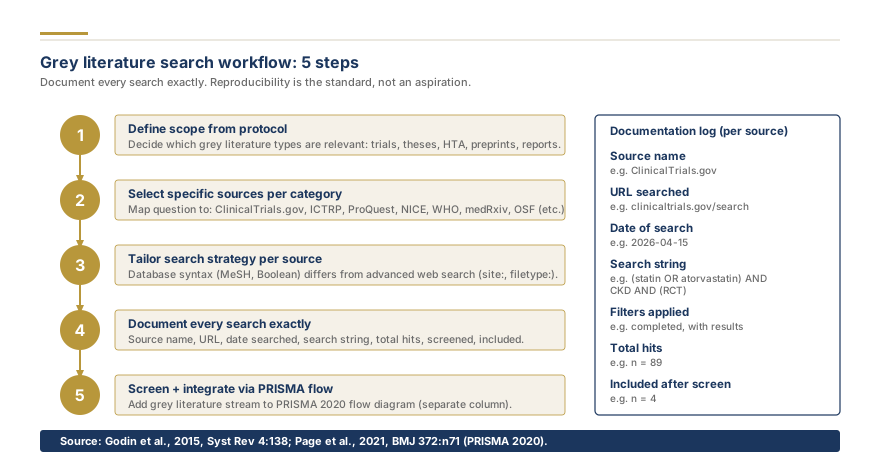
Document every search exactly. Source: Godin et al., 2015, Syst Rev 4:138; PRISMA 2020.
Searching grey literature requires a different approach than searching structured bibliographic databases. Most grey literature sources do not support complex Boolean operators, controlled vocabulary, or advanced field-specific searching. You need to adapt your strategy accordingly.
Start with your structured database search. Before searching grey literature, finalize your search strategy for databases like PubMed, Embase, and the Cochrane Library. Use our literature search builder to construct and validate your search strings. This structured search forms the foundation that your grey literature search extends.
Adapt your search terms. Grey literature databases typically use simple keyword searching rather than Medical Subject Headings (MeSH) or Emtree terms. Convert your structured search into natural language keywords and key phrases. For example, if your PubMed search uses the MeSH term "Diabetes Mellitus, Type 2," your grey literature search should include the plain-language terms "type 2 diabetes," "T2DM," "adult-onset diabetes," and related synonyms.
Search iteratively. Because grey literature interfaces are less sophisticated, plan to run multiple targeted searches rather than one comprehensive search. For trial registries, search by condition, intervention, and outcome separately. For thesis repositories, try different combinations of your key concepts.
Translate your search across platforms. Different databases use different syntax for the same operations. Our online database search converter helps you convert a search strategy written for one platform into the correct syntax for another, saving time and reducing translation errors.
Document every search as you go. Record the database or source name, the date searched, the exact search terms used, any filters applied, and the number of results retrieved. This documentation is essential for PRISMA reporting and for reproducibility.
Set date and language boundaries consistently. Apply the same date range and language restrictions to your grey literature search that you applied to your database search. If your database search covers January 2010 to December 2025, your grey literature search should use the same window.
Contact experts in the field. Reaching out to researchers, clinicians, and organizations working on your topic can uncover unpublished studies, ongoing projects, and datasets that no database search will find. The Cochrane Handbook recommends this as a supplementary search method.
Documenting Grey Literature Searches for PRISMA Compliance
The PRISMA 2020 statement requires systematic review authors to provide a complete account of all information sources searched, including grey literature. Transparent reporting of your grey literature search strategy is not optional; it is a requirement for publication in most journals. For a complete walkthrough of PRISMA reporting requirements, see our PRISMA 2020 guidelines explained.
In the Methods section of your manuscript, you should report the following for each grey literature source:
Name of the source (e.g., ClinicalTrials.gov, ProQuest Dissertations and Theses Global, WHO ICTRP)
Date the search was conducted (specific to each source, as you may search different sources on different days)
Search terms and strategy used (exact keywords, filters, and any limitations applied)
Number of records retrieved from each source
Any contact with study authors or experts and the outcomes of those contacts
In the PRISMA flow diagram, grey literature records should be reported separately from database records. PRISMA 2020 introduced a revised flow diagram with a dedicated box for "Records identified from other sources," which includes grey literature databases, trial registries, citation searching, and expert contacts. This separation allows readers to see how much of your evidence base came from non-traditional sources.
In the search strategy appendix, include the complete search strings for each grey literature source, just as you would for PubMed or Embase. Even if the search was a simple keyword search, documenting it verbatim enables other researchers to reproduce your work.
Common documentation mistakes to avoid:
Listing "grey literature was searched" without specifying which sources were searched
Failing to record the date of each search
Not distinguishing grey literature results from database results in the flow diagram
Omitting grey literature sources from the search strategy appendix
Searching Google Scholar without documenting the number of results screened and the screening method (since Google Scholar can return tens of thousands of results, you must specify how many were screened, typically the first 200 to 300 results sorted by relevance)
Need help structuring a comprehensive search that covers both databases and grey literature? Research Gold's team builds systematic review search strategies that meet Cochrane and PRISMA standards, including documented grey literature searches across all relevant sources. get a project estimate and share your review topic.
Need help building a search strategy that covers databases and grey literature sources? Research Gold's team constructs systematic review search strategies that meet Cochrane and PRISMA standards, including documented grey literature searches across all relevant sources. Request a free quote and share your review topic.
Assessing the Quality of Grey Literature
Grey literature has not undergone traditional peer review, which raises legitimate questions about its quality and reliability. However, excluding grey literature entirely introduces a different type of bias: the systematic omission of evidence that may be methodologically sound but simply unpublished. The solution is to include grey literature while applying appropriate quality assessment.
Apply the same risk of bias tools you use for published studies. If you are using the Cochrane Risk of Bias tool (RoB 2) for randomized trials or ROBINS-I for non-randomized studies, apply these tools to grey literature studies just as you would to published ones. A conference abstract reporting a well-conducted randomized trial should be assessed on the same criteria as a journal article reporting the same trial design.
Use AACODS for non-research grey literature. The AACODS checklist (Tyndall, 2010) was developed specifically for appraising grey literature. It evaluates six dimensions: Authority (who produced the document and what are their credentials), Accuracy (is the information supported by evidence), Coverage (are limitations stated), Objectivity (is there potential bias), Date (is the information current), and Significance (is the source relevant to your review question). AACODS is particularly useful for government reports, organizational publications, and technical documents that do not fit the mold of traditional clinical research.
Conduct sensitivity analyses. After including grey literature in your synthesis, run a sensitivity analysis that compares results with and without grey literature studies. If the pooled effect changes substantially when grey literature is excluded, this finding is itself informative: it suggests that published studies alone may overestimate or underestimate the true effect. Report these sensitivity analyses transparently.
Acknowledge limitations explicitly. In the Discussion section of your manuscript, address the quality of included grey literature. Note which studies were conference abstracts (and therefore provide limited methodological detail), which were theses (and therefore underwent committee review but not journal peer review), and which were regulatory documents (and therefore contained data reviewed by regulatory scientists). This nuanced discussion demonstrates methodological awareness without dismissing grey literature entirely.
Handle incomplete data proactively. Grey literature sources, particularly conference abstracts, often report limited data (e.g., effect sizes without confidence intervals, or sample sizes without detailed outcome data). Contact the study authors to request complete data. Document these attempts and their outcomes. If data remain incomplete, consider including the study in a narrative synthesis while excluding it from quantitative meta-analysis, and explain this decision in your manuscript.
Addressing Common Reviewer Questions About Grey Literature
Peer reviewers frequently raise questions about grey literature inclusion. Anticipating these questions and addressing them in your manuscript strengthens your submission and reduces the likelihood of revision requests.
"Why did you include unpublished studies?" The answer is methodological: excluding unpublished studies introduces publication bias, which the Cochrane Handbook and PRISMA 2020 both recognize as a threat to review validity. Cite the empirical evidence showing that meta-analyses excluding grey literature overestimate effects.
"How did you assess the quality of grey literature?" Describe the specific tools you used (RoB 2, ROBINS-I, AACODS, or others appropriate to your review). Explain that grey literature studies were assessed using the same criteria as published studies, or describe the alternative appraisal framework used for non-research documents.
"Conference abstracts provide insufficient methodological detail. How can you assess risk of bias?" Acknowledge this limitation honestly. State that you contacted authors for additional information and report the response rate. Note that conference abstracts were included to reduce publication bias and that sensitivity analyses explored their impact on the pooled results.
"Did the inclusion of grey literature change your results?" Report your sensitivity analysis. If results were robust to the exclusion of grey literature, this strengthens confidence in your findings. If results changed, this demonstrates that publication bias was present and that grey literature inclusion provided a more accurate estimate.
"How did you search Google Scholar systematically?" Explain your protocol: the exact search terms used, the number of results screened (commonly the first 200 to 300 results sorted by relevance), and the screening criteria applied. Reviewers want to see that your Google Scholar search was reproducible and bounded, not an unstructured browse.
"Is grey literature of lower quality than published literature?" Not necessarily. Some grey literature, such as FDA medical reviews and Cochrane protocol data, undergoes rigorous scrutiny by regulatory scientists or methodologists. Theses and dissertations are reviewed by academic committees. The distinction between "published" and "grey" reflects distribution channels, not inherent quality differences.
For a comprehensive understanding of how to construct your overall search approach, including database selection, search term development, and grey literature integration, see our complete search strategy guide.
Frequently Asked Questions
6
Grey literature includes any research output not published through traditional commercial or academic channels. Common types include conference abstracts, doctoral and master's theses, government reports, health technology assessments, preprints, clinical trial registry entries, regulatory documents from the FDA or EMA, working papers, and organizational reports.
The Cochrane Handbook strongly recommends searching for grey literature to minimize publication bias. PRISMA 2020 requires reporting all sources searched. Most high-quality journals and all Cochrane reviews expect a documented grey literature search. Omitting it without justification will likely draw reviewer criticism.
There is no fixed number. At minimum, most reviewers expect a search of at least one trial registry (ClinicalTrials.gov or WHO ICTRP), one thesis database, and one or two additional sources relevant to your field. Comprehensiveness matters more than counting sources.
PRISMA 2020 introduced a revised flow diagram that separates records from databases and registers from records identified from other methods, including grey literature. Report grey literature records in this separate section, then merge with database records at the screening stage.
Yes, provided the source reports sufficient quantitative data for pooling. When data are incomplete, contact study authors. If data remain unavailable, include the study in a narrative synthesis and explain why it was excluded from quantitative pooling. Always run a sensitivity analysis.
Apply the same risk of bias tool used for full publications and note where information is insufficient. Contact authors for the full dataset. Flag conference abstracts as having unclear risk of bias for domains with missing information, and conduct a sensitivity analysis excluding them.
Share
Found this useful? Share it with your colleagues.
Need help with your evidence synthesis?
Our methodologists handle narrative synthesis, thematic analysis, umbrella reviews, and all forms of evidence synthesis, following established frameworks.
Complex Synthesis? Our PhD Team Specializes in Every Type.
Systematic reviews, narrative synthesis, umbrella reviews, and rapid reviews. We match the right methodology to your research question and deliver a publication-ready manuscript.
Our promise: Free rework on synthesis or GRADE assessment if reviewers push back.
4.9 / 5Quote within a few hoursPRISMA 2020 + GRADE certaintyPhD methodologistConfidential by default
Research Gold Team is our group of PhD methodologists and statisticians who deliver our systematic review, meta-analysis and statistical analysis work. The same team writes and checks the guides and tools on this site.
Ready to ensure your systematic review captures the full evidence base? Research Gold provides end-to-end systematic review services with comprehensive grey literature searching, PRISMA-compliant documentation, and publication bias analysis. Get a quote today.
Complex Synthesis? Our PhD Team Specializes in Every Type.
Systematic reviews, narrative synthesis, umbrella reviews, and rapid reviews. We match the right methodology to your research question and deliver a publication-ready manuscript.
A systematic literature review for health technology assessment (HTA) is a payer-focused, protocol-driven evidence synthesis that identifies, appraises, and summarizes clinical, economic, and humanistic studies to support reimbursement decisions. It differs from an academic review in audience, PICOS rigor, and timelines. This guide explains how these reviews work and the standards that govern them.
A clinical evaluation report (CER) literature review is a protocol-driven, fully documented search and appraisal of clinical and safety evidence built to survive regulatory inspection. It differs from an academic review by prioritizing traceability, reproducibility, and an audit trail. This guide explains how these reviews work under EU MDR, MEDDEV 2.7/1 Revision 4, and Good Pharmacovigilance Practices.