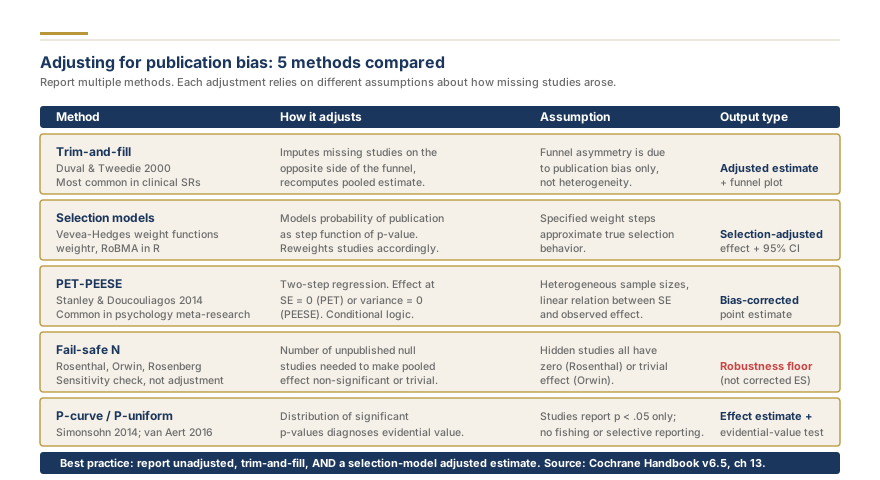
Publication bias detection is the process of identifying whether the studies included in a meta-analysis represent a systematically skewed sample of all research conducted on a given question. When statistically significant results are more likely to be published than null or negative findings, the pooled estimate from a meta-analysis can overestimate the true effect. Detecting, testing, and adjusting for this bias is a core requirement for any credible evidence synthesis.
In our meta-analyses at Research Gold, we routinely run Egger's test alongside funnel plots before finalizing any pooled estimate. This article covers the full workflow: what publication bias is, how it distorts meta-analysis results, visual and statistical methods for detection, adjustment techniques, and how to report your findings in line with PRISMA 2020 and GRADE requirements. For a broader overview of the meta-analysis process, see our guide on how to do a meta-analysis step by step.
The Publication Filter Behind the Evidence
The consequence for meta-analysis is straightforward: if the available evidence is enriched with positive results and depleted of null results, the pooled effect size will be larger than the true population effect. The meta-analysis does not merely summarize the evidence, it summarizes the evidence that made it through a publication filter. The Cochrane Handbook for Systematic Reviews of Interventions (Higgins et al., 2023) identifies publication bias as one of the most serious threats to the validity of systematic review conclusions.
Publication bias is not the only form of reporting bias. Selective outcome reporting, where authors report only the outcomes that achieved significance, and selective analysis reporting, where authors choose analytical approaches that produce favorable results, operate through similar mechanisms. The broader category is sometimes called reporting bias or dissemination bias. However, publication bias, the selective publication of entire studies based on results, is the form most amenable to detection through the methods described in this article.
The magnitude of the problem is well documented. Empirical studies have shown that trials with statistically significant results are roughly twice as likely to be published as those with null results (Dwan et al., 2008). In pharmacological research, the imbalance is even larger. The practical effect on meta-analyses is that pooled estimates may be inflated by 10-30% when significant publication bias is present.
How It Affects Meta-Analysis Results
A meta-analysis pools effect sizes from individual studies using a weighted average, where larger and more precise studies receive greater weight. Publication bias distorts this process because the missing studies are not randomly distributed, they are systematically those with smaller, null, or negative effects.
Consider a hypothetical meta-analysis of 20 published studies examining the effect of an intervention. If 8 additional studies were conducted but remain unpublished because they found no significant effect, the pooled estimate from the 20 published studies will overstate the intervention's effectiveness. The magnitude of the overestimation depends on the number of missing studies, the size of their effects, and their precision.
The distortion compounds with other biases. Small studies are more susceptible to publication bias because their results are more variable, a small study might find a large effect by chance, get published, while another small study finding no effect goes unpublished. This is why the concept of small-study effects is closely linked to publication bias. Larger studies are more likely to be published regardless of results because they represent substantial investments and contribute important evidence even when results are null.
The impact on clinical decision-making is real. If a Cochrane review concludes that a treatment has a moderate effect based on biased evidence, clinicians may adopt that treatment for patients who would receive no benefit. In public health, biased meta-analyses can influence policy recommendations, resource allocation, and guideline development. The GRADE Working Group explicitly includes publication bias as one of five domains that can reduce the certainty of evidence, reflecting its importance in evidence-based practice.
Funnel Plots, Visual Detection
A funnel plot is a scatter plot that displays the relationship between each study's effect size (x-axis) and a measure of its precision (y-axis, typically standard error with the scale inverted so that more precise studies appear at the top). In the absence of bias, the plot should resemble a symmetric inverted funnel: large, precise studies cluster near the pooled estimate at the top, while smaller, less precise studies scatter more widely but symmetrically around the same central value.
Funnel plot asymmetry occurs when the scatter is not symmetric. The most common pattern associated with publication bias is a gap in the bottom-right or bottom-left corner of the funnel, indicating that small studies with null or negative results are missing from the evidence base. When you observe this pattern, small studies on the side favoring the treatment are present while small studies on the opposite side are absent.
Interpreting funnel plots requires nuance. The Cochrane Handbook recommends visual inspection as a starting point but warns against over-reliance on subjective assessment. Different observers may reach different conclusions about asymmetry, especially when the number of studies is small. Funnel plots with fewer than 10 studies are difficult to interpret because the expected symmetry may not emerge even in the absence of bias simply due to sampling variability.
When constructing a funnel plot, use the standard error on the y-axis rather than sample size or inverse variance. The standard error produces the expected funnel shape more reliably and is the convention used by major software packages including RevMan, Stata, and R's metafor package. You can generate publication-ready funnel plots using our free use our funnel plot generator, which accepts effect sizes and standard errors and produces formatted output suitable for journal submission.
A well-constructed funnel plot communicates three things simultaneously: the distribution of precision across studies, the degree of scatter relative to the pooled estimate, and any asymmetry that might suggest systematic bias. These visual properties make funnel plots one of the most informative single graphics in evidence synthesis.
| Funnel Plot Feature | What It Suggests | Action Required |
|---|---|---|
| Symmetric scatter around pooled estimate | No evidence of publication bias | Report as reassuring; proceed with pooled estimate |
| Gap in bottom-right corner | Small negative/null studies may be missing | Run formal statistical tests; consider trim-and-fill |
| Gap in bottom-left corner | Small studies with large positive effects missing (less common) | Investigate data; may indicate other biases |
| Asymmetry with outliers | Possible heterogeneity rather than bias | Investigate study-level characteristics; run subgroup analysis |
| Hollow funnel (few small studies) | Small studies not conducted or not found | Assess search comprehensiveness; note in limitations |
Need rigorous publication bias assessment for your systematic review? Our biostatisticians apply multiple detection methods, including funnel plots, Egger's test, and trim-and-fill analysis, with transparent GRADE-compliant reporting. book your complimentary research assessment, or see our our meta-analysis team.
Statistical Tests for Publication Bias
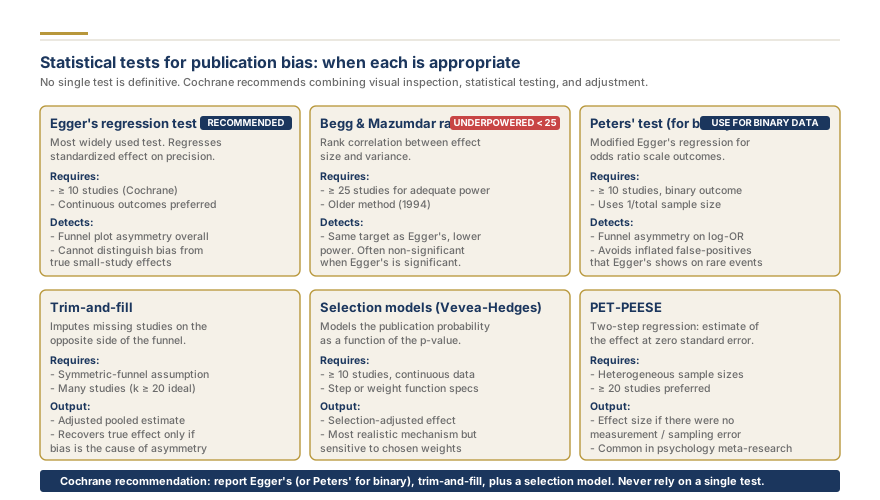
Visual inspection of funnel plots is inherently subjective. Statistical tests provide a formal, reproducible method for quantifying funnel plot asymmetry and assessing whether the observed pattern is consistent with chance alone. Three tests are used most frequently: Egger's regression, Begg's rank correlation, and Peter's test.
Egger's Weighted Regression Test
Egger's test (Egger et al., 1997) is the most widely used statistical test for funnel plot asymmetry. It regresses the standardized effect estimate (effect size divided by its standard error) against precision (the inverse of the standard error). If no asymmetry is present, the regression intercept should not differ significantly from zero. A statistically significant intercept (typically p less than 0.10, using a more liberal threshold to maintain power) suggests that smaller, less precise studies tend to report systematically different effect sizes than larger studies.
The test is computed using weighted least squares regression, where each study's contribution is weighted by the inverse of its variance. The test statistic follows a t-distribution, and the Eggers regression p-value is obtained from the slope's deviation from zero. In practice, most meta-analysis software packages, including R's metafor package (function regtest), Stata's metabias command, and RevMan, compute Egger's test automatically.
Egger's test has well-established limitations. Its power is low when the meta-analysis includes fewer than 10 studies, which is why the Cochrane Handbook recommends a minimum of 10 studies before applying asymmetry tests. The test can also produce false positives when effect sizes are measured as odds ratios, particularly when the event rate is very low or very high. In these circumstances, Peter's test is the preferred alternative.
Begg's Rank Correlation Test
Begg and Mazumdar's rank correlation test (Begg & Mazumdar, 1994) uses a non-parametric approach to detect funnel plot asymmetry. It calculates the rank correlation (Kendall's tau) between the standardized effect sizes and their variances. A significant correlation suggests that study size is associated with effect magnitude, the pattern expected under publication bias.
Begg's test is less powerful than Egger's test in most scenarios, meaning it is more likely to miss true asymmetry. However, it makes fewer distributional assumptions and may be appropriate as a complementary analysis. When both Egger's test and Begg's test agree, the evidence for or against asymmetry is strengthened.
Peter's Test for Binary Outcomes
Peter's test (Peters et al., 2006) was developed specifically for meta-analyses of binary outcomes where the effect measure is an odds ratio or risk ratio. Egger's test applied to log odds ratios can produce spurious significant results because of the mathematical relationship between the effect size and its standard error when events are rare. Peter's test addresses this by regressing the effect size against the inverse of the total sample size rather than the inverse of the standard error.
For meta-analyses using odds ratios with sparse data (few events per study), Peter's test is the recommended choice. For meta-analyses using standardized mean differences or risk differences, Egger's test remains the standard.
| Test | Best Used For | Minimum Studies | Key Limitation |
|---|---|---|---|
| Egger's regression | Continuous outcomes, standardized mean difference, MD | 10+ | False positives with binary data |
| Begg's rank correlation | Complementary to Egger's | 10+ | Lower power than Egger's |
| Peter's test | Binary outcomes (OR, RR) | 10+ | Less widely implemented in software |
| Harbord's test | Binary outcomes (alternative) | 10+ | Similar to Peter's; choose one |
In our practice, we run Egger's test as the default for continuous outcome meta-analyses and Peter's test for binary outcome meta-analyses, reporting both the test statistic and p-value alongside the funnel plot. This combination of visual and statistical evidence provides the most defensible assessment.