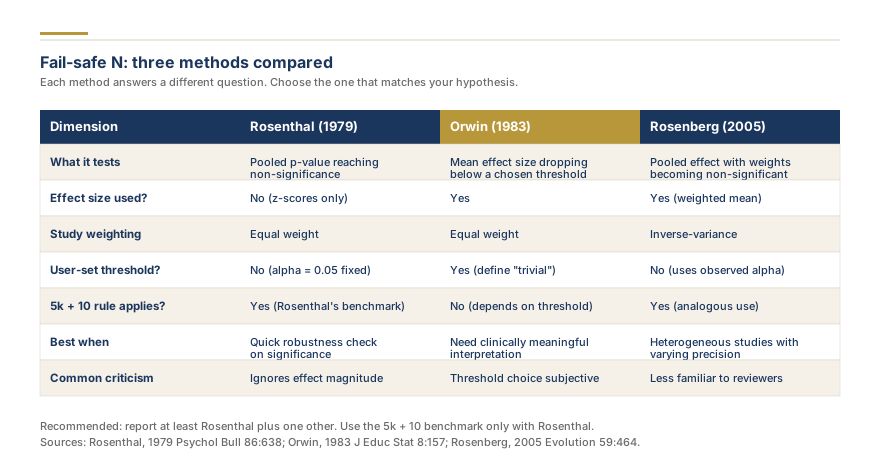
Fail-safe N is a publication bias sensitivity statistic that answers one focused question: how many unpublished, null-result studies would need to exist in file drawers before your pooled effect became statistically non-significant (or practically trivial)? A large fail-safe N means your result is robust. A small one means a handful of suppressed studies could invalidate your finding.
Three methods dominate the literature: Rosenthal's classic approach, Orwin's target-effect variant, and Rosenberg's weighted refinement. Each asks a slightly different version of the same question, and choosing the wrong one can either overstate or understate your robustness. This guide walks through all three, compares them directly, and tells you when each is most appropriate.
Try our free free funnel plot maker to visualize asymmetry in your study pool before running fail-safe N calculations.
Why Fail-Safe N Matters More Than a Significant Funnel Test
Funnel plot asymmetry tests such as Egger's and Begg's have known limitations. They require at least 10 studies for reasonable power, and asymmetry can arise from heterogeneity rather than publication bias alone. Fail-safe N sidesteps these problems by framing the question as a tolerance calculation rather than a hypothesis test.
The practical threshold most reviewers use is: if the fail-safe N exceeds 5k + 10 (where k is the number of studies in your synthesis), the result is considered tolerant of publication bias.
Rosenthal's Method: The Classic 5k + 10 Rule
Rosenthal (1979) proposed the original fail-safe N as a straightforward way to address what he called the "file drawer problem." The calculation asks: how many studies averaging a null result (z = 0) would reduce the combined p-value to the significance threshold, usually p = 0.05?
When to use Rosenthal's method: Use it when your outcome is binary (significant or not), when you want a widely recognized benchmark your reviewers will immediately understand, and when you have fewer than 10 studies where funnel tests lack power.
Limitation: Rosenthal's method assumes the null studies average exactly zero effect. Real file-drawer studies may have small but non-zero effects, making the estimate conservative.
Use our free forest plot visualization tool to visualize your k studies and their individual z-scores before computing the combined z-sum.
Orwin's Method: Setting a Practical Trivial Threshold
Orwin (1983) introduced a modification that many regard as more practically meaningful. Instead of asking how many null studies would push p above 0.05, Orwin asks: how many studies averaging a specified trivial effect would reduce the pooled effect size to a criterion threshold you define as negligible?
When to use Orwin's method: Use it when effect size magnitude matters more than p-value significance, when your field has established minimum clinically important differences, or when reviewers are likely to question practical relevance rather than statistical significance.
Limitation: The result depends entirely on your chosen criterion and trivial effect values. Two researchers using different thresholds will produce different fail-safe N values. Always report your chosen thresholds explicitly.
Rosenberg's Method: Incorporating Study Weights
Rosenberg (2005) observed that both Rosenthal's and Orwin's methods treat all studies as equally informative, which contradicts the standard practice in meta-analysis of weighting studies by their precision (inverse variance).
When to use Rosenberg's method: Use it when your studies vary substantially in sample size and precision, when your synthesis uses random-effects or inverse-variance weighting, and when you want the most methodologically rigorous of the three approaches.
See also our Sensitivity Analysis Tool to check whether excluding individual studies shifts your pooled estimate substantially before computing fail-safe N.
The Fail-Safe N Formulas, Written Out (with a Worked Example)
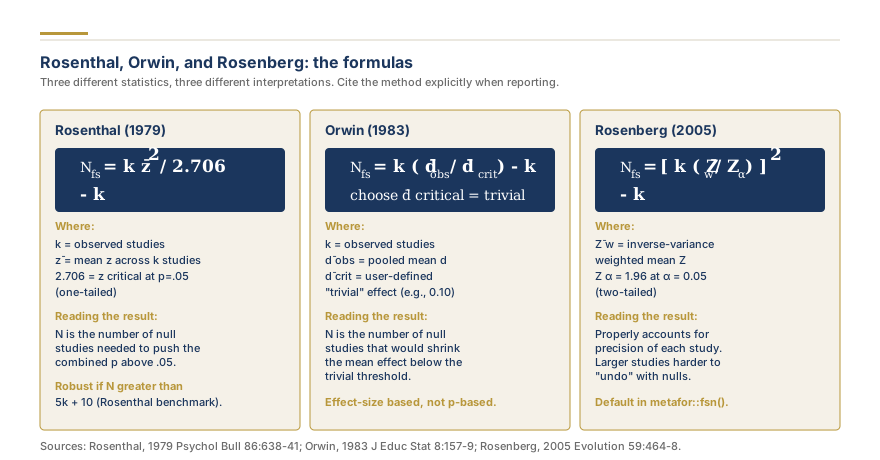
A formula trapped inside an image cannot be read by a screen reader, indexed by a search engine, or checked by a reviewer. Here are the actual equations behind each method, in text, with numbers carried through.
Rosenthal's fail-safe N asks how many unpublished studies averaging a null result (z = 0) would be needed to push the combined significance test back above the alpha threshold:
N_fs = (Σ z_i)² / z²_α − k
Σ z_i is the sum of the individual study z-scores, k is the number of observed studies, and z_α is the critical value for your chosen alpha. For a one-tailed test at α = 0.05, z_α = 1.645, so z²_α = 2.706 (use 1.96 and 3.842 for two-tailed).
Worked example. With k = 15 studies whose z-scores sum to Σ z_i = 36.7:
N_fs = 36.7² / 2.706 − 15 = 1346.9 / 2.706 − 15 = 497.7 − 15 = 483
It would take roughly 483 null studies to overturn the result. Rosenthal's own benchmark, the "5k + 10 rule," asks whether N_fs exceeds 5·15 + 10 = 85; at 483 the finding is robust.
Orwin's fail-safe N improves on Rosenthal by working in effect-size units rather than significance, so you can set a trivial threshold instead of a null one:
N_fs = k · (d̄ − d_c) / (d_c − d_0)
d̄ is the observed mean effect, d_c is the smallest effect you would still consider meaningful (the criterion), and d_0 is the assumed mean effect of the unpublished studies.
Worked example. With k = 15, an observed d̄ = 0.45, a trivial criterion d_c = 0.10, and assuming the missing studies are truly null (d_0 = 0):
N_fs = 15 · (0.45 − 0.10) / (0.10 − 0) = 15 · 0.35 / 0.10 = 53
Only about 53 null studies would drag the pooled effect down to the "trivial" boundary, a far more conservative and interpretable answer than Rosenthal's 483, because it targets practical importance rather than mere statistical significance.
Rosenberg's fail-safe N is the weighted generalization. Unlike Rosenthal's method, which treats every study equally, Rosenberg recomputes the inverse-variance weighted combined effect and solves for how many average-weight null studies would render that weighted result non-significant at α. Because it respects the same weighting scheme used to compute the meta-analytic estimate itself, it is the version most consistent with a modern random- or fixed-effects analysis. It does not reduce to a clean one-line hand calculation, so it is normally produced by software, for example metafor::fsn(yi, vi, type = "Rosenberg") in R, which returns the weighted fail-safe number alongside the target significance level.
library(metafor)
# yi = effect sizes, vi = their variances
fsn(yi, vi, type = "Rosenthal")   # significance-based
fsn(yi, vi, type = "Orwin", target = 0.10)  # effect-size threshold
fsn(yi, vi, type = "Rosenberg")   # inverse-variance weighted
Report whichever you use transparently and prefer Orwin or Rosenberg over a bare Rosenthal number, since a large Rosenthal N can give false reassurance when the underlying effect is small. Pair any fail-safe N with a funnel plot and Egger's test rather than treating it as standalone proof against publication bias.