Multi-database searching is not optional in a systematic review. Every major reporting guideline, including PRISMA 2020 and the Cochrane Handbook, requires searches across multiple bibliographic databases. PubMed covers approximately 37 million records but has limited coverage of conference proceedings, gray literature, and non-English journals. Embase captures broader European and pharmacological literature. Cochrane's CENTRAL indexes controlled trials not always found in PubMed. CINAHL covers nursing and allied health. Web of Science spans science, social sciences, and humanities. Scopus provides the largest abstract and citation database.
Each database uses a different controlled vocabulary, different syntax rules, and different conventions for Boolean operators, proximity searching, truncation, and field codes. A search that works in PubMed will fail in every other database unless you translate it deliberately.
Try our free Cochrane search translator to convert your PubMed search string automatically.
Why Direct Copy-Paste Fails
A typical PubMed search uses MeSH (Medical Subject Headings) terms and free-text terms with field tags like [MeSH] and [tiab]. If you paste this into Embase, [MeSH] is not recognized. Embase uses Emtree with different term names and hierarchies. The [tiab] tag does not exist in Embase; it uses :ti,ab instead. Web of Science does not support any controlled vocabulary at all. Scopus uses its own field codes (TITLE-ABS-KEY) that look nothing like PubMed tags.
Running an untranslated string typically generates errors, retrieves zero results, or silently drops controlled vocabulary terms while retrieving only free-text matches, introducing retrieval bias into your review.
MeSH vs Emtree: Key Differences
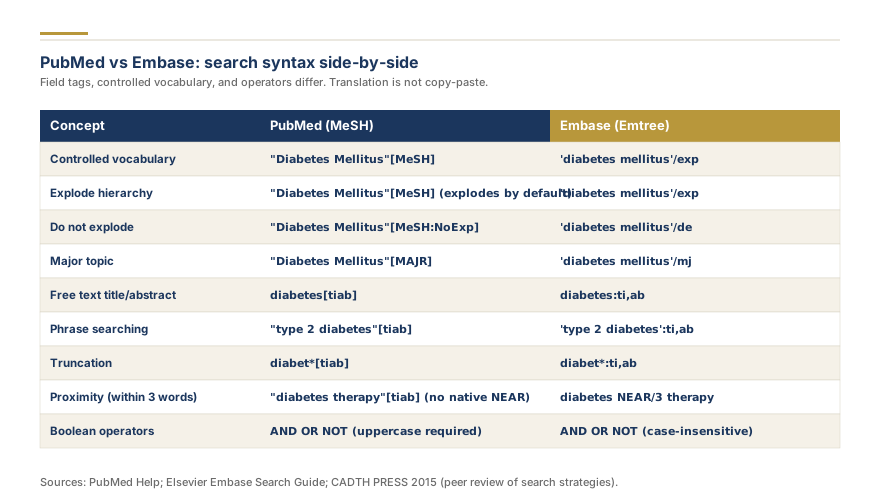
NLM MeSH and Embase Emtree both organize biomedical concepts in hierarchical trees, but term names and explosion behaviors differ substantially. Myocardial Infarction (MeSH) becomes heart infarction (Emtree). Neoplasms becomes neoplasm. Diabetes Mellitus, Type 2 (MeSH) maps to non insulin dependent diabetes mellitus (Emtree).
In Embase, controlled terms use /exp for explosion: diabetes mellitus/exp. Without /exp, Embase searches only the exact descriptor without narrower terms. PubMed explodes MeSH terms by default, so forgetting the /exp modifier in Embase is one of the most common translation errors.
Cochrane CENTRAL Syntax
MeSH descriptor searches follow the format: [MeSH descriptor: [term] explode all trees]. Field restrictions use :ti for title, :ab for abstract, and :kw for keywords. Boolean operators must be capitalized (AND, OR, NOT). Cochrane does not support Emtree or CINAHL headings.
CINAHL Syntax
CINAHL uses EBSCO as its platform. Controlled vocabulary follows: (MH "term+") where + indicates explosion. Title and abstract fields use TI and AB, capitalized. TX searches all text fields.
For building your initial strategy, see our build your search strategy. For developing Boolean queries, read our Boolean search strategy guide.
Web of Science and Scopus Syntax
Web of Science has no controlled vocabulary. Key field codes: TS (Topic), TI (Title), AB (Abstract). A PubMed "diabetes mellitus"[tiab] becomes TS=("diabetes mellitus"). Supports NEAR/x proximity and lemmatization by default.
Scopus uses TITLE-ABS-KEY() for title, abstract, and author keywords. Supports W/n (within n words, ordered) and PRE/n (preceding within n words) proximity operators.
Both databases lack controlled vocabulary, so translation involves dropping MeSH terms and expanding free-text synonyms. Without this expansion, your search underperforms because you lose the automatic mapping that MeSH provides.
PsycINFO (APA PsycInfo) Syntax and Thesaurus Terms
APA PsycInfo uses the APA Thesaurus of Psychological Index Terms, distinct from both MeSH and Emtree. On EBSCO, controlled terms use (DE "term"). Key MeSH mapping differences: "Depressive Disorder" becomes "Major Depression" and "Cognitive Behavioral Therapy" becomes "Cognitive Behavior Therapy" (note spelling). For systematic reviews in psychology or behavioral health, PsycINFO is essential. Failing to search it can mean missing 20% or more of relevant studies.
ProQuest Dissertations Search Syntax
ProQuest Dissertations and Theses (PQDT) is the primary source for unpublished dissertations, an important gray literature source for reducing publication bias. Field codes: ti (title), ab (abstract), su (subject terms), noft (all fields except full text). Supports truncation with *, wildcard with ?, and phrase searching with double quotes. No controlled vocabulary.
For more on gray literature databases, see our guide on gray literature sources for systematic reviews.
Boolean Operator Differences Across Platforms
PubMed processes Boolean operators left-to-right. Embase (Ovid) processes OR first, then AND, then NOT. This means A AND B OR C is interpreted as A AND (B OR C) in Ovid but (A AND B) OR C in PubMed. Always use explicit parentheses. Scopus requires AND NOT (not just NOT). CINAHL and PsycINFO (EBSCO) use standard precedence.
Proximity Operators by Database
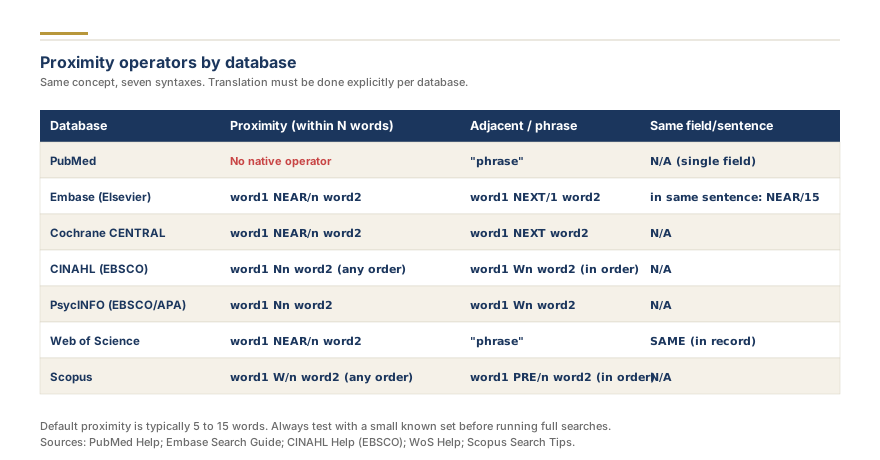
Proximity operators find terms near each other, more precise than Boolean AND.
| Database | Operator | Example |
|---|---|---|
| PubMed | Not supported | N/A |
| Embase (Ovid) | ADJn (ordered) | pain ADJ3 management |
| Web of Science | NEAR/n (any order) | pain NEAR/3 management |
| Scopus | W/n (ordered), PRE/n | pain W/3 management |
| CINAHL/PsycINFO | Nn (any order), Wn (ordered) | pain N3 management |
PubMed does not support proximity searching. If your PubMed strategy uses phrase searching, use proximity operators in other databases to capture variations.
Truncation and Wildcard Differences
| Feature | PubMed | Embase (Ovid) | Web of Science | Scopus | CINAHL/PsycINFO |
|---|---|---|---|---|---|
| Truncation | * (unlimited) | * or $ (limited) | * (unlimited) | * (unlimited) | * (unlimited) |
| Single char wildcard | Not supported | ? | ? | ? | ? |
| Internal truncation | Not supported | Supported | Not supported | Not supported | Supported |
Key pitfall: In Ovid Embase, $ truncates to a limited number of characters, while * is unlimited. In Web of Science, $ represents zero or one character. Mixing these up will over-retrieve or miss records. PubMed's "randomi*" works in most databases to capture randomized, randomised, randomization, and randomisation.
Step-by-Step Conversion Process
Step 1: Audit your PubMed search line by line. Separate MeSH terms, free-text terms, and filters.
Step 2: For each MeSH term, find the equivalent controlled vocabulary term: Emtree browser for Embase, APA Thesaurus for PsycINFO, CINAHL headings for CINAHL. For Web of Science and Scopus, expand free-text synonyms instead.
Step 3: Convert field tags using this reference table.
| PubMed | Embase (Ovid) | Cochrane | CINAHL | Web of Science | Scopus | PsycINFO |
|---|---|---|---|---|---|---|
| [tiab] | .ti,ab | :ti,ab | TI or AB | TS= | TITLE-ABS-KEY() | TI or AB |
| [MeSH] | /exp | MeSH descriptor explode | (MH "term+") | N/A | N/A | (DE "term") |
| [pt] | .pt | N/A | (PT "type") | DT= | DOCTYPE() | (ZZ "type") |
Step 4: Convert Boolean operators and parenthetical grouping, paying attention to precedence differences.
Step 5: Replace any proximity operators or wildcards using the translation tables above.
Step 6: Run a test search. Differences over 30% from PubMed results warrant investigation.
Step 7: Document every search string, date, interface, and result count.
Our Database Search Translator automates steps 2 through 5.