The number needed to treat (NNT) is the single most clinically useful statistic in evidence-based medicine. It answers one practical question: how many patients must receive an intervention for one additional patient to benefit? Where a hazard ratio or odds ratio requires statistical training to interpret, an NNT of 8 is immediately understood by every clinician and every guideline panel.
Most systematic reviews and meta-analyses report odds ratios or relative risks, not NNT. Reviewers who stop at relative measures miss the opportunity to translate statistical significance into clinical significance. This guide shows you how to convert between these measures correctly, avoid common errors, and present NNT in ways that drive clinical decision-making.
Try our free NNT Calculator to convert odds ratios, relative risks, and absolute risk differences into NNT values with confidence intervals.
Why Odds Ratios Alone Are Not Enough
An odds ratio (OR) of 0.65 tells you the odds are 35% lower in the treatment group. But it conceals baseline risk entirely.
Two scenarios with identical OR of 0.65: a control event rate of 40% gives NNT = 9. A control event rate of 2% gives NNT = 167. Only the NNT makes that difference visible. The Cochrane Handbook (Section 15.4) explicitly recommends presenting absolute measures alongside relative measures for exactly this reason.
Relative risk reduction stays constant across populations, but the absolute risk reduction that clinicians care about changes dramatically with baseline risk. A drug that reduces heart attacks by 35% (relative) sounds impressive regardless. An NNT of 9 versus 167 immediately reveals whether the treatment is worthwhile for a specific population.
Converting an Odds Ratio to NNT: Step-by-Step Worked Example
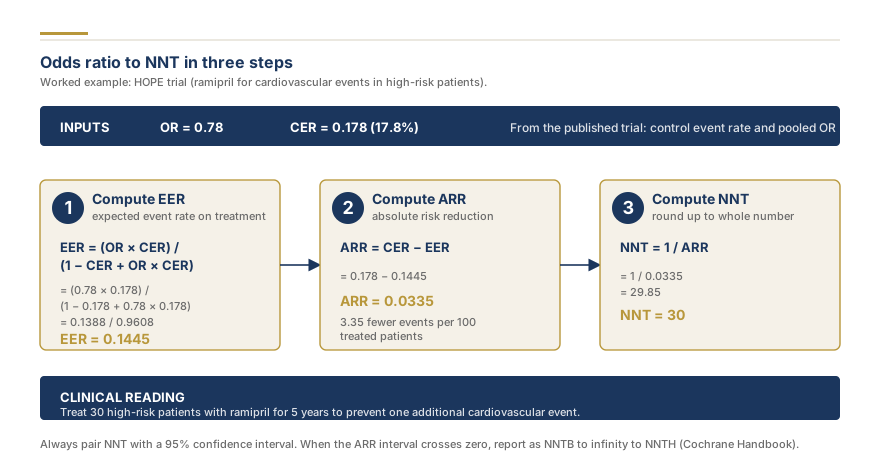
The conversion requires the control event rate (CER). The formulas, first formalized by Laupacis et al. (1988) and refined by Altman (1998), follow three steps.
Step 1: EER = (OR x CER) / (1 - CER + OR x CER)
Step 2: ARR = CER - EER
Step 3: NNT = 1 / ARR (rounded up to the next whole number)
Worked Example with Real Clinical Trial Data
Consider the HOPE trial (Heart Outcomes Prevention Evaluation), which assessed ramipril for cardiovascular events in high-risk patients. The trial reported an odds ratio of 0.78 with a control event rate of 17.8% (CER = 0.178).
Step 1: EER = (0.78 x 0.178) / (1 - 0.178 + 0.78 x 0.178) = 0.1388 / 0.9608 = 0.1445
Step 2: ARR = 0.178 - 0.1445 = 0.0335
Step 3: NNT = 1 / 0.0335 = 30 (rounded up)
For every 30 high-risk patients treated with ramipril for 5 years, one additional cardiovascular event is prevented. The NNT Calculator automates this process including confidence intervals.
NNT from Absolute Risk Reduction
When a study reports raw event counts or percentages directly, you can calculate NNT from the absolute risk reduction without intermediate conversion.
Formula: NNT = 1 / ARR = 1 / (CER - EER)
A randomized trial reports that 15% of control patients experienced surgical site infection compared to 9% in the treatment group. ARR = 0.15 - 0.09 = 0.06. NNT = 1 / 0.06 = 17 patients per one prevented infection.
This direct calculation avoids approximation issues that arise when converting from odds ratios at higher event rates.
Converting from Relative Risk
When a study reports relative risk (RR), the conversion is more straightforward: EER = RR x CER, then ARR = CER - EER, then NNT = 1 / ARR.
A meta-analysis reports RR = 0.75 for mortality with a control group mortality of 12%. EER = 0.09. ARR = 0.03. NNT = 34.
Odds ratios and relative risks are numerically similar only when event rates are low (below 10%). At higher event rates, the OR overestimates the RR, producing an overly optimistic NNT. For guidance on these conversions, see our effect size calculation guide.
Why Baseline Risk Matters: Same OR, Different NNT
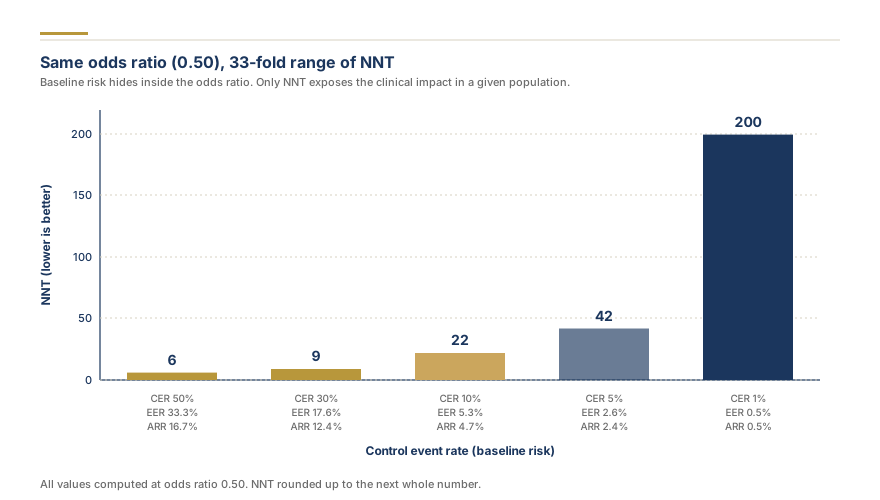
The same odds ratio produces vastly different NNT values depending on the control event rate. Consider an intervention with OR = 0.50:
| Control Event Rate | EER | ARR | NNT |
|---|---|---|---|
| 50% | 33.3% | 16.7% | 6 |
| 30% | 17.6% | 12.4% | 9 |
| 10% | 5.3% | 4.7% | 22 |
| 5% | 2.6% | 2.4% | 42 |
| 1% | 0.5% | 0.5% | 200 |
The same treatment (OR = 0.50) yields NNT = 6 in a high-risk population but NNT = 200 in a low-risk population. The GRADE Working Group requires specifying assumed baseline risks when calculating absolute effects in Summary of Findings tables.
For systematic review teams, three defensible choices for baseline risk exist: the median control event rate across included studies, a population-specific rate from registry data, or presenting NNT across a range of clinically plausible baseline risks (most transparent for guideline panels).
Confidence Intervals for NNT
Every NNT must be accompanied by a confidence interval. Derive from the ARR confidence interval. If ARR 95% CI is (0.04, 0.12): NNT = 13 (95% CI: 9 to 25).
The Discontinuity Problem
When the ARR confidence interval crosses zero, the NNT confidence interval becomes discontinuous. Altman (1998) proposed the notation NNTB 17 to infinity to NNTH 50, which the Cochrane Handbook has adopted. This accurately reflects genuine uncertainty about whether the treatment helps or harms.
For broader effect size calculations, use our online effect size tool.
Number Needed to Harm (NNH)
When ARR is negative (treatment increases risk), report as NNH (number needed to harm). NNH = 20 means for every 20 patients treated, one additional patient is harmed.
The ratio of NNT to NNH gives the likelihood of being helped versus harmed (LHH). If NNT = 15 for preventing stroke and NNH = 120 for major bleed, the LHH is 8: for every patient harmed, eight benefit. The GRADE evidence framework integrates these numbers into its balance of benefits and harms assessment.
NNT for Continuous Outcomes Using Cohen's d
When a meta-analysis reports a standardized mean difference (Cohen's d or Hedges' g), you can estimate an equivalent NNT using the formula by Kraemer and Kupfer (2006). A practical approximation: NNT = 1 / (d x 0.40) for d values between 0.2 and 1.5.
| Cohen's d | Approximate NNT |
|---|---|
| 0.20 (small) | 13 |
| 0.50 (medium) | 5 |
| 0.80 (large) | 4 |
This is useful when communicating continuous outcome results (pain scores, depression scales) to clinicians accustomed to NNT. For converting between effect size measures, see our compute effect size and the guide on converting between odds ratios, Cohen's d, and Hedges' g.