A search strategy systematic review is the structured, reproducible plan that defines exactly which databases you will search, which terms you will use, and how those terms are combined with Boolean operators to retrieve every relevant study on your research question. It is the single most consequential methodological decision in a systematic review, because every downstream step, from screening to meta-analysis, depends on the completeness and precision of your search. When your search is final, screen the records it returns after removing duplicates for a clean PRISMA count.
A poorly constructed search produces a biased review. An overly narrow search misses relevant studies. An overly broad search buries your team in thousands of irrelevant records. The search strategy is what separates a rigorous systematic review from a narrative literature review, and it is the component most scrutinized by peer reviewers, journal editors, and Cochrane assessors. Teams that want the search and screening handled to that standard often rely on a professional literature review writing service. In our systematic reviews, we build search strategies across 3-5 databases with librarian validation and PRESS peer review before executing a single search.
This guide walks you through the complete process of building a comprehensive, reproducible search strategy, from defining your PICO framework through MeSH and Emtree subject headings, Boolean logic, database selection, syntax translation, PRESS validation, and PRISMA 2020 documentation.
Document each database search in a reproducible search log.
Why Search Strategy Matters
The search strategy is the foundation upon which every systematic review stands. The Cochrane Handbook for Systematic Reviews of Interventions, Chapter 4 (Lefebvre et al., 2023), dedicates an entire chapter to searching because the validity of a systematic review is directly proportional to the comprehensiveness of its search. A systematic review that misses relevant studies produces biased estimates of treatment effects, overstates certainty, and may lead to clinical decisions that harm patients.
Consider the consequences. If your search strategy fails to retrieve three randomized controlled trials that show no treatment effect, your meta-analysis will overestimate the intervention's benefit. If your search misses studies from non-English databases or grey literature sources, your review is vulnerable to publication bias. These are not theoretical risks, they are documented in methodological research comparing systematic reviews that used comprehensive versus restricted search strategies.
Sensitivity refers to the proportion of all relevant studies that your search retrieves. A highly sensitive search captures nearly every relevant study but also returns many irrelevant records. Specificity refers to the proportion of retrieved records that are actually relevant. The tension between sensitivity and specificity is the central challenge of search strategy design.
For systematic reviews, sensitivity takes priority over specificity. It is better to screen 5,000 records and find 50 relevant studies than to screen 500 records and miss 20 relevant studies. The cost of over-inclusion is time spent screening. The cost of under-inclusion is a biased review. Cochrane guidance is explicit: err on the side of sensitivity (Lefebvre et al., 2023).
Reproducibility is the second pillar. Every search strategy must be documented with enough detail that another researcher could execute the identical search and retrieve the identical set of records. This requirement is codified in PRISMA 2020, which mandates that authors present the full search strategy for at least one database in a supplementary appendix (Page et al., 2021). Without reproducibility, the systematic review cannot be updated, replicated, or audited.
Building from PICO, Six Steps to a Complete Search
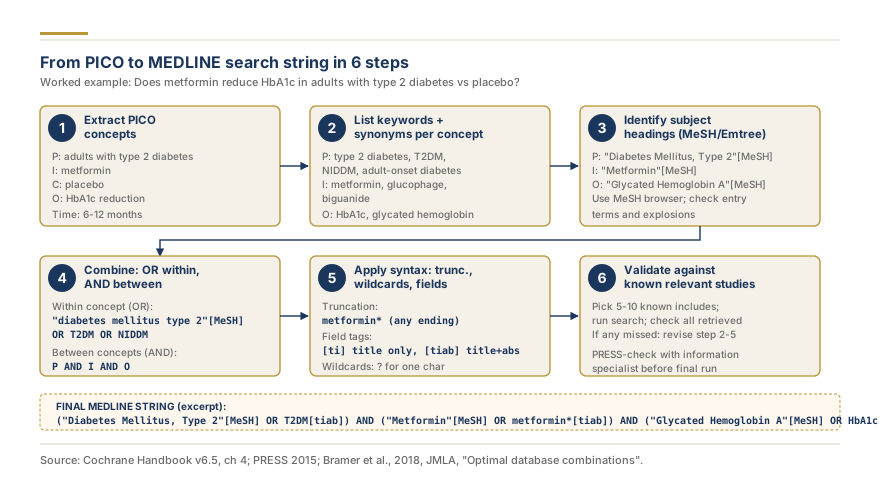
Every search strategy begins with a well-defined research question, and the PICO framework is the standard tool for structuring that question. PICO stands for Population, Intervention, Comparison, and Outcome. Each PICO element becomes a concept block in your search strategy, and the way you translate PICO into search terms determines whether your strategy is comprehensive or incomplete.
As you work through the six steps below, you can turn a PICO question into a database-ready Boolean string and keep every concept block in one place.
Step 1: Define your PICO elements clearly. Write out each element in plain language before touching a database. For example: Population = adults with type 2 diabetes; Intervention = metformin; Comparison = sulfonylureas; Outcome = glycated hemoglobin (HbA1c). The clearer your PICO, the easier the translation. Use our interactive pico framework builder to structure your question before building your search.
Step 2: Generate synonyms and related terms for each PICO element. For "type 2 diabetes," your synonym list might include: type 2 diabetes mellitus, T2DM, non-insulin-dependent diabetes, NIDDM, adult-onset diabetes. For "metformin," include brand names: Glucophage, Fortamet, Glumetza. Do not rely on a single term for any concept, the vocabulary of medicine is broad, and authors use different terminology across disciplines, countries, and time periods.
Step 3: Identify MeSH terms and Emtree terms for each concept. Search the MeSH Browser (meshb.nlm.nih.gov) for your population and intervention terms. Note the preferred MeSH heading, its tree number, and any relevant narrower terms. If you are searching Embase, repeat this process using the Emtree thesaurus. Subject headings are the backbone of a systematic search because they standardize terminology, a study about "sugar diabetes" and a study about "type 2 diabetes mellitus" are both indexed under the same MeSH heading.
Step 4: Combine synonyms within each concept block using OR. Within the population block, combine all your synonyms and MeSH terms with OR. Within the intervention block, do the same. OR is the Boolean operator that broadens your search, it tells the database to retrieve records containing any of the listed terms.
Step 5: Combine concept blocks using AND. Once each PICO element has its own block of OR-combined terms, join the blocks with AND. AND is the Boolean operator that narrows your search, it tells the database to retrieve only records that contain at least one term from every block. A typical systematic review search combines two to four concept blocks with AND.
Step 6: Add filters and limits only when justified. Language filters, date limits, and study design filters should be applied only with explicit methodological justification. The Cochrane Handbook warns against routine use of language restrictions because they introduce bias (Lefebvre et al., 2023). If you restrict to English-language publications, document why and acknowledge the limitation.
This six-step process produces a search strategy that is comprehensive, transparent, and reproducible. For a detailed walkthrough of the broader systematic review process, see our guide on how to write a systematic review step by step.
MeSH Terms, Emtree, and Subject Headings
Subject heading systems are controlled vocabularies maintained by database producers to standardize the indexing of biomedical literature. Understanding how they work is essential for building a search strategy that captures every relevant study, not just those that happen to use your preferred terminology in their title or abstract.
MeSH (Medical Subject Headings) is the controlled vocabulary used by the National Library of Medicine to index articles in PubMed and MEDLINE. Every article in MEDLINE is reviewed by trained indexers who assign MeSH terms based on the content of the article, regardless of the terminology the authors used. This means that a search using the MeSH term "Diabetes Mellitus, Type 2" will retrieve articles about T2DM, NIDDM, adult-onset diabetes, and any other synonym, as long as the article has been indexed.
Emtree is the controlled vocabulary used by Elsevier to index articles in Embase. Emtree is larger than MeSH, containing over 90,000 preferred terms compared to MeSH's approximately 30,000. Emtree includes more drug terms, device terms, and disease terms than MeSH, making it particularly valuable for pharmacological and device-related systematic reviews.
CINAHL Subject Headings are used in the Cumulative Index to Nursing and Allied Health Literature. They are based on MeSH but include additional terms specific to nursing, physiotherapy, occupational therapy, and other allied health disciplines. If your systematic review includes nursing or rehabilitation outcomes, CINAHL subject headings capture studies that MeSH may miss.
The critical principle is this: always combine subject headings with free-text searching. Subject headings only work for articles that have been indexed, and indexing takes time, recently published articles may not have MeSH terms assigned for weeks or months after publication. Free-text searching (searching title, abstract, and keyword fields) catches these unindexed articles as well as articles where the indexer chose a different MeSH term than you expected.
Within each concept block, combine your subject headings and free-text terms with OR. This is the standard approach recommended by the Cochrane Handbook and taught in every information literacy course for systematic reviewers. For a deeper understanding of Boolean logic in literature searching, see our Boolean search strategy guide.
Database Selection and Syntax, A Comparison
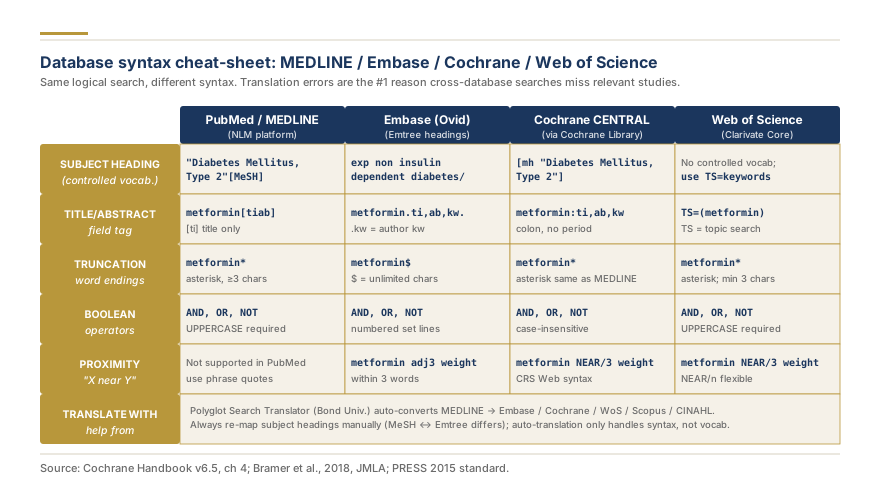
Choosing which databases to search is a methodological decision that directly affects the comprehensiveness of your review. The Cochrane Handbook recommends searching MEDLINE and at least one other database, but the optimal set depends on your research question, discipline, and the types of studies you need to find.
| Database | Producer | Subject Headings | Unique Content | Best For | Truncation | Proximity |
|---|---|---|---|---|---|---|
| PubMed/MEDLINE | NLM | MeSH | 36M+ records; free access | Biomedical, clinical | * | Not supported |
| Embase | Elsevier | Emtree | 43M+ records; strong pharma/device coverage | Pharmacology, devices, European literature | * | NEAR/n, NEXT/n |
| CINAHL | EBSCO | CINAHL Headings | Nursing, allied health journals not in MEDLINE | Nursing, rehabilitation, public health | * | Nn, Wn |
| Cochrane Library | Cochrane | MeSH | CENTRAL trial register; Cochrane Reviews | RCTs, systematic reviews | * | NEAR/n, NEXT/n |
| Web of Science | Clarivate | None (keyword only) | Citation indexing; multidisciplinary | Cross-disciplinary, citation tracking | * | NEAR/n |
| PsycINFO | APA | Thesaurus of Psychological Index Terms | Psychology, behavioral science | Mental health, behavioral interventions | * | Nn, Wn |
| Scopus | Elsevier | None (keyword only) | Largest abstract database; strong engineering | Multidisciplinary, non-biomedical | * | W/n, PRE/n |
PubMed is the most widely used database for biomedical systematic reviews and the logical starting point for most searches. It is free, its MeSH system is well-documented, and its search interface provides transparent automatic term mapping that shows you exactly how your query was interpreted. PubMed search strategy development benefits from the MeSH Browser, which lets you explore the hierarchical structure of subject headings and identify narrower terms you might otherwise miss.
Embase is essential for any systematic review in pharmacology, toxicology, or device-related topics. Embase indexes approximately 2,900 journals not covered by MEDLINE, with particularly strong coverage of European and non-English-language publications. Its Emtree thesaurus is more granular than MeSH for drug and device terms. Drug reviews also draw on regulatory and trial-registry sources, which our pharmacy and pharmacology review guide lists.
CINAHL adds value when your review involves nursing, allied health, or patient-reported outcomes. CINAHL indexes journals and conference proceedings not found in MEDLINE or Embase.
The Cochrane Library contains CENTRAL (the Cochrane Central Register of Controlled Trials), which aggregates trial records from multiple sources including MEDLINE, Embase, and hand-searched journals. Searching CENTRAL is particularly efficient for identifying randomized controlled trials.
Web of Science provides citation indexing, which enables forward citation searching, a strategy for finding studies that cited a known relevant article. This is a valuable supplement to traditional keyword searching and is recommended by the Cochrane Handbook as an additional search method.
For most biomedical systematic reviews, a minimum set of PubMed, Embase, and one discipline-specific database provides adequate coverage. Our dental systematic review guide shows how that choice plays out for oral health topics. Adding the Cochrane Library and Web of Science increases comprehensiveness further.
Want a comprehensive, peer-reviewer-approved search strategy? Our information specialists build and validate multi-database searches with full PRISMA documentation and sensitivity analysis. request an expert opinion on your project, or explore our systematic review search strategy support.
Translating Across Databases
One of the most common errors in systematic review search strategies is copying a PubMed search and pasting it directly into Embase or CINAHL. Each database uses different syntax, different field tags, different subject heading systems, and sometimes different truncation or proximity operators. A search that works perfectly in PubMed may retrieve zero results or wildly different results in another database if it is not properly translated.
A MeSH to Emtree syntax converter handles the mechanical part of this rewrite, though every translated line still needs a human check before you run it.
Subject heading translation is the most important step. Replace every MeSH term with its Emtree equivalent when moving to Embase. Use the Emtree browser to find the corresponding preferred term, it is not always a direct one-to-one match. Some MeSH terms map to multiple Emtree terms, and some Emtree terms have no direct MeSH equivalent. Similarly, when translating to CINAHL, replace MeSH terms with CINAHL Subject Headings.
Field tag translation requires changing the syntax that tells the database where to search. In PubMed, "[MeSH Terms]" searches the MeSH field. In Embase on Ovid, the equivalent is ".sh." or "/exp" on the Embase.com interface. In CINAHL on EBSCO, it is "(MH "term")". These differences seem minor but cause search failures when overlooked.
Truncation and wildcards are generally consistent across databases (the asterisk * is nearly universal), but proximity operators vary significantly. PubMed does not support proximity searching at all. Embase uses NEAR/n and NEXT/n. CINAHL on EBSCO uses Nn and Wn. Web of Science uses NEAR/n. If your PubMed search relies on phrase searching, you may want to use proximity operators in databases that support them to capture variations in word order.
Boolean operator handling is consistent across all major databases, AND, OR, and NOT work the same way, but the order of operations and nesting with parentheses can produce different results if not carefully managed. Always use explicit parentheses to control the logic of your search, and never rely on a database's default operator precedence.
A practical approach is to build and validate your search in PubMed first, then create a translation table that maps every PubMed element to its equivalent in each target database. This systematic translation process ensures nothing is lost in conversion and makes your search documentation complete for PRISMA 2020 reporting.
Our free free search translation tool automates much of this process, converting PubMed syntax into Embase, CINAHL, and Cochrane Library formats with the appropriate field tags and subject headings.