The PRISMA-P protocol checklist is a 17-item reporting guideline designed to ensure that systematic review protocols are complete, transparent, and reproducible before the review begins. Published by Shamseer et al. (2015), PRISMA-P (Preferred Reporting Items for Systematic review and Meta-Analysis Protocols) serves as the protocol-level counterpart to the PRISMA 2020 statement used for reporting completed systematic reviews (Page et al., 2021). If you are planning a systematic review, this checklist tells you exactly what to document and how to structure your protocol so that it meets the reporting standards expected by journals, funders, and registration platforms like PROSPERO.
A well-developed protocol is the foundation of a credible systematic review. It establishes the research question, defines eligibility criteria, pre-specifies the search strategy and synthesis methods, and identifies the tools you will use for risk of bias assessment. The PRISMA-P guidelines exist because protocols written without a structured framework tend to omit critical details, details that reviewers, editors, and peer evaluators will flag later. By following PRISMA-P from the start, you prevent post-hoc outcome switching, reduce the risk of bias in your own review process, and produce a document that is ready for PROSPERO registration or journal publication.
This guide walks through all 17 items, explains how PRISMA-P differs from PRISMA 2020, provides a practical workflow for writing your protocol, and identifies the most common mistakes researchers make when completing the checklist.
Turn this checklist into a plan with a ready-to-use protocol template.
Why PRISMA-P Was Developed
PRISMA-P was developed to address a persistent problem in evidence synthesis: systematic review protocols were being written with inconsistent quality, missing key methodological details, and failing to provide the transparency needed for replication. The EQUATOR Network, the international library of health research reporting guidelines, endorsed the guideline as the standard for protocol reporting in systematic reviews and meta-analyses.
The checklist was published in two companion papers, the checklist itself (Shamseer et al., 2015) and an explanation and elaboration document (Moher et al., 2015) that provides detailed guidance for each item. Together, these papers define what a complete systematic review protocol should contain.
PRISMA-P guides protocol development by structuring the document into three sections: Administrative Information (items 1-5), Introduction (items 6-7), and Methods (items 8-17). Each item corresponds to a specific element that the protocol must address. The checklist does not prescribe how to conduct the review, it prescribes what to report in the protocol so that readers can evaluate the planned methodology before data collection begins.
The relationship between PRISMA-P and the completed review is direct: PRISMA-P guides protocol development, and PRISMA 2020 guides the reporting of the finished review. A protocol written using PRISMA-P translates naturally into a PRISMA 2020-compliant report because the same methodological elements are addressed at both stages.
PRISMA-P vs PRISMA 2020, What Is the Difference?
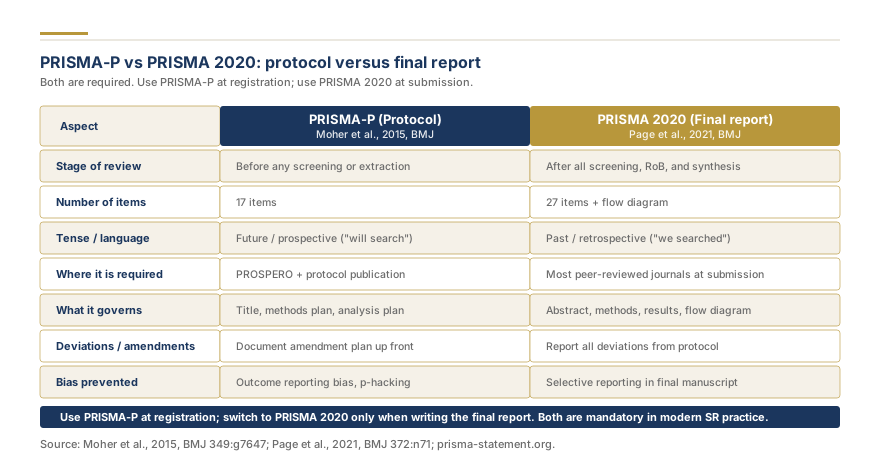
Researchers frequently confuse these two guidelines, but they serve distinct purposes at different stages of the review lifecycle. Understanding the difference is essential for applying each one correctly.
PRISMA-P addresses what to plan and document before the review begins. It covers items specific to the planning phase: protocol registration details, amendment procedures, and the rationale for the review. The PRISMA-P checklist ensures that your pre-specified methods are documented transparently so that deviations during the review can be identified and justified.
PRISMA 2020 (Page et al., 2021) addresses what to report after the review is complete. It covers items specific to the reporting phase: search results, study selection outcomes, the PRISMA flow diagram, synthesis results, and certainty of evidence assessments. For a detailed walkthrough, see our PRISMA 2020 guidelines explained guide.
The two checklists are complementary, not interchangeable. Here is a comparison of their key differences:
| Feature | PRISMA-P (Protocol) | PRISMA 2020 (Completed Review) |
|---|---|---|
| When to use | Before starting the review | When reporting the finished review |
| Number of items | 17 | 27 |
| Focus | What you plan to do | What you actually did |
| Registration | PROSPERO registration details | Registration number and protocol citation |
| Search strategy | Planned search strategy (draft) | Final executed search strategy |
| Results | Not applicable | Study selection, synthesis results |
| Flow diagram | Not included | Required (PRISMA flow diagram) |
| Amendments | Planned amendment process | Documented protocol deviations |
| Reference | Shamseer et al., 2015 | Page et al., 2021 |
A systematic review follows PRISMA 2020 reporting guidelines in the final manuscript, but that manuscript is stronger when the underlying protocol was developed using PRISMA-P. The protocol serves as the benchmark against which the completed review is evaluated.
The 17 PRISMA-P Checklist Items Explained
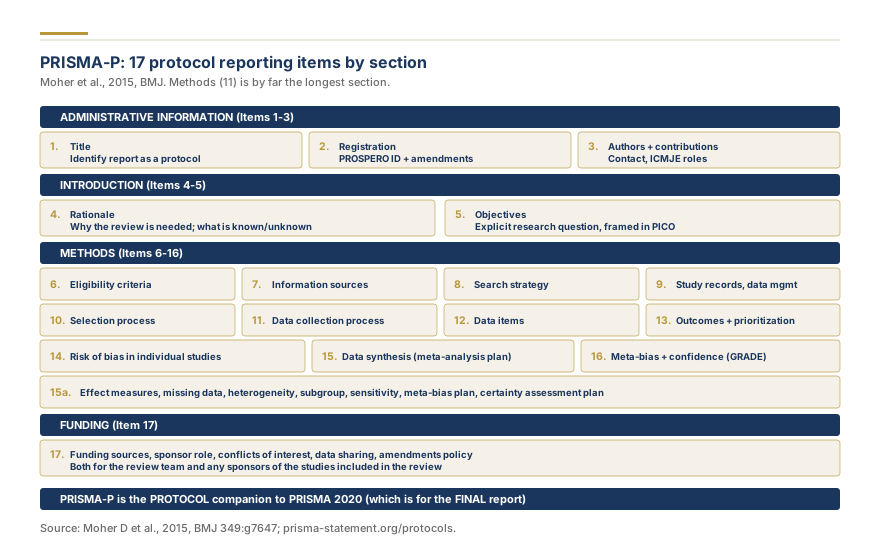
The 17 items in the PRISMA-P protocol checklist are organized into three sections. Each item requires specific information that must be documented in your protocol. The Cochrane Handbook (Higgins et al., 2023) provides additional methodological guidance for many of these elements.
Administrative Information (Items 1-5)
Item 1: Identification, Identify the protocol as a systematic review protocol in the title. Use terms like "protocol" and "systematic review" explicitly. A clear title ensures the document is indexed correctly in databases and registration platforms.
Item 2: Registration, Provide the registration number and registry name if the protocol has been registered. PROSPERO is the most widely used registry for systematic review protocols. If registration is pending, state this and provide the anticipated registry. For step-by-step guidance, see our our guide to prospero registration guide.
Item 3: Authors, List all protocol authors with their affiliations, contact details, and contributions. Specify the guarantor, the person responsible for the overall content of the protocol.
Item 4: Amendments, Describe the process for documenting any amendments to the protocol after registration. State where amendments will be recorded (e.g., PROSPERO update, published corrigendum, supplementary file with the final review).
Item 5: Support, Identify all sources of financial and non-financial support. Disclose the role of funders in the review process, including whether funders had any influence on the review question, methods, or interpretation.
Introduction (Items 6-7)
Item 6: Rationale, Describe the rationale for the review in the context of what is already known. Identify the gap in the existing evidence base that the review aims to address. Reference existing systematic reviews on the topic and explain why a new or updated review is needed.
Item 7: Objectives, Provide an explicit statement of the research question using a structured framework. The PICO framework structures research questions for intervention reviews (Population, Intervention, Comparator, Outcome). For qualitative or scoping reviews, use PCC (Population, Concept, Context) or another appropriate framework. State whether the review will address effectiveness, diagnostic accuracy, prognosis, or another question type.
Methods (Items 8-17)
Item 8: Eligibility criteria, Define the inclusion and exclusion criteria for studies. Specify the study designs to be included, the population characteristics, the intervention or exposure of interest, the comparator conditions, and the outcomes to be measured. Eligibility criteria must be specific enough that two independent reviewers would make the same inclusion decisions.
Item 9: Information sources, List all databases and sources to be searched, including gray literature sources, trial registries, and reference lists of included studies. Specify the date range for each source and any language restrictions. Name each database explicitly (e.g., MEDLINE via PubMed, Embase via Ovid, CINAHL via EBSCOhost).
Item 10: Search strategy, Present the full draft search strategy for at least one database. Include all search terms, Boolean operators, filters, and limits. The search strategy should be reproducible by an independent researcher using the same database.
Item 11: Study records, data management, Describe how records will be managed throughout the review. Specify the reference management software (e.g., EndNote, Zotero, Covidence) and how duplicates will be identified and removed.
Item 12: Study records, selection process, Describe the study selection process, including the number of reviewers who will screen titles, abstracts, and full texts. Specify how disagreements will be resolved (e.g., discussion, third reviewer, consensus). State whether a pilot screening exercise will be conducted.
Item 13: Study records, data collection process, Describe how data will be extracted from included studies. Specify whether a standardized data extraction form will be used, whether extraction will be performed independently by two reviewers, and how discrepancies will be resolved.
Item 14: Data items, List all variables for which data will be sought, including study characteristics, participant demographics, intervention details, outcome measures, and timing of assessments. Specify how missing data will be handled.
Item 15: Outcomes and prioritization, List the primary and secondary outcomes. Define each outcome including the metric, method of aggregation, and time points. Specify any outcome prioritization scheme.
Item 16: Risk of bias in individual studies, Describe the method for assessing risk of bias in included studies. Name the specific tools by study design: RoB 2 for randomized controlled trials, ROBINS-I for non-randomized studies of interventions, Newcastle-Ottawa Scale for observational studies, or other validated instruments. Specify who will conduct the assessments and how disagreements will be resolved. For practical guidance, see our online risk of bias assessment tool.
Item 17: Data synthesis, Describe the planned approach to data synthesis. For quantitative reviews, specify the meta-analysis model (fixed-effect or random-effects), the effect measure (risk ratio, odds ratio, mean difference, standardized mean difference), the software to be used, and the method for assessing statistical heterogeneity (e.g., I-squared, Cochran Q test). For qualitative synthesis, describe the narrative synthesis approach. Specify any planned subgroup analyses, sensitivity analyses, and meta-regression. State how publication bias will be assessed (e.g., funnel plot, Egger test).
Need help writing a PRISMA-P compliant protocol? Our team drafts complete systematic review protocols with PROSPERO registration support and journal-ready formatting. enquire about your research project, or explore our full-service systematic review support.