A systematic review protocol template is a structured document that pre-specifies every methodological decision you will make before you begin your review. The protocol defines your research question, eligibility criteria, search strategy, screening process, data extraction plan, risk of bias assessment, and synthesis approach, all documented and registered before a single study is screened. It is the blueprint that separates a rigorous systematic review from an ad hoc literature summary.
At Research Gold, we always develop the protocol first, it is the blueprint that guides every subsequent decision in the review process. Without a registered protocol, reviewers and editors have no way to verify that your methods were pre-specified rather than shaped by the results you found. This guide walks you through every section of a systematic review protocol, maps each section to the PRISMA-P checklist, and shows you how to register on PROSPERO.
Download a PRISMA-P-structured plan as a ready-made protocol file.
How a Protocol Locks Decisions Before the Data Arrive
The protocol serves the same function in evidence synthesis that a study protocol serves in clinical trials. Just as a clinical trial protocol prevents researchers from changing their primary outcome after seeing the data, a systematic review protocol prevents reviewers from adjusting eligibility criteria, analysis methods, or outcome definitions based on what the included studies happen to show. This transparency is fundamental to the credibility of the review.
A protocol is not a rough plan or a set of notes. It is a formal document that contains enough detail for another researcher to execute the review independently. When published or registered, it becomes a public commitment to a specific set of methods, and any departures from that commitment must be documented and justified.
The Cochrane Handbook for Systematic Reviews of Interventions (Chapter 3) states that writing the protocol is one of the most important steps in the review process. The Handbook emphasizes that the protocol should be developed iteratively with input from the review team, methodologists, and information specialists before it is finalized and registered.
Why You Need a Protocol
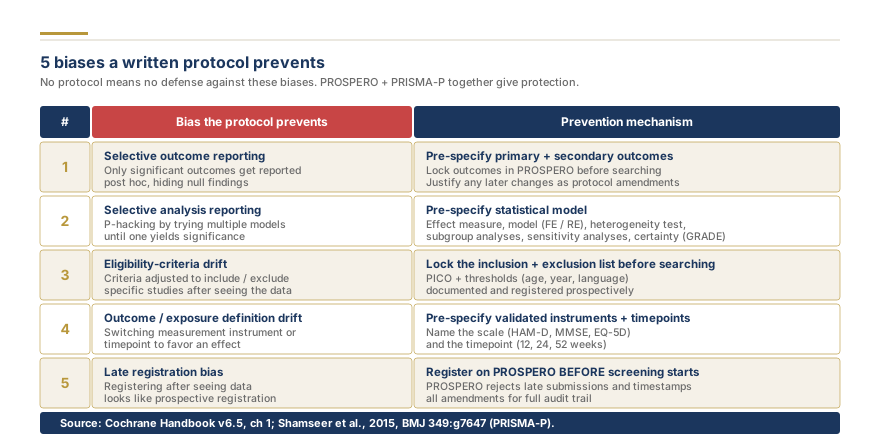
Writing a protocol takes time and effort, and researchers under pressure to publish sometimes question whether it is necessary. The evidence is clear: a protocol strengthens every aspect of your systematic review.
Prevents selective reporting. Without a pre-specified protocol, there is no way to verify that you did not change your eligibility criteria after seeing which studies were available, or add an outcome measure after discovering a significant result. Selective reporting undermines the entire purpose of systematic review methodology. A registered protocol creates a time-stamped record of your original intentions.
Reduces methodological bias. When decisions about inclusion criteria, search scope, and analysis methods are made in advance, they cannot be influenced by the data. This is the same principle that underpins pre-registration of clinical trials and has been widely adopted across the evidence synthesis community.
Improves team coordination. For reviews with multiple authors, the protocol is the reference document that keeps everyone aligned. When a disagreement arises during screening, does this study meet the age criterion?, the protocol provides the answer. Without it, decisions become inconsistent and subjective.
Increases publication credibility. Many high-impact journals now require or strongly recommend protocol registration before they will consider a systematic review for publication. Editors and peer reviewers check whether your methods match your protocol. Deviations without justification raise red flags.
Avoids duplication. Registering your protocol on PROSPERO makes your planned review visible to the research community. Other teams considering a similar review can see that yours is underway, reducing wasted effort and unnecessary duplication. The reverse check matters too: find out whether your topic is already covered before you write the protocol.
Supports reproducibility. A detailed protocol allows other researchers to evaluate your methodological choices, replicate your search strategy, and assess whether your review can be updated in the future. Reproducibility is a cornerstone of the scientific method, and the protocol is where it begins for systematic reviews.
The PRISMA-P Checklist: 17 Items for Protocol Reporting
The PRISMA-P (Preferred Reporting Items for Systematic Reviews and Meta-Analyses Protocols) checklist was published by Shamseer et al. (2015) to standardize the content and reporting of systematic review protocols. It contains 17 items organized into three sections: administrative information, introduction, and methods. Every item should be addressed in your protocol.
| # | PRISMA-P Item | Section | What to Include |
|---|---|---|---|
| 1 | Title identification | Admin | Identify the document as a protocol; include "protocol" in the title |
| 2 | Registration | Admin | Registration number and registry name (e.g., PROSPERO CRD42026XXXXXX) |
| 3a | Authors and contact | Admin | Full names, affiliations, corresponding author contact details |
| 3b | Contributions | Admin | Each author's planned contribution to the review |
| 4 | Amendments | Admin | Mechanism for documenting protocol amendments |
| 5a | Sources of support | Admin | Funding sources and their role in the review |
| 5b | Sponsor | Admin | Name and contact information for the sponsor |
| 6 | Rationale | Introduction | Context for the review: what is known and what gap exists |
| 7 | Objectives | Introduction | Research question using PICO or PCC framework |
| 8 | Eligibility criteria | Methods | Inclusion and exclusion criteria for studies |
| 9 | Information sources | Methods | Databases, registers, grey literature sources, date limits |
| 10 | Search strategy | Methods | Complete search string for at least one database |
| 11a | Study records, data management | Methods | How records will be managed (e.g., reference management software) |
| 11b | Study records, selection process | Methods | Screening process: independent dual screening, conflict resolution |
| 11c | Study records, data collection | Methods | Data extraction process: forms, piloting, variables to extract |
| 12 | Outcomes and prioritization | Methods | Primary and secondary outcomes, how they will be measured |
| 13 | Risk of bias in individual studies | Methods | Tool(s) to be used (RoB 2, ROBINS-I, NOS), domains assessed |
| 14 | Data synthesis | Methods | Narrative synthesis plan, meta-analysis model if applicable, heterogeneity assessment |
| 15a | Meta-bias(es) | Methods | Plans to address publication bias and selective outcome reporting |
| 15b | Confidence in cumulative evidence | Methods | GRADE or equivalent certainty assessment approach |
| 16 | Dissemination plans | Methods | How results will be published and shared |
| 17 | Ethics and dissemination | Methods | Ethical approval (usually not required) and dissemination strategy |
Shamseer et al. (2015) designed PRISMA-P so that each item maps directly to a section of the protocol document. Use this checklist as a writing guide: address each item in order, and your protocol will be complete. The EQUATOR Network hosts the full checklist with elaboration and explanation for each item.
Need a professionally written systematic review protocol? Our methodologists draft complete protocols with PICO frameworks, search strategies, and PROSPERO-ready registration documents. get a free funnel plot analysis estimate, or explore our systematic review protocol support.
Key Sections of a Systematic Review Protocol
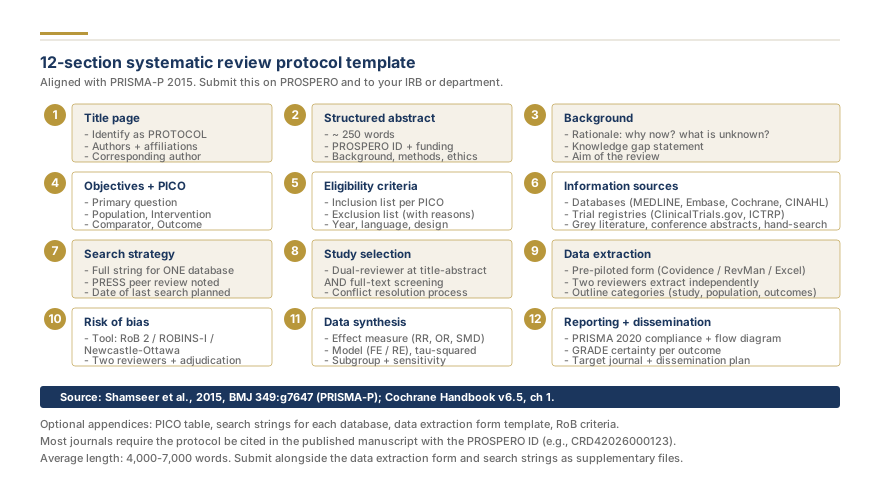
While the PRISMA-P checklist tells you what to report, the following sections describe how to write each component with sufficient methodological detail. Each section corresponds to one or more PRISMA-P items.
Research Question Using PICO or PCC
The research question is the foundation of your protocol. For intervention reviews, structure it using the PICO framework: Population, Intervention, Comparator, Outcome. For scoping reviews or qualitative evidence syntheses, use the PCC framework: Population, Concept, Context.
A well-constructed PICO question constrains every other decision in the protocol. The Population defines your eligibility criteria. The Intervention and Comparator define what you are comparing. The Outcome defines what you will measure and synthesize. If your PICO is vague, your protocol will be vague, and your review will suffer from inconsistent decision-making.
For example, a PICO question might read: "In adults aged 18 years and older with type 2 diabetes (P), does structured exercise training (I) compared with usual care (C) reduce HbA1c levels (O)?" Every word in that question carries methodological implications. "Adults aged 18 years and older" means you will exclude pediatric studies. "Structured exercise training" means you need to define what counts as structured. "Usual care" means you need to define what you accept as a comparator. "HbA1c levels" means you need studies that report this specific outcome measure.
Use our free try the pico framework builder to structure your research question before drafting the rest of the protocol. The tool helps you define each element precisely and generates a formatted PICO statement ready for your protocol document.
Eligibility Criteria
Eligibility criteria translate your PICO or PCC framework into explicit inclusion and exclusion rules. Every study you encounter during screening will be evaluated against these criteria, so they must be specific, measurable, and unambiguous.
State your criteria across the standard PICOS dimensions plus study design:
| Dimension | Inclusion Criteria | Exclusion Criteria |
|---|---|---|
| Population | Adults aged 18+ with confirmed type 2 diabetes | Type 1 diabetes, gestational diabetes, prediabetes |
| Intervention | Structured exercise programs (minimum 4 weeks duration, at least 2 sessions per week) | Unstructured physical activity advice, single-session interventions |
| Comparator | Usual care, no exercise, waitlist control | Active comparator interventions (e.g., dietary programs) |
| Outcome | HbA1c measured at any time point post-intervention | Studies not reporting HbA1c |
| Study design | Randomized controlled trials | Non-randomized studies, case reports, reviews |
| Other | Published in English, peer-reviewed | Conference abstracts without full-text, animal studies |
Each criterion should be justified. Why exclude non-English studies? Because resources for translation are unavailable and the expected impact on findings is minimal. Why require a 4-week minimum? Because shorter interventions are unlikely to produce measurable changes in HbA1c. Peer reviewers will ask these questions, answer them in the protocol.
Our Inclusion/Exclusion Criteria generator can help you draft and organize these criteria systematically.
Search Strategy
The search strategy is arguably the most technically demanding section of the protocol. It must be comprehensive enough to identify all relevant studies, reproducible enough for another researcher to execute independently, and documented with sufficient detail for peer review.
Your protocol should specify the databases you will search (e.g., MEDLINE via PubMed, Embase via Ovid, CENTRAL, PsycINFO, CINAHL), any supplementary sources (trial registries, grey literature databases, reference lists of included studies, citation searching), the date range for the search, and any language or publication type restrictions.
Include the full search string for at least one database. For MEDLINE, this typically combines MeSH terms and free-text terms using Boolean operators (AND, OR, NOT). The search strategy is usually developed in collaboration with an information specialist or librarian, their expertise ensures that your search is both sensitive (capturing all relevant studies) and specific (excluding irrelevant records).
A well-written search strategy section looks something like this: "We will search MEDLINE (via PubMed), Embase (via Ovid), CENTRAL (via Cochrane Library), CINAHL (via EBSCOhost), and PsycINFO (via Ovid) from inception to the date of the search. The search strategy was developed in consultation with a research librarian and combines controlled vocabulary terms with free-text synonyms. The full MEDLINE search strategy is provided in Appendix 1. We will also search ClinicalTrials.gov and the WHO International Clinical Trials Registry Platform for ongoing or completed trials. Reference lists of included studies and relevant systematic reviews will be screened for additional eligible studies."
For a comprehensive walkthrough of building search strategies and completing each stage of the review, see our guide on how to write a systematic review step by step.
Screening Process
The screening section describes how you will select studies from the search results. State the screening software you will use (e.g., Covidence, Rayyan, EPPI-Reviewer), the number of reviewers who will independently screen titles and abstracts, the process for resolving disagreements, and whether you will pilot the screening criteria on a sample of records before full screening begins.
Best practice requires two independent reviewers to screen all records at both the title/abstract stage and the full-text stage. Disagreements should be resolved by discussion, with a third reviewer available to arbitrate if consensus cannot be reached. Pilot screening on a random sample of 50-100 records helps calibrate the team and identify ambiguities in the eligibility criteria before committing to full screening.
State the anticipated flow of records. While you will not know exact numbers at the protocol stage, you can describe the process: "Records identified from database searches will be imported into reference management software and deduplicated. Unique records will be screened independently by two reviewers at the title and abstract level. Records selected by either reviewer will proceed to full-text screening. Full-text articles will be assessed independently by two reviewers against the eligibility criteria. Reasons for exclusion at the full-text stage will be recorded and reported in a PRISMA flow diagram."
Data Extraction
The data extraction section specifies what data you will collect from each included study and how. Define the variables to be extracted, typically study characteristics (author, year, country, setting, design), participant characteristics (sample size, age, sex, disease severity), intervention details (type, duration, frequency, intensity), comparator details, and outcome data (means, standard deviations, event counts, follow-up duration).
Describe the extraction process: will you use a standardized form? Will it be piloted? Will two reviewers extract data independently, or will one extract and a second verify? State how you will handle missing data, will you contact study authors? Use imputation methods? Exclude studies with insufficient data?
The protocol should include a draft data extraction form or at minimum list every variable that will be extracted. This level of detail prevents post-hoc additions of variables that were not part of the original plan.
Risk of Bias Assessment
Name the specific risk of bias tool you will use for each study design included in your review. Do not write "risk of bias will be assessed", this is too vague. State the exact tool and version.
| Study Design | Risk of Bias Tool | Reference |
|---|---|---|
| Randomized controlled trials | RoB 2 (Revised Cochrane Risk of Bias Tool) | Sterne et al. (2019) |
| Non-randomized studies of interventions | ROBINS-I | Sterne et al. (2016) |
| Observational (cohort, case-control) | Newcastle-Ottawa Scale (NOS) | Wells et al. |
| Diagnostic accuracy studies | QUADAS-2 | Whiting et al. (2011) |
| Qualitative studies | CASP Qualitative Checklist | Critical Appraisal Skills Programme |
Describe the assessment process: two independent reviewers, with disagreements resolved by discussion or a third reviewer. State how risk of bias results will be incorporated into your synthesis, will you conduct sensitivity analyses excluding high risk-of-bias studies? Will you use GRADE to downrate certainty of evidence based on risk of bias?
Synthesis Method
The synthesis section describes how you will combine and present the findings of included studies. This is where you distinguish between narrative (qualitative) synthesis and statistical (quantitative) meta-analysis, and where you pre-specify the details of each approach.
For narrative synthesis, describe the framework you will follow (e.g., Synthesis Without Meta-analysis, SWiM guidelines by Campbell et al., 2020). State how you will group and compare studies, what visual displays you will use (harvest plots, effect direction plots), and how you will assess the consistency of findings across studies.
For meta-analysis, specify the statistical model (random-effects or fixed-effect, with justification), the effect measure (risk ratio, odds ratio, mean difference, standardized mean difference), the software you will use (R metafor, RevMan, Stata), and how you will assess and explore heterogeneity (I-squared statistic, prediction intervals, subgroup analyses, meta-regression).
Pre-specify the conditions under which you will or will not conduct a meta-analysis. A common statement is: "We will conduct meta-analysis when at least two studies report the same outcome using comparable measures and the clinical and methodological heterogeneity across studies is judged to be sufficiently low. When meta-analysis is not appropriate, we will present results using narrative synthesis following the SWiM guidelines."
State your planned subgroup analyses and sensitivity analyses. Subgroup analyses might compare results by age group, intervention duration, or risk of bias category. Sensitivity analyses might exclude studies with high risk of bias, studies with imputed data, or studies published only as conference abstracts.