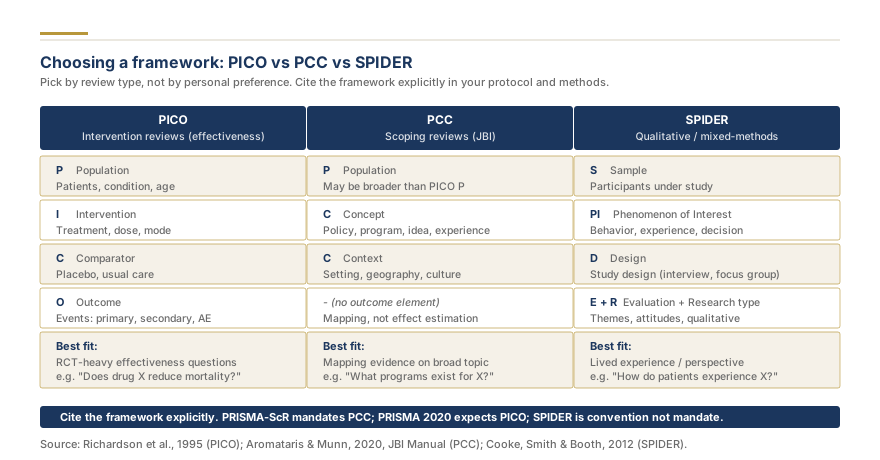
A PICO framework research question is a structured clinical inquiry composed of four elements, Population, Intervention, Comparison, and Outcome, that defines the scope of a systematic review by specifying exactly who is studied, what treatment is evaluated, what it is compared against, and what result is measured. PICO transforms vague research interests into answerable, searchable questions.
Every systematic review begins with a question, but not every question leads to a successful review. The difference between a productive eighteen-month project and an abandoned one often comes down to how precisely that question was formulated. The PICO framework is the methodological tool that bridges the gap between clinical curiosity and rigorous evidence synthesis. When we develop systematic review protocols, defining the PICO question takes longer than any other step, and it should. A well-crafted PICO prevents scope creep that can add months to your timeline, eliminates ambiguity during title and abstract screening, and provides the structural backbone for your search strategy, eligibility criteria, and data extraction form.
The Cochrane Handbook for Systematic Reviews of Interventions identifies PICO as the recommended approach for formulating review questions about the effects of interventions (Higgins et al., 2023). PROSPERO registration requires you to state your question in structured format, and the PICO elements map directly to the registration fields. Whether you are conducting a clinical effectiveness review, a public health evaluation, or a health services research synthesis, the PICO research question is where your review protocol begins. Structure your research question with our free our pico framework generator, supports PICO, PCC, and SPIDER formats.
The Four PICO Elements and What Each One Excludes
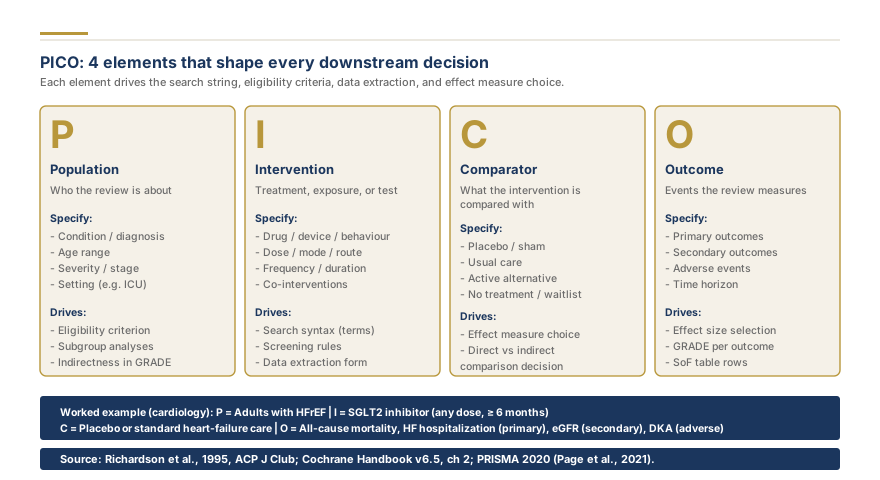
PICO stands for Population (who), Intervention (what treatment or exposure), Comparison (what alternative), and Outcome (what result). Each element serves a dual purpose: it defines what the review will include and, equally important, what it will exclude. A PICO question structures a systematic review so that every downstream decision, from database selection to risk of bias assessment, flows logically from the original formulation.
Richardson et al. (1995) introduced the PICO structure as a framework for formulating "well-built clinical questions" that facilitate efficient literature searching. Since then, PICO has become the dominant method taught in evidence-based practice courses, embedded in reporting guidelines like PRISMA 2020, and required by protocol registration platforms including PROSPERO and the Cochrane Library.
The power of PICO lies in its precision. A vague question like "Does exercise help diabetes?" cannot guide a systematic search. But reformulated as a PICO systematic review question, "In adults with type 2 diabetes (P), does structured aerobic exercise (I) compared to usual care (C) reduce HbA1c levels (O)?", every word becomes actionable. The population defines your eligibility criteria. The intervention and comparison define your search terms and study design requirements. The outcome defines your primary endpoint for data extraction and, if applicable, meta-analysis.
How Each PICO Element Shapes Your Review
Each element of the PICO framework does more than describe your research question, it directly determines the operational decisions you will make at every stage of your systematic review. Understanding how each component translates into protocol-level decisions is essential for avoiding the most common pitfalls in review design.
Population
The Population element defines who is included in your review. This is not simply a demographic descriptor, it is your primary inclusion criterion. With your PICO set, screen studies against your eligibility concepts in a free browser tool. Population specification determines which studies your screening team will accept and which they will reject during title and abstract review.
A well-defined population includes the condition or disease of interest, the demographic boundaries (age, sex, clinical setting), and any relevant clinical characteristics. "Adults with hypertension" is a starting point, but a review-ready population definition might specify "adults aged 18 years and older with diagnosed essential hypertension (systolic blood pressure greater than or equal to 140 mmHg), excluding those with secondary hypertension or concurrent renal disease."
The specificity of your population directly affects your search yield. A population defined too broadly will return thousands of irrelevant records, increasing screening burden without improving evidence quality. A population defined too narrowly may exclude studies that provide valuable indirect evidence. The Cochrane Handbook recommends defining the population at a level of specificity where two independent reviewers would reach the same eligibility decision for the same study (Higgins et al., 2023).
Intervention
The Intervention element specifies the treatment, exposure, diagnostic test, or prognostic factor under investigation. In clinical effectiveness reviews, this is typically a drug, surgical procedure, behavioral intervention, or health service delivery model. In public health reviews, interventions may include policy changes, educational programs, or environmental modifications.
Defining the intervention requires decisions about dosage, duration, delivery mode, and provider qualifications. "Cognitive behavioral therapy" is too broad for most systematic reviews. "Individual face-to-face CBT delivered by a licensed psychologist over 12 or more weekly sessions" is operationally precise. These details feed directly into your search strategy, each characteristic becomes a search term or filter, and into your data extraction form, where you will record intervention parameters for each included study.
For reviews that examine exposures rather than treatments, the Intervention element is sometimes relabeled as Exposure, creating the PECO framework (Population, Exposure, Comparison, Outcome). The logic is identical: define what is being studied with enough precision to guide screening, searching, and extraction.
Comparison
The Comparison element identifies what the intervention is being measured against. In randomized controlled trials, this is typically a placebo, standard care, waitlist control, or an active comparator. The choice of comparator fundamentally shapes the clinical relevance of your review findings.
Some reviews omit the comparison element entirely, creating a PIO structure. This is acceptable when the research question asks "What is the effect of X?" without specifying a reference group. However, the Cochrane Handbook notes that an explicit comparator strengthens a review's clinical applicability and makes the research question more answerable (Higgins et al., 2023). "Does mindfulness-based stress reduction reduce anxiety?" is weaker than "Does mindfulness-based stress reduction reduce anxiety compared to pharmacological treatment with SSRIs?" The second formulation produces a review with direct clinical decision-making value.
When defining the comparison, consider whether you want a single comparator or multiple comparison groups. A review comparing a new drug to placebo produces different evidence than one comparing the same drug to all existing treatments. Multiple comparators may require a network meta-analysis framework rather than standard pairwise meta-analysis.
Outcome
The Outcome element specifies what you are measuring. Primary outcomes should be clinically meaningful endpoints that matter to patients, clinicians, or policymakers. Secondary outcomes provide supporting evidence but do not define the scope of the review.
Outcome specification includes the measurement instrument (e.g., PHQ-9 for depression, HbA1c for glycemic control), the time point of assessment (e.g., at 6 months post-intervention), and the direction of effect that constitutes improvement. A review that specifies "depression symptoms" as the outcome will struggle during data extraction when included studies use different scales, different time points, and different thresholds for clinical significance.
Clear outcome definition is particularly critical for meta-analysis. If your PICO outcome is "pain measured by visual analogue scale at 12 weeks," you can pool effect sizes directly. If your outcome is simply "pain," you will face heterogeneity in measurement that complicates quantitative synthesis.
Once your PICO is defined, build your eligibility criteria with our inclusion/exclusion criteria tool.
PICO Examples for Systematic Reviews
Seeing the PICO framework applied to real research questions clarifies how abstract elements translate into operational review parameters. Below are three worked PICO examples spanning clinical, public health, and educational research domains. Each example demonstrates how the four elements interact to create a focused, answerable question for a systematic review.
| Element | Clinical Example | Public Health Example | Education Example |
|---|---|---|---|
| Population | Adults (18+) with chronic low back pain lasting more than 12 weeks | Adolescents aged 12-18 in low-income urban communities | Undergraduate nursing students in accredited programs |
| Intervention | Structured yoga program (minimum 8 weeks, supervised sessions) | School-based mental health literacy programs | Simulation-based clinical education (high-fidelity mannequins) |
| Comparison | Standard physiotherapy (exercise and manual therapy) | No intervention or standard health education curriculum | Traditional clinical placement in hospital settings |
| Outcome | Pain intensity (NRS or VAS) and functional disability (ODI) at 6 months | Mental health help-seeking behavior (validated scale) at 12 months | Clinical competence scores (OSCE) at end of program |
| Full Question | In adults with chronic low back pain, does a structured yoga program compared to standard physiotherapy reduce pain intensity and functional disability at 6 months? | In adolescents in low-income urban communities, do school-based mental health literacy programs compared to standard health education improve help-seeking behavior at 12 months? | In undergraduate nursing students, does simulation-based clinical education compared to traditional hospital placement improve clinical competence scores? |
Each of these PICO elements maps directly to search strategy construction. The population terms become one search block, the intervention terms become another, the comparison may or may not generate its own block depending on specificity, and the outcome terms form the final block. Combined with Boolean operators, these blocks create a reproducible Boolean search strategy that retrieves studies from databases systematically.
Notice the level of specificity in each example. The clinical PICO does not just say "yoga", it specifies minimum duration and supervision requirements. The public health PICO does not just say "mental health intervention", it specifies the delivery setting and target mechanism. This precision is what separates a PICO that guides efficient screening from one that produces unmanageable search results.
Need help structuring your research question and systematic review protocol? Our team develops focused PICO frameworks, comprehensive search strategies, and PROSPERO-ready protocols. find out what your project will cost, or learn more about our systematic review question development support.