Learn how to write clear inclusion and exclusion criteria for your systematic review using PICO, apply them consistently across reviewers, and document them for PRISMA compliance.
Dr. Sarah Mitchell
February 26, 2026
Key Takeaways
Inclusion and exclusion criteria must be defined before the search begins and documented in both the protocol and the PRISMA methods section
Base your eligibility criteria on the PICO framework: Population, Intervention, Comparison, Outcome, and add Study Design as a fifth element
Overly broad criteria increase screening burden exponentially, while overly narrow criteria risk missing relevant studies and reducing the review's generalizability
Pilot test your criteria on a sample of 50-100 records with all reviewers before beginning full screening to calibrate agreement
Document reasons for exclusion at the full-text stage using predefined categories to populate your PRISMA flow diagram accurately
Common mistakes include adding criteria after screening has begun, using subjective language, and not specifying language or date restrictions
Inclusion and exclusion criteria are the predefined rules that determine which studies are eligible for your systematic review. They are the most consequential methodological decision you make after formulating your research question, because they directly control what evidence enters your review and therefore what conclusions you can draw. Poorly defined criteria lead to inconsistent screening, missed relevant studies, inclusion of irrelevant studies, and reviewer disagreements that delay the entire review process. Once your rules are set, screen records against your eligibility criteria with structured exclusion reasons that tally automatically.
Eligibility criteria must be established during protocol development, before the search begins, and documented in your PROSPERO registration and protocol. Changing criteria after screening starts introduces selection bias and violates the transparency principles that distinguish systematic reviews from narrative literature reviews. This guide covers how to develop clear, operational criteria based on your research question, apply them consistently across reviewers, handle borderline cases, and document everything for our guide to prisma 2020 compliance.
What Are Inclusion and Exclusion Criteria?
Exclusion criteria specify characteristics that disqualify a study, even if it otherwise meets inclusion criteria. Exclusion criteria address factors like publication type, language, or specific methodological features that make a study unsuitable.
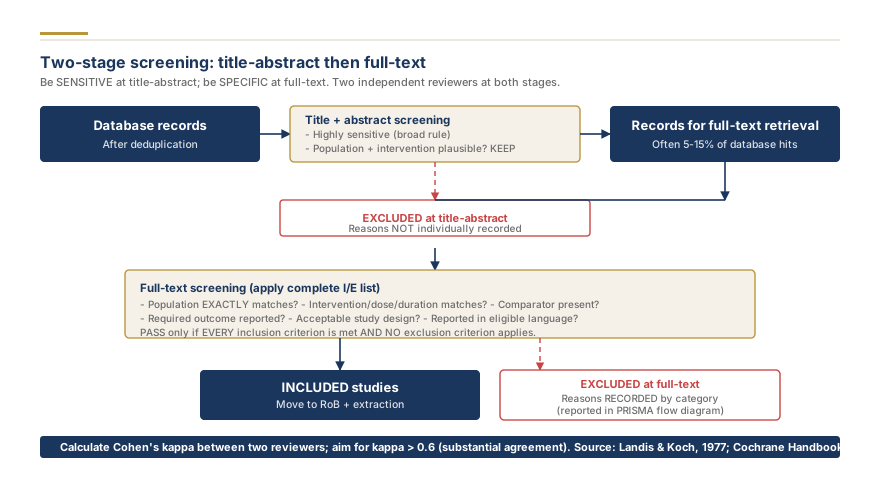
Together, these criteria define your review's eligibility framework. Every study identified by your search is assessed against this framework, first at the title-abstract screening stage and then again at full-text review. The process must be conducted by at least two independent reviewers to minimize individual bias.
The Relationship Between PICO and Eligibility Criteria
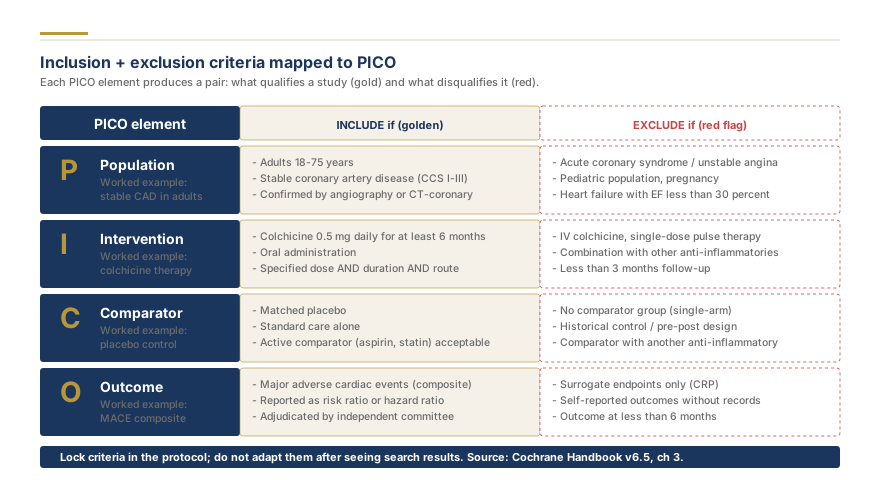
Your eligibility criteria are directly derived from your research question, which should be structured using the PICO framework (or PCC for scoping reviews). Each PICO element translates into one or more eligibility criteria.
PICO Element
Becomes
Example
Population
Who is included
Adults over 18 with type 2 diabetes
Intervention
What treatment/exposure
Cognitive behavioral therapy delivered by trained therapists
Comparison
What alternative
Usual care, waitlist control, or active comparator
I/E criteria mapped to PICO with worked example. Source: Cochrane Handbook v6.5, ch 3.
Effective inclusion criteria are specific, measurable, and unambiguous. Every reviewer reading your criteria should reach the same decision about the same study. Vague criteria are the single biggest source of screening disagreements and reviewer frustration.
Population Criteria
Define your target population with enough specificity to exclude irrelevant studies while remaining broad enough to capture all relevant evidence.
Too vague: "Studies involving patients with diabetes"
Clear: "Adults aged 18 years or older with a clinical diagnosis of type 2 diabetes mellitus, diagnosed using WHO or ADA criteria. Studies including mixed populations are eligible if results for type 2 diabetes are reported separately."
Key population considerations:
Age range: Specify exact boundaries (18+, 0-17, 65+)
Diagnosis: Reference specific diagnostic criteria or classification systems
Setting: Inpatient, outpatient, community, primary care
Geography: Worldwide or limited to specific regions (justify any restriction)
Mixed populations: State whether studies with mixed populations are included and under what conditions
Intervention Criteria
Define the intervention precisely enough that reviewers can consistently identify it across different study descriptions.
Too vague: "Exercise interventions"
Clear: "Structured exercise programs involving at least 150 minutes per week of moderate-intensity aerobic activity, delivered for a minimum of 8 weeks, with documented supervision or adherence monitoring. Home-based and facility-based programs are both eligible."
Key intervention considerations:
Type: What specific intervention or exposure
Dose/intensity: Minimum thresholds for inclusion
Duration: Minimum intervention length
Delivery: Who delivers it, in what setting
Fidelity: Any requirements for intervention adherence or protocol compliance
Comparison Criteria
Specify what comparators are acceptable, or state that any comparator (including no comparator) is eligible.
Examples:
"Any active comparator, placebo, usual care, or waitlist control"
"Usual care or no intervention only (active comparator studies excluded)"
"No comparator required (single-arm studies eligible)"
Outcome Criteria
Define which outcomes must be reported for a study to be included. Decide whether you require specific outcomes or will include studies reporting any relevant outcome.
Strict approach: "Studies must report at least one of the following primary outcomes: all-cause mortality, cardiovascular events, or HbA1c change from baseline"
Flexible approach: "Studies reporting any patient-relevant outcome related to diabetes management"
Study Design Criteria
Specify which study designs are eligible. This is one of the most impactful criteria because it determines the volume and type of evidence in your review.
Language: State language restrictions if any (and justify them)
Date range: Specify if studies before a certain date are excluded (e.g., "Published before January 2000")
Duplicate populations: "If multiple publications report the same study population, only the most comprehensive or most recent publication will be included"
Specific methodological features: "Studies with fewer than 10 participants per arm" or "Studies without a control group"
Full text availability: "Studies for which the full text could not be obtained after contacting authors"
Important: Exclusion criteria should not simply restate the inverse of inclusion criteria. If your inclusion criterion is "adults aged 18+," you do not need a separate exclusion criterion for "studies of children." Only add exclusion criteria that address additional factors beyond what inclusion criteria already define.
Need expert support developing your eligibility criteria and managing the screening process? Our methodologists build precise criteria, validate them against pilot screening samples, and conduct dual-reviewer screening for your entire review. request a consultation for your study to discuss your project, or see our systematic review screening support.
Pilot Testing Your Criteria
Before beginning full screening, pilot test your criteria on a sample of 50 to 100 records with all reviewers. This is one of the most important steps in the systematic review process and is frequently skipped, leading to problems that cost weeks to resolve later.
How to Pilot Test
Select a random sample of 50 to 100 title-abstract records from your search results
Have all reviewers independently screen the sample using your eligibility criteria
Compare decisions and calculate inter-rater agreement (Cohen's kappa or percent agreement)
Discuss all disagreements and identify which criteria caused confusion
Revise criteria wording to resolve ambiguities
Repeat with a new sample if agreement was below 80 percent
Document the final, refined criteria in your protocol
What Good Agreement Looks Like
Kappa above 0.80: Excellent agreement, proceed with full screening
Kappa 0.60 to 0.80: Substantial agreement, minor revisions may help
Kappa below 0.60: Moderate or poor agreement, criteria need significant revision
At this stage, reviewers assess each record based on the information available in the title and abstract. The general rule is include if uncertain. If the title and abstract do not provide enough information to confidently exclude a study, it should advance to full-text review.
Use systematic review software like Covidence or Rayyan for efficient dual-reviewer screening with conflict resolution. For guidance on building your learn about search strategy that feeds into screening, see our dedicated guide.
Full-Text Screening
At full-text review, apply your criteria more rigorously using the complete study report. For each excluded study, record the primary reason for exclusion using predefined categories that correspond to your eligibility criteria. These reasons populate the "Excluded studies" section of your PRISMA flow diagram.
Common exclusion reason categories:
Wrong population
Wrong intervention/exposure
Wrong comparator
Wrong outcome
Wrong study design
Duplicate publication
Full text unavailable
Wrong publication type (e.g., conference abstract only)
Handling Borderline Cases
Borderline studies are inevitable. Establish a process for handling them before screening begins:
Decision rules: Create written rules for predictable borderline scenarios (e.g., "If a study includes both adults and adolescents, include if at least 80 percent of participants are adults")
Third reviewer: Designate a third reviewer or senior methodologist to resolve persistent disagreements
Sensitivity analysis: Consider including borderline studies in a sensitivity analysis to assess whether their inclusion or exclusion changes the review's conclusions
Documenting Criteria for PRISMA Compliance
learn about prisma 2020 requires transparent reporting of eligibility criteria. Specifically:
Item 5 (Eligibility criteria): "Specify the inclusion and exclusion criteria for the review and how studies were grouped for the syntheses"
Item 16 (Selection process): "Describe the results of the search and study selection process, including the number of records identified, screened, assessed for eligibility, and included"
Present your criteria as a structured table or clearly formatted list in the Methods section. Include specific definitions, thresholds, and examples for any criteria that could be interpreted differently by different readers.
Example Criteria Table
Criterion
Inclusion
Exclusion
Population
Adults aged 18+ with confirmed type 2 diabetes (WHO/ADA criteria)
Type 1 diabetes, gestational diabetes, prediabetes only
Dietary interventions alone, lifestyle counseling without structured exercise
Comparator
Usual care, waitlist, active comparator, or no comparator
None (all comparators eligible)
Outcomes
HbA1c, fasting glucose, BMI, quality of life, adverse events
Studies not reporting at least one listed outcome
Study design
RCTs, cluster RCTs, quasi-experimental with control group
Cross-sectional, case series, qualitative, narrative reviews
Language
English, Spanish, Portuguese
Other languages (translation resources unavailable)
Dates
Published January 2010 to March 2026
Published before 2010
Publication
Peer-reviewed journal articles, dissertations
Conference abstracts only, editorials, letters
Common Mistakes to Avoid
1. Criteria Too Broad
Overly inclusive criteria generate thousands of irrelevant records that must still be screened, wasting months of reviewer time. If your search returns 15,000 records and you include only 30 studies, your criteria may need tightening.
2. Criteria Too Narrow
Excessively restrictive criteria risk excluding relevant evidence and producing a review with too few studies to draw meaningful conclusions. If your search returns only 200 records after applying eligibility criteria, consider whether your restrictions are necessary.
3. Vague or Subjective Language
Criteria containing words like "relevant," "significant," "appropriate," or "high quality" without operational definitions will produce inconsistent screening decisions. Every criterion should be concrete enough that two independent reviewers reach the same conclusion.
4. Adding Criteria After Screening Begins
Post-hoc criteria changes introduce selection bias. If you realize during screening that a criterion needs modification, document the change as a protocol amendment with justification and apply it consistently to all records, including those already screened.
5. Not Specifying Date or Language Restrictions
If you have no date restriction, state "No date restriction applied." If you have no language restriction, state "No language restriction applied." Omitting these statements leaves reviewers and readers uncertain about your search scope.
6. Inconsistent Application
Ensure all reviewers apply criteria identically. Calibration through pilot testing, written decision rules, and regular team discussions prevents drift over the course of a lengthy screening process.
Inclusion criteria define the characteristics a study must have to be eligible for the review, such as specific population, intervention type, study design, or outcome. Exclusion criteria define characteristics that disqualify a study even if it meets inclusion criteria, such as specific languages, publication types, or methodological features. In practice, exclusion criteria are often the inverse of inclusion criteria, but they can also address additional disqualifying factors.
Eligibility criteria must be defined during the protocol development phase, before the literature search is conducted. They should be documented in your registered protocol on PROSPERO and in your final manuscript's methods section. Defining criteria after seeing search results introduces selection bias and violates systematic review methodology.
Modifying eligibility criteria after screening has begun is strongly discouraged because it introduces potential bias. If changes are absolutely necessary, they must be documented transparently in the protocol amendment, justified with a clear rationale, and reported in the methods section of the final manuscript. PROSPERO allows protocol amendments with documented justification.
There is no fixed number, but criteria should be sufficient to define the review scope without being unnecessarily restrictive. Most systematic reviews use 5 to 10 criteria covering population, intervention, comparator, outcomes, study design, language, and publication date. Each criterion should serve a clear methodological purpose. Avoid adding criteria that eliminate only a handful of studies.
Language restrictions should be carefully considered and transparently reported. Excluding non-English studies may introduce language bias, potentially missing relevant evidence published in other languages. However, translation resources are not always available. If you restrict by language, state this clearly in your methods and acknowledge it as a limitation. Cochrane recommends against language restrictions when possible.
Share
Found this useful? Share it with your colleagues.
Need help with your systematic review?
Our team builds comprehensive search strategies, handles screening across databases, and delivers PRISMA 2020-compliant systematic reviews.
Building Your Search Strategy? We Can Run the Whole Review.
From protocol to PRISMA flow diagram, our PhD team handles database searches, screening, data extraction, and a publication-ready manuscript. Every step, done right.
Our promise: Free rework on search, screening, or synthesis if reviewers push back.
4.9 / 5Quote within a few hoursPRISMA 2020 + Cochrane HandbookPhD methodologistConfidential by default
Dr. Sarah Mitchell holds a PhD in Biostatistics from Johns Hopkins Bloomberg School of Public Health and has over 15 years of experience in systematic review methodology and meta-analysis. She has authored or co-authored 40+ peer-reviewed publications in journals including the Journal of Clinical Epidemiology, BMC Medical Research Methodology, and Research Synthesis Methods. A former Cochrane Review Group statistician and current editorial board member of Systematic Reviews, Dr. Mitchell has supervised 200+ evidence synthesis projects across clinical medicine, public health, and social sciences.
Building Your Search Strategy? We Can Run the Whole Review.
From protocol to PRISMA flow diagram, our PhD team handles database searches, screening, data extraction, and a publication-ready manuscript. Every step, done right.
CHEERS 2022 checklist explained: all 28 items, what changed from CHEERS 2013, and how to report a cost-effectiveness analysis so payers and journals can use it.
SPIRIT 2025 checklist explained: all 34 items by section, what changed from SPIRIT 2013, and how the protocol lines up with CONSORT 2025 when you report the trial.
ARRIVE 2.0 guidelines explained: the Essential 10 and the Recommended Set, what changed from ARRIVE 2010, and the items journals check in animal research reports.