Living Systematic Review: What It Is and How It Works
A living systematic review is continuously updated as new evidence emerges. Learn how they work, when they are appropriate, and how they differ from traditional systematic reviews.
Dr. Sarah Mitchell
March 3, 2026
Key Takeaways
A living systematic review incorporates new relevant evidence as it becomes available through ongoing surveillance, screening, and periodic re-analysis rather than being published as a static, one-time product
The Cochrane Collaboration has established formal methodology for living Cochrane reviews, including guidance on search frequency, update triggers, and statistical re-analysis
Living reviews are most appropriate when the research question is a high priority for decision-making, there is ongoing uncertainty, and new evidence is being published that could change conclusions
The COVID-19 pandemic demonstrated the value of living systematic reviews, with hundreds published to track rapidly evolving evidence on treatments, vaccines, and public health interventions
Practical challenges include securing sustained funding, maintaining team commitment over years, managing version control, and deciding when to retire a living review
Living reviews can begin as traditional systematic reviews and transition to living mode if the evidence base is active and the question remains clinically important
A living systematic review is an evidence synthesis that is continuously updated as new relevant evidence becomes available, rather than being published as a static, one-time product. Instead of conducting a systematic review, publishing it, and letting it become outdated as new studies emerge, a living review maintains ongoing evidence surveillance, screens new studies against existing eligibility criteria, and periodically re-analyzes the accumulated evidence to determine whether conclusions have changed.
The concept gained significant momentum during the COVID-19 pandemic, when evidence on treatments, vaccines, and public health interventions was evolving so rapidly that traditional systematic reviews became outdated within weeks of publication. Hundreds of living systematic reviews were published during the pandemic, demonstrating the approach's value for rapidly evolving evidence landscapes. The Cochrane Collaboration has since formalized living review methodology for its Cochrane Database of Systematic Reviews.
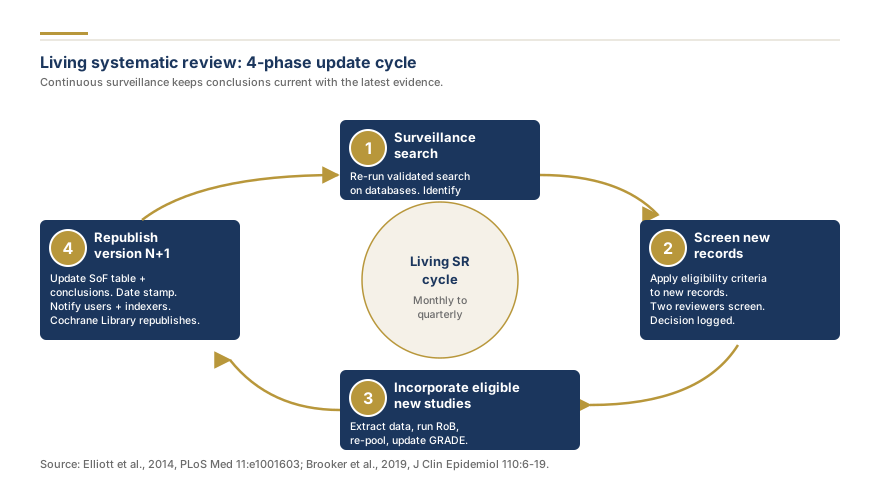
The living systematic review process follows the same initial steps as a traditional systematic review but adds an ongoing cycle of surveillance, screening, and re-analysis.
Phase 1: Initial Review (Same as Traditional)
Develop and register a protocol on PROSPERO specifying the living review methodology
Publish update. Release a new version of the review with clear version numbering
Phase 3: Retirement
When predefined retirement criteria are met, the living review reverts to a static systematic review with a final publication date.
When Is a Living Systematic Review Appropriate?
The Cochrane Living Evidence Network recommends living reviews when three conditions are met simultaneously:
The question is a high priority for clinical practice, public health, or policy decisions
There is important uncertainty in the current evidence, meaning the existing conclusions could change with new data
New evidence is being published at a rate that could change the review's conclusions within the planned update interval
If any of these conditions is not met, a traditional systematic review with planned periodic updates is more appropriate and resource-efficient.
Examples of appropriate living review topics:
Effectiveness of new treatment classes where trials are actively being published
Safety surveillance for medications with emerging safety signals
Public health interventions during ongoing outbreaks or pandemics
Clinical questions where practice guidelines are being actively revised
Examples where living reviews are NOT appropriate:
Historical questions where the evidence base is stable
Questions where all relevant trials have been completed and published
Topics with very low rates of new evidence publication
Need help with your evidence synthesis?
Our methodologists handle narrative synthesis, thematic analysis, umbrella reviews, and all forms of evidence synthesis, following established frameworks.
Living reviews require ongoing resources for searches, screening, extraction, analysis, and publication updates. Most research grants fund one-time projects, not continuous activities. Solutions include institutional support (as Cochrane provides for living Cochrane reviews), integration into routine evidence surveillance programs, and shared-resource models where multiple living reviews share infrastructure.
Statistical Considerations for Sequential Updates
Repeatedly updating a meta-analysis with new data introduces multiple testing concerns. Each time you re-analyze the data and assess whether the pooled effect is statistically significant, you inflate the overall false positive rate. Several statistical approaches address this:
Trial sequential analysis (TSA) adjusts significance boundaries for repeated analyses
Cumulative meta-analysis with formal monitoring boundaries (similar to interim analyses in clinical trials)
Bayesian updating that naturally incorporates prior evidence without multiple testing penalties
Each version of a living review must be clearly labeled, dated, and archived. Readers should be able to access previous versions to see how conclusions have evolved. The free prisma flow diagram should be updated with each version, showing cumulative screening and selection numbers.
Predefined retirement criteria should be specified in the protocol. Common criteria include:
The evidence base has stabilized (no new studies expected or new studies are unlikely to change conclusions)
The clinical question is no longer a priority (replaced by newer interventions or questions)
The team can no longer maintain the review
A more comprehensive review has been published by another group
Trial Sequential Analysis: Controlling False Positives Across Updates
The section above names trial sequential analysis as the fix for repeated testing, but naming it is not enough to apply it. A living review that re-tests significance every quarter is running an interim analysis on a clinical trial without the statistical safeguards that clinical trials are required to use. Here is the actual mechanism, so you can implement it rather than just cite it.
The problem, stated precisely. If you test a pooled effect at the conventional two-sided alpha of 0.05 once, your false positive rate is 5 percent. If you test it after every update, say ten times over three years, the probability that at least one of those looks crosses P < 0.05 by chance alone climbs toward 20 to 30 percent, depending on correlation between looks. An early "significant" result in a living review is therefore much weaker evidence than the same P value in a one-shot analysis. This is the sequential multiplicity problem, and it is the single most common statistical error in continuously updated evidence.
Required information size (RIS). Trial sequential analysis borrows the idea of a required sample size from primary trials and applies it to the cumulative meta-analysis. You compute the number of participants a meta-analysis would need to detect a chosen effect with conventional power, exactly as you would power a single trial, but inflated for heterogeneity:
RIS = (required sample for a single trial) / (1 - I-squared)
The division by (1 - I-squared) is the heterogeneity adjustment, also called the diversity adjustment (D-squared) in the more refined version. If between-study heterogeneity is I-squared = 50 percent, the required information size doubles, because heterogeneous studies carry less independent information per participant. Until the cumulative number of participants reaches the RIS, the evidence is treated as immature regardless of the nominal P value.
Alpha-spending boundaries. Rather than testing at a flat 0.05 every look, TSA spends the total 0.05 error budget across looks using an O'Brien-Fleming alpha-spending function. Early looks face a very stringent boundary (you might need P < 0.001 at the first interim look), and the boundary relaxes toward 0.05 only as the cumulative information approaches the RIS. The monitoring boundary as a function of information fraction t (cumulative sample divided by RIS) is approximately:
Z-boundary(t) = Z(alpha/2) / sqrt(t)
So at 25 percent of the required information (t = 0.25), the boundary is roughly 1.96 / sqrt(0.25) = 3.92 on the Z scale, corresponding to about P < 0.0001, not P < 0.05. Crossing that boundary is real evidence; crossing a flat 0.05 line at the same point usually is not.
A worked example. Suppose your living review of a behavioral intervention has, after four quarterly updates, accumulated 1,400 participants across 9 trials, with a pooled standardized mean difference giving Z = 2.4 (nominal two-sided P = 0.016, which looks significant). You compute an RIS of 4,200 participants after the heterogeneity adjustment (I-squared = 45 percent). The information fraction is t = 1,400 / 4,200 = 0.33. The O'Brien-Fleming boundary at t = 0.33 is approximately 1.96 / sqrt(0.33) = 3.41. Your observed Z of 2.4 does not cross 3.41, so trial sequential analysis tells you the result is not yet conclusive, even though the naive P value is below 0.05. The correct living-review conclusion is "effect plausible, evidence immature, continue surveillance," not "intervention works." This is exactly the kind of premature-positive that flat testing would have published and that a later update might have reversed, damaging the review's credibility.
Futility boundaries. TSA also draws an inner-wedge futility boundary. If the cumulative Z stays inside the wedge as information approaches the RIS, you can conclude the effect, if any, is smaller than the one you powered for, and consider retiring the question. This gives a principled, pre-specified answer to the "when do we stop" problem rather than an arbitrary call.
You can run trial sequential analysis with the free TSA software from the Copenhagen Trial Unit, or in R with the RTSA package. Report the RIS, the chosen alpha-spending function, the assumed intervention effect, and whether the cumulative Z crossed the monitoring or futility boundary, in every version of the review, so readers can see whether a "significant" update is genuinely conclusive or merely early. For the underlying pooling that feeds TSA, see our heterogeneity and I-squared guide.
Publication and Hosting
Living reviews can be published in several ways:
Cochrane Library. Cochrane has a formal living review program with dedicated infrastructure
Journal publication with updates. Some journals accept living review protocols with planned updates published as new versions of the same article
Online platforms. Platforms like the EPPI Centre's living evidence maps provide interactive, continuously updated evidence displays
Preprint servers. Interim updates can be posted on preprint servers while awaiting formal peer review
The key requirement is that each version is permanently accessible, clearly dated, and distinguishable from other versions. Readers must be able to cite a specific version with confidence that it will remain available.
The update frequency depends on the rate of new evidence publication and the clinical urgency of the question. Cochrane living reviews typically conduct searches monthly and incorporate new studies within 1 to 3 months of identification. Some living reviews during the COVID-19 pandemic were updated weekly. The protocol should specify the planned search frequency and the criteria that trigger a re-analysis.
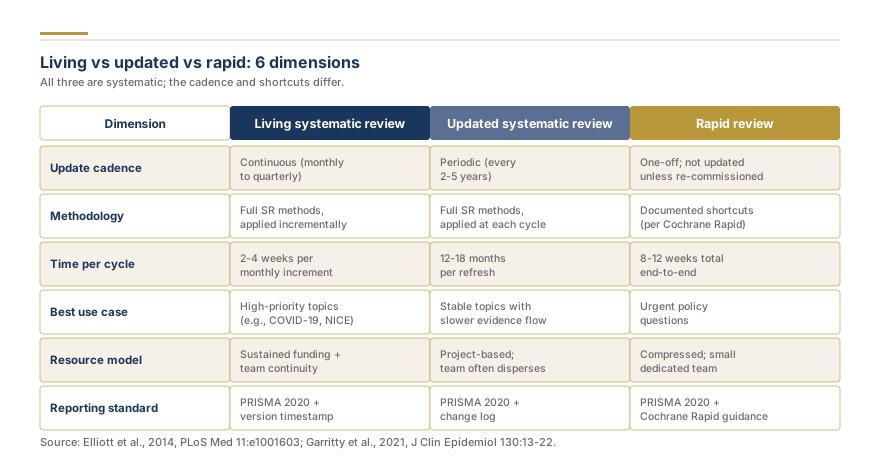
A traditional updated systematic review is a discrete project where a new team or the original team repeats the review process from scratch at a specific point in time, typically years after the original. A living systematic review maintains continuous surveillance and incorporates new evidence on an ongoing basis without starting over. The living approach is more efficient because the existing data extraction and analysis infrastructure is maintained between updates.
In principle, any research team can conduct a living systematic review, but it requires sustained commitment, resources, and infrastructure that go beyond a traditional one-time review. Cochrane and JBI have formal processes for registering living reviews. Independent teams can also conduct living reviews, but should follow published living review methodology and clearly describe their update process in the protocol.
A living review should be retired (reverted to a static review) when the research question is no longer a high priority, when the evidence base has stabilized and new studies are unlikely to change conclusions, when the team can no longer maintain the review, or when a more comprehensive review has been published that supersedes it. Cochrane provides guidance on retirement criteria.
Share
Found this useful? Share it with your colleagues.
Need help with your evidence synthesis?
Our methodologists handle narrative synthesis, thematic analysis, umbrella reviews, and all forms of evidence synthesis, following established frameworks.
Complex Synthesis? Our PhD Team Specializes in Every Type.
Systematic reviews, narrative synthesis, umbrella reviews, and rapid reviews. We match the right methodology to your research question and deliver a publication-ready manuscript.
Our promise: Free rework on synthesis or GRADE assessment if reviewers push back.
4.9 / 5Quote within a few hoursPRISMA 2020 + GRADE certaintyPhD methodologistConfidential by default
Dr. Sarah Mitchell holds a PhD in Biostatistics from Johns Hopkins Bloomberg School of Public Health and has over 15 years of experience in systematic review methodology and meta-analysis. She has authored or co-authored 40+ peer-reviewed publications in journals including the Journal of Clinical Epidemiology, BMC Medical Research Methodology, and Research Synthesis Methods. A former Cochrane Review Group statistician and current editorial board member of Systematic Reviews, Dr. Mitchell has supervised 200+ evidence synthesis projects across clinical medicine, public health, and social sciences.
Complex Synthesis? Our PhD Team Specializes in Every Type.
Systematic reviews, narrative synthesis, umbrella reviews, and rapid reviews. We match the right methodology to your research question and deliver a publication-ready manuscript.
CHEERS 2022 checklist explained: all 28 items, what changed from CHEERS 2013, and how to report a cost-effectiveness analysis so payers and journals can use it.
SPIRIT 2025 checklist explained: all 34 items by section, what changed from SPIRIT 2013, and how the protocol lines up with CONSORT 2025 when you report the trial.
ARRIVE 2.0 guidelines explained: the Essential 10 and the Recommended Set, what changed from ARRIVE 2010, and the items journals check in animal research reports.