Rapid reviews deliver evidence synthesis in 2-6 months using streamlined methods. Learn how they differ from systematic reviews, when each is appropriate, and which approach fits your project.
Dr. Sarah Mitchell
February 18, 2026
Key Takeaways
A rapid review uses abbreviated systematic review methods to deliver results in 2 to 6 months, compared to 12 to 18 months for a full systematic review
Rapid reviews typically limit database searches to 2-3 sources, may use single-reviewer screening with verification, and simplify data extraction
Both rapid and systematic reviews follow transparent, reproducible methods, but rapid reviews make explicit trade-offs between comprehensiveness and timeliness
Rapid reviews are appropriate when policy decisions cannot wait, the evidence base is small, or existing systematic reviews need updating
Journals increasingly accept rapid reviews for publication, especially when the methodology is transparently reported and limitations are acknowledged
The Cochrane Rapid Reviews Methods Group has published interim guidance to standardize rapid review methodology
A rapid review is a form of evidence synthesis that uses streamlined systematic review methods to deliver results in 2 to 6 months instead of the 12 to 18 months required for a full systematic review. Rapid reviews make explicit, documented trade-offs between comprehensiveness and timeliness by limiting database searches, simplifying screening processes, or abbreviating quality assessment while maintaining transparency and reproducibility.
The distinction matters because researchers, policymakers, and health technology assessment agencies increasingly need evidence summaries faster than traditional systematic review timelines allow. The COVID-19 pandemic accelerated the adoption of rapid reviews, with hundreds published in response to urgent clinical questions. Understanding when a rapid review is appropriate and when a full systematic review is necessary is a critical methodological decision that affects the credibility and utility of your evidence synthesis.
What Is a Rapid Review?
The Cochrane Rapid Reviews Methods Group defines a rapid review as "a form of knowledge synthesis that accelerates the process of conducting a traditional systematic review through streamlining or omitting specific methods to produce evidence for stakeholders in a resource-efficient manner." This definition emphasizes that rapid reviews are not shortcuts that ignore methodology but rather deliberate adaptations that trade comprehensiveness for speed.
Key characteristics of rapid reviews include:
Focused research question. Rapid reviews typically address narrower questions than comprehensive systematic reviews
Fewer databases searched. Usually 2 to 3 databases instead of 5 to 7
Single reviewer with verification. Instead of independent dual-reviewer screening
Simplified data extraction. Shorter extraction forms focused on key outcomes
Narrative synthesis emphasis. Meta-analysis is performed only when clearly appropriate
How Rapid Reviews Differ From Systematic Reviews
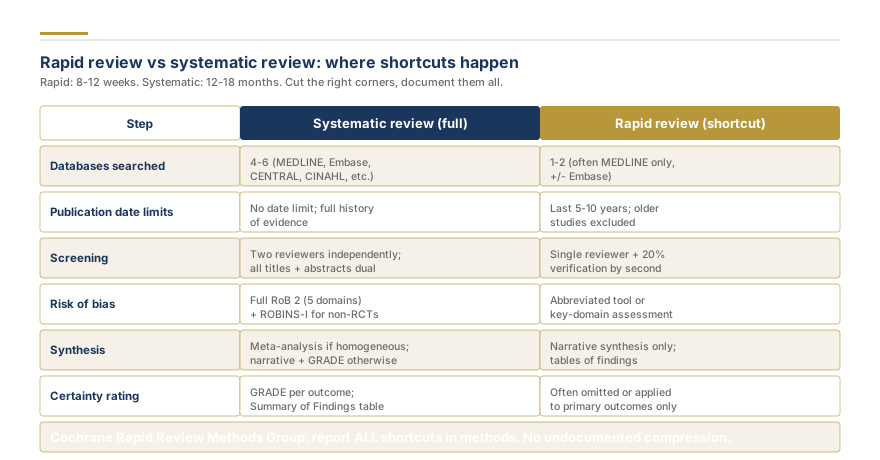
Rapid review vs systematic review: where shortcuts happen
The table below summarizes the key methodological differences between rapid reviews and full systematic reviews.
Feature
Rapid Review
Systematic Review
Timeline
2-6 months
12-18 months
Databases searched
2-3
4-7+
Grey literature
Limited or excluded
Comprehensive
Screening
Single reviewer + verification
Dual independent reviewers
Data extraction
Single extractor + verification
Dual independent extractors
Quality assessment
Simplified or abbreviated
Full tool (RoB 2, ROBINS-I, NOS)
Synthesis
Usually narrative
Narrative and/or meta-analysis
Protocol registration
Recommended but less common
PROSPERO registration standard
PRISMA reporting
Adapted PRISMA
Full PRISMA 2020
Update frequency
Often a one-time product
May be updated periodically
The fundamental difference is not in the goals but in the depth of each methodological step. Both approaches aim to identify, appraise, and synthesize the best available evidence. Rapid reviews achieve this with documented shortcuts that are transparent to the reader. For a deeper comparison of evidence synthesis approaches, see our guides on systematic review vs literature review and types of systematic reviews.
When to Choose a Rapid Review
Rapid reviews are appropriate in specific circumstances where the full systematic review timeline is not feasible or not necessary.
Policy and Clinical Decision Urgency
Health technology assessment agencies, clinical guideline developers, and public health departments frequently need evidence summaries within weeks or months. Waiting 18 months for a full systematic review is not practical when a policy decision must be made now. The World Health Organization, National Institute for Health and Care Excellence (NICE), and the Canadian Agency for Drugs and Technologies in Health (CADTH) all commission rapid reviews for time-sensitive decisions.
Small or Well-Defined Evidence Base
When the body of evidence on a topic is small (fewer than 500 initial records from a comprehensive search), the time savings from dual-reviewer screening and exhaustive database searching are minimal. A rapid review may capture the same evidence with fewer resources. If preliminary scoping suggests that only 10 to 30 studies exist on a topic, a rapid review is often sufficient.
Updating an Existing Systematic Review
When a systematic review was published 2 to 3 years ago and needs updating, a rapid review approach can efficiently identify new evidence without repeating the entire process. The original review provides the methodological framework, and the rapid update searches only for studies published since the original search date.
Resource-Constrained Settings
Research teams in low-resource settings or those without dedicated funding for a full systematic review may find that a well-conducted rapid review provides actionable evidence within their constraints. A transparent rapid review is more valuable than an abandoned systematic review or a poorly conducted one.
Need help with your evidence synthesis?
Our methodologists handle narrative synthesis, thematic analysis, umbrella reviews, and all forms of evidence synthesis, following established frameworks.
If your target publication venue is the Cochrane Database of Systematic Reviews or a journal that requires full systematic review methodology, a rapid review will not meet their standards. Some grant funders also require full systematic reviews as part of the funding justification.
Meta-Analysis Is the Primary Objective
If the main goal of your evidence synthesis is to produce a pooled effect estimate through introduction to meta-analysis, a full systematic review is strongly recommended. The abbreviated search of a rapid review may miss studies that would affect the pooled estimate, potentially biasing the results. learn about publication bias assessment is also less reliable when the search is not comprehensive.
High-Stakes Clinical Guidelines
Clinical practice guidelines that directly affect patient care should be based on the most comprehensive evidence synthesis available. While rapid reviews can inform interim guidelines, definitive guidelines typically require full systematic reviews with GRADE certainty assessments and Summary of Findings tables.
Regulatory Submissions
Pharmaceutical and medical device regulatory submissions to agencies like the FDA or EMA require comprehensive systematic reviews that meet specific methodological standards. Rapid reviews are not accepted for these purposes.
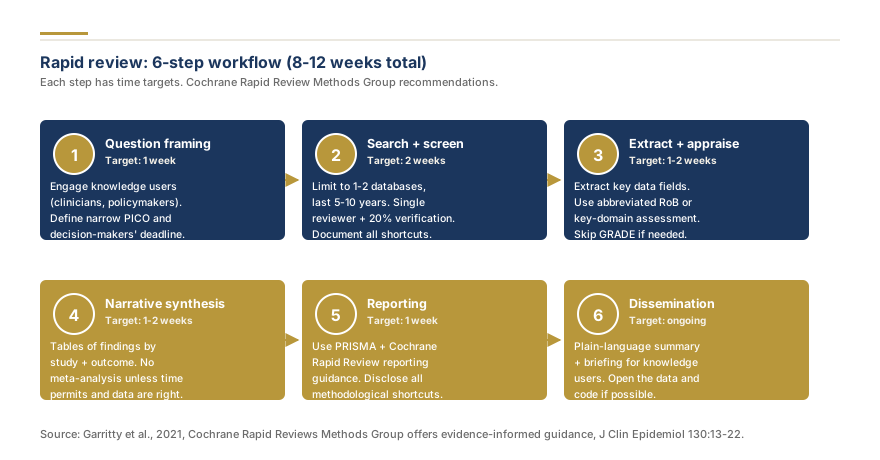
Develop a focused research question using the our guide to pico framework. Write a brief protocol that documents your search strategy, eligibility criteria, data extraction plan, and synthesis approach. Explicitly state which systematic review methods you will abbreviate and why. Consider registering your protocol on PROSPERO or the Open Science Framework.
Step 2: Search 2-3 Key Databases
Build a Boolean search strategy for your primary databases. For most health-related topics, search MEDLINE (via PubMed) and at least one additional relevant database. Use the same Boolean operator principles as a full systematic review but with a more focused set of search terms. Document your search strategy for reproducibility.
Step 3: Screen With Single Reviewer Plus Verification
One reviewer screens all titles and abstracts against your eligibility criteria. A second reviewer verifies a random sample of 10 to 20 percent of excluded records to check for missed inclusions. Full-text screening follows the same approach. This saves approximately 40 to 60 percent of the screening time compared to full dual-reviewer screening.
Step 4: Extract Data and Assess Quality
Use a simplified extraction form focused on your key outcomes. One reviewer extracts data, and a second reviewer verifies accuracy. For quality assessment, use abbreviated versions of standard tools or a simplified critical appraisal checklist. The our guide to newcastle-ottawa scale is often used in rapid reviews because it is faster to apply than explore rob 2.
Step 5: Synthesize and Report
Conduct a narrative synthesis organized by your research question components. If quantitative synthesis is appropriate, calculate our guide to effect sizes and consider a meta-analysis with explicit caveats about the non-exhaustive search. Report using the PRISMA checklist, noting any deviations from full systematic review methods. Use our our prisma flow chart builder tool to document your screening process.
Quality Considerations and Limitations
The primary limitation of rapid reviews is the potential for missing relevant studies due to fewer databases searched and less comprehensive grey literature coverage. Research comparing rapid reviews to systematic reviews on the same topic has found that rapid reviews identify 90 to 95 percent of the same studies when the evidence base is well-indexed in major databases. However, for topics where key evidence exists in grey literature, specialized databases, or non-English publications, the gap can be larger.
Other limitations include:
Single-reviewer bias. Without independent dual screening, individual reviewer judgment errors are more likely to affect study selection
Abbreviated quality assessment. Simplified critical appraisal may miss important methodological weaknesses in included studies
Limited synthesis depth. Narrative synthesis without meta-analysis provides less precise estimates of treatment effects
Reproducibility concerns. Some methodological shortcuts are harder to document transparently, reducing the reproducibility of the review
These limitations must be acknowledged explicitly in the discussion section of any rapid review. The value of a rapid review lies in providing the best available evidence within time constraints, not in claiming equivalence with a full systematic review.
Emerging Standards for Rapid Reviews
The methodology for rapid reviews is evolving rapidly. Several important developments are shaping the field.
The Cochrane Rapid Reviews Methods Group has published interim guidance on conducting rapid reviews within the Cochrane framework. This guidance provides recommendations for each phase of the review process, from protocol development through reporting.
PRISMA extension for rapid reviews is currently in development and will provide a standardized reporting framework specifically designed for rapid reviews. Until this is published, rapid reviewers should use the standard PRISMA 2020 checklist with documented deviations.
Living systematic reviews represent a related approach where the review is continuously updated as new evidence becomes available. Living reviews can begin with a rapid review approach and evolve into a comprehensive systematic review over time. This hybrid model is gaining acceptance in fields where the evidence base changes quickly.
Cost and Timeline Comparison
Feature
Rapid Review
Systematic Review
DIY timeline
2-6 months
12-18 months
Professional service timeline
4-6 weeks
8-12 weeks
DIY cost
Researcher time only
Researcher time only
Professional service cost
$2,000-$6,000
$5,000-$15,000
Publication acceptance
Growing (most journals)
Universal
Meta-analysis possible
Yes, with caveats
Yes, standard
PROSPERO registrable
Yes
Yes
The professional service timeline reflects the efficiency of dedicated teams with established workflows. For either approach, our team provides systematic review that meet journal publication standards.
No, a rapid review is not the same as a traditional literature review. A rapid review follows systematic, transparent methods with predefined eligibility criteria, structured search strategies, and explicit inclusion and exclusion processes. A narrative literature review does not require these methodological safeguards and is more susceptible to selection bias. A rapid review sits between a systematic review and a narrative review in terms of methodological rigor.
Yes, a rapid review can include a meta-analysis if the included studies provide sufficient homogeneous quantitative data. However, many rapid reviews use narrative synthesis because the abbreviated search may not capture all relevant studies, which could bias pooled estimates. If meta-analysis is performed in a rapid review, the potential impact of missing studies should be explicitly discussed.
Most rapid review guidelines recommend searching at least 2 to 3 databases, typically MEDLINE and one additional source relevant to the topic (such as Embase, CINAHL, or the Cochrane Library). Full systematic reviews search 4 to 7 or more databases. The reduced database coverage is one of the primary time savings in a rapid review but also its main limitation.
Rapid reviews should follow PRISMA guidelines to the extent possible, and the PRISMA statement is increasingly used as the reporting framework for rapid reviews. A PRISMA extension for rapid reviews is currently in development. In the meantime, rapid reviewers should use the standard PRISMA 2020 checklist and note any deviations from full systematic review methods.
Yes, rapid reviews are increasingly accepted by peer-reviewed journals, especially in health policy, public health, and clinical guideline development. Journals like BMJ Evidence-Based Medicine, Systematic Reviews, and the Journal of Clinical Epidemiology have published rapid reviews. The key to acceptance is transparent reporting of the methods used and honest discussion of the limitations.
Share
Found this useful? Share it with your colleagues.
Need help with your evidence synthesis?
Our methodologists handle narrative synthesis, thematic analysis, umbrella reviews, and all forms of evidence synthesis, following established frameworks.
Complex Synthesis? Our PhD Team Specializes in Every Type.
Systematic reviews, narrative synthesis, umbrella reviews, and rapid reviews. We match the right methodology to your research question and deliver a publication-ready manuscript.
Our promise: Free rework on synthesis or GRADE assessment if reviewers push back.
4.9 / 5Quote within a few hoursPRISMA 2020 + GRADE certaintyPhD methodologistConfidential by default
Dr. Sarah Mitchell holds a PhD in Biostatistics from Johns Hopkins Bloomberg School of Public Health and has over 15 years of experience in systematic review methodology and meta-analysis. She has authored or co-authored 40+ peer-reviewed publications in journals including the Journal of Clinical Epidemiology, BMC Medical Research Methodology, and Research Synthesis Methods. A former Cochrane Review Group statistician and current editorial board member of Systematic Reviews, Dr. Mitchell has supervised 200+ evidence synthesis projects across clinical medicine, public health, and social sciences.
Complex Synthesis? Our PhD Team Specializes in Every Type.
Systematic reviews, narrative synthesis, umbrella reviews, and rapid reviews. We match the right methodology to your research question and deliver a publication-ready manuscript.
CHEERS 2022 checklist explained: all 28 items, what changed from CHEERS 2013, and how to report a cost-effectiveness analysis so payers and journals can use it.
SPIRIT 2025 checklist explained: all 34 items by section, what changed from SPIRIT 2013, and how the protocol lines up with CONSORT 2025 when you report the trial.
ARRIVE 2.0 guidelines explained: the Essential 10 and the Recommended Set, what changed from ARRIVE 2010, and the items journals check in animal research reports.