RoB 2 assessment is the process of evaluating risk of bias in randomized controlled trials using the revised Cochrane tool developed by Sterne et al. (2019). RoB 2 (Risk of Bias 2) provides a structured framework with five domains, signalling questions, and a judgement algorithm that produces transparent, reproducible bias evaluations for every included randomized controlled trial in a systematic review. Whether you are conducting your first systematic review or updating a Cochrane review, understanding how to apply the RoB 2 tool correctly is essential for credible evidence synthesis.
RoB 2 replaced the original Cochrane risk of bias tool (Higgins et al., 2008) in response to documented limitations in reproducibility and the overuse of the "unclear" judgement category. The revised tool eliminates ambiguity by requiring assessors to answer structured signalling questions that map directly to domain-level judgements. This guide walks you through every domain, explains how to answer signalling questions, and shows how your RoB 2 results feed into GRADE certainty of evidence ratings.
Run your assessment in the free RoB 2 traffic-light tool, which records domain judgements for every study and exports the summary figure journals require.
RoB 2 at a Glance
| Element | Quick answer |
|---|---|
| Applies to | Randomized controlled trials only; use ROBINS-I for non-randomized studies |
| Domains | 5: randomization, deviations from intended interventions, missing outcome data, outcome measurement, selection of the reported result |
| Judgement levels | Low risk, Some concerns, High risk; the old "unclear" category is gone |
| Unit of assessment | Each trial-outcome pair, not the trial as a whole |
| Overall rule | The worst domain judgement sets the overall judgement |
| Decide first | Effect of assignment (intention-to-treat) or effect of adhering (per-protocol); this changes which Domain 2 questions you answer |
| Reviewers | Two, calibrated on 3 to 5 pilot studies, with documented inter-rater agreement |
The Cochrane Handbook Chapter 8 (Higgins et al., 2023) provides detailed guidance on implementing RoB 2 within a systematic review. The tool is designed for outcome-level assessment, meaning you assess each trial separately for each outcome of interest. A trial may be at low risk of bias for its primary outcome but at high risk for a secondary outcome measured using a subjective scale.
Before beginning any RoB 2 assessment, you must specify your effect of interest, either the effect of assignment to intervention (intention-to-treat analysis) or the effect of adhering to intervention (per-protocol analysis). This choice determines which version of Domain 2 you use and affects how you evaluate deviations from intended interventions throughout the trial.
The 5 RoB 2 Domains Explained
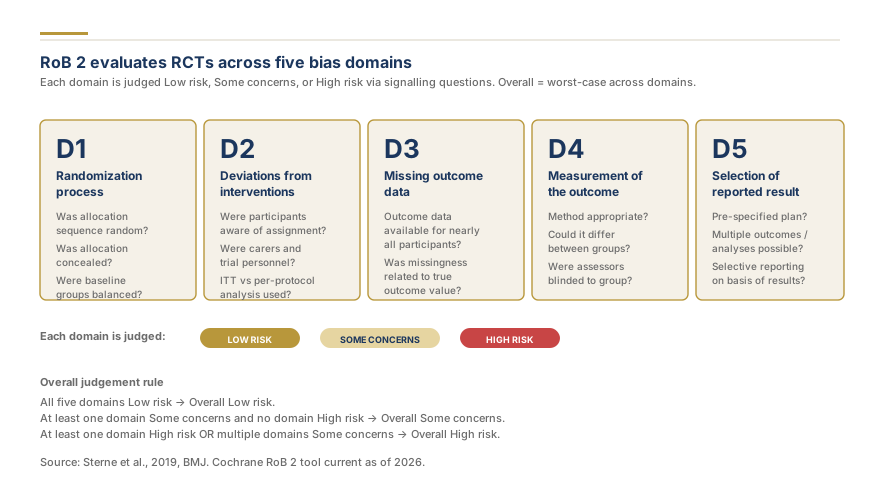
RoB 2 organizes bias evaluation into five sequential RoB 2 domains, each addressing a distinct stage in the trial process where bias can enter. Understanding each domain in depth is critical for accurate and consistent assessment.
Domain 1: Bias Arising From the Randomization Process
This domain evaluates whether the randomization sequence was truly random and whether allocation concealment was adequate. Signalling questions ask whether the allocation sequence was random, whether it was concealed until participants were enrolled, and whether there were baseline differences suggesting problems with randomization.
Adequate randomization requires a validated method such as computer-generated random numbers or random number tables. Allocation concealment means that the person enrolling participants could not foresee the upcoming assignment. If baseline imbalances exist between groups, you must judge whether they are consistent with chance or suggest a flaw in the randomization process.
Domain 2: Bias Due to Deviations From Intended Interventions
Domain 2 evaluates whether participants, caregivers, or trial personnel were aware of intervention assignments during the trial and whether any deviations from the intended interventions affected the outcome. This is where blinding becomes relevant, the domain asks whether participants and those delivering the intervention were blinded, and whether any unblinding or co-interventions could have introduced bias.
The version of Domain 2 you use depends on your specified effect of interest. For the effect of assignment (intention-to-treat), you evaluate whether an appropriate analysis was used that estimates the effect regardless of deviations. For the effect of adhering to intervention, you evaluate whether deviations occurred and whether they were balanced between groups.
Domain 3: Bias Due to Missing Outcome Data
This domain addresses attrition, whether outcome data were available for all or nearly all participants. Missing data can introduce bias if the reasons for missingness differ between groups or are related to the outcome itself. Signalling questions ask whether data were available for all participants, whether evidence exists that the result was not biased by missing data, and whether missingness could depend on the true value of the outcome.
If more than 5% of outcome data are missing, assessors should carefully evaluate whether appropriate methods such as multiple imputation or sensitivity analyses were used to handle missingness. An intention-to-treat (ITT) analysis that includes all randomized participants reduces but does not eliminate concerns about missing data.
Domain 4: Bias in Measurement of the Outcome
Domain 4 asks whether the method of outcome measurement was appropriate, whether it was applied consistently across groups, and whether outcome assessors were aware of intervention assignments. Subjective outcomes such as pain scales or quality of life measures are more susceptible to measurement bias than objective outcomes like mortality or laboratory values.
When outcome assessors are not blinded, there is a risk that knowledge of the assigned intervention influences how they measure or interpret the outcome. This domain also evaluates whether the outcome measure itself could have been influenced by knowledge of treatment assignment, for example, if participants self-report outcomes and are aware of their group allocation.
Domain 5: Bias in Selection of the Reported Result
The final domain evaluates whether the trial report selectively presents results. Reported result selection bias occurs when investigators choose which outcomes, analyses, or subgroups to report based on the results themselves. Signalling questions ask whether the data were analyzed in accordance with a pre-specified analysis plan and whether the reported result is likely to have been selected from multiple eligible outcome measurements or analyses.
Pre-registration of the trial protocol on platforms such as ClinicalTrials.gov provides the strongest protection against selective reporting. Comparing the published report against the registered protocol helps assessors determine whether the reported results align with what was planned.
Signalling Questions and How to Answer Them
Each RoB 2 domain contains two to five signalling questions that guide the assessor toward a domain-level judgement. These questions are answered using a standardized set of response options: Yes (Y), Probably Yes (PY), Probably No (PN), No (N), and No Information (NI).
The response "Probably Yes" carries the same weight as "Yes" in the judgement algorithm, it indicates that the assessor believes the answer is likely affirmative based on available evidence, even if not explicitly stated in the trial report. Similarly, "Probably No" carries the same weight as "No." The "No Information" response indicates that the trial report provides insufficient detail to make a judgement.
Here is a summary of signalling question structure across all five domains:
| Domain | Number of Questions | Focus Area | Key Considerations |
|---|---|---|---|
| D1: Randomization | 3 | Sequence generation, concealment, baseline balance | Was allocation truly concealed? |
| D2: Deviations | 5-7 (varies by effect) | Blinding, co-interventions, analysis type | Effect of assignment vs. adhering |
| D3: Missing data | 4 | Completeness, reasons for missingness | Was missingness related to the outcome? |
| D4: Measurement | 4 | Assessor blinding, measurement method | Subjective vs. objective outcomes |
| D5: Reported result | 3 | Pre-registration, analysis plan adherence | Protocol vs. publication comparison |
The judgement algorithm maps signalling question responses to a domain-level judgement. If all questions suggest no bias concerns, the domain is judged as Low risk. If any question raises potential concerns without clear evidence of bias, the domain is judged as Some concerns. If any question indicates a definite bias problem, the domain is judged as High risk.
Answering "No Information" to critical signalling questions typically results in a "Some concerns" judgement because the inability to confirm adequate methodology leaves open the possibility of bias. Assessors should document their rationale for every response, particularly for "Probably Yes" and "Probably No" answers, to ensure transparency and reproducibility.
Making the Overall RoB 2 Judgement
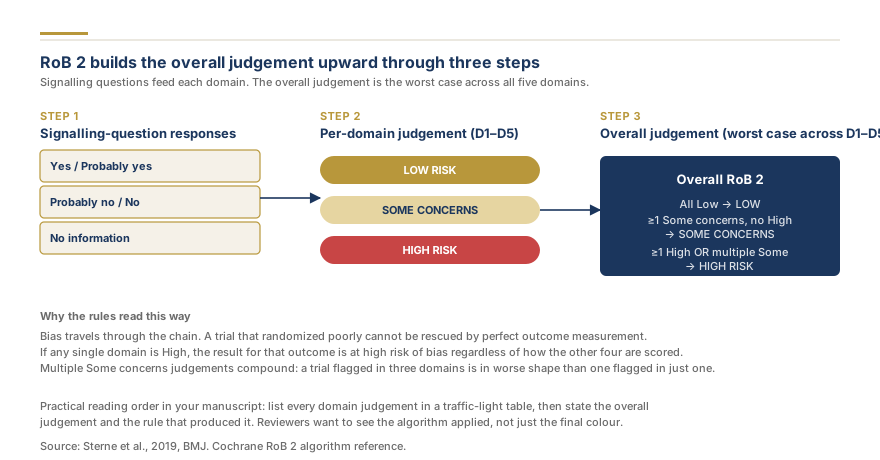
After completing all five domains, the assessor must make an overall risk of bias judgement for that trial-outcome pair. The overall judgement follows a strict hierarchical rule: it is determined by the worst domain-level judgement across all five domains.
The rules are straightforward. If all five domains are judged Low risk, the overall judgement is Low risk of bias. If any domain is judged Some concerns and none are judged High risk, the overall judgement is Some concerns. If any domain is judged High risk, the overall judgement is High risk of bias. Multiple domains judged as Some concerns may also collectively warrant an overall High risk judgement if the assessor believes the combined concerns are substantial enough to meaningfully affect the result.
This hierarchical approach means that a single domain at high risk is sufficient to classify the entire trial result as high risk, even if the other four domains are at low risk. This reflects the reality that bias in any stage of the trial process can distort the result, regardless of how well other aspects were conducted.
Documentation is essential. For each domain and for the overall judgement, assessors should provide a brief free-text justification explaining the reasoning behind their judgement. This justification serves both as a record for the review team and as transparency for readers who wish to evaluate the basis for the risk of bias assessment.
A systematic review has a component relationship with its risk of bias assessment, the assessment is integral to the review's conclusions. Without a properly conducted RoB 2 assessment, the credibility of the entire evidence synthesis is compromised.
Need expert risk of bias assessment for your systematic review? Our methodologists conduct RoB 2 assessments with dual-reviewer calibration, detailed justifications, and publication-ready summary tables. request a preliminary project assessment, or explore our systematic review risk-of-bias support.