Types of Systematic Reviews: 8 Evidence Synthesis Methods Compared
Eight types of systematic reviews explained and compared: traditional systematic review, meta-analysis, scoping review, rapid review, umbrella review, narrative review, living systematic review, and network meta-analysis. Includes decision table for choosing the right method.
Research Gold Team
April 6, 2026
Not sure which type of evidence synthesis is right for your project? Our team can advise you on the best methodology.
Key Takeaways
Eight main types of evidence synthesis exist: traditional systematic review, meta-analysis, scoping review, rapid review, umbrella review, narrative review, living systematic review, and network meta-analysis
Traditional systematic reviews with meta-analysis are the gold standard for clinical decision-making, following Cochrane methodology and PRISMA 2020 reporting
Scoping reviews map evidence breadth rather than answering specific questions, they follow PRISMA-ScR and use PCC instead of PICO
Rapid reviews use abbreviated methods to meet urgent timelines, typically 2-6 weeks vs 6-18 months
Umbrella reviews synthesize existing systematic reviews, providing the highest level of evidence aggregation
Network meta-analysis extends traditional meta-analysis by comparing multiple interventions simultaneously
The choice of review type depends on your research question, timeline, available evidence, and decision-making context
Researchers, clinicians, and policymakers rely on types of systematic reviews to make decisions grounded in the best available evidence. But "systematic review" is not a single method. It is a family of approaches, each designed for different research questions, timelines, and evidence landscapes. Choosing the wrong type wastes months of effort and produces findings that do not answer the question you actually need answered.
This guide compares eight evidence synthesis methods side by side. We cover what each type does, when to use it, how it differs from the others, and which reporting guidelines apply. Whether you are planning your first review or deciding between a scoping review and a traditional systematic review, this comparison will help you choose the right approach. For a detailed walkthrough of the most common type, see our step-by-step systematic review methodology walkthrough.
The term evidence synthesis refers to any method that systematically identifies, appraises, and combines findings from multiple studies to answer a research question. Within that umbrella, eight distinct types dominate the literature. Each occupies a specific position in the evidence hierarchy, and each serves a different purpose.
Type
Purpose
Timeline
Quality Assessment
Quantitative Pooling
Traditional Systematic Review
Answer a specific clinical/research question
6-18 months
Yes (mandatory)
Optional
Meta-Analysis
Statistically pool effect sizes from systematic reviews
6-18 months
Yes (mandatory)
Yes (defining feature)
Scoping Review
Map evidence breadth on a broad topic
3-8 months
No (typically)
No
Rapid Review
Provide timely evidence for urgent decisions
2-6 weeks
Abbreviated
Optional
Umbrella Review
Synthesize existing systematic reviews
3-6 months
Yes (AMSTAR 2)
Optional
Narrative Review
Expert summary of a focused topic
1-3 months
No
No
Living Systematic Review
Continuously updated systematic review
Ongoing
Yes
Yes (updated)
Network Meta-Analysis
Compare multiple interventions simultaneously
6-12 months
Yes
Yes (network)
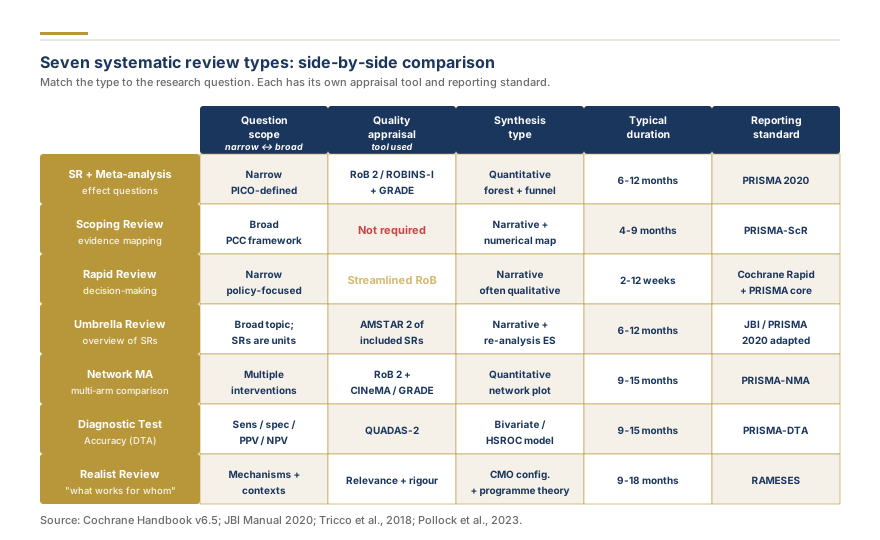
These eight types are not interchangeable. A Systematic Review is an evidence synthesis method that follows a pre-defined protocol to locate, appraise, and synthesize all relevant studies on a specific question. A Scoping Review maps the available evidence on a broad topic without answering a narrow clinical question. A Meta-Analysis is a component of a systematic review that statistically pools effect sizes. Understanding these distinctions is essential before you commit resources to a project.
At Research Gold, we deliver systematic reviews, meta-analyses, and scoping reviews. Each type requires different expertise, different timelines, and different reporting standards. The sections that follow explain each method in detail so you can determine which one fits your research goals. For a broader look at our evidence synthesis services overview, that guide covers what to expect from working with a professional team.
Traditional Systematic Review with Meta-Analysis
The traditional systematic review is the gold standard of evidence synthesis. It answers a focused research question by systematically searching the literature, applying pre-defined eligibility criteria, assessing methodological quality, and synthesizing findings according to a transparent, reproducible protocol. When quantitative pooling of effect sizes is included, it becomes a systematic review with meta-analysis.
Defining Characteristics
A traditional systematic review follows the methodology outlined in the Cochrane Handbook (Higgins et al., 2023). The process begins with a structured research question, typically framed using the PICO framework: Population, Intervention, Comparison, Outcome. The protocol is registered on PROSPERO before searches begin, ensuring transparency and reducing the risk of post hoc modifications.
The search strategy must be comprehensive. It covers multiple databases (MEDLINE, Embase, CINAHL, and others relevant to the topic), grey literature sources, trial registries, and reference lists of included studies. Two independent reviewers screen titles, abstracts, and full texts against pre-defined inclusion and exclusion criteria. Disagreements are resolved by a third reviewer or through consensus.
Risk of bias assessment is mandatory. Tools vary by study design: the Cochrane Risk of Bias tool (RoB 2) for randomized controlled trials, the Newcastle-Ottawa Scale or ROBINS-I for observational studies. Every included study receives a quality rating, and the influence of study quality on overall findings is assessed through sensitivity analyses.
When Meta-Analysis Applies
A meta-analysis is not a separate review type but rather a statistical component that can be embedded within a systematic review. It uses statistical methods to combine effect sizes from individual studies into a single pooled estimate, weighted by study precision. The result is a forest plot showing each study's contribution to the overall effect.
Meta-analysis is appropriate only when the included studies are sufficiently similar in design, population, intervention, and outcome measurement. When clinical or methodological heterogeneity is too great, a narrative synthesis replaces the quantitative pooling. For a detailed walkthrough of the statistical methods involved, see read about our complete meta-analysis guide.
Reporting Standard
Traditional systematic reviews with meta-analysis report according to PRISMA 2020 (Page et al., 2021). The PRISMA checklist contains 27 items covering title, abstract, introduction, methods, results, discussion, and funding. A systematic review follows PRISMA 2020 reporting guidelines to ensure that readers can assess the transparency and completeness of the review. The PRISMA flow diagram documents the screening process from initial database hits to final included studies. You can generate one using our free handy prisma flow diagram generator.
Strengths and Limitations
The traditional systematic review with meta-analysis produces the most rigorous and defensible evidence synthesis. It minimizes bias through systematic methods, and the pooled effect estimate from a meta-analysis provides a precise answer to a specific question. However, it is also the most resource-intensive approach. A typical systematic review takes 6 to 18 months, involves a team of at least two reviewers plus a statistician, and requires access to multiple bibliographic databases and full-text articles. Measured averages from the methods literature are collected in our systematic review statistics roundup. For many research teams, the timeline alone makes it impractical for time-sensitive decisions.
Scoping Review
A scoping review is a type of evidence synthesis designed to map the breadth and nature of evidence available on a broad topic. Unlike a traditional systematic review, it does not aim to answer a specific clinical question or assess the quality of individual studies. Instead, it identifies key concepts, evidence gaps, and the types of research that have been conducted in a particular area.
Framework and Purpose
Scoping reviews were formalized by Arksey and O'Malley (2005) and later refined by the JBI Manual (Peters et al., 2020). The research question is framed using the PCC framework: Population, Concept, Context. This broader framing reflects the exploratory nature of the scoping review, which asks "What is known about this topic?" rather than "What is the effect of this intervention?"
A scoping review maps available evidence across a domain. It identifies what types of studies exist, what populations have been studied, what outcomes have been measured, and where the gaps lie. This makes scoping reviews particularly valuable as precursors to systematic reviews: if you are unsure whether enough evidence exists to warrant a full systematic review, a scoping review answers that question first.
How It Differs from a Systematic Review
The distinction between scoping reviews and systematic reviews is one of the most commonly misunderstood points in evidence synthesis methodology. For a deeper comparison, see how scoping reviews differ from systematic reviews. The key differences are summarized here.
Feature
Systematic Review
Scoping Review
Research question
Narrow, specific (PICO)
Broad, exploratory (PCC)
Quality assessment
Mandatory
Not required
Quantitative pooling
Yes (when appropriate)
No
Protocol registration
PROSPERO
PROSPERO (since 2023) or OSF
Reporting guideline
PRISMA 2020
PRISMA-ScR
Purpose
Answer a question
Map a field
Eligibility criteria
Strict, pre-defined
Iterative, may evolve
Reporting Standard
A scoping review reports using PRISMA-ScR (Tricco et al., 2018). This extension of PRISMA includes 20 essential reporting items and two optional items specific to scoping reviews. PRISMA-ScR ensures transparency in how the review was conducted, what sources were searched, and how results were charted.
When to Choose a Scoping Review
Choose a scoping review when your research aim is to understand the landscape of evidence rather than to estimate an effect size. Common scenarios include: exploring a new or emerging research area, identifying evidence gaps to inform future primary studies, mapping the types and sources of evidence available on a policy-relevant topic, and clarifying key concepts or definitions used across a field.
Scoping reviews are not appropriate when your goal is to inform clinical practice guidelines, assess the effectiveness of an intervention, or produce a pooled effect estimate. For those purposes, a traditional systematic review with meta-analysis remains the correct choice.
Rapid Review
A rapid review is a streamlined form of evidence synthesis that uses abbreviated systematic review methods to produce actionable findings within a compressed timeline. Where a traditional systematic review takes 6 to 18 months, a rapid review typically takes 2 to 6 weeks.
Why Rapid Reviews Exist
Rapid reviews emerged from the reality that decision-makers cannot always wait for a full systematic review. During public health emergencies, policy development cycles, or clinical guideline updates, the question is not whether perfect evidence exists but whether the best available evidence can be synthesized fast enough to inform a decision.
The COVID-19 pandemic accelerated the acceptance of rapid reviews as a legitimate evidence synthesis method. Organizations including the World Health Organization, the Cochrane Rapid Reviews Methods Group, and national health technology assessment agencies produced hundreds of rapid reviews to guide clinical and policy decisions in real time.
Methodological Shortcuts
Rapid reviews achieve their speed by abbreviating one or more steps of the traditional systematic review process. Common shortcuts include searching fewer databases, limiting the date range or language of included studies, using a single reviewer for screening (with verification of a sample by a second reviewer), using abbreviated quality assessment tools, and conducting narrative synthesis rather than meta-analysis.
These shortcuts introduce known limitations. The trade-off is explicit: a rapid review sacrifices comprehensiveness for timeliness. The key requirement is transparency about which methodological shortcuts were taken and how they may affect the findings. A well-conducted rapid review with transparent limitations is more useful to a decision-maker than no evidence synthesis at all.
systematic review Step
Traditional systematic review
Rapid Review Approach
Protocol
Full, registered on PROSPERO
Brief, may not be registered
Search
5+ databases, grey literature, hand-searching
2-3 databases, limited grey literature
Screening
Dual independent
Single reviewer + spot-check
Quality assessment
Full tool (RoB 2, NOS)
Abbreviated or checklist
Synthesis
Narrative + meta-analysis
Narrative only
Timeline
6-18 months
2-6 weeks
When to Choose a Rapid Review
A rapid review is appropriate when a decision cannot wait for a full systematic review, when preliminary evidence is needed to justify a larger review, or when an existing systematic review needs to be updated quickly. It is not appropriate when the findings will directly inform clinical practice guidelines that require the highest level of evidence rigor.
Need help with your evidence synthesis?
Our methodologists handle narrative synthesis, thematic analysis, umbrella reviews, and all forms of evidence synthesis, following established frameworks.
Umbrella Review, Network meta-analysis, and Other Types
Beyond the three most common types, several additional evidence synthesis methods serve specialized purposes. Each occupies a distinct niche in the evidence hierarchy.
Umbrella Review
An umbrella review (also called a review of reviews or overview of reviews) synthesizes findings from multiple existing systematic reviews on the same broad topic. It sits at the top of the evidence hierarchy because it aggregates already-synthesized evidence. Our umbrella review methods guide walks through how to conduct one.
The primary tool for assessing the quality of included systematic reviews within an umbrella review is AMSTAR 2 (A MeaSurement Tool to Assess systematic Reviews). Each included systematic review receives a quality rating, and the umbrella review evaluates whether the conclusions of individual systematic reviews are consistent or contradictory.
Umbrella reviews are particularly valuable when multiple systematic reviews on the same topic have reached different conclusions. By comparing the methodological quality and scope of each systematic review, the umbrella review can identify which findings are most trustworthy and which are undermined by methodological limitations. This is why umbrella reviews provide the highest level of evidence aggregation in the evidence synthesis landscape.
Network Meta-Analysis
A network meta-analysis extends traditional meta-analysis by comparing three or more interventions simultaneously, even when those interventions have not been directly compared in head-to-head trials. A network meta-analysis compares multiple interventions by combining direct evidence (from trials that directly compared two treatments) with indirect evidence (inferred through a common comparator).
For example, if Trial A compares Drug X to placebo and Trial B compares Drug Y to placebo, a network meta-analysis can estimate the relative effectiveness of Drug X versus Drug Y, even though no trial directly compared them. The result is a ranking of interventions from most to least effective, presented as a league table or ranking probability plot. For a deeper exploration, see our network meta-analysis overview.
Network meta-analysis is used extensively in health technology assessment to inform formulary decisions, clinical guidelines, and coverage determinations. It requires specialized statistical expertise (typically Bayesian methods in R or WinBUGS) and careful assessment of the transitivity assumption: the assumption that the studies in the network are sufficiently similar to make indirect comparisons valid.
Narrative Review
A narrative review (sometimes called a traditional review or expert review) is a non-systematic summary of the literature on a focused topic. Unlike a systematic review, a traditional narrative review does not follow a pre-defined protocol, does not conduct a comprehensive search, and does not formally assess study quality. The author selects studies based on their expertise and presents a synthesized overview of the evidence.
Narrative reviews serve an important function in medical journals. They provide accessible overviews of complex topics, written by subject matter experts who can contextualize findings and identify emerging trends. However, because the study selection process is not transparent or reproducible, narrative reviews are susceptible to selection bias. They sit below systematic reviews in the evidence hierarchy and are not appropriate for informing clinical practice guidelines.
The distinction between a narrative review and a general literature review is subtle. Both are non-systematic. However, narrative reviews published in medical journals are typically commissioned, written by recognized experts, and focused on a specific clinical or methodological question. A general literature review, as written in a graduate thesis, tends to be broader in scope and less focused in its synthesis.
Living Systematic Review
A living systematic review is a traditional systematic review that is continually updated as new evidence becomes available. Rather than publishing once and becoming outdated, a living systematic review incorporates new studies at regular intervals (monthly, quarterly, or as they appear), re-runs meta-analyses, and updates its conclusions accordingly.
Living systematic reviews are particularly valuable in rapidly evolving fields where the evidence base changes frequently. The Cochrane Collaboration has pioneered living systematic reviews in areas such as COVID-19 treatments, where new trial results appeared weekly and clinical guidelines needed to reflect the latest evidence.
The methodology follows the same rigorous standards as a traditional systematic review, with the added requirement of ongoing surveillance, updated searches, and transparent version control. The PRISMA 2020 guidelines apply, supplemented by specific guidance for living reviews published by the Cochrane Collaboration.
The practical challenge of living systematic reviews is sustainability. They require a dedicated team willing to maintain the review indefinitely, update the search strategy as new databases or indexing terms emerge, and re-assess the quality of the evidence base with each iteration. For most research teams, this makes living systematic reviews feasible only with institutional support or grant funding.
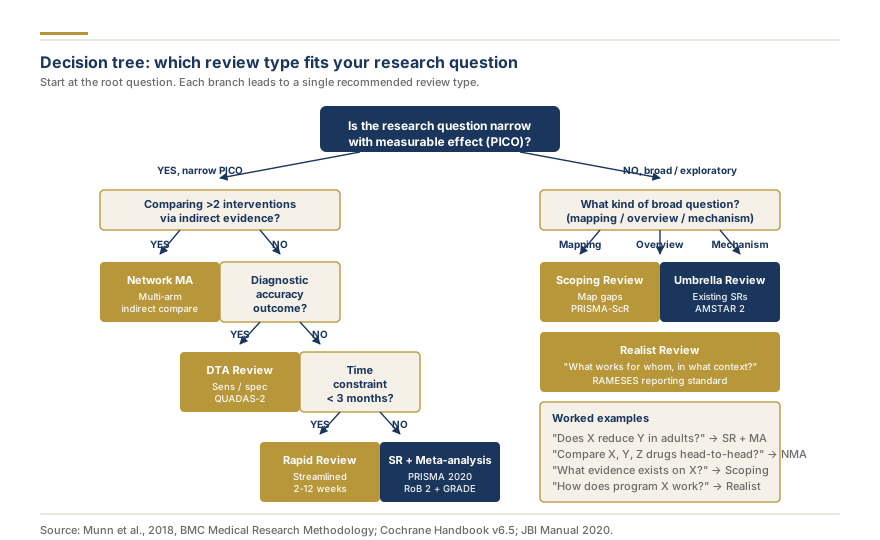
4-question decision tree narrows 7 types. Source: Munn et al., 2018, BMC Med Res Methodol.
Selecting the right evidence synthesis method is the most consequential decision you make before starting a review. The wrong choice leads to wasted resources, inappropriate conclusions, and findings that do not serve your intended audience. The decision depends on four factors: your research question, your timeline, the available evidence, and the context in which your findings will be used.
Decision Framework
If your goal is to...
Use this type
Framework
Timeline
Answer a specific clinical question
Traditional systematic review + meta-analysis
PICO
6-18 months
Map evidence on a broad topic
Scoping Review
PCC
3-8 months
Inform an urgent policy decision
Rapid Review
Modified PICO
2-6 weeks
Synthesize multiple existing systematic reviews
Umbrella Review
Varies
3-6 months
Compare 3+ interventions without direct trials
Network meta-analysis
PICO + network
6-12 months
Provide an expert overview of a topic
Narrative Review
None required
1-3 months
Maintain current evidence in a fast-moving field
Living systematic review
PICO
Ongoing
Pool quantitative effect sizes
Meta-Analysis (within systematic review)
PICO
6-18 months
Question Type Determines Method
The structure of your research question is the strongest predictor of the appropriate review type. If you can articulate a focused question using PICO (Population, Intervention, Comparator, Outcome), you need a systematic review. If your question is broad and exploratory, framed using PCC (Population, Concept, Context), a scoping review is more appropriate.
Consider these examples. "Does cognitive behavioral therapy reduce anxiety symptoms in adults with generalized anxiety disorder compared to waitlist control?" is a PICO question that calls for a systematic review with meta-analysis. "What is known about digital mental health interventions for young adults?" is a PCC question that calls for a scoping review.
Timeline Constraints
If your decision cannot wait 6 to 18 months, a traditional systematic review is not feasible. A rapid review provides the best available evidence within 2 to 6 weeks. If you need to keep the evidence current beyond the initial publication, a living systematic review is the appropriate choice, though it requires ongoing resources.
Evidence Landscape
The type and volume of existing evidence also influences your choice. If multiple systematic reviews already exist on your topic, an umbrella review avoids duplicating effort and instead synthesizes the existing synthesis. If the evidence base is sparse or heterogeneous, a scoping review helps you understand what exists before committing to a full systematic review. A quick count of existing reviews and newer trials on your topic shows which of these situations you are in.
If the clinical question involves multiple competing interventions and no single trial compares them all, a network meta-analysis fills that gap. If you are writing for a clinical audience and need an accessible summary rather than a rigorous synthesis, a narrative review may be appropriate, provided you acknowledge its limitations.
Registration and Protocol
For traditional systematic reviews and scoping reviews focused on health topics, PROSPERO registration is strongly recommended and increasingly required by journals. PROSPERO registration demonstrates transparency and reduces the risk of duplicate reviews. Network meta-analyses should also be registered. Rapid reviews and narrative reviews are not typically registered, though documenting a brief protocol is always good practice.
Common Misconceptions
Several persistent misconceptions about types of systematic reviews lead researchers to choose the wrong method or misinterpret their findings.
Misconception 1: A meta-analysis is a type of review. Meta-analysis is a statistical technique, not a review type. It is a component that can be included within a systematic review when quantitative pooling is appropriate. A meta-analysis is a component of a systematic review. You can conduct a systematic review without a meta-analysis (narrative synthesis), but you should not conduct a meta-analysis without a systematic review (because the study selection would not be reproducible or comprehensive).
Misconception 2: Scoping reviews are easier than systematic reviews. Scoping reviews involve the same rigorous search and screening processes as systematic reviews. The difference is in scope and purpose, not in effort. A scoping review on a broad topic may actually require more screening than a narrowly focused systematic review because the eligibility criteria are broader and the volume of potentially relevant literature is larger.
Misconception 3: Rapid reviews are low-quality systematic reviews. A rapid review is not a poorly conducted systematic review. It is a distinct methodology with explicit, transparent trade-offs between rigor and timeliness. The quality of a rapid review depends on how transparently the methodological shortcuts are reported and whether the conclusions appropriately reflect those limitations.
Misconception 4: Narrative reviews have no place in evidence-based practice. Narrative reviews serve a valuable function as educational resources and expert syntheses. They provide context, identify emerging trends, and make complex evidence accessible to clinicians. The limitation is not that narrative reviews are useless but that they should not be the sole basis for clinical practice guidelines because their study selection is not transparent or reproducible.
Misconception 5: You need a meta-analysis to publish a systematic review. Many high-quality systematic reviews are published with narrative synthesis only. When included studies are too heterogeneous for quantitative pooling, a well-conducted narrative synthesis with structured tables and sensitivity analyses is both appropriate and publishable. Forcing a meta-analysis on incompatible data produces misleading results.
Misconception 6: An umbrella review replaces conducting a new systematic review. An umbrella review synthesizes existing systematic reviews, but it can only be as current and rigorous as the reviews it includes. If the underlying systematic reviews are outdated, poorly conducted, or inconsistent in scope, the umbrella review inherits those limitations. An umbrella review answers "What do existing systematic reviews say?" not "What does the primary evidence say?"
Understanding these distinctions is not academic pedantry. Choosing the wrong review type leads to findings that do not answer the question decision-makers need answered, wastes the time and resources of the review team, and may produce conclusions that mislead rather than inform.
For teams that need help determining the right approach, affordable research support pricing is available for every review type covered in this guide. Whether you are planning a traditional systematic review, a scoping review, or a network meta-analysis, our methodologists can guide you through the process from protocol development to publication. See how we can help or reach out for a quote.
An emerging type is the living systematic review, which is continuously updated as new evidence is published, making it particularly valuable in rapidly evolving fields.
Pro Tip
Match review type to your research question
If your question is specific, use a systematic review. If broad, use a scoping review. Don't force the wrong methodology.
Pro Tip
Consider a rapid review for time-sensitive decisions
A well-conducted rapid review with transparent limitations is better than no evidence synthesis at all.
Pro Tip
Use an umbrella review to identify conflicting evidence
When multiple systematic reviews on the same topic disagree, an umbrella review can adjudicate by comparing methodological quality.
Frequently Asked Questions
6
Traditional systematic reviews with meta-analysis are the most common, accounting for approximately 60% of Cochrane reviews.
Traditionally no, scoping reviews map evidence breadth without quantitative pooling.
Similar but distinct. Both are non-systematic, but narrative reviews in medical journals are typically written by subject experts and cover a focused topic.
Systematic reviews answer specific questions using PICO and assess quality. Scoping reviews map evidence breadth using PCC and don't assess quality.
PROSPERO accepts systematic reviews and scoping reviews of health topics. Rapid reviews and narrative reviews typically don't require registration.
Share
Found this useful? Share it with your colleagues.
Need help with your evidence synthesis?
Our methodologists handle narrative synthesis, thematic analysis, umbrella reviews, and all forms of evidence synthesis, following established frameworks.
Complex Synthesis? Our PhD Team Specializes in Every Type.
Systematic reviews, narrative synthesis, umbrella reviews, and rapid reviews. We match the right methodology to your research question and deliver a publication-ready manuscript.
Our promise: Free rework on synthesis or GRADE assessment if reviewers push back.
4.9 / 5Quote within a few hoursPRISMA 2020 + GRADE certaintyPhD methodologistConfidential by default
Research Gold Team is our group of PhD methodologists and statisticians who deliver our systematic review, meta-analysis and statistical analysis work. The same team writes and checks the guides and tools on this site.
Complex Synthesis? Our PhD Team Specializes in Every Type.
Systematic reviews, narrative synthesis, umbrella reviews, and rapid reviews. We match the right methodology to your research question and deliver a publication-ready manuscript.
A systematic literature review for health technology assessment is a payer-focused, protocol-driven evidence synthesis that identifies, appraises, and summarizes clinical, economic, and humanistic studies to support reimbursement decisions. It differs from an academic review in audience, PICOS rigor, and timelines. This guide explains how these reviews work and the standards that govern them.
How to conduct a systematic review in psychology, including PsycINFO search strategies, behavioral effect sizes, APA reporting standards, and handling the replication crisis context.
A qualitative systematic review identifies, appraises, and synthesizes findings from qualitative research studies to answer questions about human experiences, perceptions, and behaviors. Unlike quantitative reviews that pool numerical data, qualitative reviews use synthesis methods such as thematic synthesis, meta-ethnography, and framework synthesis to produce new interpretive insights. This guide covers every stage, from search strategy and quality appraisal with CASP and JBI tools, to ENTREQ reporting and CERQual confidence assessment.