Scoping Review vs Systematic Review: How to Choose
Scoping review vs systematic review compared across 10+ dimensions, PCC vs PICO, PRISMA 2020 vs PRISMA-ScR, quality appraisal, synthesis approach, and a decision guide for choosing the right review type.
Research Gold Team
April 6, 2026
Deciding between a scoping review and a systematic review? Our team can advise on the best methodology.
Key Takeaways
The fundamental difference: systematic reviews answer specific questions using PICO; scoping reviews map evidence breadth using PCC
Systematic reviews assess risk of bias and may include meta-analysis; scoping reviews do not
Different reporting guidelines: PRISMA 2020 vs PRISMA-ScR
Both require protocol registration, comprehensive searching, and transparent reporting
Scoping reviews are not "easier" systematic reviews, they serve a distinct purpose
If "What works?" then systematic review. If "What is known?" then scoping review
A scoping review vs systematic review comparison is one of the most common methodological decisions in evidence synthesis. Both are structured, transparent, and protocol-driven approaches to reviewing literature, but they serve fundamentally different purposes. A scoping review maps the breadth and nature of available evidence on a topic, while a systematic review answers a focused clinical or research question with formal quality appraisal and, often, quantitative pooling of results. Choosing the wrong review type leads to wasted months of work, reviewer criticism, and potential rejection.
At Research Gold, we regularly advise clients on whether a scoping review or systematic review best serves their research question. This guide explains the core distinctions across ten dimensions, shows you when each review type is appropriate, and helps you make the right decision before you invest hundreds of hours in a project that does not match your objective.
Scoping Review vs Systematic Review -- Definitions
A systematic review is a structured research method that identifies, appraises, and synthesizes all available evidence to answer a specific, narrowly defined research question. The Cochrane Handbook (Higgins et al., 2023) defines it as a review that uses explicit, reproducible methods to minimize bias in the identification, selection, critical appraisal, and synthesis of all relevant studies. Systematic reviews follow the PICO framework (Population, Intervention, Comparator, Outcome) to formulate a precise question and apply formal risk of bias assessment tools to evaluate the quality of included studies. When studies are sufficiently homogeneous, a meta-analysis pools their results into a single quantitative estimate.
A scoping review is a type of evidence synthesis that aims to map the key concepts, types of evidence, and gaps in research related to a broadly defined area (Peters et al., 2020). The JBI Manual for Evidence Synthesis provides the authoritative methodological framework for scoping reviews. Rather than answering "What works?" a scoping review answers "What is known?" or "What is the nature and extent of evidence on this topic?" Scoping reviews use the PCC framework (Population, Concept, Context) instead of PICO, reflecting their broader orientation. They do not assess risk of bias or perform meta-analysis because their goal is breadth, not judgment about the strength of evidence.
Understanding these definitions is essential before you begin planning your review. If you are new to evidence synthesis, our guide on types of evidence synthesis reviews provides a broader overview of the landscape, including narrative reviews, rapid reviews, and umbrella reviews.
Key Differences
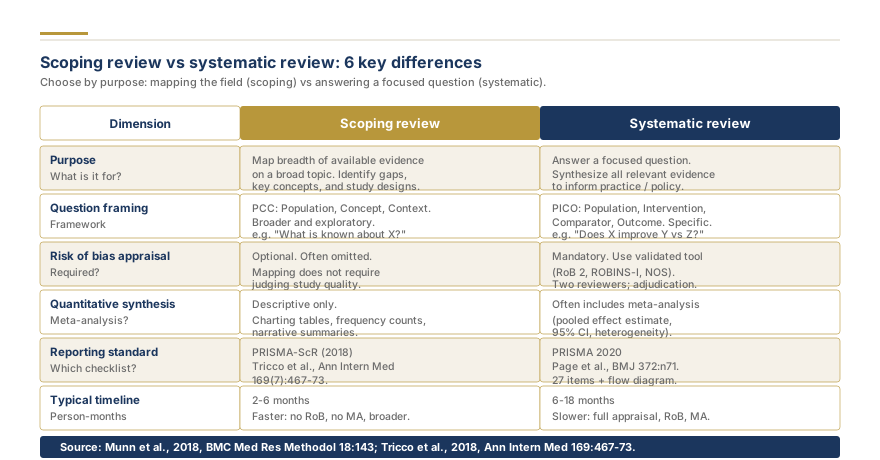
6 dimensions separate scoping from systematic reviews. Source: Munn et al., 2018, BMC Med Res Methodol 18:143.
The scoping review difference from a systematic review spans multiple dimensions. The following table compares them across the most important methodological features. This is the most comprehensive comparison available, covering everything from question structure to reporting guidelines.
Required (e.g., RoB 2, ROBINS-I, Newcastle-Ottawa)
Not required
Meta-analysis
May be included when studies are comparable
Not included
Data extraction
Detailed outcome-level extraction
Data charting (mapping key characteristics)
Reporting guideline
PRISMA 2020 (Page et al., 2021)
PRISMA-ScR (Tricco et al., 2018)
Protocol registration
PROSPERO (mandatory for many journals)
OSF or PROSPERO (increasingly expected)
Synthesis approach
Narrative and/or quantitative synthesis
Descriptive mapping, tables, visual charts
Study selection
Strict eligibility criteria with predetermined outcomes
Iterative criteria; may evolve during review
Typical timeline
6-18 months
3-8 months
Primary output
Evidence-based conclusion with strength-of-evidence rating
Evidence map showing scope, gaps, and characteristics
Each of these differences reflects a deeper philosophical distinction. A systematic review treats the literature as a body of evidence to be weighed and judged. A scoping review treats the literature as a territory to be surveyed and described. Neither approach is superior -- they answer different kinds of questions.
Data charting is the scoping review equivalent of data extraction, but it serves a different function. In a systematic review, you extract precise outcome data (effect sizes, confidence intervals, p-values) for potential pooling. In a scoping review, you chart study characteristics -- who studied what, where, when, using which methods, and what they found in broad terms. The JBI Manual (Peters et al., 2020) provides detailed guidance on designing a data charting form that captures the dimensions most relevant to your research question.
Protocol registration is now expected for both review types. PROSPERO accepts systematic review protocols and, as of recent policy updates, some scoping review protocols. The Open Science Framework (OSF) is an alternative platform for scoping review protocols. Regardless of which platform you use, registering your protocol before beginning searches demonstrates transparency and reduces the risk of selective reporting.
When to Choose a Scoping Review
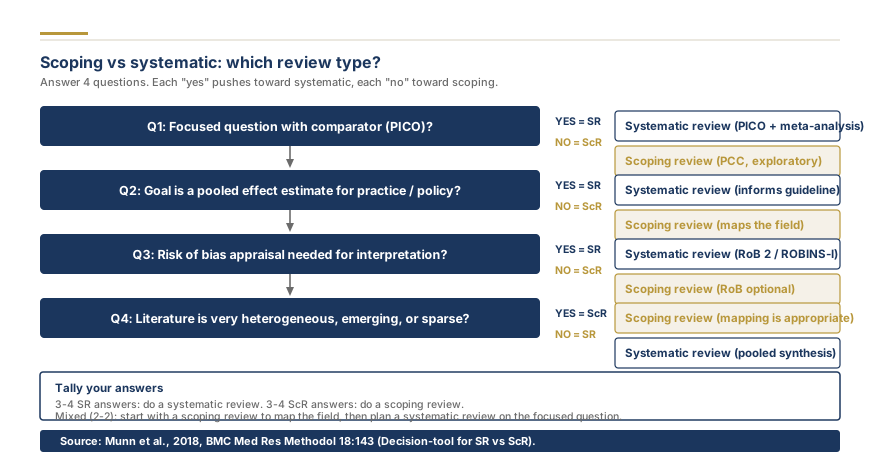
Tally your answers across 4 questions. Source: Munn et al., 2018, BMC Med Res Methodol 18:143.
A scoping review is the right choice when your objective is to understand what evidence exists rather than to determine what that evidence concludes. Several scenarios point clearly toward a scoping review.
When the topic is new or heterogeneous. If your research area is emerging and the literature spans multiple disciplines, study designs, and populations, a scoping review maps this heterogeneity without forcing it into a single analytical framework. For example, a scoping review of artificial intelligence applications in clinical trial design would capture the full landscape -- from machine learning for patient recruitment to natural language processing for protocol writing -- without needing to synthesize them into a single effect estimate.
When you need to identify evidence gaps. Funding bodies, research institutes, and policy organizations frequently commission scoping reviews to identify where evidence is lacking. The output -- an evidence gap map -- directly informs future research priorities. If your goal is to show where more research is needed rather than to determine what current research proves, a scoping review fits.
When the question is too broad for PICO. If you cannot define a specific intervention and comparator, your question is likely a PCC question. "What is known about patient experiences of telemedicine in rural communities?" is a PCC question. It defines a population (patients), concept (experiences of telemedicine), and context (rural communities) without specifying an intervention or comparator.
When you are planning a future systematic review. A scoping review can serve as a preliminary step to determine whether enough evidence exists to justify a full systematic review, and to identify the key variables and outcomes that should be examined. This is a legitimate and strategically sound use of the scoping review methodology.
When you need to map how a concept is defined. If the core concept in your field is defined inconsistently across studies -- for example, "treatment adherence" or "patient engagement" -- a scoping review can map these definitions and identify conceptual boundaries before anyone attempts a synthesis.
If any of these scenarios describe your situation, our guide on how to write a scoping review walks through the complete process from protocol to publication. You can also use our free PRISMA for scoping reviews tool to track your reporting compliance from the start.
Need help with your scoping review?
Our team delivers complete scoping reviews: protocol, search, charting, and a PRISMA-ScR-compliant manuscript ready for submission.
A systematic review is the appropriate choice when you need an evidence-based answer to a focused question, and the literature is mature enough to support formal appraisal and synthesis.
When the clinical or policy question is specific. "Does cognitive behavioral therapy reduce anxiety symptoms in adults with generalized anxiety disorder compared to waitlist control?" is a classic PICO question. It specifies population, intervention, comparator, and outcome. A systematic review is the right vehicle to answer it.
When evidence-based conclusions are needed. If your review will inform clinical guidelines, treatment decisions, or policy recommendations, stakeholders need to know not just what evidence exists but how strong it is. Only a systematic review provides the risk of bias assessment and strength-of-evidence evaluation that underpin actionable conclusions. The Cochrane Handbook (Higgins et al., 2023) provides gold-standard methods for this evaluation.
When meta-analysis is feasible and meaningful. If multiple studies report the same outcome using comparable measures, a meta-analysis can pool their results into a single summary estimate with a confidence interval. This quantitative synthesis is one of the most powerful tools in evidence-based practice. Meta-analysis requires a systematic review framework -- it cannot be conducted within a scoping review.
When the journal or funder expects it. Many clinical journals and funding agencies explicitly require systematic reviews for evidence synthesis submissions. If your target outlet specifies systematic review methodology, a scoping review will not be accepted regardless of quality.
When updating previous evidence. If a systematic review on your topic already exists but is several years old, an updated systematic review using the same protocol and search strategy is the appropriate approach. Scoping reviews do not update systematic reviews.
If your project fits these criteria, our comprehensive guide on how to write a systematic review covers every phase from protocol registration through PRISMA reporting.
Where Scoping Reviews and Systematic Reviews Overlap
Despite their differences, scoping reviews and systematic reviews share a substantial methodological core. Understanding these overlaps prevents the common misconception that scoping reviews are less rigorous or less demanding than systematic reviews.
Both require comprehensive searching. A scoping review search strategy should be just as thorough as a systematic review search strategy. You must search multiple databases, use a combination of controlled vocabulary and free-text terms, document every search in enough detail for replication, and report the full strategy in your manuscript or supplementary materials. Neither review type tolerates a Google Scholar-only search or a single-database approach.
Both require protocol registration. Registering your protocol before you begin searching is now expected for both review types. For systematic reviews, PROSPERO is the primary registry. For scoping reviews, OSF registrations are widely accepted, and PROSPERO has begun accepting scoping review registrations in some cases. A registered protocol protects you from allegations of selective reporting and provides a public record of your original plan.
Both require dual screening. To minimize selection bias, both review types recommend that at least two reviewers independently screen titles, abstracts, and full texts. Disagreements are resolved through discussion or by a third reviewer. Single-reviewer screening is a methodological weakness regardless of review type.
Both require transparent reporting. Systematic reviews report using PRISMA 2020 (Page et al., 2021). Scoping reviews report using PRISMA-ScR (Tricco et al., 2018). Both checklists require a PRISMA 2020-compliant flow diagram, detailed search strategy, clear eligibility criteria, and a structured presentation of results. The checklists differ in specific items -- PRISMA 2020 includes items for risk of bias and certainty of evidence, while PRISMA-ScR includes items for data charting -- but the commitment to transparency is identical.
Both demand significant time and resources. A well-conducted scoping review is not a weekend project. With broad inclusion criteria and exploratory aims, scoping reviews often screen more records than systematic reviews because they cast a wider net. The data charting process, while different from outcome-level data extraction, can be equally time-consuming when hundreds of studies are included.
These overlaps matter because they counter the persistent myth that scoping reviews are a shortcut. They are not. They are a different tool for a different job, demanding the same level of methodological rigor as any other form of evidence synthesis.
Common Mistakes When Choosing Between Them
The difference between scoping and systematic review methodology is clear in theory but frequently blurred in practice. These are the most common mistakes researchers make, and each one can derail a project months into its execution.
Choosing a scoping review to avoid risk of bias assessment. This is the most common and most damaging mistake. Some researchers select a scoping review because they want to avoid the labor-intensive process of formal quality appraisal. Peer reviewers and journal editors recognize this immediately. If your research question is specific enough to answer with a PICO framework, reviewers will ask why you did not conduct a systematic review -- and "it was easier" is not an acceptable answer. The JBI Manual (Peters et al., 2020) explicitly states that scoping reviews are not a less rigorous alternative to systematic reviews.
Using PICO for a scoping review. If you structure your scoping review around a PICO question, you are setting up a methodological contradiction. A PICO question implies you are looking for effectiveness evidence, which requires quality appraisal, which requires a systematic review. Scoping reviews use PCC because their questions are broader and do not center on intervention effectiveness. If your question naturally fits PICO, you need a systematic review.
Calling a literature review a scoping review. A scoping review requires a registered protocol, a comprehensive search across multiple databases, dual screening, a data charting framework, and reporting against PRISMA-ScR. A narrative summary of literature you happened to find is not a scoping review -- it is a literature review. Labeling it as a scoping review invites criticism from reviewers who will expect the full methodological apparatus.
Attempting meta-analysis within a scoping review. Scoping reviews describe and map evidence; they do not synthesize it quantitatively. If you find yourself wanting to pool effect sizes, calculate heterogeneity statistics, or generate forest plots, you have a systematic review on your hands, not a scoping review. Redirect your methodology accordingly.
Ignoring the iterative nature of scoping review eligibility criteria. Unlike systematic reviews, where eligibility criteria are fixed before screening begins, scoping review eligibility criteria can evolve as you become more familiar with the literature. This iterative process is a feature, not a bug -- but it must be documented transparently. Failing to report how and why your criteria changed undermines credibility.
Not registering a protocol. Some researchers skip protocol registration for scoping reviews because it is not as strictly enforced as it is for systematic reviews. This is a strategic error. A registered protocol protects you from post-hoc criticism, demonstrates methodological rigor, and is increasingly required by journals that publish scoping reviews, including BMJ Open, Systematic Reviews, and JBI Evidence Synthesis.
At Research Gold, we see these mistakes regularly in manuscripts that come to us for revision or methodological support. The most efficient way to avoid them is to make the right choice at the start. Ask yourself one question: "Am I trying to answer a specific question, or am I trying to map what is known?" If the former, conduct a systematic review. If the latter, conduct a scoping review. For a stage-by-stage start on that path, see getting started with a scoping review.
For researchers who need guidance on choosing the right approach, our methodology support services include protocol development for both review types. You can also explore our scoping review service or our pricing breakdown for transparent cost information. If you are ready to start, schedule a consultation and we will help you determine the most appropriate review type for your research question, your timeline, and your target journal.
If your research involves qualitative evidence, consider whether a qualitative systematic review might be more appropriate than either a scoping or traditional systematic review.
When your question spans both quantitative and qualitative domains, a mixed-methods systematic review combines the strengths of both approaches.
Pro Tip
Ask: Am I answering a question or mapping a territory?
This determines your choice.
Pro Tip
Don't use a scoping review to avoid quality assessment
Reviewers recognize this shortcut.
Pro Tip
Consider a scoping review as a pilot for a systematic review
It can identify the evidence landscape before you commit.
Frequently Asked Questions
5
Not necessarily. Broader inclusion criteria can result in more studies to screen and chart. The workload is different, not less.
A scoping review can inform a future systematic review, but you cannot retroactively convert one without a new protocol.
Most clinical journals prefer systematic reviews for evidence-based conclusions. Many journals (BMJ Open, Systematic Reviews, JBI Evidence Synthesis) actively publish scoping reviews.
Traditionally no. Scoping reviews focus on mapping rather than quantitative synthesis.
Need a Scoping Review? Our Team Follows JBI and PRISMA-ScR.
Complete scoping reviews following Arksey and O'Malley or JBI methodology, with PRISMA-ScR reporting. From protocol to publication, handled by PhD methodologists.
Our promise: Free rework on charting or PRISMA-ScR flow if reviewers ask for changes.
4.9 / 5Quote within a few hoursPRISMA-ScR + JBI methodologyPhD methodologistConfidential by default
Research Gold Team is our group of PhD methodologists and statisticians who deliver our systematic review, meta-analysis and statistical analysis work. The same team writes and checks the guides and tools on this site.
Need a Scoping Review? Our Team Follows JBI and PRISMA-ScR.
Complete scoping reviews following Arksey and O'Malley or JBI methodology, with PRISMA-ScR reporting. From protocol to publication, handled by PhD methodologists.
Complete guide to getting help with a scoping review, covering JBI and Arksey-O Malley frameworks, PRISMA-ScR reporting, common pitfalls, and when free resources vs professional services are needed.
Learn how to write a scoping review using the Arksey & O'Malley 6-stage framework, PCC question formulation, data charting, and PRISMA-ScR reporting. A JBI-aligned methodology guide for researchers at every level.
Eight types of systematic reviews explained and compared: traditional systematic review, meta-analysis, scoping review, rapid review, umbrella review, narrative review, living systematic review, and network meta-analysis. Includes decision table for choosing the right method.