A qualitative systematic review is a structured, transparent method for identifying, appraising, and synthesizing findings from qualitative research studies. While a quantitative systematic review pools numerical data through statistical meta-analysis, a qualitative systematic review integrates textual findings, participant quotes, and author interpretations to produce new conceptual insights about human experiences, perceptions, and behaviors.
Researchers use qualitative systematic reviews to answer "how" and "why" questions that numbers alone cannot address, such as how patients experience chronic pain management, why clinicians resist adopting new guidelines, or what barriers prevent medication adherence in adolescents. The Joanna Briggs Institute defines them as reviews that aggregate findings from primary qualitative studies using recognized synthesis methodologies, and the Cochrane Qualitative and Implementation Methods Group (Cochrane QIMG) maintains guidance on integrating qualitative evidence into Cochrane reviews.
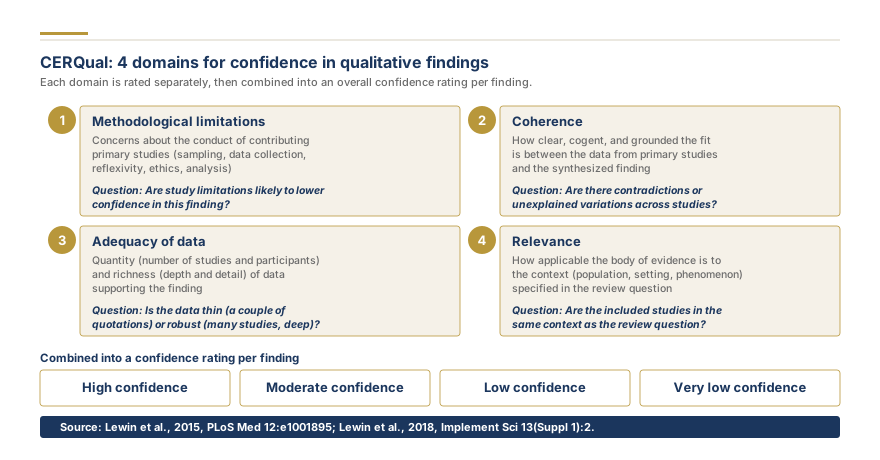
Which synthesis method should you use? The short answer: thematic synthesis for reviews informing practice or policy, meta-ethnography for theory-building from 10 to 15 conceptually rich studies, framework synthesis when an existing theory already structures your question, and meta-aggregation for JBI-style reviews feeding clinical recommendations. The comparison table below unpacks each choice, then this guide covers appraisal, extraction, reporting, and CERQual confidence assessment.
Explore the full landscape of review methodologies to understand where qualitative systematic reviews fit within the broader evidence synthesis family.
How Qualitative Reviews Differ from Quantitative Reviews
The distinction between qualitative and quantitative systematic reviews extends far beyond the type of data they handle. The differences shape every stage of the review process, from question formulation to synthesis, reporting, and confidence assessment.
Research questions in quantitative reviews typically follow the PICO format (Population, Intervention, Comparison, Outcome). Qualitative reviews use broader frameworks such as PICo (Population, Interest, Context) or SPIDER (Sample, Phenomenon of Interest, Design, Evaluation, Research type). These frameworks accommodate the exploratory, context-dependent nature of qualitative inquiry. A quantitative review might ask whether cognitive behavioral therapy reduces depression scores compared to standard care. A qualitative review might ask how patients with depression experience cognitive behavioral therapy and what factors influence their engagement with the treatment.
Search strategies also differ significantly. Qualitative studies are indexed inconsistently across databases. Many lack structured abstracts, and MeSH indexing for qualitative research is unreliable. This means that qualitative reviewers must search more databases (including CINAHL, PsycINFO, Sociological Abstracts, and ASSIA alongside PubMed and Embase), use broader search terms, and supplement database searching with citation tracking, hand-searching of key journals, and contact with authors. The concept of search saturation replaces the quantitative ideal of comprehensive retrieval.
Quality appraisal in quantitative reviews focuses on risk of bias using tools like the Cochrane Risk of Bias tool or the Newcastle-Ottawa Scale. Qualitative reviews use different instruments entirely, including the Critical Appraisal Skills Programme (CASP) Qualitative Checklist and the JBI Critical Appraisal Checklist for Qualitative Research. These tools evaluate methodological coherence, researcher reflexivity, ethical considerations, and the relationship between data and interpretations.
Synthesis is where the approaches diverge most dramatically. Quantitative reviews combine effect sizes using statistical methods. Qualitative reviews use interpretive or aggregative synthesis methods, including thematic synthesis, meta-ethnography, framework synthesis, and meta-aggregation, to generate findings that go beyond what any individual study reported. The result is not a pooled statistic but a new conceptual framework, a set of synthesized findings, or a line-of-argument that advances theoretical understanding.
Synthesis Methods: Choosing the Right Approach
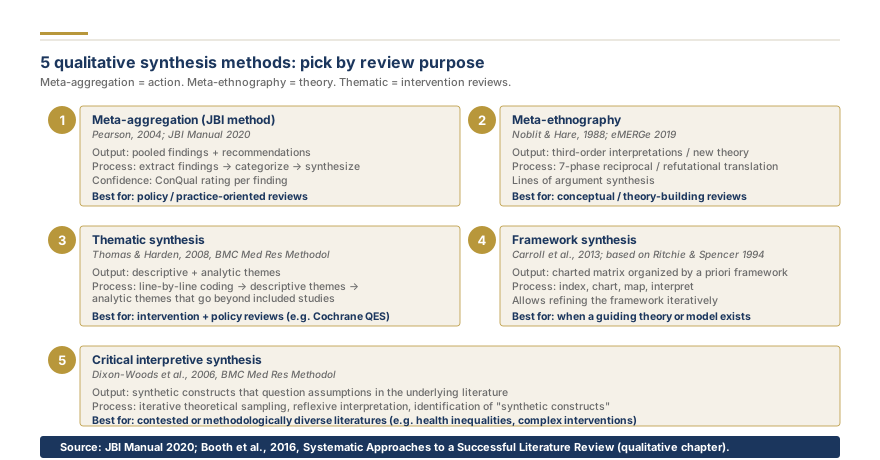
Selecting the appropriate synthesis method is one of the most consequential decisions in a qualitative systematic review. Each method carries different epistemological assumptions, produces different types of output, and suits different review questions. The table below compares the four most widely used approaches.
| Method | Originator | Epistemological Basis | Output Type | Best Suited For |
|---|---|---|---|---|
| Thematic synthesis | Thomas and Harden (2008) | Pragmatic, integrative | Analytical themes derived from descriptive themes | Reviews informing policy and practice; mixed-method reviews |
| Meta-ethnography | Noblit and Hare (1988) | Interpretive, constructivist | Line-of-argument synthesis; reciprocal and refutational translations | Reviews seeking new theoretical understanding; conceptually rich primary studies |
| Framework synthesis | Carroll et al. (2013) | Deductive, theory-driven | Findings mapped onto a pre-existing conceptual framework | Reviews testing or extending existing theories; reviews with a clear a priori framework |
| Meta-aggregation | Joanna Briggs Institute | Pragmatic, aggregative | Synthesized findings grouped under categories, with actionable recommendations | Reviews informing clinical guidelines; JBI-affiliated reviews |
Thematic synthesis, developed by Thomas and Harden (2008), is the most commonly used method. It follows three stages: line-by-line coding of primary study findings, organization of codes into descriptive themes, and generation of analytical themes that go beyond the content of the original studies. Thematic synthesis is accessible to researchers who are new to qualitative evidence synthesis because it draws on familiar qualitative analysis techniques. It works well for reviews that aim to inform practice or policy decisions.
Meta-ethnography, developed by Noblit and Hare (1988), is the most interpretive approach. It involves seven phases: identifying the research interest, deciding what is relevant, reading the studies, determining how studies relate to each other (reciprocal translation, refutational translation, or line-of-argument synthesis), translating studies into one another, synthesizing translations, and expressing the synthesis. Meta-ethnography produces the richest conceptual output but demands significant interpretive skill and is best suited to reviews of 10 to 15 studies with thick descriptive data.
Framework synthesis uses an existing conceptual or theoretical framework as a scaffold for organizing and interpreting findings from primary studies. Reviewers code data deductively into the framework's categories while remaining open to new themes that do not fit. This method is particularly useful when a review aims to test or extend an existing theory, or when policymakers need findings organized around predetermined categories.
Meta-aggregation, the approach developed and promoted by the Joanna Briggs Institute, takes a more aggregative stance. It groups findings from primary studies into categories based on similarity of meaning, then produces synthesized findings with accompanying recommendations for practice graded by a ConQual assessment of confidence. Meta-aggregation preserves the original meaning of participants' experiences rather than reinterpreting them, making it the most conservative synthesis method.
For a step-by-step guide to the systematic review process, including protocol registration, searching, and screening, our comprehensive guide covers each stage in detail.
Quality Appraisal: CASP, JBI, and the Role of Methodological Assessment
Critical appraisal of included studies is essential in any systematic review. In qualitative reviews, the purpose is not to assign a risk-of-bias score but to evaluate whether each study's methodology is coherent, transparent, and trustworthy. Two tools dominate qualitative critical appraisal.
The CASP Qualitative Checklist contains 10 questions organized around three broad issues: Are the results valid? What are the results? Will the results help locally? The checklist evaluates whether the research design was appropriate for the aims, whether the recruitment strategy was suitable, whether data collection addressed the research issue, whether the researcher-participant relationship was adequately considered, whether ethical issues were considered, whether the analysis was sufficiently rigorous, whether there is a clear statement of findings, and how valuable the research is. CASP does not produce a numerical score; instead, it prompts structured critical thinking about each study's strengths and limitations. You can complete and export the JBI qualitative checklist for every included study with our JBI critical appraisal tool.
The JBI Critical Appraisal Checklist for Qualitative Research contains 10 criteria that assess congruity between the stated philosophical perspective, methodology, research question, methods of data collection, data analysis, and interpretation of results. It also evaluates whether participants and their voices are adequately represented, whether the research is ethical, and whether conclusions flow from the analysis. You can apply this checklist using our free JBI critical appraisal tool.
Should studies be excluded based on quality? This is one of the most debated questions in qualitative evidence synthesis. Some methodologists argue that excluding studies based on quality assessment removes potentially important perspectives and introduces a form of bias. Others argue that including methodologically weak studies undermines the trustworthiness of the synthesis. The Cochrane QIMG recommends conducting sensitivity analysis by synthesizing findings with and without studies of lower methodological quality, then assessing whether the results change.
A practical approach is to include all studies that meet eligibility criteria, appraise them using CASP or JBI, present the appraisal results transparently in a table, and conduct sensitivity analysis to test the robustness of synthesized findings. This balances rigor with inclusiveness and allows readers to form their own judgments.
Struggling with critical appraisal, data extraction, or synthesis for your qualitative review? These are the most technically demanding stages of any qualitative systematic review. Research Gold's team includes experienced qualitative researchers who handle evidence synthesis projects from protocol to publication. get a personalized quote and tell us about your review.
Data Extraction from Qualitative Studies
Data extraction in qualitative systematic reviews differs fundamentally from quantitative extraction. Instead of extracting numerical outcomes, effect sizes, and confidence intervals, qualitative reviewers extract textual data: participant quotes, author interpretations, themes, concepts, and contextual information.
Before coding begins, it helps to map findings against studies in a single grid so that gaps in the evidence are visible while you extract rather than after.
A well-designed extraction form captures two categories of information. The first is study-level metadata: authors, year, country, setting, population characteristics, sample size, research design, data collection method (interviews, focus groups, observation, document analysis), and analytical approach. The second is findings-level data: the actual qualitative findings that will enter the synthesis.
The definition of a "finding" depends on the synthesis method you are using. For thematic synthesis, findings are typically passages from the results or findings sections of primary studies that contain themes, subthemes, or descriptive codes. For meta-ethnography, findings include first-order constructs (participant quotes), second-order constructs (authors' interpretations), and the relationships between them. For meta-aggregation, findings are defined as a conclusion or theme supported by an illustration (a direct quotation from a participant) and accompanied by a credibility rating (unequivocal, credible, or unsupported).
Build your extraction form using our free data extraction template builder, which allows you to customize fields for qualitative, quantitative, or mixed-method reviews.
Key extraction decisions:
- Extract from results sections only or from discussion sections as well? Most methodologists recommend extracting primarily from results or findings sections, where data is presented closest to participants' accounts. Discussion sections contain more author speculation and less data.
- Who extracts? At least two reviewers should extract data independently for a subset of studies to establish consistency. Discrepancies should be resolved through discussion.
- How to handle thick versus thin descriptions? Studies with rich, detailed findings contribute more to synthesis than studies with sparse descriptions. Document this variation during extraction so it can inform the confidence assessment later.
- Contextual information matters. Record the setting, population characteristics, healthcare system, and cultural context. Qualitative findings are inherently context-dependent, and stripping context during extraction undermines the interpretive validity of the synthesis.