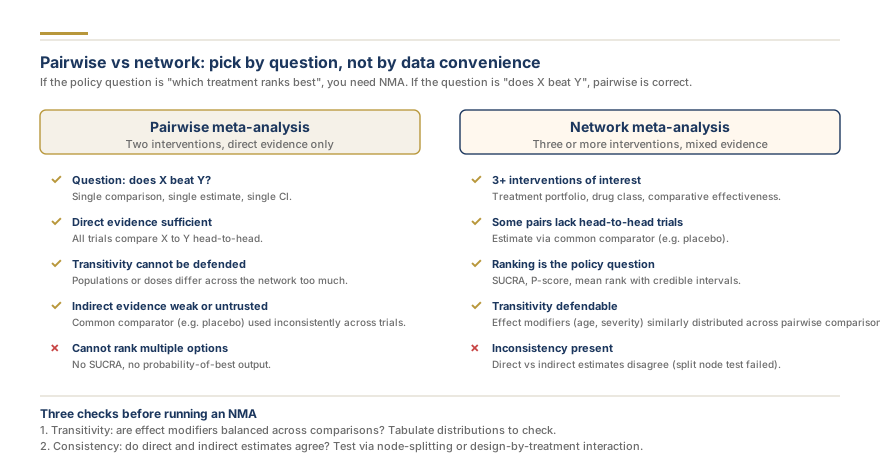
A network meta-analysis, also called mixed treatment comparison, is a statistical method that simultaneously compares three or more interventions by combining direct evidence from head-to-head trials with indirect evidence inferred through a common comparator. network meta-analysis produces treatment rankings (SUCRA) and league tables showing all pairwise comparisons. When researchers need to determine which treatment performs best among several competing options, network meta-analysis provides the only evidence synthesis framework capable of answering that question within a single, coherent analysis.
Traditional pairwise meta-analysis restricts comparisons to two interventions at a time. If you have studies comparing Drug A versus placebo, Drug B versus placebo, and Drug A versus Drug B, a pairwise approach requires three separate analyses. Network meta-analysis explained in its simplest form is the method that unifies all of these comparisons into one model, borrowing strength across the entire evidence base to produce estimates for every treatment pair, including pairs that have never been compared directly in a clinical trial.
Why Pairwise Meta-Analysis Falls Short With Many Treatments
In a standard pairwise meta-analysis, you pool effect sizes from studies that compare the same two interventions. The limitation is obvious: clinical practice rarely involves choosing between just two options. A physician selecting an antidepressant might need to choose among ten or more candidates. A health technology assessment body evaluating a new drug must understand how it compares not only to placebo but to every existing alternative. network meta-analysis addresses this gap by synthesizing the entire network of available evidence.
The key innovation is the use of indirect evidence. If Treatment A has been compared to Treatment C in several trials, and Treatment B has also been compared to Treatment C in other trials, network meta-analysis uses the common comparator (Treatment C) to estimate the relative effectiveness of A versus B, even if no trial has ever directly compared them. This indirect comparison, combined with any available direct evidence, produces what is called mixed evidence for each treatment pair.
Network meta-analysis requires that all studies in the network measure the same outcome and use compatible study designs. The treatments form a network where nodes represent interventions and edges represent direct comparisons from one or more studies. As long as the network is connected, meaning there is a path of comparisons linking every treatment to every other treatment, network meta-analysis can estimate all pairwise treatment effects.
How Network Meta-Analysis Works
The mechanics of network meta-analysis rest on three types of evidence. Direct evidence comes from head-to-head trials comparing two specific treatments. Indirect evidence is derived through a common comparator using the principle of transitivity. Mixed evidence combines both direct and indirect evidence for comparisons where both exist.
Consider a simple three-treatment network. Suppose five trials compare Drug A to placebo, three trials compare Drug B to placebo, and one trial compares Drug A to Drug B. The network meta-analysis model uses all nine trials simultaneously. For the A-versus-B comparison, it combines the single direct trial with the indirect estimate obtained through the placebo comparator. The result is a more precise estimate than either source of evidence could provide alone.
Two primary statistical frameworks exist for conducting network meta-analysis. The frequentist approach uses the R package netmeta, which fits a graph-theoretical model based on electrical network theory. This approach is computationally fast, produces familiar confidence intervals, and is increasingly popular for its accessibility. The Bayesian approach uses software such as JAGS, OpenBUGS, WinBUGS, or the R package gemtc to fit hierarchical models with Markov Chain Monte Carlo (MCMC) sampling. Bayesian network meta-analysis produces credible intervals rather than confidence intervals and naturally accommodates treatment ranking probabilities.
Both frameworks require the same inputs: a dataset of study-level treatment comparisons with their effect sizes and standard errors (or equivalent). The choice between frequentist and Bayesian analysis often depends on the research context, institutional preferences, and whether probabilistic treatment rankings are needed. The Cochrane Handbook Chapter 11 (Higgins et al., 2023) provides detailed guidance on both approaches.
The output of a network meta-analysis includes: a pooled effect estimate for every pairwise comparison in the network, a measure of heterogeneity, treatment rankings, and tests for inconsistency between direct and indirect evidence.
The Network Geometry Diagram

Before running any statistical model, every network meta-analysis should begin with a network geometry diagram, a visual representation of the evidence structure. This diagram, first formalized by Salanti (2012), communicates more information at a glance than any table of included studies.
In a network diagram, nodes represent treatments. The size of each node is typically proportional to the number of patients randomized to that treatment across all studies. Edges (lines connecting nodes) represent direct comparisons. The thickness of each edge is proportional to the number of studies making that comparison. A thick edge between two nodes signals robust direct evidence; a thin edge signals sparse evidence.
The geometry of the network reveals several critical features. A well-connected network has multiple edges linking many nodes, with several closed loops (triangles or polygons) that allow consistency checks between direct and indirect evidence. A star-shaped network has one central comparator (often placebo) connected to all other treatments, with no direct comparisons between active treatments. Star networks rely entirely on indirect evidence for active-versus-active comparisons.
A disconnected network contains two or more subgroups of treatments with no path of comparisons linking them. network meta-analysis cannot estimate relative effects between treatments in separate subnetworks. If your network diagram reveals disconnected components, you must either find additional studies to bridge the gap or restrict your analysis to connected subnetworks.
The network diagram also highlights potential vulnerability. If a single study is the only connection between two clusters of treatments, removing that study would disconnect the network. Such bridges deserve careful scrutiny for risk of bias, because the entire network depends on their validity.
Key Assumptions in Network Meta-Analysis
Every network meta-analysis rests on assumptions that must be evaluated before results can be trusted. Violations of these assumptions can produce misleading treatment rankings and incorrect conclusions about relative effectiveness.
Transitivity
The transitivity assumption is the foundation of all indirect comparisons. It states that the relative effect of Treatment A versus Treatment B estimated indirectly through a common comparator C is valid only if the studies comparing A-C and B-C are sufficiently similar in all important effect modifiers. Effect modifiers include patient population characteristics, disease severity, outcome definitions, follow-up duration, and co-interventions.
Transitivity is assessed qualitatively by examining the distribution of potential effect modifiers across comparisons. If trials of Drug A versus placebo enrolled mostly mild patients while trials of Drug B versus placebo enrolled mostly severe patients, the indirect comparison of A versus B is confounded by disease severity. The transitivity assumption validates indirect comparisons only when the study populations and designs are comparable across the network.
Researchers should create tables comparing the distribution of key clinical and methodological characteristics across all direct comparisons in the network. Systematic differences in effect modifiers across comparisons threaten the validity of the entire network meta-analysis.
Consistency
The consistency assumption states that direct and indirect evidence for the same comparison should agree. When studies directly comparing A versus B yield a different treatment effect than the indirect estimate of A versus B obtained through comparator C, the network exhibits inconsistency. Inconsistency signals that the transitivity assumption may be violated or that there are other unmodeled differences between study populations.
How to Test for Inconsistency
The primary method for detecting inconsistency is the node-splitting test (also called back-calculation or side-splitting). For each comparison that has both direct and indirect evidence, the node-splitting test separates the two sources and tests whether they differ statistically. A significant p-value (typically p < 0.05) indicates inconsistency for that comparison.
Global inconsistency tests evaluate the overall fit of the consistency model versus an inconsistency model. The design-by-treatment interaction test is another approach, particularly useful in frequentist frameworks. If significant inconsistency is detected, researchers should investigate potential sources, such as differences in patient populations, outcome definitions, or study quality across comparisons, before interpreting the network meta-analysis results.
Need expert support for your network meta-analysis? Our biostatisticians conduct network meta-analysis using frequentist and Bayesian frameworks, including ranking probabilities, inconsistency testing, and SUCRA plots. reach out for a free research project estimate, or see our network meta-analysis support.
SUCRA Rankings and League Tables
One of the most powerful outputs of network meta-analysis is the ability to rank treatments from best to worst. SUCRA (Surface Under the Cumulative Ranking Curve) is the most widely used ranking metric. It assigns each treatment a score between 0% and 100%, where 100% indicates the treatment is certainly the best and 0% indicates it is certainly the worst.
SUCRA is calculated from the cumulative ranking probabilities produced by the network meta-analysis model. For each treatment, the model estimates the probability that it ranks first, second, third, and so on. The cumulative ranking curve plots these cumulative probabilities, and the area under this curve is the SUCRA value. A rankogram displays the full probability distribution of ranks for each treatment, showing not just the most likely rank but the uncertainty around it.
| Treatment | SUCRA (%) | Mean Rank | Interpretation |
|---|---|---|---|
| Drug A | 92 | 1.3 | Very likely the best treatment |
| Drug C | 71 | 2.1 | Likely second best |
| Drug B | 45 | 3.2 | Middle of the pack |
| Placebo | 8 | 4.4 | Very likely the worst |
However, SUCRA values must be interpreted cautiously. A SUCRA difference of a few percentage points may not reflect a clinically meaningful difference between treatments. Rankings should always be accompanied by the underlying effect estimates and their confidence or credible intervals. Over-interpreting SUCRA without examining the precision of treatment comparisons is one of the most common mistakes in network meta-analysis.
A league table presents all pairwise comparison results in a single matrix format. Each cell contains the pooled effect estimate (e.g., odds ratio or mean difference) and its confidence interval for the comparison between the row treatment and the column treatment. League tables allow readers to quickly look up the relative effectiveness of any two treatments in the network. They are the primary reporting format recommended by PRISMA-NMA (Hutton et al., 2015).