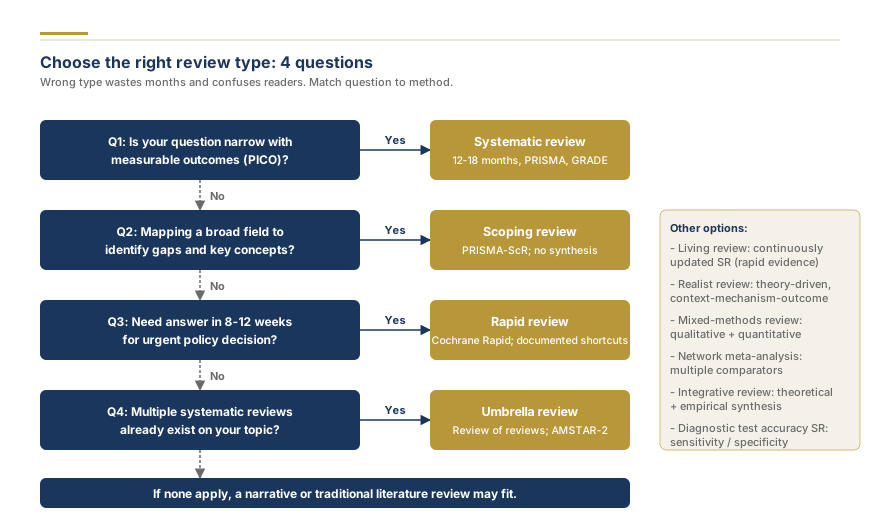
Understanding the systematic review vs literature review distinction is one of the most important methodological decisions a researcher faces. Both approaches synthesize existing evidence, but they differ fundamentally in protocol, search strategy, screening, quality assessment, and reporting. Choosing the wrong type can undermine the credibility of your findings, delay your project, or fail to meet journal and institutional requirements.
A systematic review is a protocol-driven evidence synthesis method that uses comprehensive, reproducible searches, dual-reviewer screening, standardized quality assessment, and PRISMA 2020 reporting. A literature review (also called a narrative review) is a selective summary of existing research without standardized methodology.
This guide provides a head-to-head comparison of both review types, explains when each is appropriate, introduces related review types, and addresses the most common misconceptions. If you have already decided on a systematic review, our step-by-step guide walks you through the complete process.
How a Systematic Review Is Conducted and Reported
A systematic review is an evidence synthesis method. It follows PRISMA 2020 reporting guidelines, which require authors to report against a 27-item checklist and include a four-phase flow diagram (Page et al., 2021). Before the review begins, the protocol is registered on PROSPERO or another public registry, ensuring transparency and reducing the risk of selective reporting.
The core methodological components of a systematic review include a systematic search strategy across multiple databases (typically PubMed, Embase, CINAHL, and discipline-specific sources), dual-reviewer screening at both title-abstract and full-text stages, standardized risk of bias assessment using validated tools such as RoB 2 (for randomized trials) or the NOS (Newcastle-Ottawa Scale, for observational studies), and structured data extraction with predefined variables.
A systematic review has a component of dual-reviewer screening, meaning at least two independent reviewers evaluate every study at each stage. Disagreements are resolved through discussion or by a third reviewer. This process minimizes selection bias and strengthens the reliability of the included evidence base.
When quantitative pooling is appropriate, a systematic review may include Meta-Analysis, the statistical combination of effect sizes from multiple studies to produce a single pooled estimate. However, not all systematic reviews include meta-analysis; when studies are too heterogeneous, a narrative synthesis is used instead. For a detailed breakdown of the relationship between these two methods, see our guide on the difference between systematic review and meta-analysis.
The Cochrane Handbook (Higgins et al., 2023) is the authoritative methodological reference for conducting systematic reviews in health sciences. It specifies standards for search strategy development, screening, quality assessment, data synthesis, and reporting.
What Is a Literature Review?
A Literature Review, also called a Narrative Review or narrative literature review, is a qualitative summary of existing research on a topic. Unlike a systematic review, a literature review does not follow a standardized protocol, does not require comprehensive database searches, and does not mandate quality assessment of included studies.
Literature reviews are common in dissertation introductions, textbook chapters, and invited journal articles. They allow the author flexibility in selecting and organizing sources to build an argument, identify research gaps, or provide context for a new study. The author decides which studies to include and how to synthesize them, without a predefined inclusion/exclusion framework.
A narrative literature review typically covers a broad topic rather than answering a specific, focused research question. The search strategy may be informal, relying on known references, citation chaining, and targeted database searches rather than the comprehensive, multi-database approach required for systematic reviews. There is no requirement for dual screening, no standardized quality assessment, and no mandatory reporting guideline equivalent to PRISMA 2020.
This flexibility is both a strength and a limitation. Literature reviews can be completed faster and provide a broader contextual overview, but they are susceptible to selection bias because the author chooses which studies to include. Results are not reproducible because another researcher following the same topic would likely select different studies and reach different conclusions.
Systematic Review vs Literature Review, Side-by-Side Comparison
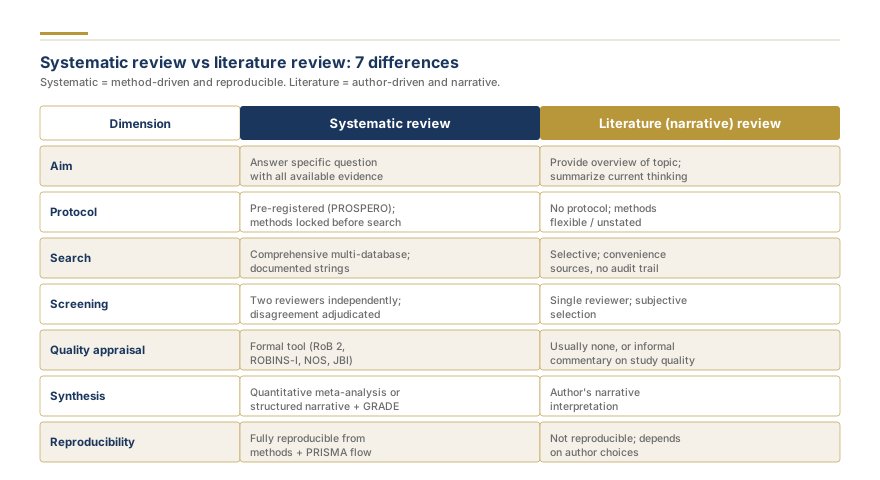
The difference between systematic review and literature review is best understood through a direct comparison across every major methodological dimension. The following review type comparison table highlights the key distinctions.
| Feature | Systematic Review | Literature Review (Narrative) |
|---|---|---|
| Protocol | Pre-registered (PROSPERO) | None required |
| Research question | Focused, structured (PICO/PEO) | Broad, exploratory |
| Search strategy | Comprehensive, multi-database, reproducible | Selective, informal |
| Screening | Dual-reviewer, independent | Single author, subjective |
| Quality assessment | Standardized tools (RoB 2, NOS, AMSTAR 2) | Not required |
| Data synthesis | Structured narrative or meta-analysis | Qualitative summary |
| Reporting guideline | PRISMA 2020 (27-item checklist + flow diagram) | None |
| Reproducibility | High, another team can replicate the review | Low, author-dependent |
| Timeline | 6-18 months (median 67 weeks) | 2-8 weeks |
| Team size | Minimum 2 reviewers (recommended 3+) | Typically 1 author |
| Bias control | Multiple safeguards (protocol, dual screening, quality assessment) | Susceptible to selection bias |
| Best for | Clinical guidelines, policy, evidence-based decisions | Background context, introductions, broad overviews |
The median time from protocol registration to publication for systematic reviews is 67 weeks (Borah et al., 2017), compared to 2-8 weeks for a typical literature review. This difference reflects the comprehensive methodology required, not inefficiency. Every stage of a PRISMA 2020 compliant systematic review demands documented, reproducible procedures.
The systematic review methodology is fundamentally about minimizing bias. Protocol registration prevents outcome switching. Comprehensive searches reduce the chance of missing relevant studies. Dual reviewer screening catches errors in study selection. Standardized quality assessment tools (a risk of bias assessment framework) ensure that the strength of evidence is evaluated consistently across studies. The literature review vs systematic review distinction ultimately comes down to this: one prioritizes rigor and reproducibility, the other prioritizes flexibility and speed.
When to Use a Systematic Review
A systematic review is the appropriate method when the goal is to produce comprehensive evidence review results that can inform clinical practice, health policy, or evidence-based guidelines. Specific scenarios where a systematic review is required or strongly recommended include:
Clinical or policy decision-making. When your findings will influence treatment decisions, clinical guidelines, or public health policy, the methodological rigor of a systematic review is non-negotiable. Regulatory bodies, guideline panels, and health technology assessment agencies rely on systematic reviews as the highest level of evidence.
Journal submission as a standalone study. Many journals, particularly in medicine, nursing, and public health, expect or require systematic reviews to follow PRISMA 2020 and to register protocols on PROSPERO. A publication-ready review in these fields must demonstrate reproducible research methods from search to synthesis.
PhD or doctoral thesis in health sciences. Most health science doctoral programs now expect at least one systematic review chapter. The structured methodology provides examiners with clear evidence of methodological competence and the ability to critically appraise evidence.
Answering a specific, focused question. Systematic reviews are designed around tightly defined research questions using frameworks like PICO (Population, Intervention, Comparator, Outcome). If your question is specific enough to define inclusion and exclusion criteria, a systematic review is likely the right approach.
When reproducibility matters. If other researchers need to verify, update, or build on your review, the transparent, protocol-driven approach of a systematic review makes this possible. The evidence synthesis methodology is documented at every step.
For a complete walkthrough, see step-by-step systematic review methodology.
Ready to upgrade from a narrative literature review to a full systematic review? Our team handles every methodological step, from PROSPERO registration and search strategy to meta-analysis and PRISMA reporting. get a free protocol writing estimate, or explore our professional systematic review service.