An integrative review includes diverse study designs and theoretical literature, while a systematic review follows strict protocols for a focused question. Learn when to use each approach.
Dr. Sarah Mitchell
March 4, 2026
Key Takeaways
An integrative review synthesizes diverse source types including empirical studies (quantitative, qualitative, mixed methods), theoretical papers, and grey literature to provide a comprehensive understanding of a phenomenon
A systematic review follows a strict, pre-registered protocol with explicit inclusion criteria, systematic search strategies, risk of bias assessment, and often statistical pooling through meta-analysis
The Whittemore and Knafl (2005) framework is the most widely cited methodology for conducting integrative reviews, providing a structured five-stage process
Integrative reviews are common in nursing, education, and social sciences where research questions span multiple methodologies and theoretical perspectives
Systematic reviews provide stronger evidence for clinical decision-making because their rigid methodology minimizes bias, while integrative reviews provide broader conceptual understanding
Both review types require transparent reporting of search strategies, inclusion decisions, and synthesis methods to be considered rigorous
Integrative review vs systematic review is one of the most common methodological questions in evidence synthesis, particularly in nursing, education, and social sciences where research questions often span multiple study designs. Both are structured approaches to synthesizing existing literature, but they differ fundamentally in scope, methodology, inclusion criteria, and the type of evidence they produce.
An integrative review synthesizes diverse source types, including quantitative studies, qualitative studies, mixed-methods research, theoretical papers, and grey literature, to develop a comprehensive understanding of a topic or phenomenon. A complete systematic review writing guide follows a strict, pre-registered protocol to answer a focused question using studies of similar design, with formal risk of bias assessment and often statistical pooling through explore meta-analysis.
Neither approach is inherently superior. The right choice depends on your research question, the available evidence, and the intended use of your findings.
Purpose and Research Question
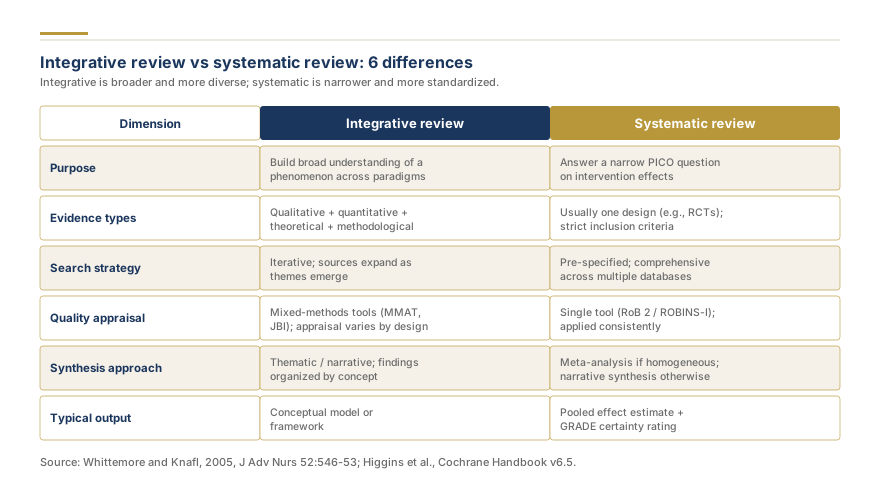
Integrative review vs systematic review: 6 differences
The fundamental difference starts with the type of question each review answers.
Systematic reviews answer focused, answerable questions structured around a specific comparison. The interactive PICO builder tool (Population, Intervention, Comparison, Outcome) is the standard tool for framing systematic review questions. Examples: "Does cognitive behavioral therapy reduce anxiety symptoms compared to waitlist control in adults?" or "What is the diagnostic accuracy of rapid antigen tests for COVID-19?"
Integrative reviews address broader conceptual or phenomenological questions that cannot be reduced to a single comparison. Examples: "What is known about the experience of moral distress among critical care nurses?" or "How has the concept of patient engagement evolved across healthcare disciplines?" These questions require evidence from multiple paradigms, mixing quantitative outcome data with qualitative experiences and theoretical frameworks.
If your question fits PICO and the evidence base consists primarily of similar study designs (RCTs, cohort studies, or diagnostic accuracy studies), a systematic review is almost always the better choice. If your question is exploratory, spans methodologies, or aims to build conceptual understanding rather than estimate an effect size, an integrative review is appropriate.
Inclusion Criteria and Source Types
Systematic reviews define narrow, explicit inclusion criteria, typically restricted to specific study designs. A systematic review of intervention effectiveness usually includes only randomized controlled trials, or at most quasi-experimental studies. Sources are limited to empirical research. Theoretical papers, editorials, and expert opinions are excluded. explore prisma 2020 provides the reporting standard.
Integrative reviews cast a deliberately wide net. The hallmark of an integrative review is its inclusion of diverse source types: randomized trials, observational studies, qualitative studies, mixed-methods research, theoretical and conceptual papers, dissertations, and sometimes policy documents or clinical guidelines. This breadth is the defining feature and primary strength of the approach.
This difference in scope has practical consequences. A systematic review might include 12 RCTs; an integrative review on the same topic might include 45 sources spanning experimental studies, interview-based qualitative research, concept analyses, and grey literature. The integrative review provides a richer, more contextualized picture, but with less certainty about any specific causal claim.
Search Strategy
Both review types require systematic, reproducible search strategies across multiple databases. However, the scope and emphasis differ.
Systematic reviews demand exhaustive searches designed to identify all relevant studies. This typically includes 3-5 electronic databases, hand-searching of key journals, citation tracking, and searching grey literature sources like ClinicalTrials.gov and conference proceedings. The search strategy is detailed enough to be replicated. A research librarian is strongly recommended.
Integrative reviews also require comprehensive searches, but the broader inclusion criteria often mean searching additional databases beyond the clinical ones. For a nursing integrative review, you might search CINAHL, PubMed, PsycINFO, Education Source, Sociological Abstracts, and ProQuest Dissertations. Theoretical literature may require hand-searching specific journals and using Google Scholar for citation tracking.
Both review types should report the complete search strategy. The interactive PRISMA diagram builder applies to both, documenting the number of records identified, screened, assessed for eligibility, and included.
Integrative reviews face a unique challenge: no single quality appraisal tool works across all source types. The Mixed Methods Appraisal Tool (MMAT) is commonly used because it provides assessment criteria for quantitative, qualitative, and mixed-methods studies within a single instrument. For theoretical papers, quality assessment focuses on conceptual clarity, logical consistency, and contribution to the field.
Some methodologists argue that quality appraisal is less critical in integrative reviews because the goal is comprehensive understanding rather than an unbiased effect estimate. Others counter that including low-quality evidence without flagging its limitations undermines the review's credibility. The Whittemore and Knafl framework recommends quality evaluation as a core stage, even though the tools are less standardized.
Need help with your evidence synthesis?
Our methodologists handle narrative synthesis, thematic analysis, umbrella reviews, and all forms of evidence synthesis, following established frameworks.
Integrative reviews use qualitative synthesis techniques that can accommodate diverse evidence types:
Constant comparison method: Adapted from grounded theory. Data from each source is coded, compared with data from other sources, and iteratively grouped into themes and categories
Thematic analysis: Identifying recurring themes across sources, regardless of their methodology
Content analysis: Counting and categorizing the frequency of specific concepts or findings
Conceptual mapping: Visually representing relationships between concepts, findings, and theories
Narrative summary: Structured description organized by themes, with attention to convergence and divergence across source types
The Whittemore and Knafl (2005) framework specifically recommends data reduction (coding findings from each source), data display (creating matrices or visual representations), data comparison (identifying patterns and themes), and drawing conclusions with verification.
The Whittemore and Knafl Framework
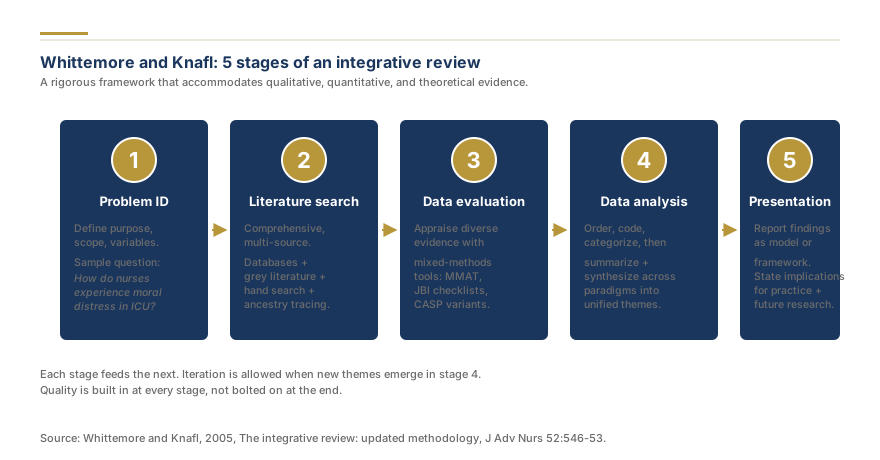
Whittemore and Knafl: 5 stages of an integrative review
Published in 2005, the Whittemore and Knafl framework is the most widely cited methodology for integrative reviews. It updated and expanded the original integrative review method proposed by Cooper (1982) and refined by Ganong (1987).
Five stages:
Problem identification. Define the purpose, variables of interest, and boundaries of the review. A clear problem statement guides all subsequent stages.
Literature search. Conduct comprehensive, well-documented searches across electronic databases, hand-search relevant journals, and use citation tracking. Document the search strategy for reproducibility.
Data evaluation. Assess the quality of included sources using appropriate tools for each study design. The MMAT is commonly used for its cross-design applicability.
Data analysis. This is the most complex stage. Extract relevant data from each source into a structured matrix. Code findings using constant comparison. Display data visually to identify patterns. Compare findings across sources and across source types (e.g., do qualitative findings align with quantitative results?).
Presentation. Report the review process transparently, present synthesized findings organized by theme, and discuss implications, limitations, and directions for future research.
When to Choose Each Review Type
Choose a systematic review when:
Your research question is focused and answerable with a specific comparison (PICO-structured)
The available evidence consists primarily of studies with similar designs
You need to estimate an effect size or diagnostic accuracy measure
Your findings will directly inform clinical guidelines, policy, or treatment decisions
Peer reviewers or your target journal expect the highest level of evidence synthesis
Choose an integrative review when:
Your research question is broad, conceptual, or exploratory
You need to include diverse study designs alongside theoretical literature
The phenomenon of interest has been studied from multiple methodological perspectives
You are developing a new conceptual framework or model
You want to identify the full scope of knowledge on a topic, including gaps
Choose a scoping review vs systematic review guide when your primary goal is mapping the extent and nature of evidence on a topic without synthesizing findings or assessing quality.
Common Misconceptions
"An integrative review is just a literature review with extra steps." This is incorrect. A well-conducted integrative review follows a structured methodology, uses systematic search strategies, applies quality assessment, and employs defined analytical techniques. The rigor is different from but not less than a systematic review.
"Systematic reviews are always better than integrative reviews." This conflates hierarchy of evidence with fitness for purpose. A systematic review with meta-analysis provides the strongest evidence for a focused clinical question. But for a broad conceptual question, forcing the evidence into a systematic review framework either excludes essential non-empirical sources or results in a narrative synthesis that would have been better served by an integrative review methodology from the start.
"You can do an integrative review because it is easier." Integrative reviews done well are not easier. The synthesis stage, combining findings from qualitative interviews, randomized trials, and theoretical papers into a coherent whole, is analytically demanding. Using an integrative review to avoid the rigor of systematic review methodology is a misuse of the approach and will be caught by knowledgeable peer reviewers.
"Integrative reviews cannot be published in high-impact journals." While systematic reviews with meta-analyses dominate the evidence synthesis literature in medicine, integrative reviews are well-established and valued in nursing (Journal of Advanced Nursing, Worldviews on Evidence-Based Nursing), education (Review of Educational Research), and social sciences. The key is rigorous execution and transparent reporting.
Integrative reviews do not have a single dedicated reporting guideline equivalent to PRISMA. Many authors adapt PRISMA for their integrative reviews, which is acceptable and improves transparency. Some journals accept integrative reviews reported using the Whittemore and Knafl stages as the organizational framework. The ENTREQ (Enhancing Transparency in Reporting the Synthesis of Qualitative Research) statement may be relevant when the integrative review emphasizes qualitative findings.
Regardless of which review type you conduct, transparent reporting of your search strategy, inclusion decisions, quality assessment, and synthesis methods is non-negotiable for publication in reputable journals.
A systematic review uses a strict, pre-registered protocol to answer a focused clinical question using studies of similar design (typically RCTs), with risk of bias assessment and often meta-analysis. An integrative review uses a broader methodology to synthesize diverse evidence types (quantitative studies, qualitative studies, theoretical papers, grey literature) around a topic or phenomenon. Systematic reviews prioritize minimizing bias; integrative reviews prioritize comprehensive understanding.
No. An integrative review follows a structured methodology with defined stages: problem identification, literature search, data evaluation, data analysis, and presentation. A traditional literature review (narrative review) has no required methodology and is susceptible to selection bias and subjective interpretation. Integrative reviews are more rigorous than narrative reviews but less methodologically prescribed than systematic reviews.
Technically yes, but it is rare. If an integrative review includes a subset of quantitative studies with comparable designs and outcomes, that subset could be pooled statistically. However, the primary strength of integrative reviews is synthesizing diverse evidence types that are typically not suitable for meta-analysis. If your evidence is homogeneous enough for meta-analysis, a systematic review with meta-analysis is usually the more appropriate approach.
The Whittemore and Knafl (2005) framework describes five stages: (1) Problem identification, defining the purpose and scope of the review. (2) Literature search, using comprehensive search strategies across multiple databases. (3) Data evaluation, assessing the quality of included sources. (4) Data analysis, extracting, coding, and synthesizing findings across diverse sources. (5) Presentation, reporting results in a structured, transparent format.
Use an integrative review when your research question spans multiple study designs or methodologies, when you need to include theoretical and conceptual literature alongside empirical studies, when the phenomenon is understudied and you need to map the full scope of available knowledge, or when you are developing a conceptual framework. Use a systematic review when you have a focused clinical question answerable by studies of similar design.
Share
Found this useful? Share it with your colleagues.
Need help with your evidence synthesis?
Our methodologists handle narrative synthesis, thematic analysis, umbrella reviews, and all forms of evidence synthesis, following established frameworks.
Complex Synthesis? Our PhD Team Specializes in Every Type.
Systematic reviews, narrative synthesis, umbrella reviews, and rapid reviews. We match the right methodology to your research question and deliver a publication-ready manuscript.
Our promise: Free rework on synthesis or GRADE assessment if reviewers push back.
4.9 / 5Quote within a few hoursPRISMA 2020 + GRADE certaintyPhD methodologistConfidential by default
Dr. Sarah Mitchell holds a PhD in Biostatistics from Johns Hopkins Bloomberg School of Public Health and has over 15 years of experience in systematic review methodology and meta-analysis. She has authored or co-authored 40+ peer-reviewed publications in journals including the Journal of Clinical Epidemiology, BMC Medical Research Methodology, and Research Synthesis Methods. A former Cochrane Review Group statistician and current editorial board member of Systematic Reviews, Dr. Mitchell has supervised 200+ evidence synthesis projects across clinical medicine, public health, and social sciences.
Complex Synthesis? Our PhD Team Specializes in Every Type.
Systematic reviews, narrative synthesis, umbrella reviews, and rapid reviews. We match the right methodology to your research question and deliver a publication-ready manuscript.
CHEERS 2022 checklist explained: all 28 items, what changed from CHEERS 2013, and how to report a cost-effectiveness analysis so payers and journals can use it.
SPIRIT 2025 checklist explained: all 34 items by section, what changed from SPIRIT 2013, and how the protocol lines up with CONSORT 2025 when you report the trial.
ARRIVE 2.0 guidelines explained: the Essential 10 and the Recommended Set, what changed from ARRIVE 2010, and the items journals check in animal research reports.