Heterogeneity in meta-analysis explained: I-squared interpretation, tau-squared estimation, Cochrane Q-test, subgroup analysis, meta-regression. Cochrane thresholds and a decision guide for when studies disagree.
Research Gold Team
March 29, 2026
Drowning in I-squared above 75 percent? Our biostatisticians run subgroup, meta-regression, and sensitivity analyses to explain the heterogeneity for your discussion and rebuttal letter. Get a free quote.
Key Takeaways
Heterogeneity in meta-analysis means the included studies produce different effect sizes, their results are inconsistent beyond what chance alone would explain
I² measures the percentage of variability due to true differences between studies (not sampling error), Cochrane classifies <25% as low, 25-50% moderate, 50-75% substantial, >75% considerable
τ² (tau-squared) quantifies the actual magnitude of between-study variance in the true effect sizes
Cochrane's Q-test tests whether heterogeneity is statistically significant, but has low power with few studies, I² and τ² are more informative
High heterogeneity doesn't automatically invalidate a meta-analysis, explore sources through subgroup analysis, meta-regression, and sensitivity analysis before discarding the pooled estimate
Clinical, methodological, and statistical heterogeneity should be assessed separately, clinical judgment comes first, then statistical testing
Heterogeneity in meta-analysis is the variability in effect sizes across the studies included in a quantitative synthesis that exceeds what would be expected from sampling error alone. The I-squared statistic quantifies it as the percentage of that variability reflecting true between-study differences rather than chance: 0 to 25% reads as low, 25 to 50% as moderate, 50 to 75% as substantial, and above 75% as considerable heterogeneity. Assessing heterogeneity determines whether a single pooled estimate meaningfully represents all the included evidence.
When you conduct a meta-analysis, you are combining results from multiple studies to estimate a single summary effect. But those studies were conducted in different settings, with different populations, using different protocols. The question is not whether the results will vary, they will. The question is whether the variation is small enough that a single pooled estimate tells a coherent story, or whether the studies are measuring fundamentally different things. Heterogeneity assessment answers that question, and it is one of the most consequential steps in any evidence synthesis.
In our meta-analyses, the most common finding is I-squared between 50-80%, and the most common mistake is treating this as a reason to abandon pooling rather than an invitation to explore sources of variation. This guide explains what the statistics actually tell you and what to do with that information.
The Three Types: Clinical, Methodological, and Statistical Heterogeneity
Clinical heterogeneity arises from differences in participants, interventions, and outcomes across the included studies. If one trial enrolls young adults with mild hypertension and another enrolls elderly patients with severe hypertension, the true treatment effect may genuinely differ between those populations. Clinical heterogeneity is assessed through expert judgment, not statistics, you examine the study characteristics and ask whether it makes clinical sense to combine them. The Cochrane Handbook (Higgins et al., 2023) emphasizes that clinical diversity should be the first consideration, before any statistical test is performed.
Methodological heterogeneity stems from differences in study design and risk of bias. A double-blinded randomized controlled trial and an open-label observational study may produce different effect sizes not because the treatment works differently but because the study designs introduce different biases. Methodological heterogeneity includes differences in allocation concealment, blinding, follow-up duration, outcome measurement, and attrition. Choosing the right appraisal instrument for each design is covered in our quality assessment tool comparison. When high-quality studies produce systematically different results from low-quality studies, methodological heterogeneity is the likely explanation.
Statistical heterogeneity is the measurable variability in effect sizes across studies after accounting for sampling error. This is what I-squared, tau-squared, and the Q-test quantify. Statistical heterogeneity is a consequence of clinical and methodological heterogeneity, it tells you that something is making the results differ, even if it does not tell you what. A meta-analysis produces a forest plot that visually displays this variability, showing each study's effect size and confidence interval alongside the pooled diamond.
Type
What It Reflects
How It Is Assessed
Example
Clinical
Differences in populations, interventions, outcomes
Expert judgment, table of study characteristics
Adults vs. children, high dose vs. low dose
Methodological
Differences in study design and risk of bias
Risk of bias tools (RoB 2, ROBINS-I)
randomized controlled trials vs. observational, blinded vs. open-label
Statistical
Variability in effect sizes beyond chance
I-squared, tau-squared, Q-test
I-squared = 72%, tau-squared = 0.15
Understanding these three categories is essential because high statistical heterogeneity always has clinical or methodological roots. Reducing your heterogeneity assessment to a single I-squared number without investigating the underlying causes misses the point entirely.
I-Squared, Measuring the Proportion of Heterogeneity
I-squared (I-squared) measures the percentage of total variability across studies that is attributable to true heterogeneity rather than sampling error. It answers a specific question: of all the variation you observe in the forest plot, how much is real and how much is just noise? I-squared measures statistical heterogeneity as a proportion, making it the most commonly reported heterogeneity statistic in published meta-analyses.
The formula for I-squared is straightforward. It derives from Cochrane's Q statistic:
I-squared = ((Q - df) / Q) x 100%
where Q is the weighted sum of squared differences between each study's effect and the pooled effect, and df is the degrees of freedom (number of studies minus one). When Q equals df, I-squared is zero, all observed variability is consistent with sampling error. When Q greatly exceeds df, I-squared approaches 100%, nearly all variability reflects true differences between studies.
The Cochrane Handbook (Higgins et al., 2023) provides widely used thresholds for I-squared interpretation:
I-squared Range
Interpretation
Implication
0-25%
Low heterogeneity
Results are reasonably consistent
25-50%
Moderate heterogeneity
Some variability; investigate potential sources
50-75%
Substantial heterogeneity
Considerable inconsistency; pooled estimate requires caution
75-100%
Considerable heterogeneity
Results highly inconsistent; explore sources before relying on pooled estimate
These thresholds are guidelines, not rigid cutoffs. Higgins et al. (2023) caution that the importance of heterogeneity depends on the clinical context, the magnitude of effects, and the strength of evidence for the inconsistency. An I-squared of 60% in a meta-analysis where all effect sizes point in the same direction and are clinically meaningful is very different from an I-squared of 60% where some studies show benefit and others show harm.
Limitations of I-squared deserve attention. First, I-squared is a proportion, not a measure of absolute variability. Two meta-analyses can both have I-squared = 75% but vastly different amounts of actual variation, one may have effect sizes ranging from 0.3 to 0.5, while another ranges from -0.2 to 1.8. Second, I-squared is sensitive to the precision of the included studies. Adding more precise (larger) studies increases I-squared even when the actual between-study variance remains constant, because the larger studies shrink the within-study error, making the between-study component look proportionally larger. Borenstein et al. (2009) demonstrate this paradox with worked examples showing that I-squared can increase as studies become more precise, even when the actual heterogeneity has not changed. Third, the confidence interval around I-squared is often wide, especially with fewer than 20 studies, making point estimates unreliable.
You can calculate I-squared for your own data using our I-squared and tau-squared calculator, which reports both statistics alongside your pooled forest plot.
Tau-Squared, The Magnitude of Between-Study Variance
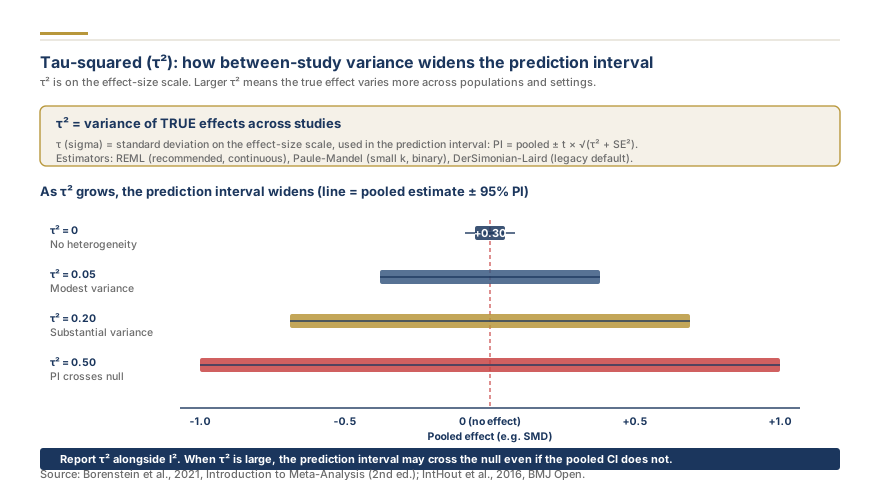
Tau-squared and the prediction interval at 4 levels. Source: Borenstein et al., 2017, Res Synth Methods; Cochrane Handbook v6.5.
Tau-squared quantifies the actual variance of the true effect sizes across studies. While I-squared tells you what proportion of variability is due to heterogeneity, tau-squared tells you how much variability there is in absolute terms. Tau-squared estimates between-study variance on the scale of the effect size itself, making it directly interpretable.
If you are working with standardized mean differences, a tau-squared of 0.04 means the standard deviation of the true effects across studies is 0.20 (the square root of tau-squared). This tells you that the true effects vary by about 0.20 standard deviations from the average, a practically meaningful amount of variation that I-squared alone cannot convey.
The relationship between tau-squared and the prediction interval is direct. The prediction interval uses tau-squared to estimate the range within which the true effect of a future study would likely fall. When tau-squared is large, the prediction interval is wide, signaling that the meta-analytic average may not apply uniformly across settings.
Two primary methods are used to estimate tau-squared:
DerSimonian-Laird estimator, The most widely used method due to its computational simplicity. The DerSimonian-Laird approach uses a method-of-moments calculation that is fast and straightforward. However, it tends to underestimate tau-squared, particularly when the number of studies is small or when the true heterogeneity is large. DerSimonian and Laird (1986) developed this estimator for practical convenience, but its known negative bias has led methodologists to recommend alternatives.
REML (Restricted Maximum Likelihood), A more accurate estimation method that accounts for the uncertainty in estimating the overall effect. REML generally produces less biased estimates of tau-squared than DerSimonian-Laird, particularly with small numbers of studies. The Cochrane Handbook (Higgins et al., 2023) notes that REML is preferred in many applications, though it requires iterative computation and may not converge with very sparse data.
Estimator
Strengths
Limitations
When to Use
DerSimonian-Laird
Simple, fast, widely available
Underestimates tau-squared, especially with few studies
Quick preliminary analyses, very large number of studies
REML
Less biased, accounts for estimation uncertainty
Iterative, may not converge with sparse data
Preferred default, especially with < 20 studies
Paule-Mandel
Unbiased for normal data
Less well-known, not available in all software
Normal outcomes, small number of studies
Choosing between a random-effects and fixed-effect model depends directly on whether you assume tau-squared is zero (fixed-effect) or allow it to be estimated from the data (random-effects). The random-effects model accounts for between-study heterogeneity by incorporating tau-squared into the study weights, giving smaller studies relatively more weight than they would receive under a fixed-effect model.
Dealing with high heterogeneity in your meta-analysis? Our biostatisticians conduct subgroup analyses, meta-regression, and sensitivity analyses to identify and address sources of variation. begin your research project today, or explore our our meta-analysis service.
Cochrane's Q-Test
The Q-test is a formal hypothesis test for the presence of heterogeneity. It tests the null hypothesis that all studies share a common true effect size, that tau-squared equals zero. When the Q statistic exceeds its expected value under the null (the degrees of freedom), the test rejects homogeneity.
The Q statistic sums the weighted squared deviations of each study's effect from the pooled estimate:
Q = sum of (w_i x (effect_i - pooled_effect)^2)
where w_i is the inverse-variance weight for study i. Under the null hypothesis of homogeneity, Q follows a chi-squared distribution with k-1 degrees of freedom, where k is the number of studies.
Despite its widespread use, the Q-test has well-documented limitations. Its statistical power is low when the meta-analysis includes fewer than 20 studies, which describes the majority of published meta-analyses. With only 5-10 studies, the Q-test frequently fails to detect true heterogeneity (Type II error), leading analysts to incorrectly conclude that heterogeneity is absent. Borenstein et al. (2009) demonstrate that the Q-test has roughly 35% power to detect moderate heterogeneity with 10 studies at the conventional alpha = 0.10 threshold.
For this reason, the Cochrane Handbook (Higgins et al., 2023) recommends using a liberal significance threshold of alpha = 0.10 rather than the conventional 0.05 for the Q-test, and emphasizes that a non-significant Q-test should not be interpreted as evidence that heterogeneity is absent. I-squared and tau-squared provide more informative assessments because they quantify heterogeneity rather than simply testing its presence.
The Q-test also has inflated power when the number of studies is very large or when individual studies are very precise. In these situations, even trivially small heterogeneity produces a significant Q statistic, leading to the opposite problem: concluding that important heterogeneity exists when the actual variation is negligible.
In practice, report all three statistics together. The Q-test p-value tells you whether heterogeneity reaches statistical significance. I-squared tells you what proportion of variability is real. Tau-squared tells you how large the actual variation is. No single statistic tells the complete story.
Need help with your meta-analysis?
Our PhD statisticians run complete meta-analyses: effect sizes, forest plots, heterogeneity testing, and publication-ready results sections.
Naming an estimator is not the same as understanding it. Reviewers increasingly ask which tau-squared estimator you used and why, so it helps to see what each one actually computes.
The DerSimonian-Laird (DL) estimator is a closed-form, method-of-moments calculation built directly from Cochran's Q:
Here w_i = 1 / v_i are the fixed-effect (inverse-variance) weights, k is the number of studies, and Q = Σ w_i (y_i − M)² with M the fixed-effect pooled estimate. The max(0, …) truncation is why DL never returns a negative variance: when Q is smaller than its degrees of freedom, τ² is set to zero. DL is fast and deterministic, but simulation studies (Veroniki et al., 2016) show it underestimates between-study variance when the number of studies is small or effect sizes are unbalanced.
The REML (restricted maximum likelihood) estimator has no closed form. It maximizes the restricted log-likelihood of the random-effects model, which separates the variance-component estimation from the estimation of the pooled mean and therefore corrects the downward bias that ordinary maximum likelihood carries. In practice it is solved iteratively. Starting from an initial τ² (often the DL value), each Fisher-scoring update is:
The weights w*_i and the weighted mean M are recomputed at each step, and the loop continues until τ² stops changing (typically within a few iterations).
Worked Comparison on the Same Data
Take four studies with log odds ratios y = (0.40, 0.30, 0.70, 0.10) and within-study variances v = (0.04, 0.05, 0.10, 0.02). The fixed-effect weights are 25, 20, 10, and 50, the pooled mean is M = 0.267, and Q = 3.73 on df = 3.
DL: C = 105 − (3625 / 105) = 70.48, so τ²_DL = (3.73 − 3) / 70.48 = 0.0104.
REML: starting from 0.0104 and applying the update once gives τ² = 0.0115; a second pass barely moves it, converging to τ²_REML ≈ 0.012, modestly larger than DL.
That difference looks trivial here because heterogeneity is genuinely low, but with few studies and substantial heterogeneity the gap widens, and a larger τ² produces a wider pooled confidence interval and a wider prediction interval. This is precisely why methods groups (including Cochrane's current guidance) default to REML for continuous and most binary outcomes, reserving DL mainly for legacy replication.
Report the estimator explicitly in your methods section, for example: "Between-study variance (τ²) was estimated using restricted maximum likelihood, and a 95% prediction interval was calculated to express the dispersion of true effects." For how that estimator choice plays out across software, see our comparison of meta-analysis software beyond RevMan.
What to Do When Heterogeneity Is High
High heterogeneity does not automatically invalidate your meta-analysis. It means the studies produced different results, and your job is to understand why. Abandoning the pooled estimate without investigation wastes the most valuable information heterogeneity provides, the opportunity to explore what makes results differ across settings, populations, and methods.
Subgroup analysis divides studies into groups based on pre-specified characteristics and compares the pooled effects within each subgroup. Subgroup analysis is the most straightforward tool for exploring heterogeneity. If you hypothesize that the intervention works differently in adults versus children, you split your studies accordingly and examine whether heterogeneity decreases within each subgroup while the subgroup effects differ from each other. The test for subgroup differences (interaction test) has more credibility than comparing individual subgroup estimates visually.
Effective subgroup analyses meet several criteria. The grouping variable must be a study-level characteristic (not patient-level data from aggregated studies). The subgroups must be pre-specified in the protocol, post-hoc subgroup analyses are viewed skeptically because researchers can generate numerous groupings until one appears significant. The number of subgroup comparisons should be limited to avoid multiple testing problems. And each subgroup must contain enough studies to produce a reliable estimate.
Meta-regression extends subgroup analysis to continuous moderators. If you suspect that intervention duration, sample size, or mean participant age explains variation in effect sizes, meta-regression models the relationship between the moderator and the effect size across studies. It is conceptually similar to standard regression but operates at the study level rather than the individual level. Meta-regression requires at least 10 studies per covariate to avoid overfitting (Higgins et al., 2023), and results should be interpreted cautiously because the analysis is ecological, associations observed between studies may not hold within studies.
Sensitivity analysis tests whether your conclusions change when you modify your analytical decisions. Sensitivity analysis tests result robustness by systematically altering the meta-analysis, removing one study at a time (leave-one-out analysis), excluding high risk-of-bias studies, changing the statistical model, or using alternative effect size measures. If the pooled estimate and its significance remain stable across these variations, the finding is robust despite the heterogeneity. If a single study drives both the pooled effect and the heterogeneity, that study warrants close scrutiny. Use our leave-one-out analysis tool to perform this assessment systematically.
When to abandon the pooled estimate, In rare cases, heterogeneity is so extreme and unexplainable that a single pooled estimate cannot meaningfully represent the evidence. This decision should follow, not precede, a thorough investigation. Cochrane Handbook guidance (Higgins et al., 2023) suggests that if I-squared exceeds 75% and no subgroup analysis or meta-regression reduces heterogeneity meaningfully, the analyst should consider presenting study-level results without pooling, or presenting the pooled estimate alongside the prediction interval with clear caveats. Even in these situations, a narrative synthesis that describes the pattern of results is more informative than simply reporting that the studies were "too heterogeneous to combine."
Detecting publication bias is also critical when heterogeneity is high. Missing studies, particularly small negative studies, can inflate both the pooled estimate and the apparent heterogeneity. Funnel plot asymmetry and statistical tests like Egger's regression should be part of any thorough heterogeneity investigation.
Reviewers asking why you did not use a Knapp-Hartung adjustment or a REML estimator? Our biostatisticians handle every technical defense so your revision sails through. Get a free quote.
Heterogeneity and Model Selection
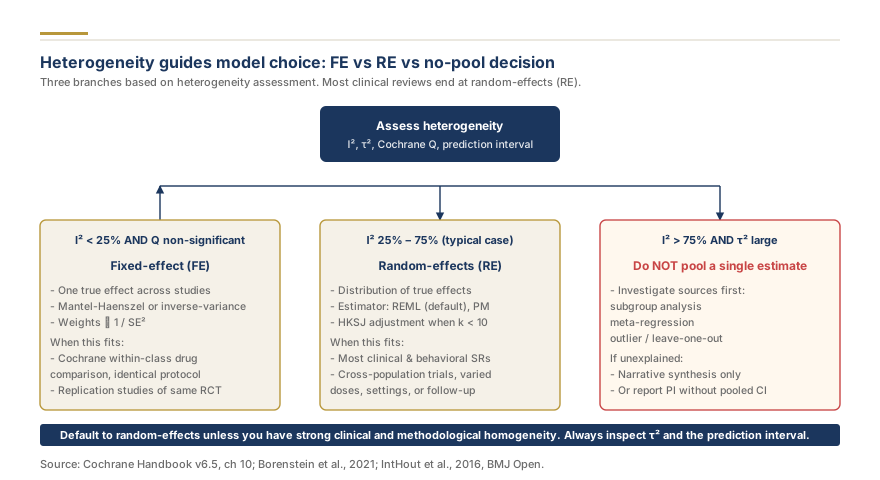
FE vs RE vs no-pool decision branches. Source: Borenstein et al., 2010, Res Synth Methods; Cochrane Handbook v6.5.
The choice between a fixed-effect model and a random-effects model is fundamentally a choice about heterogeneity. Understanding when each applies prevents both overconfident and overly conservative conclusions.
A fixed-effect model assumes that all included studies estimate exactly the same true effect size. Any observed variability is attributed entirely to within-study sampling error. The fixed-effect model is appropriate only when you believe the studies are functionally identical, same population, same intervention, same outcome measured the same way. In practice, this assumption is rarely tenable. When studies truly share a common effect, tau-squared is zero, and the fixed-effect and random-effects models produce identical results.
A random-effects model assumes that each study estimates its own true effect size, and these true effects are drawn from a distribution with mean mu and variance tau-squared. The random-effects model accounts for between-study heterogeneity by incorporating tau-squared into the study weights. This gives less weight to very large, precise studies and more weight to smaller studies compared to the fixed-effect model, because under random-effects, even a very precise study is only one draw from the distribution of true effects.
Feature
Fixed-Effect Model
Random-Effects Model
Assumption
All studies share one true effect
True effects vary across studies
Tau-squared
Assumed to be zero
Estimated from data
Study weights
Based solely on within-study variance
Based on within-study + between-study variance
Confidence interval
Narrower (may be overconfident)
Wider (reflects additional uncertainty)
Inference
Applies to the specific studies included
Generalizes to the broader population of studies
When appropriate
Studies are truly identical (rare)
Studies differ in population, setting, or methods (typical)
The Cochrane Handbook (Higgins et al., 2023) recommends the random-effects model as the default for most meta-analyses because clinical and methodological diversity is nearly universal. However, the random-effects model has an important limitation: when heterogeneity is large, the pooled estimate has a wide confidence interval and may not be clinically useful. In these cases, the prediction interval provides a more honest summary of uncertainty.
The prediction interval estimates the range of true effects you would expect in a future study conducted in a similar but not identical setting. While the confidence interval estimates the average effect with a certain precision, the prediction interval captures the spread of effects across settings. With high heterogeneity, the prediction interval may include the null value even when the confidence interval does not, meaning that while the average effect favors the treatment, some settings may see no benefit or even harm. IntHout et al. (2016) argue that prediction intervals should be routinely reported alongside confidence intervals in random-effects meta-analyses.
Consider a meta-analysis of 15 trials with a pooled standardized mean difference of 0.45 (95% CI: 0.30 to 0.60) and I-squared = 68%. The confidence interval suggests a clear, moderate benefit. But the prediction interval might be -0.10 to 1.00, meaning that in a new study, the true effect could range from slightly harmful to very large. Both intervals are correct; they answer different questions. The CI answers "what is the average effect?" The prediction interval answers "what might happen in the next study?"
Selecting the right model is a decision you should make before seeing the results, based on your clinical assessment of whether the included studies are estimating the same or different effects. Switching from fixed-effect to random-effects after observing high heterogeneity is a form of data-driven decision making that can bias the analysis.
Bringing It All Together, A Decision Framework
The following framework summarizes the heterogeneity assessment process from start to finish, integrating clinical judgment with statistical evidence.
First, assess clinical heterogeneity by examining your study characteristics table. Are the populations, interventions, comparators, and outcomes similar enough that combining makes clinical sense? If fundamental clinical differences exist, consider separate meta-analyses by subgroup rather than a single pooled analysis.
Second, assess methodological heterogeneity using risk of bias tools. If high-risk and low-risk studies produce systematically different results, methodological heterogeneity is present.
Third, compute and report the three statistical heterogeneity measures: Q-test p-value, I-squared with its confidence interval, and tau-squared. Interpret them together, not individually. A significant Q-test with I-squared = 40% and tau-squared = 0.02 tells a different story than a significant Q-test with I-squared = 85% and tau-squared = 0.50.
Fourth, if heterogeneity is substantial (I-squared > 50% or tau-squared is clinically meaningful), investigate sources through pre-specified subgroup analyses and, if sufficient studies exist, meta-regression. Document which analyses were pre-specified and which were exploratory.
Fifth, conduct sensitivity analyses, leave-one-out, exclusion of high risk-of-bias studies, alternative models, to test the robustness of your findings. Report these transparently.
Sixth, report the prediction interval alongside the confidence interval when using a random-effects model with non-trivial heterogeneity. This gives readers an honest picture of the expected range of effects across settings.
Heterogeneity is not a problem to be eliminated, it is information to be explored. The studies in your meta-analysis produced different results for reasons that may be clinically important. Understanding why results disagree is often more valuable than the pooled estimate itself. A meta-analysis that identifies patient populations, intervention characteristics, or study designs that moderate the treatment effect provides actionable evidence for clinical decision-making, research prioritization, and guideline development.
When heterogeneity is substantial, prediction intervals provide a more honest picture of expected effects in future settings. See our guide on prediction intervals in meta-analysis.
Visual tools like the Galbraith plot and Baujat plot complement I-squared by identifying which studies drive heterogeneity.
Pro Tip
Report both I² and τ²
I² tells you the proportion; τ² tells you the magnitude. A small I² with a large τ² means few studies with large variability. Report both for complete transparency.
Pro Tip
Use the prediction interval in high-heterogeneity meta-analyses
The CI around the diamond estimates the average effect. The prediction interval estimates what you'd expect in a new study. When I² > 50%, the prediction interval is more honest about uncertainty.
Pro Tip
Pre-specify subgroup analyses in your protocol
Post-hoc subgroup analyses (fishing for explanations of heterogeneity) are viewed skeptically. Pre-specify your planned explorations in your PROSPERO registration.
Frequently Asked Questions
6
I² > 50% indicates substantial heterogeneity, more than half the variability between studies reflects true differences rather than sampling error. Explore sources before relying on the pooled estimate.
Not necessarily. It means studies produced different results, which may be clinically meaningful. Exploring sources of heterogeneity through subgroup analysis can be more informative than the overall pooled estimate.
I² is a percentage (0-100%) showing the proportion of variability due to heterogeneity. τ² is the absolute variance of the true effect sizes across studies. I² can be identical with very different amounts of actual variation.
When you expect clinical or methodological diversity across studies, which is nearly always. Cochrane recommends random-effects as the default unless you can justify the assumption that all studies estimate the exact same effect.
Yes, but report the heterogeneity prominently, explore sources with subgroup analysis or meta-regression, and emphasize the prediction interval rather than just the confidence interval around the pooled estimate.
The prediction interval estimates the range of true effects expected in a new study. While the CI estimates the average effect, the prediction interval captures the spread. With high heterogeneity, the prediction interval may cross the null even when the CI doesn't.
Share
Found this useful? Share it with your colleagues.
Need help with your meta-analysis?
Our PhD statisticians run complete meta-analyses: effect sizes, forest plots, heterogeneity testing, and publication-ready results sections.
Reading About Meta-Analysis? Our PhD Team Runs Them Every Day.
From data extraction to forest plots, sensitivity analysis, and a journal-ready manuscript. We handle the full meta-analysis so you can focus on your research question.
Our promise: Free re-run of the pooled analysis if reviewers question the estimate or model.
4.9 / 5Quote within a few hoursmetafor R + Cochrane HandbookPhD methodologistConfidential by default
Research Gold Team is our group of PhD methodologists and statisticians who deliver our systematic review, meta-analysis and statistical analysis work. The same team writes and checks the guides and tools on this site.
Heterogeneity diagnostics are where most meta-analyses fail peer review. Our statisticians run subgroup analyses, meta-regression, and influence diagnostics, then write the section reviewers ask to see. Explore the meta-analysis service or start a free quote.
Reading About Meta-Analysis? Our PhD Team Runs Them Every Day.
From data extraction to forest plots, sensitivity analysis, and a journal-ready manuscript. We handle the full meta-analysis so you can focus on your research question.
Learn when to use subgroup analysis vs meta-regression in your meta-analysis. Covers methodology, interpretation, pitfalls, and reporting requirements for both approaches.
Forest plots show you that heterogeneity exists. Galbraith and Baujat plots show you exactly which studies are causing it. This guide explains both diagnostic tools and how to act on what they reveal.
While Excel can perform basic fixed-effect pooling with manual formulas, it cannot handle random-effects models, forest plots, publication bias tests, or sensitivity analysis. Learn what Excel can and cannot do for meta-analysis, and discover better free alternatives.