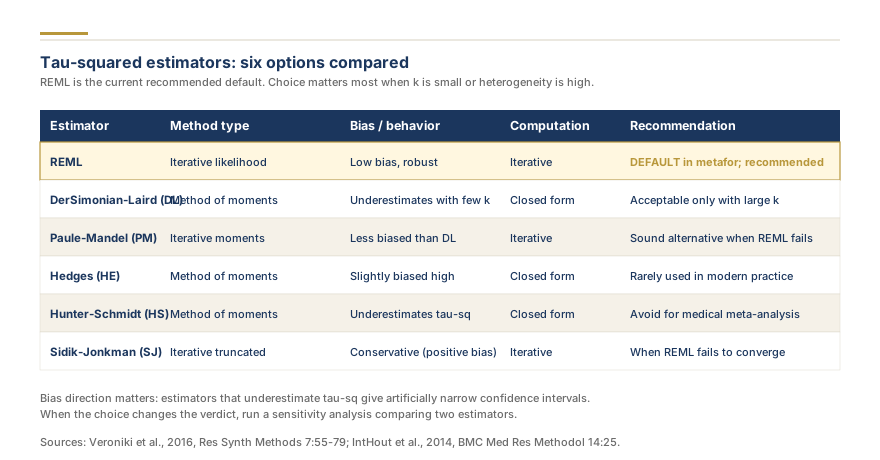
Every random-effects meta-analysis rests on an estimate of tau-squared, the between-study variance that quantifies how much true effect sizes differ across your included studies. The estimator you choose to compute tau-squared is not a technical footnote. It determines the weights assigned to each study, the width of your pooled confidence interval, and ultimately the precision of your summary effect.
Two estimators dominate the field: DerSimonian-Laird (DL), introduced in 1986 and still the most commonly used, and REML (Restricted Maximum Likelihood), which simulation studies consistently show outperforms DL in most realistic meta-analysis scenarios.
Try our free free forest plot maker to visualize pooled effects under both estimators and compare how your forest plot changes.
How Tau-Squared Estimation Shapes Your Entire Random-Effects Analysis
In a random-effects synthesis, each study receives a weight proportional to the inverse of its total variance, which is the sum of within-study sampling variance and the between-study variance tau-squared.
When tau-squared is small, large studies dominate. When tau-squared is large, weights become more equal across studies. An overestimated tau-squared makes your weights artificially uniform and widens confidence intervals unnecessarily. An underestimated tau-squared produces overconfident results and artificially narrow intervals.
The DerSimonian-Laird Method: Strengths and Known Limitations
DerSimonian and Laird (1986) proposed a method-of-moments estimator that became the default in almost every meta-analysis software package. Its appeal is computational simplicity with a closed-form solution.
However, simulation studies identified consistent problems. The estimator is biased downward, tending to underestimate the true tau-squared, particularly when the number of studies is small (k less than 30) or when heterogeneity is moderate to high. Studies by Viechtbauer (2005) and Langan and colleagues (2019) showed that DL produces 95% confidence intervals with actual coverage closer to 92-93%.
REML: Fisher Scoring, Iterations, and Why It Performs Better
Restricted Maximum Likelihood estimation treats tau-squared as a variance component estimated via maximum likelihood applied to a restricted log-likelihood function. Unlike DL, REML uses iterative optimization with Fisher scoring iterations, updating the estimate at each step based on the gradient and curvature of the likelihood until convergence.
Simulation results consistently favor REML. Viechtbauer's comprehensive comparison showed REML has lower mean squared error than DL across most scenarios, particularly when k is small (5-20 studies). The metafor package in R uses REML as its default estimator, reflecting the methodological consensus.
When DerSimonian-Laird Remains Acceptable
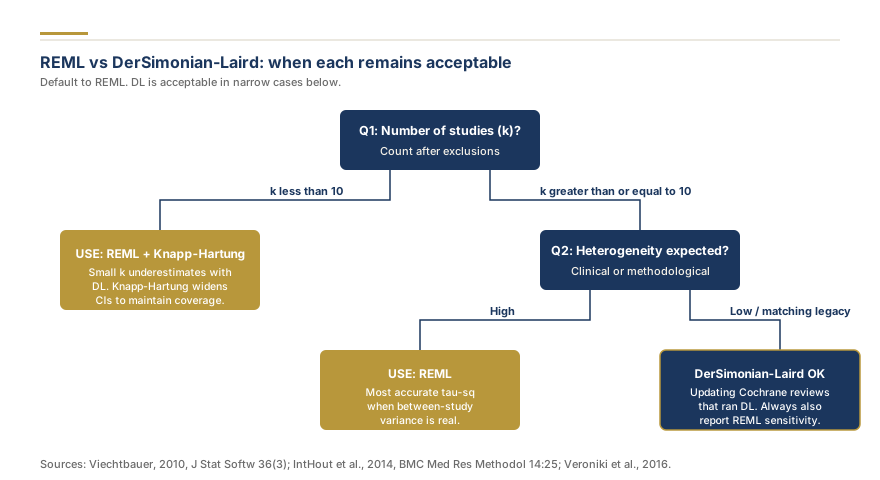
When k is large (30 or more studies), DL's bias diminishes substantially. When tau-squared is very small or zero, both estimators agree by definition. For exploratory preliminary analyses where computational simplicity aids rapid iteration, DL remains useful.
However, if you are writing for a high-quality clinical journal, if your synthesis has fewer than 20 studies, or if reviewers are likely to scrutinize your heterogeneity estimate, REML is the defensible choice.
See our influence diagnostics tool to examine whether your pooled estimate is stable across individual study exclusions.
The DerSimonian-Laird and REML Formulas, Written Out
A guide that compares two estimators should show what each one computes. Both estimate the same quantity, the between-study variance τ², but they reach it by completely different routes.
DerSimonian-Laird is a method-of-moments estimator with a closed-form solution derived from Cochran's Q:
τ²_DL = max(0, (Q − (k − 1)) / C), where C = Σ w_i − (Σ w_i² / Σ w_i)
The weights w_i = 1 / v_i are the fixed-effect inverse-variance weights, k is the number of studies, and Q = Σ w_i (y_i − M)² with M the fixed-effect weighted mean. One pass through the data returns the answer, which is why DL dominated for thirty years before iterative methods were practical on a laptop. Its weakness is structural: as a moment estimator it assumes the weights are known constants, so when k is small or the studies are unbalanced it systematically underestimates τ² and produces confidence intervals that are too narrow.
REML instead maximizes the restricted log-likelihood of the random-effects model. By restricting the likelihood to the residual contrasts, it removes the degrees of freedom consumed in estimating the pooled mean, correcting the downward bias that plain maximum likelihood shares with DL. There is no closed form, so it is solved by iteration. A common Fisher-scoring update, starting from an initial value (often the DL estimate), is:
τ²_(new) = [ Σ w_i² · ( (y_i − M)² + 1/Σ w_i − v_i ) ] / Σ w_i², where w_i = 1 / (v_i + τ²)
At each step the random-effects weights w*_i and the weighted mean M are recomputed, and the loop runs until τ² converges, usually within three or four iterations.
Same Data, Two Answers
Take four studies with effects y = (0.40, 0.30, 0.70, 0.10) and variances v = (0.04, 0.05, 0.10, 0.02). The fixed-effect weights are 25, 20, 10, 50; M = 0.267; and Q = 3.73 on df = 3.
- DL: C = 105 − (3625/105) = 70.48, so τ²_DL = (3.73 − 3)/70.48 = 0.0104.
- REML: starting from 0.0104 and applying the update gives 0.0115, then ≈ 0.012 at convergence.
Feed those back into the pooled model and the consequence is concrete: with τ²_DL the random-effects standard error is smaller and the diamond narrower; with the larger τ²_REML the confidence interval and the prediction interval both widen. When heterogeneity is genuinely larger or k is below roughly 10, that gap is no longer cosmetic, and a too-narrow DL interval can flip a borderline result to spuriously significant.
library(metafor)
yi <- c(0.40, 0.30, 0.70, 0.10)
vi <- c(0.04, 0.05, 0.10, 0.02)

dl   <- rma(yi, vi, method = "DL")
reml <- rma(yi, vi, method = "REML")

c(DL = dl$tau2,   REML = reml$tau2)          # between-study variance
c(DL = dl$se,     REML = reml$se)            # SE of the pooled effect
predict(reml)                                # pooled estimate + prediction interval
The practical default is REML for continuous and most binary outcomes; reach for DL only when you are explicitly replicating an older analysis that used it.