The choice between a random effects vs fixed effect meta-analysis is one of the most consequential statistical decisions you will make when synthesizing evidence. The model you select determines how study weights are calculated, how wide your confidence intervals become, how your pooled effect size is interpreted, and ultimately whether your conclusions generalize beyond the specific studies in your review. Despite its importance, the decision is frequently made by default rather than by design, researchers select whichever model their software defaults to, or whichever their supervisor used last, without interrogating the assumptions underneath.
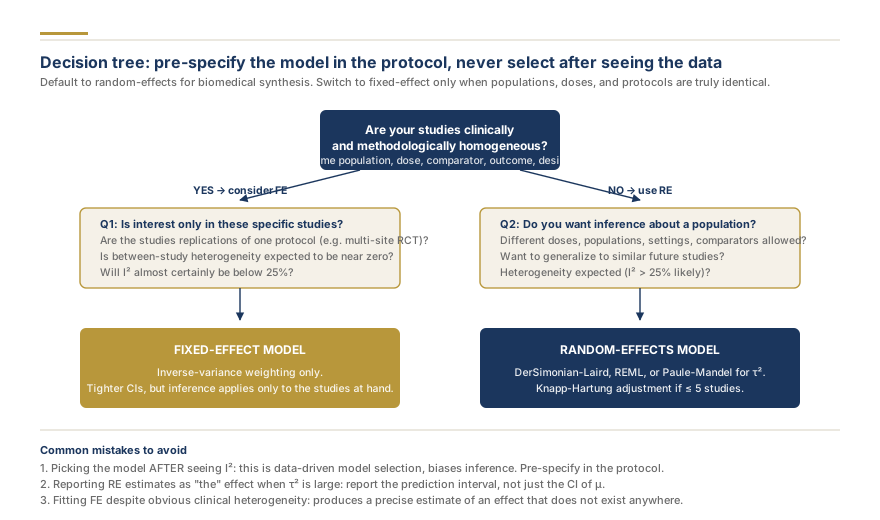
This guide explains the fundamental difference between the two models, walks through how each computes a pooled estimate, compares the three most common tau-squared estimators (DerSimonian-Laird, REML, and Paule-Mandel), and provides a practical decision framework for choosing the right model for your meta-analysis. In our meta-analyses, we default to random-effects because clinical diversity across studies is the norm, identical populations, interventions, and outcome measurement are the exception, not the rule.
What Is the Difference Between Fixed-Effect and Random-Effects Meta-Analysis?
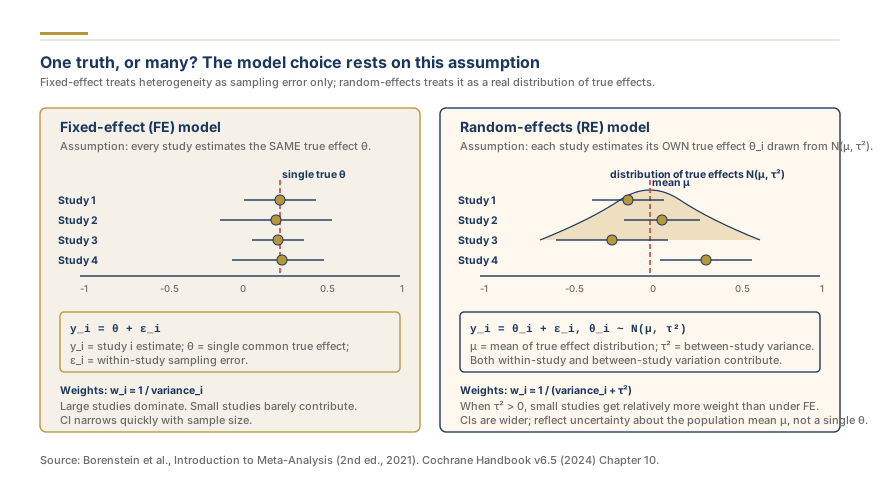
The difference is rooted in what you believe about the studies you are combining. A fixed-effect model assumes that every study in your meta-analysis estimates the same single true effect. Differences between observed study results are attributed entirely to sampling error, the random variation that occurs because each study enrolls a finite number of participants. Under this assumption, there is one true effect size in the population, and every study is trying to estimate that same number.
A random-effects model assumes that the true effect size varies from study to study. Each study estimates its own true effect, and those true effects are drawn from a distribution of possible true effects. The variability between study-level true effects is called between-study heterogeneity, quantified by the variance parameter tau-squared. Under this assumption, your pooled estimate represents the mean of the distribution of true effects rather than a single common effect.
This distinction is not merely philosophical. It changes the mathematics of pooling, the interpretation of the result, and the width of the confidence interval around the pooled estimate.
Under a fixed-effect model, you are asking: "What is the best estimate of the single true effect, given these data?" Under a random-effects model, you are asking: "What is the mean of the distribution of true effects across the population of studies that could have been conducted?" The Cochrane Handbook for Systematic Reviews of Interventions (Higgins et al., 2023) frames the distinction precisely this way and notes that the random-effects question is usually the more clinically relevant one.
How the Fixed-Effect Model Works
In a fixed-effect meta-analysis, each study receives a weight that is the inverse of its within-study variance. Larger studies, those with smaller standard errors, receive proportionally greater weight because they provide more precise estimates of the single true effect. The pooled effect size is a weighted average of the individual study effects, where the weights are determined solely by each study's precision.
The formula for the weight of study i under a fixed-effect model is:
w_i = 1 / v_i
where v_i is the within-study variance (the square of the standard error) of study i. The pooled estimate is the sum of (w_i multiplied by the effect size of study i) divided by the sum of all w_i.
Because all variability between studies is attributed to sampling error, the confidence interval around the pooled estimate reflects only within-study uncertainty. If studies are truly homogeneous, estimating the same true effect, this approach is statistically efficient because it maximizes the precision of the pooled estimate.
The fixed-effect model works well in narrow contexts. When you are combining results from multiple centers within a single multi-center trial, or pooling nearly identical replications of the same experiment in the same population, the assumption of a common true effect may be justified. In these cases, the fixed-effect model provides the tightest possible confidence interval and the most precise pooled estimate.
However, in most systematic reviews, studies differ in patient populations, intervention dosing and delivery, comparator conditions, outcome measurement instruments, follow-up durations, and risk of bias. The Cochrane Handbook acknowledges that some degree of clinical and methodological heterogeneity is almost always present, which makes the fixed-effect assumption difficult to justify in practice.
How the Random-Effects Model Works
A random-effects meta-analysis adds a second source of variability: between-study variance, denoted tau-squared. Each study's weight now incorporates both within-study variance and between-study variance:
w_i = 1 / (v_i + tau-squared)
This adjustment has a profound effect on how studies are weighted. In a fixed-effect model, a very large study might receive 60-70% of the total weight. In a random-effects model, adding tau-squared to the denominator compresses the weights, large studies still receive more weight, but the gap between large and small studies narrows. Small studies gain relative influence because the between-study variance component is the same for all studies regardless of size.
The pooled estimate under random-effects represents the estimated mean of the distribution of true effects. The confidence interval reflects uncertainty about this mean, incorporating both within-study sampling error and between-study heterogeneity. As a result, random-effects confidence intervals are wider than fixed-effect confidence intervals whenever tau-squared is greater than zero.
DerSimonian-Laird (DL) Estimator
The DerSimonian-Laird method (DerSimonian and Laird, 1986) is the most widely used approach for estimating tau-squared. It uses a method-of-moments estimator derived from the Cochran Q statistic. DL is computationally simple, it requires only one pass through the data, and is the default in many software packages including RevMan, Comprehensive Meta-Analysis, and the meta package in R.
The DL estimator computes tau-squared as:
tau-squared = max(0, (Q - df) / C)
where Q is the Cochran heterogeneity statistic, df is the number of studies minus one, and C is a constant derived from the fixed-effect weights. If Q is less than or equal to df, tau-squared is set to zero.
The main limitation of DerSimonian-Laird is that it can underestimate tau-squared, particularly when the number of studies is small (Veroniki et al., 2016). Because it is a moment-based estimator, it does not produce confidence intervals for tau-squared itself, and it can yield a point estimate of zero even when true heterogeneity exists. This underestimation means the random-effects confidence interval may be too narrow, partially defeating the purpose of using a random-effects model.
Restricted Maximum Likelihood (REML) Estimator
REML is an iterative likelihood-based method that provides less biased estimates of tau-squared compared to DerSimonian-Laird, especially with fewer than 15-20 studies. REML accounts for the fact that estimating the mean effect size "uses up" one degree of freedom, which the unrestricted maximum likelihood (ML) estimator does not. This correction reduces downward bias in the variance estimate.
REML is the default estimator in the metafor package in R and is increasingly recommended by methodological guidelines. Its main disadvantage is computational, it requires iterative optimization, but in practice this is negligible with modern software. Veroniki et al. (2016) conducted a comprehensive simulation study comparing 16 tau-squared estimators and found that REML performed well across a range of scenarios, particularly when the number of studies was small.
Paule-Mandel (PM) Estimator
The Paule-Mandel estimator is an iterative generalized method-of-moments estimator that has gained attention as a robust alternative to both DL and REML. It solves for the value of tau-squared such that the generalized Q statistic equals its expected value under the random-effects model. Simulation studies have shown that PM produces confidence intervals with close to nominal coverage, even with as few as five studies.
PM is less widely implemented in software than DL or REML, but it is available in the metafor package and is referenced as a recommended estimator in recent Cochrane methods guidance. For researchers who want a balance between statistical rigor and robustness, Paule-Mandel is worth considering.
Unsure which model to use for your meta-analysis? Our biostatisticians help you select the appropriate model, run sensitivity analyses across both approaches, and produce publication-ready results. get your free project cost breakdown, or explore our meta-analysis modelling support.
Comparison Table: Fixed-Effect vs Random-Effects Meta-Analysis
| Feature | Fixed-Effect Model | Random-Effects Model |
|---|---|---|
| Core assumption | One true effect across all studies | True effect varies across studies |
| Sources of variance | Within-study only | Within-study + between-study (tau-squared) |
| Weighting | Inverse of within-study variance | Inverse of (within-study variance + tau-squared) |
| Weight distribution | Large studies dominate | Weights more balanced across studies |
| Confidence interval | Narrower | Wider (unless tau-squared = 0) |
| Interpretation of pooled estimate | Estimate of the single common effect | Estimate of the mean of the distribution of true effects |
| Generalizability | Limited to studies included | Generalizes to population of similar studies |
| When I-squared = 0% | Standard result | Collapses to fixed-effect result |
| Common estimator | Inverse variance (Mantel-Haenszel for binary) | DerSimonian-Laird, REML, Paule-Mandel |
| Cochrane recommendation | Use when studies are truly identical | Default for most clinical meta-analyses |
| Tau-Squared Estimator | Method | Strengths | Weaknesses |
|---|---|---|---|
| DerSimonian-Laird | Method of moments | Simple, fast, widely available | Underestimates tau-squared with few studies |
| REML | Iterative likelihood | Less biased, good small-sample properties | Requires iteration, less intuitive |
| Paule-Mandel | Iterative generalized moments | Robust, good CI coverage | Less widely implemented |