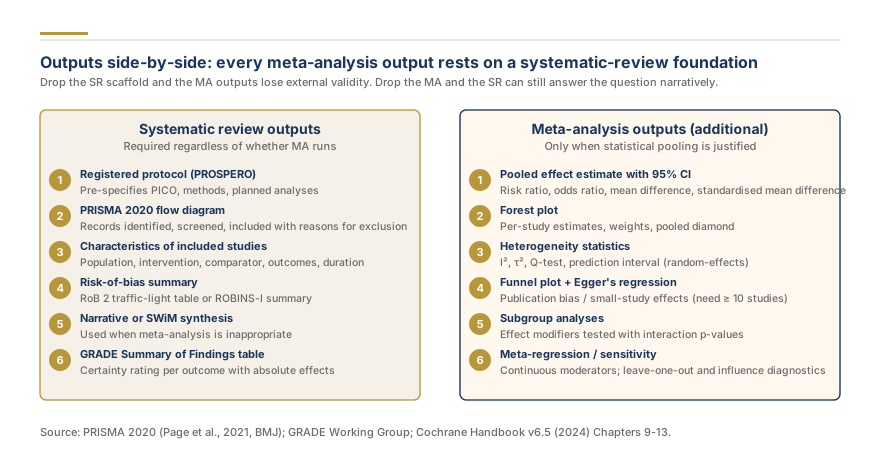
Systematic review vs meta-analysis, two terms that appear together so often in academic literature that many researchers treat them as interchangeable. They are not. One is a comprehensive research methodology. The other is a statistical technique. Understanding the difference between systematic review and meta-analysis is essential for planning your evidence synthesis project, writing your protocol, and communicating your findings accurately.
In our evidence synthesis work, we frequently receive requests labeled "meta-analysis" that actually require a full systematic review, or conversely, clients who assume every systematic review must produce a pooled effect estimate. This guide clarifies what each term means, how they relate to one another, and when your project needs one, the other, or both.
Systematic Review vs Meta-Analysis, Defining Each Term
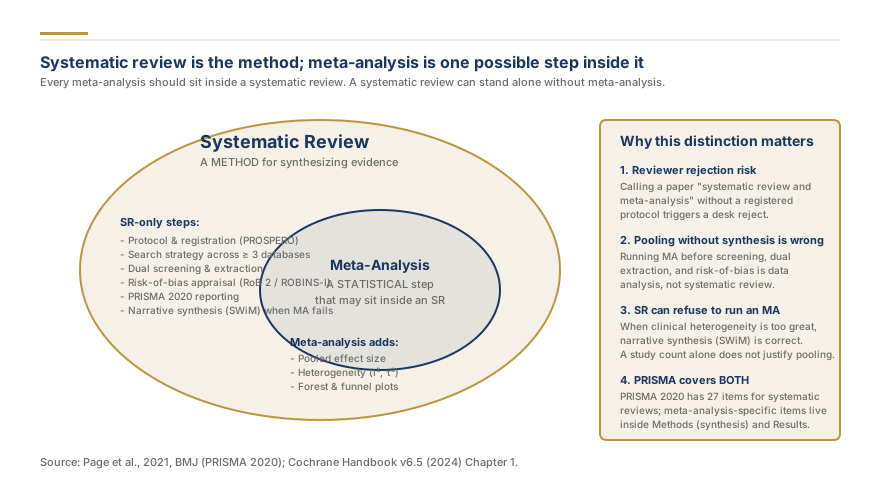
A systematic review is a structured, protocol-driven research methodology designed to identify, appraise, and synthesize all available evidence addressing a specific research question. It follows a predefined search strategy across multiple databases, applies explicit inclusion and exclusion criteria, assesses the risk of bias in included studies, and synthesizes findings, either narratively or statistically. The Cochrane Handbook for Systematic Reviews of Interventions puts it this way: "A systematic review attempts to collate all the empirical evidence that fits pre-specified eligibility criteria in order to answer a specific research question" (Chapter 1, section 1.1).
A meta-analysis is a statistical technique that quantitatively combines results from multiple independent studies to produce a single pooled effect size. It uses weighted averages, typically based on inverse variance, to generate a combined estimate with a narrower confidence interval than any individual study. The meta-analysis produces a forest plot that displays individual study results alongside the pooled estimate, and it includes formal assessment of heterogeneity across studies using statistics such as I-squared, tau-squared, and Cochran's Q test.
The relationship between the two is hierarchical. A meta-analysis is a component that may exist within a systematic review. A systematic review is the overarching methodology. Every meta-analysis should be conducted within a systematic review framework, but not every systematic review includes a meta-analysis. When studies are too different in design, population, intervention, or outcome measurement to be pooled meaningfully, the systematic review uses narrative synthesis instead. For a detailed walkthrough of systematic review methodology, see our step-by-step systematic review methodology walkthrough.
Still deciding which one your project needs? Send your research question and get a free quote for both options, priced as a systematic review alone and with a meta-analysis added.
Key Differences Between Systematic Reviews and Meta-Analysis
The following table presents eight dimensions along which systematic reviews and meta-analyses differ. This comparison addresses the most common points of confusion researchers encounter when planning an evidence synthesis project.
| Dimension | Systematic Review | Meta-Analysis |
|---|---|---|
| Nature | Research methodology, a structured process for finding and appraising evidence | Statistical technique, a quantitative method for combining results |
| Scope | Encompasses the entire review process from protocol to synthesis | One step within the systematic review process |
| Output | Comprehensive evidence summary (narrative or quantitative) | Pooled effect size with confidence interval |
| Requirement | Can stand alone as a complete study | Requires a systematic review framework to be methodologically valid |
| Data type | Handles qualitative, quantitative, or mixed data | Requires quantitative data with comparable effect measures |
| Key deliverable | PRISMA flow diagram, evidence tables, risk of bias assessment, synthesis | Forest plot, heterogeneity statistics, funnel plot, sensitivity analysis |
| Software | Reference managers (Rayyan, Covidence), screening tools | Statistical software (R metafor/meta, Stata, RevMan) |
| When not feasible | Always feasible if studies exist on the topic | Not feasible when studies are too heterogeneous or too few |
The simplest way to remember the distinction: a systematic review answers the question "What does the evidence say?" through a rigorous methodology. A meta-analysis answers the question "What is the combined numerical estimate?" through statistical pooling. The systematic review is the journey. The meta-analysis, when appropriate, is one destination within that journey.
This distinction matters practically because it shapes your protocol registration on PROSPERO, your data extraction forms, your analysis plan, and your reporting. A protocol that promises a meta-analysis when the data cannot support one creates problems at the synthesis stage. A protocol that omits meta-analysis when the data clearly supports pooling misses an opportunity to strengthen the evidence.
When Does a Systematic Review Include a Meta-Analysis?
A systematic review includes a meta-analysis when three conditions are met simultaneously. First, the included studies must measure the same or comparable outcomes using similar metrics, allowing effect sizes to be calculated on a common scale (odds ratios, risk ratios, standardized mean differences, or similar). Second, the studies must be sufficiently similar in design, population, and intervention that combining their results produces a clinically meaningful estimate rather than a statistical artifact. Third, there must be enough studies, typically at least two, though three or more is preferable, to make pooling informative.
Clinical heterogeneity refers to differences in populations, interventions, comparators, and outcomes across studies. Methodological heterogeneity refers to differences in study design and risk of bias. Statistical heterogeneity, measured by I-squared, tau-squared, and the Q statistic, quantifies the extent to which variability across study results exceeds what would be expected from sampling error alone. An I-squared value above 75% suggests substantial heterogeneity, though the threshold for acceptable heterogeneity depends on the clinical context.
When clinical and methodological heterogeneity are manageable, the systematic review proceeds to meta-analysis. The analyst selects an appropriate model, typically a random-effects model when between-study variability is expected, and calculates the pooled estimate. The result is displayed as a forest plot showing each study's effect size, confidence interval, and weight, alongside the pooled diamond at the bottom. For a detailed guide on reading and interpreting forest plots, see our forest plot interpretation guide.
In practice, many systematic reviews contain multiple meta-analyses, one for each outcome or comparison. A single systematic review examining the effectiveness of cognitive behavioral therapy for depression might include separate meta-analyses for depression symptom scores, remission rates, quality of life measures, and dropout rates. Each meta-analysis pools a different outcome across the included studies.
Worked Example: Five Trials, Two Different Evidence Bases
The decision to pool is easiest to see with numbers. Below are two hypothetical sets of five trials of the same intervention, with event counts in the treatment and control arms. Each trial's risk ratio and 95% CI is calculated on the log scale, and the trials are pooled by inverse variance with the DerSimonian-Laird random-effects estimator.
| Trial | Scenario A: events (treatment vs control) | Scenario A: risk ratio (95% CI) | Scenario B: events (treatment vs control) | Scenario B: risk ratio (95% CI) |
|---|---|---|---|---|
| 1 | 18/100 vs 26/100 | 0.69 (0.41 to 1.18) | 18/100 vs 26/100 | 0.69 (0.41 to 1.18) |
| 2 | 14/80 vs 21/80 | 0.67 (0.37 to 1.22) | 8/80 vs 24/80 | 0.33 (0.16 to 0.70) |
| 3 | 22/120 vs 30/120 | 0.73 (0.45 to 1.20) | 34/120 vs 30/120 | 1.13 (0.74 to 1.73) |
| 4 | 10/60 vs 15/60 | 0.67 (0.33 to 1.36) | 5/60 vs 18/60 | 0.28 (0.11 to 0.70) |
| 5 | 16/90 vs 24/90 | 0.67 (0.38 to 1.17) | 27/90 vs 24/90 | 1.12 (0.71 to 1.79) |
| Pooled (random effects) | 0.69 (0.54 to 0.89), p = 0.004 | 0.67 (0.40 to 1.11), p = 0.12 | ||
| Heterogeneity | Q = 0.10, I² = 0% | Q = 15.41 (p = 0.004), I² = 74%, τ² = 0.24 |
Scenario A is what a meta-analysis is for. No single trial is statistically significant on its own (p values from 0.16 to 0.27), yet all five point the same way. Pooling narrows the interval to 0.54 to 0.89, a precise estimate of roughly a 31% relative reduction that a narrative synthesis could only describe as consistently favorable but individually inconclusive.
Scenario B is where the systematic review does the work and the pooled number does not. Two trials show large benefits and two show slightly higher event rates with treatment. The pooled risk ratio of 0.67 looks almost identical to Scenario A, but its confidence interval crosses 1, I² is 74%, and the 95% prediction interval (t distribution with k - 2 degrees of freedom) runs from 0.12 to 3.85: the next trial could plausibly show anything from an 88% reduction to nearly four times the risk. A single pooled estimate here summarizes disagreement, not an effect. The right move is to look for the source of the heterogeneity (population, dose, risk of bias) and, with only five trials, to report the split explicitly in a structured narrative synthesis alongside or instead of the pooled figure. Our guide on what a prediction interval adds explains how to report that interval.
When a Meta-Analysis Is Not Appropriate
Not every systematic review can or should include a meta-analysis. Recognizing when quantitative pooling is inappropriate is a mark of methodological rigor, not a limitation. The Cochrane Handbook states plainly that "A systematic review need not contain any meta-analyses" and adds that if there is considerable variation in results, "particularly if there is inconsistency in the direction of effect, it may be misleading to quote an average value for the intervention effect" (Chapter 10, section 10.10.3).
A meta-analysis is not appropriate when the included studies measure fundamentally different outcomes or use incompatible measurement instruments. If one study measures anxiety using the Hamilton Anxiety Rating Scale and another uses a binary self-report question, pooling their results produces a number that lacks clinical meaning.
A meta-analysis is not appropriate when the interventions differ so substantially that a combined estimate would obscure important differences. Pooling a study of high-intensity interval training with a study of gentle yoga under the umbrella of "exercise interventions" creates a misleading average that represents neither intervention accurately.
A meta-analysis is not appropriate when the risk of bias across included studies is so severe that pooling would amplify systematic error rather than reduce random error. If all included studies have critical risk of bias in the same direction, a meta-analysis confers false precision on a biased estimate.
A meta-analysis is not appropriate when there are too few studies, particularly if those few studies differ in design or population. A meta-analysis of two studies with substantially different effect sizes tells you very little beyond what the individual studies already show, and the heterogeneity statistics are unreliable with so few data points.
In these scenarios, narrative synthesis is the recommended approach. A well-conducted narrative synthesis uses structured methods, such as vote counting based on direction of effect, harvest plots, or albatross plots, to summarize findings transparently. PRISMA 2020 reporting guidelines (Page et al., 2021) accommodate both quantitative and narrative synthesis approaches. For an understanding of how systematic reviews differ from literature reviews, see our dedicated comparison guide.