Literature Review Writing Service: Thesis, Grant | Research Gold
Literature Review Writing Service
Research Gold writes narrative literature reviews for thesis chapters, journal article introductions, and grant proposal background sections. Each review is led by a PhD researcher, delivered in 14 days, and includes a transparent search log, a thematic synthesis structured around the research question, full inline citations in AMA, APA, or Vancouver format, and a reference library file (EndNote, Zotero, or Mendeley). For an evidence-grade review with a PRISMA flow diagram, see our systematic review service.
Free written quote
Scope, timeline, and price before you commit
Quote in minutes
WhatsApp or email
Thesis + journal + grant
Reference manager file delivered
Need a PhD-written literature review for your thesis chapter, journal article, or grant proposal? Documented search, thematic synthesis, full citations, from $750. Get a free quote.
What you get from a literature review writing project
Each engagement is delivered as a complete bundle so you can drop the review straight into your thesis, manuscript, or grant document.
Documented search strategy for PubMed, Scopus, Web of Science, Google Scholar, or domain-specific databases (PsycINFO, ERIC, CINAHL, IEEE Xplore, ABI/INFORM, EconLit) with the search strings, dates, and filters used.
Screening log showing the records found, the records read, and the final included set, with a short justification per excluded source.
Thematic synthesis structured around the research question, with sub-headings that mirror your dissertation outline or your manuscript's argument.
Theoretical framework section when the review supports a thesis chapter, identifying the underlying theory or model that organises the evidence.
Critical gap analysis that explains what the field is missing and why your study addresses that gap.
Inline citations in your required style: APA 7, AMA, Vancouver, Harvard, or Chicago.
How it works
Our literature review writing process
Each project follows the same five steps so you know exactly where your work is at any point.
1
Topic + scope agreement
Define the question, target length, and citation style.
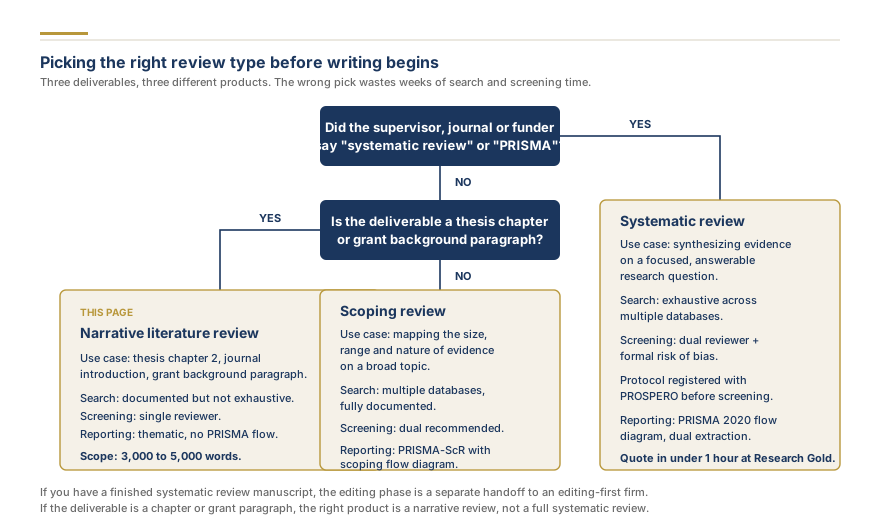
If your supervisor, journal, or funder used the words "systematic review" or "PRISMA flow diagram", you need the professional systematic review support, not this service. If the language was "scoping review" or "evidence map", use the scoping review service. If the deliverable is a thesis chapter or a grant background paragraph, this is the right service.
Where this service is the right fit
Thesis chapter 2 (the literature review chapter)
Most masters and doctoral programs require a literature review chapter that establishes the theoretical framework and the empirical state of the field. We write this chapter to your university's specifications: word count, citation style, and chapter structure. The deliverable includes the theoretical framework sub-section, the thematic synthesis sub-sections (typically three to five themes), the critical gap analysis, and the positioning paragraph that links the gap to your research question.
Journal article introduction (background section)
When a journal manuscript needs a stronger background section than a single page can hold, we write a 1,500 to 3,000 word literature review that lives in the introduction or a separate background section. This is common in narrative reviews submitted to journals such as the International Journal of Educational Research, Journal of Business Research, or Public Health Reviews, and in clinical narrative reviews where the journal does not require PRISMA.
Grant proposal background
R01, R03, R21, NIHR, ESRC, MRC, and Wellcome proposals all require a background section that establishes the evidence base for your aims. We write this section to fit the page limits of the funder template, with citations in the funder's preferred style. The grant background is bundled with our grant methodology writing service when the proposal also needs the methods section drafted.
Theoretical framework write-up
For doctoral candidates working in fields where the framework section is its own task (education, sociology, management, nursing theory), we write a standalone framework chapter that engages with the primary theorists and translates the framework into testable propositions for your study.
Standalone narrative review for journal submission
Some journals publish narrative reviews as their own article type. We write 6,000 to 10,000 word standalone narrative reviews to AMA or APA style, with a structured abstract, a documented search, a thematic synthesis, an implications section, and a reference list of 80 to 200 citations.
Citation styles we work in
Citations are formatted in your required style and exported with a reference manager file. We work in:
APA 7 (most common in psychology, education, social sciences).
AMA (medicine, biomedical journals).
Vancouver (numbered, common in clinical and biomedical writing).
Harvard (UK and Australasian dissertations, business and management).
Chicago (humanities, history, some social sciences).
IEEE (engineering, computer science).
If your university or journal uses a custom style, send the style guide with the project brief and we will conform to it.
Ready to start? A PhD methodologist will scope your project in minutes.
Free rewrite if your supervisor or reviewers ask for restructure or new sources.
Every project ships with a reference library you can re-open and edit. Choose:
EndNote (.enl, used by most universities with site licences).
Zotero (.bib, .ris, the open-source default for many doctoral candidates).
Mendeley (.ris, popular in clinical and engineering work).
The reference file is yours. You can add or remove sources, change citation style at the click of a button, and re-cite later in your manuscript.
Our process
Eight stages from a free scope call to a final walkthrough call. Search log and screening log are sent for your review before drafting starts.
Free 30-minute scope call. Research question, audience (thesis examiner, journal, funder), word count, deadline, citation style, reference manager. No quote until this call has happened.
Fixed-fee quote within 24 hours, broken down by word count, search depth, and reference count.
Search log documenting the databases, search strings, and dates. Sent for your review before screening starts.
Screening log showing included and excluded sources with short justifications.
First draft of the review. You receive an interim outline within 7 days for direction-setting.
Two rounds of revisions included.
Final delivery with the reference library file, the search log, the screening log, and the plagiarism report.
30-minute walkthrough call with the lead writer.
Cost drivers for our literature review writing service
Pricing on the literature review writing service is fixed-fee, approved before work starts, and driven by:
Word count. A thesis chapter narrative review (3,000 to 5,000 words, 50 to 80 references, single-database documented search) sits in the smallest band. A standalone narrative review (6,000 to 10,000 words, 80 to 150 references, multi-database documented search) sits in the middle. A full doctoral chapter or theoretical framework (8,000 to 15,000 words, 150 to 250 references) is the largest scope.
Reference count and search depth. The more databases, the more screening, the more cost. Searches that need access to paywalled databases (Scopus, Web of Science, Embase) are included in our standard fee.
Citation style and reference library format. AMA, APA, Vancouver, Harvard, and ICMJE all included. EndNote, Zotero, or Mendeley reference library file included.
Doctoral candidates writing chapter 2 of a masters or PhD thesis.
Journal authors strengthening the introduction of an empirical paper.
Grant teams writing the background section of an R01, NIHR, ESRC, MRC, or Wellcome proposal.
Researchers in industry producing white-paper literature reviews for product, regulatory, or policy stakeholders.
Postdocs writing standalone narrative reviews for journal submission.
Examples of work delivered
We do not publish client work, but the following anonymised snippets give a sense of typical engagements:
Doctoral education thesis (chapter 2, 12,000 words, 220 references). Theoretical framework grounded in self-determination theory. Thematic synthesis across four themes. Delivered in 18 days, two revision rounds, EndNote library included.
Journal manuscript introduction (1,800 words, 65 references). Background expansion for a behavioural economics paper resubmission to Journal of Economic Psychology. Citations in APA 7. Delivered in 8 days.
R21 grant background (2,400 words, 90 references). NIH R21 background section for a digital mental health intervention study. Vancouver citations to fit the funder template. Delivered in 10 days.
Standalone narrative review for Public Health Reviews (8,500 words, 145 references). Multi-database search across PubMed, Scopus, and CINAHL. Thematic synthesis across five themes. Delivered in 28 days.
What this service does not include
To keep the scope and pricing transparent:
Not a systematic review. No PROSPERO registration, no PRISMA 2020 flow, no dual screening, no formal risk-of-bias assessment. For that, use the Research Gold systematic review approach.
Not a scoping review. No PRISMA-ScR flow diagram and no formal evidence-mapping table. For that, use the scoping review service.
Not a meta-analysis. No statistical pooling, no forest plot. If your project needs effect-size pooling, see the meta-analysis package. For the broader funding application, our research proposal writing service drafts the full proposal.
Not a primary research write-up. We write the literature review only. The methods, results, and discussion of your own study are your work, although our medical writing service and statistical analysis service can help with those sections separately, and a research methodology consultant can advise on the overall study design.
Testimonials
"Needed a 9,000-word theoretical framework chapter with a documented multi-database search. Delivered in three weeks with 180 references in EndNote and a clean thematic synthesis. My supervisor accepted it without structural changes."
Verified Client, Doctoral Researcher, Education
"Background section for a grant application, written as a tight 1,500-word narrative review with current references. Cited by the reviewers as one of the strongest sections of the proposal."
Verified Client, Postdoctoral Fellow, Nursing
Frequently Asked Questions
10
A literature review writing service produces a structured, fully-cited synthesis of the published research on a defined topic, written for a specific audience (thesis examiner, journal editor, or grant reviewer). The service includes the search, screening, reading, thematic synthesis, and the final write-up with inline citations and a reference list.
A narrative literature review synthesizes the field thematically without an exhaustive search protocol or PRISMA flow diagram. A systematic review uses a registered protocol, an exhaustive search of multiple databases, dual screening, formal risk-of-bias assessment, and a PRISMA flow. Narrative reviews are appropriate for thesis chapters, journal introductions, and grant context. A systematic review is appropriate when the deliverable itself is the evidence base.
Pricing on the literature review writing service is fixed-fee and approved before work begins. The fee is driven by word count, reference count, and search depth. A 3,000 to 5,000 word thesis chapter narrative review sits in the smallest band. A 6,000 to 10,000 word standalone narrative review sits in the middle. A full doctoral chapter is the largest scope. For evidence-grade work, our scoping review and systematic review services are quoted separately.
Yes. We write Chapter 2 (literature review) for masters and doctoral dissertations, structured around your specific research question, in your university's preferred citation style. Each chapter includes a theoretical framework section, a thematic synthesis of the empirical literature, and an identified gap that motivates your study.
For a journal article introduction, the literature review is usually 800 to 1,500 words. For a grant proposal background, 1,500 to 3,000 words. For a masters dissertation chapter, 5,000 to 8,000 words. For a doctoral thesis chapter, 8,000 to 15,000 words. We will scope the exact word count with you before quoting.
No. AI tools can help search and summarise individual papers, but a publication-grade literature review requires human reading, synthesis across studies, and a defensible argument about gaps. Our PhD researchers read every cited paper and write the synthesis from scratch. We can also de-AI a draft a student already wrote with ChatGPT and rebuild it on a real evidence base.
Yes. Every project includes a documented search of PubMed, Scopus, Web of Science, Google Scholar, or domain databases (PsycINFO, ERIC, CINAHL, IEEE Xplore, ABI/INFORM), the screening log, and the final reference manager file in EndNote, Zotero, or Mendeley format. The reference list is exported in your preferred style (APA 7, AMA, Vancouver, Harvard, Chicago).
A research-grade narrative literature review usually has four sections: (1) the theoretical or conceptual framework, (2) a thematic synthesis of the empirical literature grouped under sub-headings, (3) a critical gap analysis explaining what the field is missing, and (4) a positioning statement that links the gap to the proposed study. We follow this structure unless your supervisor or journal requires a different one.
Yes. We write literature reviews across psychology, education, business and management, public health, nursing, social work, engineering, and environmental science. The key requirement is that we can find a PhD researcher with topic familiarity. The scope call confirms fit before any quote is sent.
You are the author of the deliverable. We sign a non-disclosure agreement before any work starts and we do not retain authorship rights. We can also provide a formal acknowledgement statement if your supervisor or journal asks how the work was supported.
If your project needs a registered protocol, exhaustive database search, dual screening, and PRISMA flow diagram, this is not the right service. Use our PRISMA-grade systematic review service instead. For evidence mapping where the question is broad, see the scoping review service.
Disclaimer
This page is for informational purposes. Research Gold provides professional academic writing support to assist researchers. Always consult your supervisor, institutional review board, or domain experts for decisions specific to your project.