Learn how to create and interpret a GRADE Summary of Findings table. Covers the 5 GRADE domains, certainty levels, GRADEpro GDT, step-by-step creation, and common mistakes to avoid.
Research Gold Team
February 16, 2026
Ready to rate the certainty of your evidence? Use our free GRADE evidence tool to structure your assessment across all 5 domains.
Key Takeaways
The SoF table is the standard output of GRADE evidence assessment, presenting a systematic review's key findings in a structured, transparent format
Each SoF table includes outcomes, number of studies and participants, effect estimates (relative and absolute), a GRADE certainty rating, and interpretive comments
GRADE rates certainty of evidence across 5 domains: risk of bias, inconsistency, indirectness, imprecision, and publication bias
Cochrane reviews require SoF tables, and many leading journals including BMJ, JAMA, and Lancet now mandate or strongly encourage them
GRADEpro GDT is the standard software tool for creating GRADE Summary of Findings tables and is free for Cochrane authors
SoF tables bridge statistical results and clinical decision-making by translating complex meta-analytic data into formats that clinicians and policymakers can act on
A summary of findings table GRADE is a standardized evidence summary produced through the GRADE framework that presents a systematic review's key outcomes alongside the number of studies, effect estimates, and certainty of evidence ratings. SoF tables are required in Cochrane reviews and bridge statistical results to clinical decision-making. Every systematic review author working with the GRADE approach needs to understand how to build and interpret these tables correctly.
The Summary of Findings table has become the gold standard for communicating evidence quality in health research. Developed by the GRADE Working Group, this structured format distills complex meta-analytic results into a single table that clinicians, guideline developers, and policymakers can interpret at a glance. Whether you are preparing a Cochrane review, submitting to a top-tier journal, or informing clinical practice guidelines, the SoF table is the vehicle that carries your evidence from statistical output to real-world impact.
The Question a Summary of Findings Table Answers
The purpose of the SoF table is to answer a deceptively simple question: how confident are we in the evidence behind each outcome? Rather than burying this information across dozens of pages of text and forest plots, the SoF table concentrates everything a decision-maker needs into a single, scannable format.
The GRADE framework produces the Summary of Findings table by systematically evaluating each outcome across five domains. This structured assessment replaces subjective quality labels with a transparent, reproducible process. Every rating decision is documented in footnotes, allowing readers to understand exactly why evidence was rated high, moderate, low, or very low.
The SoF table is not an optional add-on. Cochrane reviews have required SoF tables since 2008. Major journals including BMJ, JAMA, and Lancet now mandate or strongly encourage them. Clinical practice guidelines produced under the GRADE approach rely on SoF tables as the foundation for their recommendations. If you are conducting a systematic review in health or social sciences, you will almost certainly need to produce one.
Anatomy of a Summary of Findings Table
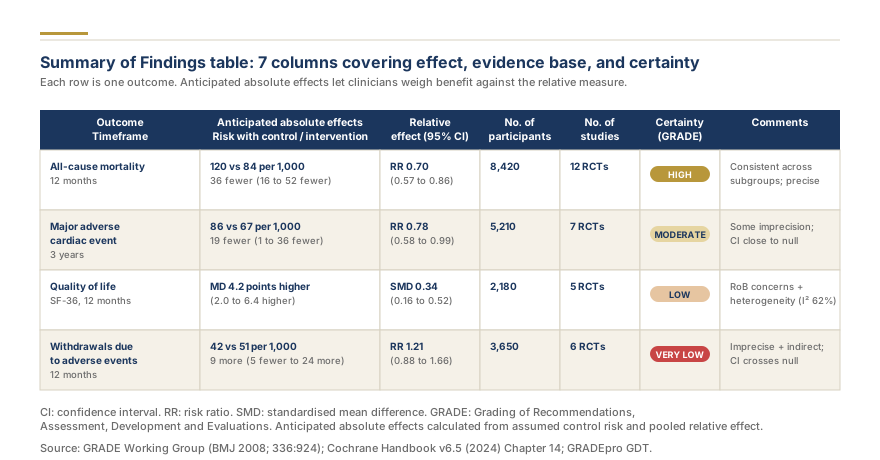
Summary of Findings table with all seven columns labelled. Source: Guyatt et al., 2008, BMJ; GRADEpro GDT.
Understanding the structure of a SoF table is essential before you can create one. Every GRADE Summary of Findings table follows the same column layout, ensuring consistency across reviews and enabling readers to quickly locate the information they need.
The standard SoF table contains seven columns arranged in a specific order:
Column
Content
Purpose
Outcome
Name and measurement timeframe
Identifies what was measured
No. of Studies
Number of studies contributing data
Shows the evidence base size
No. of Participants
Total participants across studies
Indicates statistical power
Relative Effect (95% CI)
Risk ratio, odds ratio, or hazard ratio
Shows proportional change
Absolute Effect (95% CI)
Events per 1,000 patients or mean difference
Shows real-world magnitude
Certainty (GRADE)
High, Moderate, Low, or Very Low
Rates confidence in the estimate
Comments
Plain-language interpretation
Translates numbers to meaning
Each SoF table should include a maximum of 7 outcomes, the critical and important outcomes identified in your protocol. This constraint forces authors to prioritize patient-important outcomes over surrogate markers, keeping the table focused and interpretable.
Footnotes are a mandatory component. Every downgrade decision must be explained in a footnote that justifies why certainty was reduced. For example, a footnote might state: "Downgraded one level for serious risk of bias: 3 of 5 studies had inadequate allocation concealment per RoB 2 assessment." These footnotes transform the SoF table from a summary into a transparent audit trail.
The comparison statement at the top of the table defines the population, intervention, comparator, and setting, the PICO elements that frame the entire review. Below the table, a legend explains the certainty symbols and any abbreviations used.
The 5 GRADE Domains for Rating Certainty
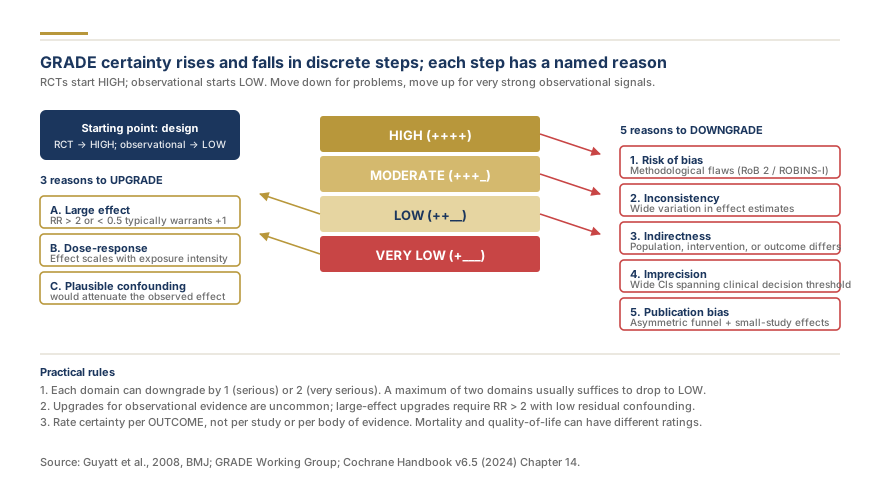
GRADE certainty rises and falls in discrete steps; each step has a named reason. Source: Guyatt et al., 2008, BMJ; Cochrane Handbook v6.5 (2024).
The GRADE framework assesses certainty of evidence across five domains. Each domain represents a distinct reason why confidence in an effect estimate might be reduced. Understanding these domains is the intellectual core of GRADE, without mastering them, you cannot produce a credible SoF table.
Risk of Bias
Risk of bias evaluates whether methodological limitations in the included studies could have distorted the results. For randomized controlled trials, this assessment typically uses the RoB 2 tool, examining domains such as randomization, allocation concealment, blinding, incomplete outcome data, and selective reporting.
Downgrade for risk of bias when a substantial proportion of the evidence comes from studies with serious methodological flaws. A single large trial with high risk of bias contributing most of the weight in a meta-analysis warrants downgrading, even if smaller studies are well-conducted.
Inconsistency
Inconsistency examines whether results vary across studies beyond what chance alone would explain. The primary statistical indicator is the I-squared statistic, which measures statistical heterogeneity, the percentage of variability in effect estimates attributable to true differences rather than sampling error.
An I-squared value above 50% generally signals substantial heterogeneity, though the statistic should be interpreted alongside the confidence interval and the clinical significance of the variation. If studies show effects in opposite directions, inconsistency is serious regardless of the I-squared value.
Indirectness
Indirectness asks whether the evidence directly answers your review question. There are two types: population indirectness (the studied population differs from the target population) and outcome indirectness (the measured outcome is a surrogate for the outcome of interest).
For example, if your review question concerns elderly patients but all included studies enrolled adults aged 18-45, the evidence is indirect for your population. Similarly, if you want to know about mortality but the studies only measured blood pressure reduction, you are dealing with outcome indirectness.
Imprecision
Imprecision evaluates whether the effect estimate is precise enough to support a confident conclusion. Wide confidence intervals that cross thresholds of clinical significance indicate imprecision. The GRADE approach typically considers imprecision serious when the confidence interval crosses the null (no effect) or when the optimal information size, the total sample size needed for adequate statistical power, has not been met.
Small sample sizes and few events are the primary drivers of imprecision. A meta-analysis of three small studies with 50 total events will produce a much wider confidence interval than a meta-analysis of ten studies with 500 events, even if the point estimate is identical.
Publication Bias
Publication bias reflects the concern that studies with statistically significant or favorable results are more likely to be published than those with null or negative findings. If publication bias is present, the pooled effect estimate in your meta-analysis may overstate the true effect.
Assessment tools include the funnel plot, a scatter plot of effect size against study precision, and statistical tests such as Egger's regression. The funnel plot detects publication bias by revealing asymmetry in the distribution of study results. However, these tools have limited power when fewer than 10 studies are included. In such cases, you assess publication bias based on the comprehensiveness of your search strategy and whether the included studies were predominantly from industry-funded sources.
Need help creating Summary of Findings tables with GRADE assessments? Our team produces publication-ready SoF tables with transparent certainty ratings and detailed footnotes. get a free project timeline and quote, or learn more about our evidence synthesis services.
Need expert quality assessment for your review?
Our methodologists conduct dual-reviewer risk of bias assessments, GRADE certainty ratings, and publication-ready summary tables.
After assessing all five domains, the GRADE certainty levels classify your confidence in each effect estimate into one of four categories. The starting point depends on the study design: randomized controlled trials begin at High certainty, while observational studies begin at Low.
Certainty Level
Symbol
Meaning
High
++++
Very confident the true effect lies close to the estimate
Moderate
+++O
Moderately confident; the true effect is likely close but may differ
Low
++OO
Limited confidence; the true effect may be substantially different
Very Low
+OOO
Very little confidence; the true effect is likely substantially different
Downgrading occurs when any of the five domains presents a serious concern. Each domain can reduce certainty by one level (serious concern) or two levels (very serious concern). An RCT-based body of evidence starting at High can be downgraded to Very Low if multiple domains are compromised.
Upgrading is possible but rare, and applies only to observational studies. Three factors can increase certainty: a large magnitude of effect (e.g., relative risk greater than 2 or less than 0.5), a dose-response gradient, or a situation where all plausible confounders would reduce the observed effect. In practice, upgrading occurs infrequently because the conditions are stringent.
The interplay between starting level and domain assessments creates the final certainty rating. An observational study starting at Low that has no serious concerns across all five domains remains at Low, it does not automatically rise to High. Conversely, a well-conducted randomized controlled trial body of evidence may remain at High if no domains warrant downgrading.
How to Create a Summary of Findings Table Step by Step
Creating a GRADE evidence table follows a systematic process. Each step builds on the previous one, and skipping steps leads to incomplete or indefensible ratings. Here is the complete workflow from protocol to finished SoF table.
Step 1: Define your PICO question and select outcomes. During the protocol stage, before you see any results, identify the critical and important outcomes for your review. GRADE distinguishes between critical outcomes (those essential for decision-making, rated 7-9 on a 9-point scale), important outcomes (rated 4-6), and outcomes of limited importance (rated 1-3). Include only critical and important outcomes in your SoF table, up to a maximum of seven.
Step 2: Complete your systematic review and meta-analysis. Extract data, assess risk of bias in individual studies, and perform meta-analyses for each outcome. Generate forest plots that display individual study results and the pooled effect estimate with confidence intervals. The forest plot visualizes pooled effect size and provides the statistical foundation for the SoF table. For guidance on reading these visualizations, see our forest plot interpretation guide.
Step 3: Assess risk of bias across the body of evidence. Using your individual study risk of bias assessments (typically conducted with RoB 2 for randomized trials or ROBINS-I for non-randomized studies), make an overall judgment about whether risk of bias across the contributing studies is serious enough to warrant downgrading. Focus on the studies that carry the most weight in the meta-analysis.
Step 4: Evaluate inconsistency. Examine the I-squared statistic, the confidence intervals of individual studies, and whether effects point in the same direction. If heterogeneity is substantial and unexplained by subgroup analyses, consider downgrading. Document your reasoning in a footnote.
Step 5: Assess indirectness, imprecision, and publication bias. For each outcome, evaluate whether the evidence directly addresses your PICO question (indirectness), whether the confidence interval is narrow enough to support a conclusion (imprecision), and whether the evidence base may be affected by selective publication (publication bias). Each domain is assessed independently.
Step 6: Determine the overall certainty rating. Combine your domain assessments to arrive at a final certainty level for each outcome. Start at High for randomized controlled trial evidence or Low for observational evidence, then apply any downgrades or upgrades. The lowest certainty rating across all domains determines the final level, you do not average across domains.
Step 7: Build the table in GRADEpro GDT. Enter your data into GRADEpro GDT, the standard software tool for producing GRADE assessments. The software auto-formats the SoF table, calculates absolute effects from relative effects and baseline risks, and generates exportable tables for your manuscript. GRADEpro GDT is free for Cochrane authors and available by subscription for other users. For an alternative starting point, our online GRADE tool helps structure the initial assessment. For a deeper understanding of the GRADE framework itself, see our our guide to grade framework guide.
Creating the SoF table is only half the task. Interpreting the finished table correctly, and helping your readers do the same, is equally important. The SoF table communicates both the direction and magnitude of effects and the confidence you should place in those estimates.
Reading the certainty column. The certainty rating is the most important output of the SoF table for decision-making. High certainty means further research is very unlikely to change confidence in the estimate. Moderate means further research is likely to have an important impact. Low means further research is very likely to change the estimate. Very Low means the estimate is very uncertain.
Each certainty level has direct implications for how the evidence should inform clinical recommendations. Guideline panels using the GRADE approach typically issue strong recommendations only when certainty is Moderate or High. Low or Very Low certainty usually leads to conditional (weak) recommendations, where the balance of benefits and harms is uncertain.
Reading the footnotes. Footnotes are not supplementary, they are the evidentiary backbone of the SoF table. Each footnote explains a specific downgrade or upgrade decision. A reader who disagrees with a certainty rating can trace the reasoning through the footnotes, identify which domain caused the downgrade, and evaluate whether the judgment was appropriate.
Well-written footnotes state the reason and the evidence. For example: "Downgraded one level for imprecision: the 95% confidence interval crosses both no effect and the minimal clinically important difference (RR 0.62, 95% CI 0.31 to 1.24; optimal information size not met with 287 total events)." This level of specificity enables readers to assess the judgment independently.
Connecting to clinical recommendations. The SoF table is designed to be read by people who will make decisions based on the evidence, clinicians, policymakers, guideline developers, and patients. The Comments column should translate statistical results into plain language. Instead of stating "RR 0.75 (0.62 to 0.90)," the comment might read: "The intervention probably reduces mortality by approximately 50 fewer deaths per 1,000 patients (range: 20 to 76 fewer)."
This translation from relative to absolute effect is what makes SoF tables actionable. A relative risk reduction of 25% means very different things depending on whether the baseline risk is 4% or 40%. The SoF table forces authors to calculate and present both, ensuring that readers understand the real-world magnitude of the effect.
Common Summary of Findings Table Mistakes
Even experienced systematic reviewers make errors when constructing SoF tables. Recognizing the most common mistakes helps you avoid them and produce tables that withstand methodological scrutiny.
Including too many outcomes. The seven-outcome limit exists for a reason. Tables with 10 or 15 outcomes overwhelm readers and dilute the focus on truly critical results. If you find yourself exceeding seven, revisit your outcome prioritization. Move less critical outcomes to supplementary appendices.
Omitting absolute effects. Reporting only relative effects (risk ratios, odds ratios) without absolute effects is one of the most consequential errors. Clinicians and patients need to know the absolute effect, how many events per 1,000 patients are prevented or caused, to make informed decisions. A risk ratio of 0.50 could mean 5 fewer events per 1,000 or 200 fewer events per 1,000, depending on the baseline risk. Without absolute effects, the SoF table fails its primary purpose of supporting clinical decision-making.
Providing inadequate footnotes. Footnotes that simply state "downgraded for risk of bias" without explanation are insufficient. Every footnote must justify the decision with specific evidence: which studies had bias, what type of bias, and how it could have affected the estimate. Footnotes that lack justification undermine the transparency that makes GRADE credible.
Applying overall certainty rather than outcome-specific ratings. GRADE rates certainty for each outcome separately. A common mistake is assigning a single certainty rating to the entire review. One outcome may have High certainty while another has Very Low, this variation is expected and informative. The overall certainty of a review, if reported at all, is typically the lowest certainty among the critical outcomes.
Selecting outcomes after seeing results. Choosing which outcomes to include in the SoF table after conducting the meta-analysis introduces outcome reporting bias. The outcomes should be specified in the protocol, before any data are extracted. If circumstances require changing outcomes, document the rationale transparently.
Failing to separate GRADE assessment from the meta-analysis. The GRADE assessment is a judgment about the body of evidence for each outcome, not a statistical calculation. Researchers sometimes conflate the width of a confidence interval (a statistical property) with the GRADE imprecision domain (a judgment that considers clinical significance thresholds and optimal information size). Similarly, a high I-squared value does not automatically mandate downgrading for inconsistency; the clinical importance of the heterogeneity matters.
Ignoring the comparison context. Every SoF table is anchored to a specific comparison: intervention versus comparator in a defined population and setting. Mixing comparisons within a single SoF table, for example, including outcomes from both active-control and placebo-control trials, creates confusion. Each comparison requires its own SoF table.
The GRADE Working Group has published detailed guidance on avoiding these errors, and the Cochrane Handbook Chapter 14 (Higgins et al., 2023) provides the authoritative reference for constructing SoF tables within Cochrane reviews. Following these standards ensures that your SoF table meets the expectations of editors, peer reviewers, and the clinical community that will use your evidence to make decisions that affect patient care.
Pro Tip
Select outcomes before seeing results
Choose critical and important outcomes in your protocol. Selecting after analysis introduces bias.
Pro Tip
Always include absolute effects
Relative effects (RR, OR) are hard for clinicians to interpret. Adding 'X fewer events per 1000 patients' transforms comprehension.
Pro Tip
Write footnotes as justification, not description
Each footnote should explain WHY you downgraded, not just state that you did.
Frequently Asked Questions
5
Required for Cochrane reviews. Increasingly required by BMJ, JAMA, Lancet, and other top journals.
Up to 7 critical and important outcomes. Prioritize patient-important outcomes over surrogate markers.
GRADEpro GDT (free for Cochrane authors) is the standard. Our GRADE evidence tool also helps structure the assessment.
Yes, for observational studies only: large effect, dose-response, or all plausible confounders would reduce the effect. Rare in practice.
It means the true effect may be substantially different from the estimate. Report it transparently, it is still valuable information for decision-makers.
Share
Found this useful? Share it with your colleagues.
Need expert quality assessment for your review?
Our methodologists conduct dual-reviewer risk of bias assessments, GRADE certainty ratings, and publication-ready summary tables.
Quality Assessment Takes Expertise. Our Team Does It Daily.
Rigorous risk of bias assessment, GRADE evaluations, and summary tables that satisfy peer reviewers. We handle the methodology so your review stands up to scrutiny.
Our promise: Free rework on search, screening, or synthesis if reviewers push back.
4.9 / 5Quote within a few hoursPRISMA 2020 + Cochrane HandbookPhD methodologistConfidential by default
Research Gold Team is our group of PhD methodologists and statisticians who deliver our systematic review, meta-analysis and statistical analysis work. The same team writes and checks the guides and tools on this site.
Quality Assessment Takes Expertise. Our Team Does It Daily.
Rigorous risk of bias assessment, GRADE evaluations, and summary tables that satisfy peer reviewers. We handle the methodology so your review stands up to scrutiny.
Complete guide to applying the GRADE framework for rating certainty of evidence in systematic reviews, 5 downgrade domains, 3 upgrade domains, Summary of Findings tables, and a worked example with step-by-step domain assessment.
The best DNP project ideas in 2026 sit at the intersection of a unit-level practice gap, a published evidence base, and a feasible 6 to 12 month timeline. Strong evidence based practice project topics target medication safety, transitions of care, sepsis screening, fall prevention, and behavioural health workflows. Avoid broad systematic reviews; pick a focused PICO question with a clinical sponsor and pre-specified outcome measures.
The five evidence-based practice models nursing programmes expect you to know, what each is actually built for, and how to choose the one that fits your project rather than the one you have heard of.