The PRISMA-ScR checklist is the internationally recognized reporting guideline for scoping reviews. Published by Tricco et al. in 2018 and endorsed by the EQUATOR Network, this 22-item checklist ensures that scoping review manuscripts report every methodological detail needed for transparency, reproducibility, and editorial acceptance.
Incomplete PRISMA-ScR compliance is the most common desk rejection reason for scoping reviews submitted to peer-reviewed journals. If you are writing a scoping review or preparing one for publication, understanding every checklist item is not optional, it is the difference between a manuscript that reaches peer review and one that does not. This guide walks through all 22 items, explains the differences between PRISMA-ScR and PRISMA 2020, and provides actionable strategies for achieving full compliance before submission.
Keep your scoping-review documents together with the scoping review checklist files.
How Scoping Reviews Differ From Systematic Reviews
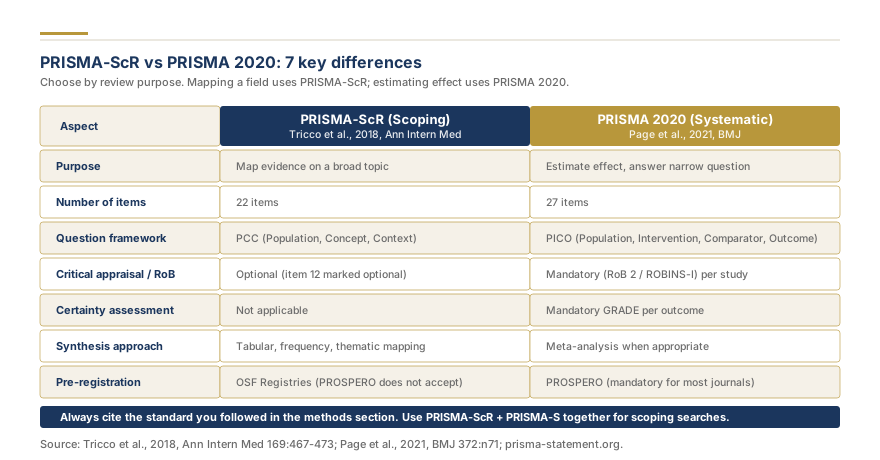
A scoping review differs from a systematic review in fundamental ways. Scoping reviews map the available evidence on a broad topic rather than answering a narrow clinical question. They use the PCC framework (Population, Concept, Context) instead of the PICO framework (Population, Intervention, Comparison, Outcome) that structures systematic reviews. Quality assessment of included studies is optional rather than mandatory. And scoping reviews do not perform meta-analysis, they chart and summarize data narratively.
These differences mean that the standard PRISMA 2020 reporting guidelines (Page et al., 2021) do not fit scoping reviews. Items related to risk of bias assessment, certainty of evidence, and meta-analytic synthesis are irrelevant, while items specific to data charting, inclusion rationale, and evidence mapping are absent from PRISMA 2020 entirely. PRISMA-ScR fills that gap with 22 items designed specifically for how scoping reviews are conducted and reported.
The EQUATOR Network hosts the official checklist and recommends that all scoping review authors complete it before manuscript submission. Many journals now require PRISMA-ScR compliance as a condition of submission, and reviewers routinely check manuscripts against the checklist during peer review. For a broader understanding of how to write a scoping review, our companion guide covers the full methodology from protocol to publication.
The 22 PRISMA-ScR Checklist Items Explained
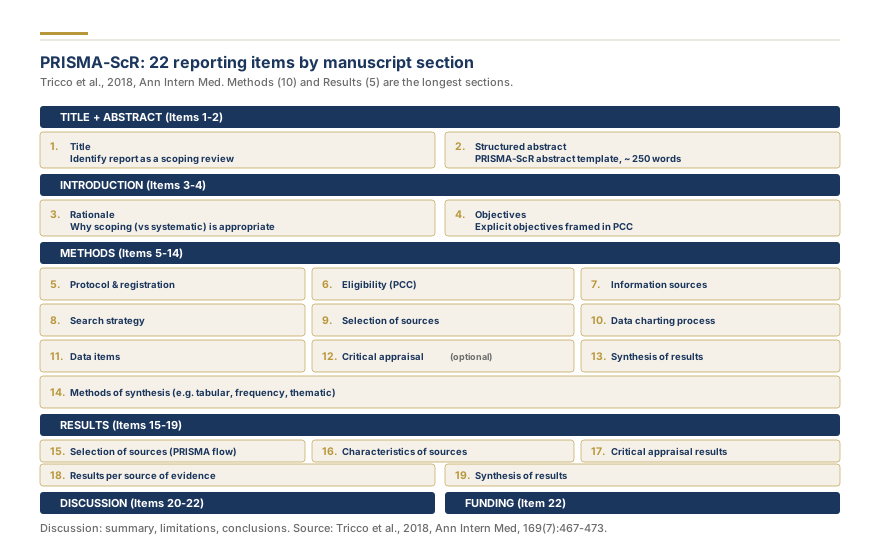
The PRISMA-ScR checklist items are organized into six sections that mirror the structure of a scoping review manuscript. Each item specifies what must be reported and where it belongs in the paper.
You can tick off all 22 items as you draft and export the completed checklist as a submission-ready table.
Title and Abstract (Items 1-2)
Item 1, Title. The title must identify the study as a scoping review. This is not a stylistic preference, it is a reporting requirement. Journals and databases use the title to classify the study type, and indexing services rely on it for accurate cataloging. A title like "Mapping the Evidence on Digital Health Interventions for Chronic Pain: A Scoping Review" meets the requirement. A title that omits "scoping review" does not.
Item 2, Structured abstract. The abstract must include the study background, objectives, eligibility criteria, sources of evidence, charting methods, results, and conclusions. Most journals require structured abstracts with labeled sections, but even when unstructured abstracts are accepted, every element listed in Item 2 must be present. The abstract is the single most-read component of any published paper, and an incomplete abstract signals methodological weakness before the reader reaches the Introduction.
Introduction (Items 3-4)
Item 3, Rationale. Describe the existing evidence landscape and explain why a scoping review is the appropriate synthesis method. This means articulating what is already known, what gaps exist, and why a scoping review, rather than a systematic review or narrative review, is the correct approach. Reference prior reviews on the topic if they exist, and explain how your scoping review extends or differs from them.
Item 4, Objectives. State the specific objectives and research questions. Scoping review objectives are typically broader than systematic review objectives. They often use language like "to map," "to identify the range," or "to examine the extent" of the evidence. Your objectives should align with your PCC framework and clearly indicate what the review intends to accomplish.
Methods (Items 5-12)
The Methods section contains the largest concentration of checklist items and is where most compliance failures occur. Items 5 through 12 cover everything from the protocol to the search strategy to the data charting process.
Item 5, Protocol and registration. Report whether a protocol exists, where it is registered (e.g., OSF, PROSPERO if accepted), and whether it was published. If deviations from the protocol occurred, they must be disclosed. Protocol transparency is a cornerstone of methodological rigor and a frequent point of reviewer scrutiny.
Item 6, Eligibility criteria. Define the inclusion and exclusion criteria using the PCC framework: Population (who), Concept (what), and Context (where/when). Be explicit about study designs included, languages, date ranges, and publication types. Ambiguous eligibility criteria are one of the most common reasons reviewers request major revisions.
Item 7, Information sources. List every database searched (e.g., PubMed, Scopus, CINAHL, Web of Science), plus any grey literature sources, hand-searching of reference lists, or expert consultations. Include the date of the last search for each source. Reproducibility depends on other researchers being able to replicate your search exactly.
Item 8, Search. Present the full electronic search strategy for at least one database, including all search terms, Boolean operators, and filters. Many authors place the complete search strategies for all databases in supplementary materials. The search strategy must be detailed enough for another researcher to execute it independently.
Item 9, Selection of sources of evidence. Describe the screening process: how many reviewers screened titles and abstracts, how many screened full texts, and how disagreements were resolved. Report inter-rater reliability if measured. This item is critical for demonstrating the rigor of your study selection.
Item 10, Data charting process. Describe how data were extracted from included sources. Scoping reviews use "data charting" rather than "data extraction", a deliberate terminological distinction that reflects the broader, more exploratory nature of scoping reviews. Report whether a charting form was used, whether it was piloted, and whether one or two reviewers independently charted data.
Item 11, Data items. List all variables for which data were charted. This typically includes study characteristics (author, year, country, design), population details, concept definitions, context, and key findings. Presenting these as a table in the Methods section improves clarity.
Item 12, Critical appraisal of individual sources of evidence. If quality assessment was conducted, describe the tool used, the process, and how results were incorporated. If quality assessment was not conducted, which is acceptable in scoping reviews, state this explicitly and explain why. This transparency is what distinguishes a rigorous scoping review from one that simply omitted quality assessment without justification.
Results (Items 13-17)
Item 13, Selection of sources of evidence. Present the results of the search and screening process, ideally using a flow diagram. Report the number of records identified, duplicates removed, titles and abstracts screened, full texts assessed, and sources included in the final review.
Item 14, Characteristics of sources of evidence. Present the characteristics of all included sources. This is typically done in a summary table showing author, year, country, study design, population, concept, context, and key findings for each included source.
Item 15, Critical appraisal within sources of evidence. If quality assessment was conducted, present the results. If not, this item is reported as not applicable. The key is transparency, the reader must know whether quality was assessed and what the findings were.
Item 16, Results of individual sources of evidence. Present the relevant data charted from each included source. This may include direct quotes, numerical data, thematic summaries, or categorical classifications depending on the nature of the evidence.
Item 17, Synthesis of results. Present the synthesized findings, organized thematically, by population, by concept, or by another logical structure. Scoping reviews synthesize descriptively rather than statistically. Tables, figures, and narrative summaries are the primary synthesis tools. This is where your scoping review maps available evidence and presents the landscape of what is known.
Discussion (Items 18-20)
Item 18, Summary of evidence. Summarize the main findings in relation to your review objectives and research questions. Link your findings back to the rationale stated in the Introduction.
Item 19, Limitations. Discuss the limitations of both the evidence (e.g., gaps in the literature, low quality of included studies) and the review process (e.g., single reviewer for screening, language restrictions). Transparent limitation reporting strengthens rather than weakens your manuscript.
Item 20, Conclusions. Provide conclusions that are supported by the evidence presented. Scoping reviews typically conclude with implications for future research, clinical practice, or policy, and often identify specific gaps that warrant full systematic reviews.
Other Information (Items 21-22)
Item 21, Funding. Report all sources of funding for the scoping review, including funding for the review itself and any funding for individual authors that could represent a conflict of interest.
Item 22, Conflicts of interest. Disclose any competing interests among the review team. This is a standard requirement across all research reporting guidelines but is explicitly included in the PRISMA-ScR checklist to ensure authors do not overlook it.