Systematic Reviews in Dentistry: A Discipline-Specific Guide for Oral Health Researchers
How to conduct a systematic review in dentistry, from dental-specific databases and oral health outcome measures to Cochrane Oral Health protocols and journal publication strategies.
Dr. Sarah Mitchell
April 9, 2026
Planning a dental systematic review? Use our free PICO framework generator to structure your research question before developing your protocol.
Key Takeaways
Dental systematic reviews require specialized databases including CENTRAL, LILACS, and Embase alongside PubMed for comprehensive retrieval
Split-mouth designs, common in periodontal and restorative research, need statistical adjustment for clustering effects during meta-analysis
The Cochrane Oral Health Group has published over 300 dental systematic reviews and provides discipline-specific methodological guidance
Risk of bias assessment in dental trials must account for operator skill variability and the frequent impossibility of blinding
Target journals like JDR, JCP, and COIR each have specific methodology requirements beyond standard PRISMA compliance
Heterogeneity in dental meta-analyses often stems from variable follow-up durations, operator experience, and material generations
A systematic review in dentistry synthesizes the best available evidence on oral health interventions, diagnostic methods, and clinical outcomes to guide evidence-based dental practice. Unlike narrative reviews that selectively cite studies, a dental systematic review follows a registered protocol, searches multiple databases, applies validated quality assessment tools, and reports findings according to PRISMA 2020 guidelines (Page et al., 2021).
Why Dentistry Requires a Specialized Systematic Review Approach
Dental research presents unique methodological challenges that generic systematic review guidance does not address. The Cochrane Oral Health Group, one of the most active Cochrane review groups, has published over 300 systematic reviews covering topics from dental implant survival rates to fluoride varnish efficacy in pediatric populations. Their protocols reflect the reality that dental outcomes often require discipline-specific measurement instruments.
Split-mouth designs, commonly used in periodontal and restorative research, require specialized statistical handling because observations within the same patient are correlated. The Cochrane Handbook (Higgins et al., 2023) addresses this, but many dental researchers overlook the adjustment for clustering effects. Similarly, network meta-analysis is increasingly used to compare multiple restorative materials or implant systems simultaneously, requiring familiarity with both direct and indirect evidence synthesis.
Dental systematic reviews also face the challenge of heterogeneous outcome reporting. A review of periodontal interventions might encounter clinical attachment level measured at 3, 6, and 12 months with different probing methods across studies. Standardizing these outcomes during learn about data extraction is critical for valid pooling.
Essential Databases for Dental Systematic Reviews
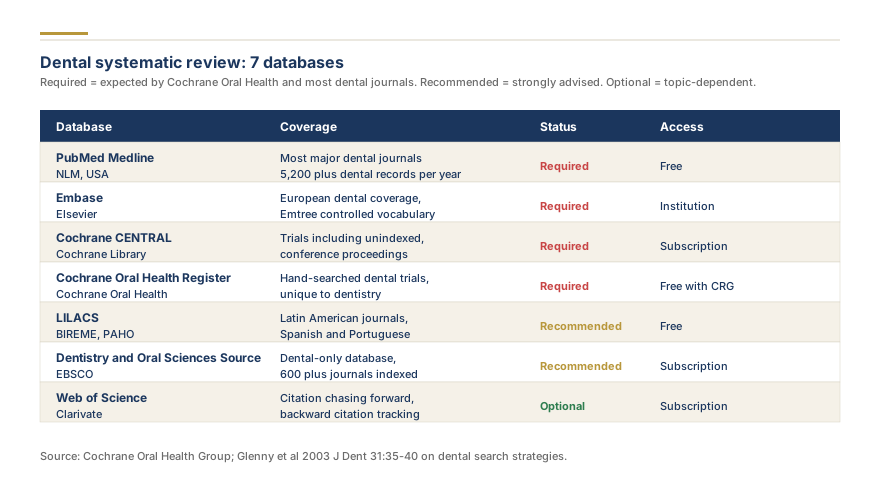
Dental systematic review: 7 databases
Searching only PubMed misses a significant portion of the dental literature. A comprehensive dental search strategy should include:
PubMed/MEDLINE remains the primary biomedical database, but dental MeSH terms require careful selection. Terms like "Dental Implants"[Mesh], "Periodontal Diseases"[Mesh], and "Dental Restoration, Permanent"[Mesh] have specific scope notes that affect retrieval.
Cochrane Central Register of Controlled Trials (CENTRAL) is essential for identifying randomized controlled trials. The Cochrane Oral Health Group maintains a specialized trials register that captures dental randomized controlled trials from sources not indexed in MEDLINE.
LILACS (Latin American and Caribbean Health Sciences Literature) captures dental research published in Portuguese and Spanish, which is substantial given Brazil's position as the world's largest producer of dental research by publication volume.
Embase includes European dental journals and conference abstracts not covered by MEDLINE. The Emtree thesaurus uses different controlled vocabulary than MeSH, so search translations are necessary using our try the search strategy builder.
Web of Science and Scopus provide citation tracking that helps identify seminal studies and their citing articles. For orthodontic reviews, the Angle Orthodontist archives and specialty databases add coverage.
A well-structured Boolean search strategy adapted across all these databases ensures comprehensive retrieval. The Cochrane Oral Health Group recommends searching at least three databases plus trial registries for dental systematic reviews.
Dental-Specific Outcome Measures and How to Handle Them
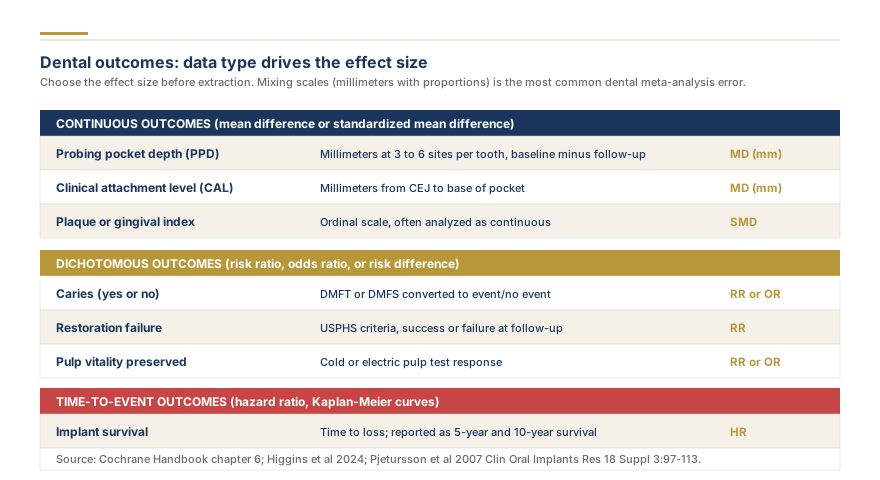
Dental outcomes: data type drives the effect size
The choice of outcome measures in dental systematic reviews directly affects clinical applicability. Common primary outcomes vary by subspecialty:
Implant dentistry reviews typically assess implant survival rate, marginal bone loss (measured in millimeters on periapical radiographs), and prosthetic complication rates. The challenge is that different studies report bone loss at different time points and using different reference lines (implant shoulder vs. first thread contact).
Periodontal research uses clinical attachment level (CAL), probing depth (PD), and bleeding on probing (BOP) as standard outcomes. The International Workshop for Classification of Periodontal Diseases (2018) introduced new staging and grading criteria that affect how older studies are interpreted.
Restorative dentistry reviews measure restoration failure rate, secondary caries, and patient-reported aesthetic outcomes. The FDI World Dental Federation criteria and modified USPHS criteria are competing assessment systems that make cross-study comparisons difficult.
When pooling these outcomes in a mastering meta-analysis, you need to decide whether to use mean difference (when all studies use the same scale) or standardized mean difference (when scales differ). Our streamlined effect size calculator helps determine the appropriate measure for your specific dental outcomes.
Need help with your evidence synthesis?
Our methodologists handle narrative synthesis, thematic analysis, umbrella reviews, and all forms of evidence synthesis, following established frameworks.
Dental randomized controlled trials present specific challenges for understanding risk of bias assessment. The Cochrane RoB 2 tool is standard for randomized trials, but several dental-specific considerations apply.
Blinding is often impossible in dental interventions. You cannot blind a clinician placing an implant to the implant system being used, and patients can often tell the difference between treatment approaches. The RoB 2 tool addresses this through the "deviations from intended interventions" domain, but dental reviewers must carefully judge whether lack of blinding actually influenced outcomes.
Operator skill is a source of bias rarely discussed in other medical fields. A systematic review comparing two surgical techniques might find that outcomes vary more by operator experience than by technique. The free rob 2 assessment tool prompts you to consider this under the "measurement of outcome" domain.
For observational dental studies (cohort studies of implant survival, case-control studies of oral cancer risk factors), the Newcastle-Ottawa Scale is widely used, and our NOS calculator helps standardize the assessment.
Handling Heterogeneity in Dental Meta-Analyses
Dental meta-analyses frequently encounter substantial statistical heterogeneity because of clinical and methodological diversity across studies. Understanding heterogeneity measures like I-squared, tau-squared, and prediction intervals is essential.
Common sources of heterogeneity in dental reviews include follow-up duration (implant studies ranging from 1 to 20 years), operator experience (general dentists vs. specialists), patient populations (healthy vs. systemically compromised), and material generations (older vs. newer implant surfaces).
When I-squared exceeds 50%, a random-effects model is typically appropriate. The Cochrane Oral Health Group recommends exploring heterogeneity through pre-specified subgroup analyses (by follow-up time, intervention type, or patient characteristics) and sensitivity analyses (removing high risk-of-bias studies). Interpreting these results requires understanding of understanding forest plots and their visual patterns.
Target journal selection significantly affects your review's methodology requirements. High-impact dental journals each have specific expectations:
Journal of Dental Research (JDR), impact factor 7.6, publishes systematic reviews with meta-analysis and requires PRISMA compliance. Reviews should address clinically significant questions with adequate included studies.
Journal of Clinical Periodontology (JCP) requires systematic reviews to follow the Cochrane methodology and strongly prefers PROSPERO-registered protocols. Network meta-analyses comparing periodontal treatments are increasingly published here.
Journal of the American Dental Association (JADA) publishes clinical practice guideline-linked systematic reviews. Their "Clinical Practice" section favors reviews with clear clinical recommendations graded using the understanding grade framework.
Clinical Oral Implants Research (COIR) is the premier journal for implant systematic reviews. They require detailed reporting of inclusion and exclusion criteria guide and prefer reviews that separate outcomes by implant system and loading protocol.
Need specialized support for your dental systematic review? Research Gold provides professional evidence synthesis services with expertise in implant survival analysis, periodontal outcomes, and dental meta-analysis methodology. Get a free quote.
Common Methodological Pitfalls in Dental Systematic Reviews
Peer reviewers in dental journals consistently flag these issues:
Overly broad research questions that try to cover all interventions for a condition rather than focusing through a well-defined explore pico framework. A review asking "What are the outcomes of dental implants?" is unpublishable; "What is the marginal bone loss around platform-switched versus platform-matched implants at 5 or more years?" is reviewable.
Inadequate search strategies that miss key databases or use incorrect MeSH terms. Dental-specific controlled vocabulary differs between MEDLINE and Embase, and many reviewers fail to translate searches properly.
Inappropriate statistical pooling of clinically heterogeneous studies. Combining 1-year and 10-year implant survival data in the same meta-analysis produces a meaningless summary estimate.
Missing protocol registration on PROSPERO or the Open Science Framework. Most dental journals now require prospective registration as a condition of review.
The timeline for a dental systematic review typically spans 6 to 18 months, depending on the breadth of the research question and the volume of included studies.
When to Seek Professional Support for Your Dental Review
Dental researchers often have strong clinical knowledge but limited training in systematic review methodology or biostatistics. This gap does not reflect poorly on clinical expertise; it reflects the reality that evidence synthesis is a specialized skill.
Consider professional support when your review requires network meta-analysis comparing multiple dental materials, when reviewer feedback demands statistical reanalysis, or when your timeline requires efficiency that comes from methodological experience. Many dental researchers outsource specific phases like the search strategy, statistical analysis, or manuscript preparation while retaining full authorship and intellectual control.
Research Gold has supported dental researchers publishing in JDR, JCP, COIR, and JADA, with expertise in implant survival analysis, periodontal outcome synthesis, and orthodontic intervention reviews. get a free literature search cost estimate to discuss your dental systematic review needs, or view our pricing for transparent cost information.
Dental journals increasingly require dual screening documentation. Learn how to coordinate a second reviewer and report inter-rater agreement for your screening process.
With the volume of dental literature growing rapidly, AI-assisted screening tools can help manage large citation sets without sacrificing sensitivity.
Frequently Asked Questions
5
The Cochrane Oral Health Group recommends at least three databases plus trial registries. A comprehensive dental search typically includes PubMed, Embase, CENTRAL, LILACS, and Web of Science or Scopus for complete coverage.
Yes, implant dentistry is one of the most reviewed topics in dental research. Focus your PICO question on a specific implant comparison, outcome measure, and follow-up period to avoid an unmanageably broad scope.
Use Cochrane RoB 2 for randomized trials and the Newcastle-Ottawa Scale for observational studies. Account for dental-specific issues like operator skill variability and the difficulty of blinding in surgical interventions.
Typically 6 to 18 months depending on scope. Implant survival reviews with long follow-up requirements and multiple databases tend to take longer than reviews of a single intervention with shorter endpoints.
JDR, JCP, JADA, Clinical Oral Implants Research, and the European Journal of Oral Implantology regularly publish systematic reviews. Each has specific methodology requirements beyond standard PRISMA 2020 compliance.
Share
Found this useful? Share it with your colleagues.
Need help with your evidence synthesis?
Our methodologists handle narrative synthesis, thematic analysis, umbrella reviews, and all forms of evidence synthesis, following established frameworks.
Complex Synthesis? Our PhD Team Specializes in Every Type.
Systematic reviews, narrative synthesis, umbrella reviews, and rapid reviews. We match the right methodology to your research question and deliver a publication-ready manuscript.
Our promise: Free rework on synthesis or GRADE assessment if reviewers push back.
4.9 / 5Quote within a few hoursPRISMA 2020 + GRADE certaintyPhD methodologistConfidential by default
Dr. Sarah Mitchell holds a PhD in Biostatistics from Johns Hopkins Bloomberg School of Public Health and has over 15 years of experience in systematic review methodology and meta-analysis. She has authored or co-authored 40+ peer-reviewed publications in journals including the Journal of Clinical Epidemiology, BMC Medical Research Methodology, and Research Synthesis Methods. A former Cochrane Review Group statistician and current editorial board member of Systematic Reviews, Dr. Mitchell has supervised 200+ evidence synthesis projects across clinical medicine, public health, and social sciences.
Research Gold supports dental researchers at every phase, from protocol development and database searching to statistical analysis and manuscript preparation. Fixed pricing, PRISMA 2020 compliance guaranteed. See our full range of research services.
Complex Synthesis? Our PhD Team Specializes in Every Type.
Systematic reviews, narrative synthesis, umbrella reviews, and rapid reviews. We match the right methodology to your research question and deliver a publication-ready manuscript.
CHEERS 2022 checklist explained: all 28 items, what changed from CHEERS 2013, and how to report a cost-effectiveness analysis so payers and journals can use it.
SPIRIT 2025 checklist explained: all 34 items by section, what changed from SPIRIT 2013, and how the protocol lines up with CONSORT 2025 when you report the trial.
ARRIVE 2.0 guidelines explained: the Essential 10 and the Recommended Set, what changed from ARRIVE 2010, and the items journals check in animal research reports.