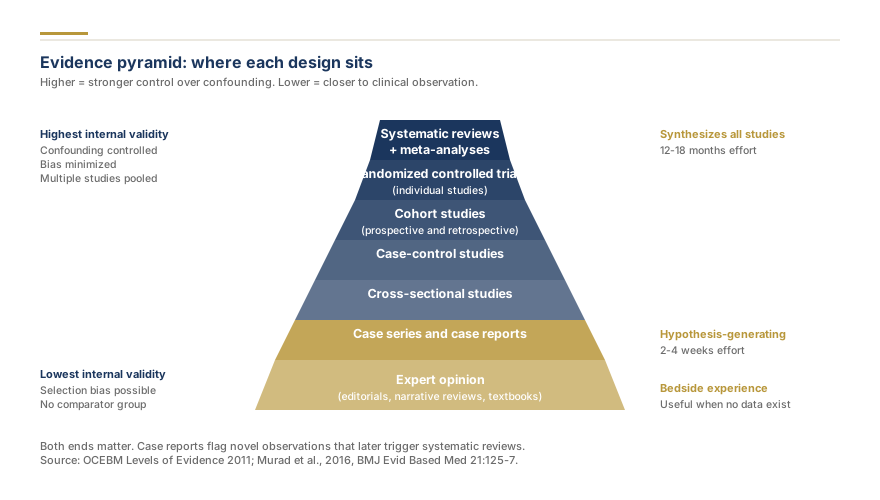
A case report is a detailed description of a single patient's diagnosis, treatment, and outcome, while a systematic review is a comprehensive synthesis of all available evidence on a focused clinical question. For early-career researchers deciding which to write first, the answer depends on your timeline, your research skills, and your career goals. A case report can be completed in 2 to 4 weeks and published within a few months, making it the fastest route to a first publication. A systematic review requires 3 to 6 months of structured work but sits significantly higher on the evidence hierarchy and carries more weight with residency programs, fellowship committees, and grant reviewers. Most researchers benefit from publishing one or two case reports early in training, then progressing to a systematic review once they have developed the methodological skills to manage a larger project.
The EQUATOR Network maintains reporting guidelines for both study types. Case reports follow the CARE guidelines (Gagnier et al., 2013), which standardize the structure and completeness of clinical case descriptions. Systematic reviews follow PRISMA 2020 (Page et al., 2021), which governs the transparent reporting of search strategy, study selection, risk of bias assessment, and evidence synthesis. Understanding both frameworks helps you choose the right project and execute it to publication standards.
How Case Reports and Systematic Reviews Differ in Scope and Purpose
A case report documents a single clinical observation. It might describe an unusual presentation of a common disease, an unexpected adverse drug reaction, a novel diagnostic finding, or a treatment approach applied to an individual patient. The scope is narrow by design. You are reporting what happened to one patient, why it matters clinically, and what other practitioners can learn from the experience. Case reports contribute to medical knowledge by flagging rare phenomena that large studies cannot capture, and they remain a cornerstone of clinical journals like BMJ Case Reports, the Journal of Medical Case Reports, and the American Journal of Case Reports.
A systematic review, by contrast, answers a broad clinical question by identifying, appraising, and synthesizing all relevant studies. The scope is comprehensive. You are not describing one patient; you are evaluating the totality of evidence on a topic. Systematic reviews published in the Cochrane Database of Systematic Reviews and indexed on PubMed inform clinical practice guidelines, health policy decisions, and future research priorities. When paired with a quantitative meta-analysis, a systematic review provides pooled effect estimates that no single study can deliver.
The fundamental difference is this: a case report adds a data point. A systematic review interprets the full dataset. Both are valuable, but they serve different purposes, require different skills, and occupy different positions in the evidence-based medicine hierarchy.
Side-by-Side Comparison: Timeline, Effort, and Impact
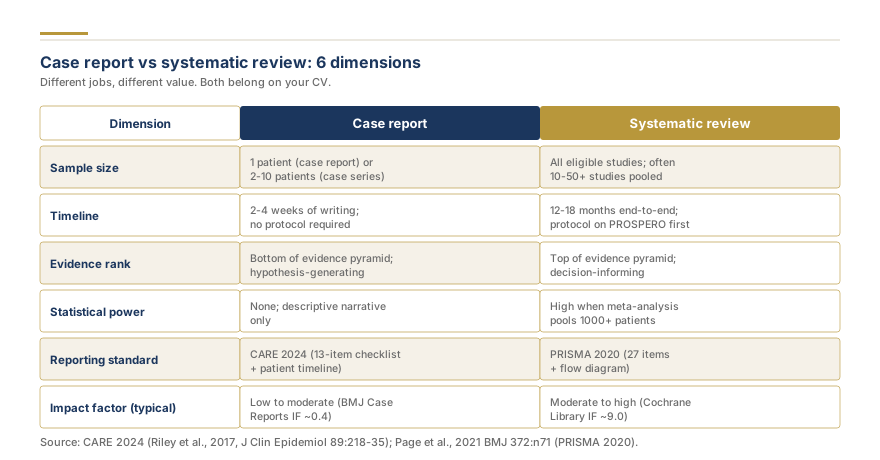
The table below compares every dimension that early-career researchers should evaluate before choosing between a case report and a systematic review.
| Dimension | Case Report | Systematic Review |
|---|---|---|
| Timeline | 2 to 4 weeks to write | 3 to 6 months from protocol to manuscript |
| Team size | 1 to 2 authors typical | 2 to 5 authors (screeners, methodologist, domain expert) |
| Research skills required | Clinical observation, literature search, medical writing | Protocol development, database searching, screening, risk of bias assessment, data extraction, synthesis |
| Evidence hierarchy level | Level 5 (lowest) | Level 1 (highest, especially with meta-analysis) |
| CV impact | Demonstrates clinical awareness; limited weight in academic hiring | Demonstrates methodological rigor; valued by residency, fellowship, and faculty search committees |
| Publication speed | 2 to 4 months from submission to publication | 4 to 8 months from submission to publication |
| Acceptance rate | 30 to 60 percent at dedicated case report journals | 15 to 30 percent at high-impact review journals; higher at specialty journals |
| Citation potential | Low (5 to 15 citations typical) | High (50 to 200+ citations for well-conducted reviews) |
| Cost to produce | Minimal (no database subscriptions, no software needed) | Moderate (reference management, screening tools, potentially statistical software) |
| Transferable skills gained | Medical writing, literature searching, clinical reasoning | Protocol writing, systematic searching, critical appraisal, data synthesis, PRISMA reporting |
| Reusability | Standalone; rarely leads to follow-up projects | Often generates hypotheses for original research, grant applications, and guideline development |
This comparison reveals a clear pattern. Case reports offer speed and accessibility. Systematic reviews offer depth and career leverage. The right choice depends on where you are in your training and what you need from the publication.
When a Case Report Is the Right First Project
A case report is the ideal starting point when you are a medical student, resident, or early-career clinician who has never published before. The barriers to entry are low: you need one interesting clinical encounter, one or two co-authors (typically an attending physician and possibly a senior resident), and the ability to write a structured narrative following the CARE checklist.
You should start with a case report if:
- You have encountered an unusual clinical presentation that other practitioners would benefit from knowing about
- You need a publication within the next 2 to 3 months for a residency or fellowship application deadline
- You have limited experience with research methodology and want to build writing skills before tackling a larger project
- Your institution does not provide access to systematic review screening tools like Covidence or Rayyan
- You want to practice the publication process, including manuscript formatting, journal selection, peer review response, and revision, on a smaller project before committing to a 6-month endeavor
The CARE guidelines (Gagnier et al., 2013) provide a 13-item checklist that structures every case report into a consistent format: patient information, clinical findings, timeline, diagnostic assessment, therapeutic intervention, follow-up and outcomes, and a discussion linking the case to the broader literature. Following CARE increases your chances of acceptance because reviewers can verify that your report is complete and transparent.
Case reports also serve as networking tools. Writing with a senior clinician establishes a mentorship relationship that can lead to larger collaborative projects. Many productive research careers began with a case report co-authored during medical school or residency.
For guidance on structuring your literature search and clinical context sections, our guide to writing a systematic review covers foundational skills that apply to case report writing as well.