How to conduct a systematic review in pharmacy and pharmacology, covering drug efficacy synthesis, network meta-analysis for drug comparisons, regulatory requirements, and pharmacokinetic data pooling.
Dr. Sarah Mitchell
April 12, 2026
Developing a pharmaceutical systematic review protocol? Use our free PICO framework generator to structure your drug comparison question.
Key Takeaways
FDA, EMA, and NICE increasingly require systematic reviews and network meta-analyses for drug approval and health technology assessment submissions
Network meta-analysis enables simultaneous comparison of multiple drugs using both direct and indirect evidence, producing treatment rankings for formulary decisions
Pharmaceutical searches must include ClinicalTrials.gov, regulatory databases (FDA EPARs), and IPA alongside standard biomedical databases to capture unpublished trial data
Pharmacokinetic meta-analysis requires log-transformation of PK parameters and careful handling of study design differences as covariates
Drug safety systematic reviews face challenges with rare events, zero-event studies, and evidence starting at low GRADE certainty
Industry-sponsored trials are more likely to report favorable outcomes, making sensitivity analyses by funding source essential in pharmaceutical reviews
A systematic review in pharmacy and pharmacology synthesizes evidence on drug efficacy, safety, pharmacokinetics, and real-world effectiveness to support clinical decision-making, formulary management, and regulatory submissions. These reviews are essential for comparing therapeutic alternatives, evaluating adverse event profiles, and translating bench-to-bedside pharmacological findings into evidence-based prescribing guidelines.
The Regulatory Imperative Driving Pharmaceutical Evidence Synthesis
Both the U.S. Food and Drug Administration (FDA) and the European Medicines Agency (EMA) increasingly require systematic reviews as part of drug approval and health technology assessment submissions. The FDA's Guidance on Systematic Review in Regulatory Submissions (2023) specifies that sponsors must use systematic, transparent methods when summarizing the evidence base for new drug applications.
The National Institute for Health and Care Excellence (NICE) in the UK mandates systematic reviews and network meta-analyses as the basis for technology appraisals that determine whether the National Health Service will fund new medications. Similar requirements exist through Canada's CADTH, Australia's PBAC, and Germany's IQWiG.
This regulatory landscape means that pharmaceutical systematic reviews must meet particularly high methodological standards. Protocol registration on PROSPERO, comprehensive search documentation, validated risk of bias assessment, and transparent statistical methods are not optional enhancements but mandatory requirements that determine whether a drug reaches patients.
Hospital pharmacy and therapeutics (P&T) committees also rely on systematic reviews when evaluating new additions to institutional formularies. A well-conducted systematic review comparing a new antibiotic against existing formulary options directly influences purchasing decisions affecting thousands of patients.
Database Strategy for Pharmaceutical Evidence
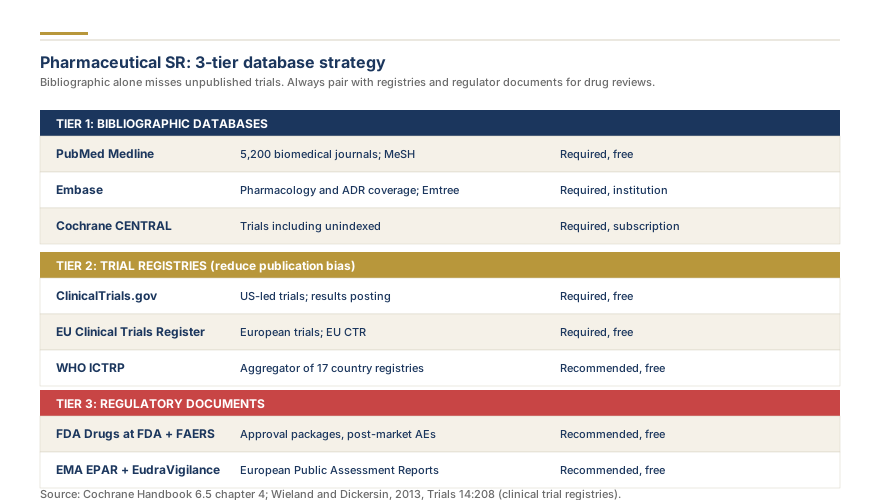
Pharmaceutical SR: 3-tier database strategy
Pharmaceutical systematic reviews require searching beyond standard biomedical databases to capture the full evidence base, including unpublished regulatory data.
PubMed/MEDLINE and Embase form the core. Embase is particularly important in pharmacy because it indexes pharmacological journals, drug concentration studies, and European pharmaceutical literature not covered by MEDLINE. The Emtree drug hierarchy provides granular drug classification that MeSH does not match.
International Pharmaceutical Abstracts (IPA) captures pharmacy practice research, drug utilization studies, and pharmaceutical technology articles from pharmacy-specific journals not indexed elsewhere.
ClinicalTrials.gov and the EU Clinical Trials Register contain results data from completed trials, including those never published in journals. The FDA Amendments Act (2007) requires registration and results reporting for most drug trials, making these registries essential for addressing understanding publication bias.
FDA Orange Book, EMA European Public Assessment Reports (EPARs), and Health Canada Drug Database contain regulatory review documents with detailed efficacy and safety data from pivotal trials.
The Cochrane Drugs and Alcohol Group and Cochrane Effective Practice and Organization of Care (EPOC) maintain specialized trial registers relevant to pharmaceutical interventions. Building an effective search strategy explained across these sources requires understanding each database's controlled vocabulary for drug names, which vary between generic names, brand names, and chemical identifiers. Use our convenient search strategy builder to structure your multi-database approach.
Network Meta-Analysis for Drug Comparisons
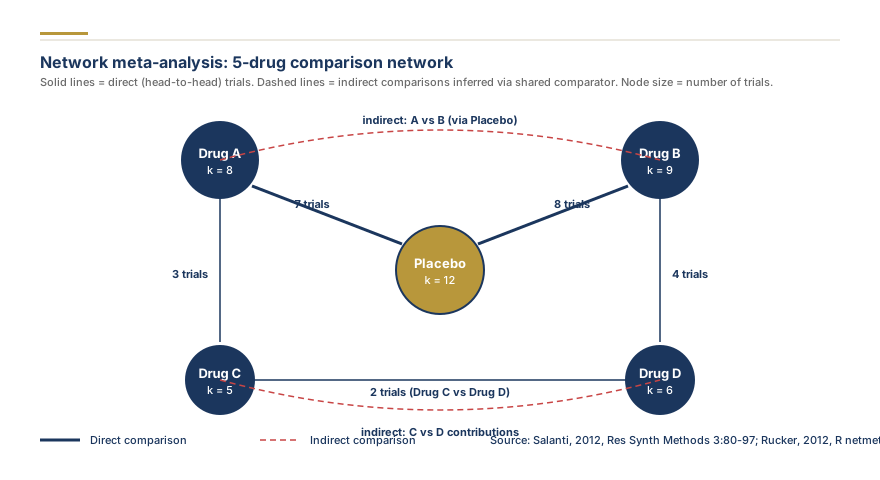
Network meta-analysis: 5-drug comparison network
Pharmacy systematic reviews frequently need to compare multiple drugs simultaneously when head-to-head trials are scarce. Network meta-analysis (NMA), also called mixed-treatment comparison, combines direct evidence (Drug A vs. Drug B) with indirect evidence (Drug A vs. placebo and Drug B vs. placebo) to estimate relative effects across an entire drug class.
The NICE Decision Support Unit technical support documents provide the methodological standard for network meta-analysis in pharmaceutical applications. Key considerations include:
Transitivity assumption: indirect comparisons are only valid if the studies comparing Drug A vs. placebo are similar in patient population, dose, and follow-up to those comparing Drug B vs. placebo. Violation of transitivity produces misleading results.
Consistency assessment: where direct and indirect evidence coexist, they should agree. Node-splitting models test for inconsistency at each comparison.
Ranking probabilities: network meta-analysis produces SUCRA (Surface Under the Cumulative Ranking) scores or P-scores that rank treatments by probability of being best. These rankings are useful for P&T committee decisions but should be interpreted alongside effect estimates and confidence intervals.
NMA requires specialized software, typically R packages (gemtc, netmeta, multinma) or WinBUGS/OpenBUGS for Bayesian models. Our biostatistical analysis support provides network meta-analysis analysis using validated Bayesian and frequentist methods.
Need help with your evidence synthesis?
Our methodologists handle narrative synthesis, thematic analysis, umbrella reviews, and all forms of evidence synthesis, following established frameworks.
A unique challenge in pharmaceutical systematic reviews is synthesizing pharmacokinetic (PK) parameters like area under the curve (AUC), maximum concentration (Cmax), half-life (t1/2), and bioavailability. Population pharmacokinetic meta-analysis pools these parameters across studies to characterize drug behavior in diverse populations.
PK data is typically log-normally distributed, requiring log-transformation before pooling and back-transformation for interpretation. Studies report PK parameters with different designs (single-dose vs. steady-state, fasted vs. fed), and these design differences must be accounted for as covariates.
Dose-response meta-analysis is another pharmaceutical-specific method that models the relationship between drug dose and clinical effect across studies. The DRmeta R package implements flexible dose-response models using restricted cubic splines.
When individual patient data (IPD) is available, IPD meta-analysis provides the gold standard for pharmacokinetic synthesis, allowing covariate adjustment for body weight, renal function, age, and genetic polymorphisms that affect drug metabolism.
Safety and Adverse Event Synthesis
Drug safety systematic reviews face distinct methodological challenges. Adverse events are often rare, requiring pooling across many trials to achieve adequate statistical power. The Peto odds ratio method performs better than standard methods for rare events (event rates below 5%), and its properties are well-established for meta-analysis of binary outcomes.
Zero-event studies (trials where no adverse events occurred in either arm) are common in safety meta-analyses. Standard methods exclude these studies, potentially biasing results. Continuity corrections (adding 0.5 to each cell) or exact methods (Mantel-Haenszel without correction) should be applied, with sensitivity analyses comparing approaches.
The GRADE framework assessment for safety outcomes often starts at "low" certainty because adverse event data typically comes from trials powered for efficacy, not safety. Observational studies and post-marketing surveillance data may actually provide more informative safety evidence, requiring integration of different evidence streams.
Seeking expert support for your pharmaceutical systematic review? Research Gold provides professional meta-analysis services with expertise in network meta-analysis, pharmacokinetic synthesis, and drug safety evidence evaluation. get a free narrative synthesis estimate with details about your therapeutic area.
Pharmaceutical trials have specific bias patterns that reviewers must evaluate. Industry sponsorship introduces potential conflicts of interest, and Cochrane reviews systematically assess funding source as a characteristic that may influence results.
Lexchin et al. (2003) demonstrated that industry-sponsored trials are more likely to report favorable outcomes for the sponsor's drug. This finding means pharmaceutical systematic reviews should conduct sensitivity analyses stratifying by funding source.
The Cochrane RoB 2 tool addresses pharmaceutical-specific concerns through its domains on randomization, blinding (typically achievable in drug trials through identical placebo capsules), and selective outcome reporting. Our use our risk of bias assessment tool guides you through each domain.
For observational drug safety studies, the ROBINS-I tool is appropriate, and the Newcastle-Ottawa Scale calculator tool provides a structured quality assessment for cohort studies of drug outcomes.
Reporting Standards and Target Journals
Pharmaceutical systematic reviews should follow complete guide to prisma 2020 with additional extensions as relevant:
PRISMA-NMA for network meta-analyses, providing specific guidance on reporting network geometry, transitivity assessment, and ranking statistics.
PRISMA-Harms for systematic reviews focused on adverse effects, which requires more detailed reporting of how adverse event data was identified and extracted.
Target journals include Cochrane Database of Systematic Reviews, British Journal of Clinical Pharmacology, Clinical Pharmacology and Therapeutics, Pharmacotherapy, Drug Safety, and Annals of Pharmacotherapy. Health technology assessment bodies like NICE and CADTH also publish systematic reviews in their own repositories.
When Professional Support Strengthens Your Pharmaceutical Review
Pharmacy and pharmacology researchers bring deep therapeutic area expertise but may need methodological support for network meta-analysis, pharmacokinetic pooling, or regulatory-grade evidence synthesis. Professional support is especially valuable when your review will be submitted to a health technology assessment body or used in a drug approval application.
Research Gold's methodologists have experience supporting pharmaceutical evidence synthesis for formulary decisions, NICE submissions, and academic publications. Our statisticians work with R, Stata, and specialized network meta-analysis software. request a free statistical pooling quote or explore our systematic review service for researchers for a complete overview.
Pharmacological reviews comparing multiple drugs benefit from network meta-analysis, which ranks treatments using both direct and indirect evidence across a connected network.
Head-to-head trials comparing all drug alternatives rarely exist. Network meta-analysis combines direct and indirect evidence to compare multiple treatments simultaneously, producing the treatment rankings that P&T committees and regulators need for formulary and reimbursement decisions.
PubMed, Embase, and CENTRAL as core databases. Add International Pharmaceutical Abstracts, ClinicalTrials.gov, EU Clinical Trials Register, and FDA/EMA regulatory documents. Embase is especially important for drug-specific indexing and European pharmaceutical literature.
Use the Peto odds ratio for events with rates below 5%. Apply continuity corrections or exact methods for zero-event studies. Conduct sensitivity analyses comparing different statistical approaches and present results transparently.
Yes. The FDA, EMA, NICE, CADTH, and PBAC all accept and increasingly require systematic reviews. NICE mandates network meta-analysis for technology appraisals. Reviews must meet high methodological standards with PROSPERO registration and transparent reporting.
PRISMA-NMA extends PRISMA 2020 with specific items for network meta-analysis reporting, including network geometry diagrams, transitivity assessment, consistency evaluation, and treatment ranking statistics like SUCRA scores.
Share
Found this useful? Share it with your colleagues.
Need help with your evidence synthesis?
Our methodologists handle narrative synthesis, thematic analysis, umbrella reviews, and all forms of evidence synthesis, following established frameworks.
Complex Synthesis? Our PhD Team Specializes in Every Type.
Systematic reviews, narrative synthesis, umbrella reviews, and rapid reviews. We match the right methodology to your research question and deliver a publication-ready manuscript.
Our promise: Free rework on synthesis or GRADE assessment if reviewers push back.
4.9 / 5Quote within a few hoursPRISMA 2020 + GRADE certaintyPhD methodologistConfidential by default
Dr. Sarah Mitchell holds a PhD in Biostatistics from Johns Hopkins Bloomberg School of Public Health and has over 15 years of experience in systematic review methodology and meta-analysis. She has authored or co-authored 40+ peer-reviewed publications in journals including the Journal of Clinical Epidemiology, BMC Medical Research Methodology, and Research Synthesis Methods. A former Cochrane Review Group statistician and current editorial board member of Systematic Reviews, Dr. Mitchell has supervised 200+ evidence synthesis projects across clinical medicine, public health, and social sciences.
Research Gold supports pharmaceutical researchers from protocol through regulatory-grade manuscript. Our statisticians specialize in NMA, dose-response modeling, and drug safety synthesis. See our pricing.
Complex Synthesis? Our PhD Team Specializes in Every Type.
Systematic reviews, narrative synthesis, umbrella reviews, and rapid reviews. We match the right methodology to your research question and deliver a publication-ready manuscript.
CHEERS 2022 checklist explained: all 28 items, what changed from CHEERS 2013, and how to report a cost-effectiveness analysis so payers and journals can use it.
SPIRIT 2025 checklist explained: all 34 items by section, what changed from SPIRIT 2013, and how the protocol lines up with CONSORT 2025 when you report the trial.
ARRIVE 2.0 guidelines explained: the Essential 10 and the Recommended Set, what changed from ARRIVE 2010, and the items journals check in animal research reports.