How to conduct a systematic review in public health, covering complex intervention synthesis, GRADE-CERQual for qualitative evidence, equity-focused reviews, and WHO-aligned evidence standards.
Dr. Sarah Mitchell
April 10, 2026
Developing a public health systematic review protocol? Structure your research question with our free PICO/SPIDER framework generator.
Key Takeaways
Public health systematic reviews evaluate complex interventions across diverse settings, requiring methods beyond standard Cochrane clinical trial synthesis
The PROGRESS-Plus framework guides equity-focused reviews that examine differential intervention effects across population subgroups
GRADE-CERQual assesses confidence in qualitative evidence, essential for understanding how and why public health interventions work
Searching public health evidence requires at least 6-8 databases including grey literature sources like WHO IRIS, OpenGrey, and CDC WONDER
Mixed-methods synthesis integrating quantitative effectiveness data with qualitative process evidence is increasingly required by WHO and other guideline bodies
Public health reviews typically take 12 to 24 months due to broader search strategies and the complexity of synthesizing diverse study designs
A systematic review in public health synthesizes evidence on population-level interventions, health policy effectiveness, and determinants of health to inform decision-making at organizational, community, and governmental levels. Public health reviews differ from clinical systematic reviews because they evaluate complex interventions delivered across diverse settings, populations, and implementation contexts, requiring methodological approaches that go beyond standard Cochrane clinical trial synthesis.
Why Public Health Evidence Synthesis Demands Different Methods
The Medical Research Council (MRC) framework for complex interventions (Skivington et al., 2021) recognizes that public health programs involve multiple interacting components, operate across organizational levels, and produce outcomes shaped by context. A school-based obesity prevention program, for example, involves dietary education, physical activity components, parental engagement, and cafeteria policy changes, all operating simultaneously within specific socioeconomic and cultural environments.
This complexity means that the standard clinical question format often falls short. While the read about pico framework works well for drug trials, public health reviews frequently use PICOS (adding Setting) or SPIDER (Sample, Phenomenon of Interest, Design, Evaluation, Research type) to capture the full scope of the question. Our PICO/SPIDER framework generator supports both formats.
The Campbell Collaboration, the social science counterpart to Cochrane, maintains a library of systematic reviews on education, crime and justice, social welfare, and international development. Their methodological standards complement Cochrane's clinical focus and provide guidance specific to public health and social policy reviews.
Unlike clinical trials with well-defined endpoints, public health outcomes are often distal and diffuse. A tobacco control policy review might measure quit rates, initiation rates, secondhand smoke exposure, healthcare utilization, and economic productivity, each requiring different data sources and synthesis approaches.
Searching the Public Health Literature
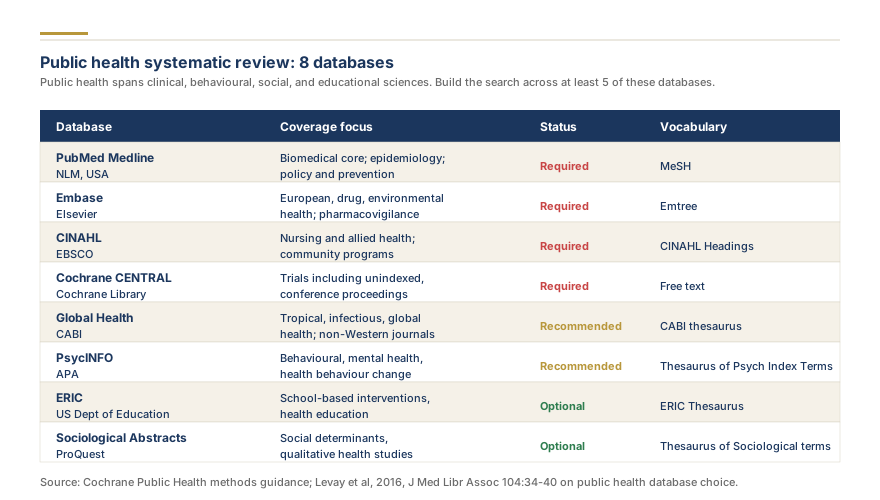
Public health systematic review: 8 databases
Public health evidence is scattered across medical, social science, education, and policy databases. A comprehensive search strategy must cast a wider net than a typical clinical systematic review.
Core databases include PubMed/MEDLINE, Embase, and the Cochrane Library. But stopping here misses critical public health evidence found in CINAHL (nursing and allied health), PsycINFO (behavioral interventions), ERIC (education-based health programs), Social Science Citation Index, and Global Health (international public health, particularly low- and middle-income countries).
Grey literature is disproportionately important in public health reviews. Government reports, WHO technical documents, NGO evaluations, and conference proceedings often contain implementation evidence not published in peer-reviewed journals. Searching OpenGrey, the WHO IRIS repository, CDC WONDER, and organizational websites is standard practice.
The search strategy development process for public health reviews requires balancing sensitivity (finding all relevant evidence) against the practical reality that broader searches generate thousands of records. A well-constructed strategy for a public health topic might retrieve 5,000 to 15,000 records, compared to 1,000 to 3,000 for a focused clinical question.
Handling Complex Interventions in Synthesis
Pooling results from complex public health interventions requires careful judgment about what is meaningfully combinable. The Cochrane Handbook (Chapter 12) provides guidance on synthesizing complex interventions, emphasizing the importance of developing a logic model before starting the review.
A logic model maps the hypothesized causal pathway from intervention components through mediators to outcomes. For a community-based diabetes prevention program, this might include: health literacy sessions (component) leading to dietary knowledge (mediator) leading to HbA1c reduction (outcome), with socioeconomic status and healthcare access as moderators.
Harvest plots and effect direction plots are visual synthesis tools particularly useful when meta-analysis is not feasible due to intervention heterogeneity. These methods, endorsed by the Cochrane Public Health Group, display the direction and magnitude of effects across studies without requiring standardized effect sizes.
When meta-analysis is appropriate, public health reviews frequently use random-effects models because between-study variation is expected and clinically meaningful. Meta-regression can explore whether intervention characteristics (duration, intensity, delivery mode) explain heterogeneity, and our practical forest plot generator visualizes these pooled estimates.
Need help with your evidence synthesis?
Our methodologists handle narrative synthesis, thematic analysis, umbrella reviews, and all forms of evidence synthesis, following established frameworks.
Equity-Focused Systematic Reviews: The PROGRESS-Plus Framework
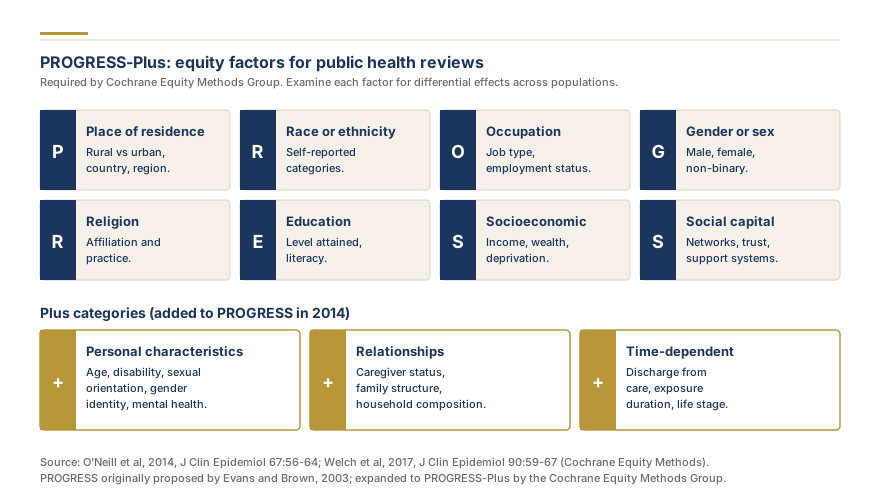
PROGRESS-Plus: equity factors for public health reviews
Public health has a unique obligation to examine how interventions affect health equity across population subgroups. The Cochrane Equity Methods Group developed the PROGRESS-Plus framework to guide equity-sensitive reviews:
Place of residence (urban/rural, country)
Race/ethnicity/culture/language
Occupation
Gender/sex
Religion
Education
Socioeconomic status
Social capital
Plus: age, disability, sexual orientation, and other characteristics
An equity-focused systematic review explicitly examines whether intervention effects differ across PROGRESS-Plus categories. This requires extracting disaggregated data from included studies, which is often incompletely reported. The PRISMA-Equity 2012 extension provides reporting guidance for these reviews.
Welch et al. (2012) demonstrated that fewer than 10% of health intervention systematic reviews assess differential effects across socioeconomic groups, representing a significant gap in the evidence base for public health policy.
Qualitative and Mixed-Methods Evidence Synthesis
Public health decisions require understanding not just whether interventions work, but how and why they work in specific contexts. This demands synthesis of qualitative research alongside quantitative evidence.
GRADE-CERQual (Confidence in the Evidence from Reviews of Qualitative Research) is the qualitative equivalent of the read about grade framework. Developed by Lewin et al. (2018), it assesses confidence in qualitative findings based on four components: methodological limitations, coherence, adequacy of data, and relevance.
Thematic synthesis (Thomas and Harden, 2008) is the most commonly used method for synthesizing qualitative studies in public health reviews. It involves coding findings from included studies, developing descriptive themes, and generating analytical themes that go beyond what individual studies reported.
Mixed-methods systematic reviews integrate quantitative effectiveness evidence with qualitative process evidence. The JBI methodology provides a structured approach to convergent and sequential mixed-methods synthesis, increasingly required by organizations like the World Health Organization when developing clinical practice guidelines.
Quality Assessment Tools for Public Health Studies
Public health reviews include diverse study designs, each requiring appropriate quality assessment. The deep dive into risk of bias assessment toolkit for public health includes:
Cochrane RoB 2 for randomized trials, with particular attention to cluster randomization (common in community-level interventions) and the risk of contamination between intervention and control groups. Our online rob 2 assessment tool guides you through each domain.
ROBINS-I for non-randomized studies, which are more prevalent in public health than in clinical medicine because randomizing communities or policies is often impractical or unethical.
CASP qualitative checklist or JBI critical appraisal tools for qualitative studies included in mixed-methods reviews.
Newcastle-Ottawa Scale for observational studies. Public health frequently relies on cohort and case-control designs, and the NOS calculator streamlines this assessment.
The GRADE Working Group recommends starting certainty of evidence at "high" for randomized controlled trials and "low" for observational studies, then rating up or down based on specific criteria. Public health evidence is often rated down for indirectness because studies may be conducted in populations or settings different from the target policy context.
Need expert support for your public health evidence synthesis? Research Gold provides professional systematic review services experienced in complex intervention synthesis, mixed-methods reviews, and equity-focused analysis. Get a free quote.
Reporting Standards and Target Journals
Public health systematic reviews should follow mastering prisma 2020 as the minimum reporting standard, with additional extensions as relevant:
PRISMA-S for search reporting
PRISMA-Equity for equity-focused reviews
ENTREQ (Enhancing Transparency in Reporting the Synthesis of Qualitative Research) for qualitative synthesis components
Leading journals for public health systematic reviews include the Lancet Public Health, BMC Public Health, American Journal of Public Health, International Journal of Environmental Research and Public Health, and Systematic Reviews (BMC). The Cochrane Database of Systematic Reviews and Campbell Systematic Reviews are dedicated repositories.
Generate your PRISMA-compliant flow diagram using our try the prisma flow diagram generator before submission. Most public health journals require this as a mandatory figure.
Timeline and Resource Planning
Public health systematic reviews typically take 12 to 24 months due to broader search strategies, larger screening volumes, and the complexity of synthesizing diverse study designs. Planning for a team of at least two reviewers is methodologically required, as independent screening and data extraction reduces bias.
Budgeting should account for database access fees (particularly for grey literature repositories), reference management software, and screening tools like Covidence or Rayyan. Understanding the full cost structure helps secure adequate funding from the outset.
When Professional Support Strengthens Your Review
Public health researchers often have deep content expertise in their intervention area but limited training in evidence synthesis methodology or biostatistics. Professional support is most valuable when your review involves mixed-methods synthesis, requires meta-regression to explore complex moderator effects, or faces a tight policy deadline that demands efficient methodology.
Research Gold has supported public health systematic reviews for WHO guideline panels, national health departments, and university research teams. Our methodologists understand the unique demands of synthesizing evidence for policy audiences. get a free search strategy development estimate to discuss your public health review, or explore our evidence synthesis support from PhD methodologists for a full overview of capabilities.
Public health reviews require extensive grey literature searching. Our guide covers grey literature sources including WHO repositories, government reports, and conference proceedings.
Public health questions often require both quantitative and qualitative evidence. Learn how mixed-methods reviews integrate diverse data types for policy-relevant conclusions.
Frequently Asked Questions
5
Public health reviews evaluate complex interventions with multiple interacting components delivered across diverse populations and settings. They more frequently include non-randomized designs, qualitative evidence, and equity considerations than clinical reviews focused on drug or device efficacy.
At minimum: PubMed, Embase, Cochrane Library, CINAHL, PsycINFO, and Global Health. Add ERIC for education-based programs, Social Science Citation Index for policy evidence, and grey literature sources like WHO IRIS and OpenGrey.
Yes. Mixed-methods systematic reviews that synthesize qualitative process evidence alongside quantitative effectiveness data are increasingly valued in public health. Use JBI methodology for synthesis and GRADE-CERQual to assess confidence in qualitative findings.
Developed by the Cochrane Equity Methods Group, PROGRESS-Plus identifies characteristics across which health equity should be examined: Place, Race, Occupation, Gender, Religion, Education, Socioeconomic status, Social capital, plus age, disability, and other factors.
Typically 12 to 24 months. The broader scope of public health questions, larger search yields, diverse study designs, and the potential need for mixed-methods synthesis extend the timeline compared to focused clinical reviews.
Share
Found this useful? Share it with your colleagues.
Need help with your evidence synthesis?
Our methodologists handle narrative synthesis, thematic analysis, umbrella reviews, and all forms of evidence synthesis, following established frameworks.
Complex Synthesis? Our PhD Team Specializes in Every Type.
Systematic reviews, narrative synthesis, umbrella reviews, and rapid reviews. We match the right methodology to your research question and deliver a publication-ready manuscript.
Our promise: Free rework on synthesis or GRADE assessment if reviewers push back.
4.9 / 5Quote within a few hoursPRISMA 2020 + GRADE certaintyPhD methodologistConfidential by default
Dr. Sarah Mitchell holds a PhD in Biostatistics from Johns Hopkins Bloomberg School of Public Health and has over 15 years of experience in systematic review methodology and meta-analysis. She has authored or co-authored 40+ peer-reviewed publications in journals including the Journal of Clinical Epidemiology, BMC Medical Research Methodology, and Research Synthesis Methods. A former Cochrane Review Group statistician and current editorial board member of Systematic Reviews, Dr. Mitchell has supervised 200+ evidence synthesis projects across clinical medicine, public health, and social sciences.
Research Gold supports public health researchers from protocol development through policy-ready manuscript. Our team understands mixed-methods synthesis, GRADE-CERQual, and equity-focused review methodology. Explore our evidence synthesis service.
Complex Synthesis? Our PhD Team Specializes in Every Type.
Systematic reviews, narrative synthesis, umbrella reviews, and rapid reviews. We match the right methodology to your research question and deliver a publication-ready manuscript.
CHEERS 2022 checklist explained: all 28 items, what changed from CHEERS 2013, and how to report a cost-effectiveness analysis so payers and journals can use it.
SPIRIT 2025 checklist explained: all 34 items by section, what changed from SPIRIT 2013, and how the protocol lines up with CONSORT 2025 when you report the trial.
ARRIVE 2.0 guidelines explained: the Essential 10 and the Recommended Set, what changed from ARRIVE 2010, and the items journals check in animal research reports.