What you get from a qualitative data analysis project
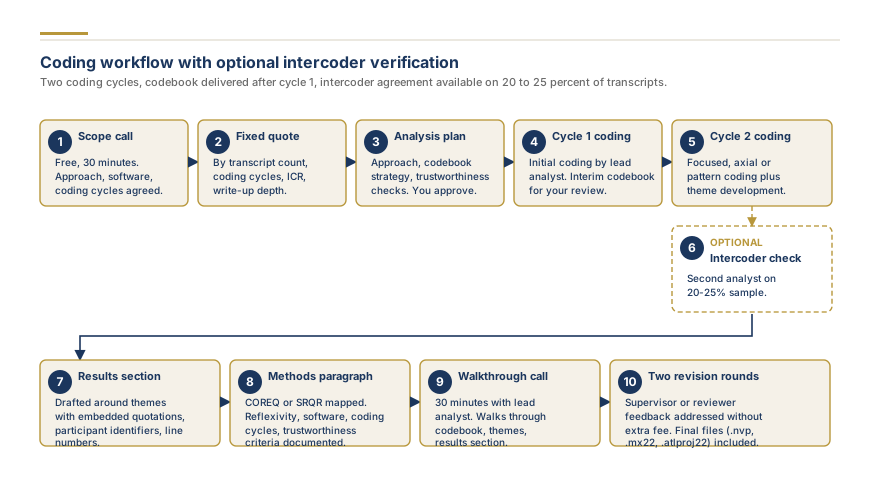
Each engagement is delivered as a complete deliverable bundle so you can drop the analysis into your thesis, manuscript, or grant report without rework. You are matched with a PhD researcher published in your field and tradition, whether that field is nursing, psychology, education, sociology, public health, and beyond. The analyst codes your interview or focus group data using thematic analysis, framework analysis, grounded theory, or content analysis, building coding frameworks and codebooks, and reporting intercoder agreement where a second coder is available, in NVivo, MAXQDA, or ATLAS.ti.
- Written analysis plan approved before coding starts: research question, methodological approach (thematic, content, framework, or grounded theory), coding cycles, software, and how trustworthiness will be addressed.
- Codebook with code names, definitions, inclusion and exclusion rules, and at least two example quotations per code.
- Coded software project file in NVivo, MAXQDA, ATLAS.ti, or Dedoose. You receive the original file, not just exported PDFs, so your supervisor or reviewers can audit the coding.
- Theme development with a visual map showing how codes were grouped into categories and how categories were grouped into themes.
- Illustrative quotations selected for each theme with participant identifiers and line numbers.
- APA-ready results section structured around the themes, written with embedded quotations.
- Methods paragraph describing the analytic approach, the coding process, the software, the analyst's reflexivity, and the trustworthiness checks performed (credibility, dependability, confirmability, transferability).
- Reflexive memos captured during analysis and delivered as a separate document so you can defend interpretive choices in your viva.
- Intercoder agreement report with Cohen's kappa or percent agreement when a second coder is requested.
- Written results walkthrough from the lead analyst, explaining every theme and coding decision so you can present the analysis in your own words.
Software we use
We work in the package your supervisor, journal, or funder expects. The same study can usually be coded in any of these tools, and the choice mainly affects collaboration, export options, and whether your institution holds a license.
NVivo qualitative analysis
NVivo is the standard package for doctoral candidates in nursing, education, social work, public health, and many social science programs. NVivo is well suited to large transcript counts, framework matrices, and coding queries (matrix coding, coding comparison, word frequency, text search). We deliver the .nvp file so your supervisor can re-run any query, plus PDF exports of the codebook, code summaries, and theme map.
MAXQDA qualitative data analysis
MAXQDA is widely used in mixed-methods research and across European universities. Its segment-level memo system is strong for grounded theory work, and its document portrait visualization helps when a discussion section needs to compare cases. Our MAXQDA deliverables include the .mx22 project file, the codebook, the document map, and any matrix coding queries used in the analysis.
ATLAS.ti coding
ATLAS.ti is common in education research, anthropology, and applied health research. Its network view is useful for showing how codes relate to each other, which translates well to a journal figure. We deliver the .atlproj22 file, the network views as PNGs, and the code-document table.
Dedoose for team coding
Dedoose runs in the browser, so it is the natural choice when several analysts are coding the same data from different institutions or countries. We use Dedoose for evaluation studies and multi-site qualitative work. Deliverables include the project export, the codebook, and intercoder reliability output.
Microsoft Word coding
For very small studies (under 10 transcripts) and when no software is required, we can code directly in Word using comments and styles. This is the lightest-touch option and is appropriate for service evaluations and small grants.
Methodological approaches we cover
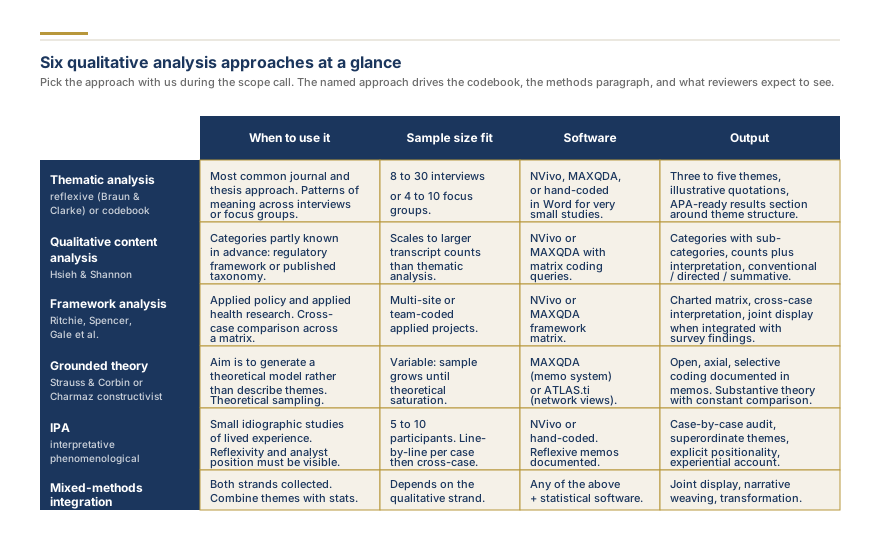
The named approach affects how we develop codes, how themes are reported, and what the methods paragraph claims. Choose the approach with us during the written scoping step rather than after coding starts.
Thematic analysis (Braun and Clarke)
Thematic analysis is the most widely used approach in journal and thesis qualitative work. We follow the six-phase reflexive thematic analysis (Braun and Clarke, 2006) procedure: familiarization, generating initial codes, constructing themes, reviewing themes, defining and naming themes, and producing the report. We are explicit about whether the analysis is reflexive (theme as pattern of meaning) or codebook-style (theme as topic summary), depending on your epistemological stance, since reviewers now expect this distinction.
Qualitative content analysis
Qualitative content analysis suits studies where the categories are partly known in advance, for example a regulatory framework or a published taxonomy. We use the Hsieh and Shannon (2005) typology and document whether the analysis is conventional (inductive), directed (deductive from prior theory), or summative (counts plus interpretation).
Framework analysis
Framework analysis, the framework method for qualitative analysis (Gale et al., 2013), is the standard approach for applied policy and applied health research, especially when the team needs to compare cases across rows of a matrix. We construct the analytical framework, chart the data, and interpret across cases. Framework matrices are produced in NVivo or MAXQDA depending on which the team prefers.
Grounded theory
Grounded theory is appropriate when the aim is to generate a theoretical model rather than to describe themes. We follow grounded theory (Corbin and Strauss, 2008), with open coding, axial coding, selective coding, theoretical sampling, and constant comparison documented in memos.
Interpretative phenomenological analysis (IPA)
For small idiographic studies with five to ten participants exploring lived experience, IPA (Smith, Flowers, and Larkin, 2009) is the right method. We code line by line per case, then look for patterns across cases. IPA work is delivered with a transparent case-by-case audit and explicit reflexivity, since reviewers expect the analyst's interpretive position to be visible.
Mixed-methods integration
When the project is mixed-methods, we integrate the qualitative themes with the quantitative statistical analysis service findings using a joint display table, narrative weaving, or transformation, depending on what the design calls for (Creswell and Plano Clark, 2018).